AI ROI (Return on Investment in AI)
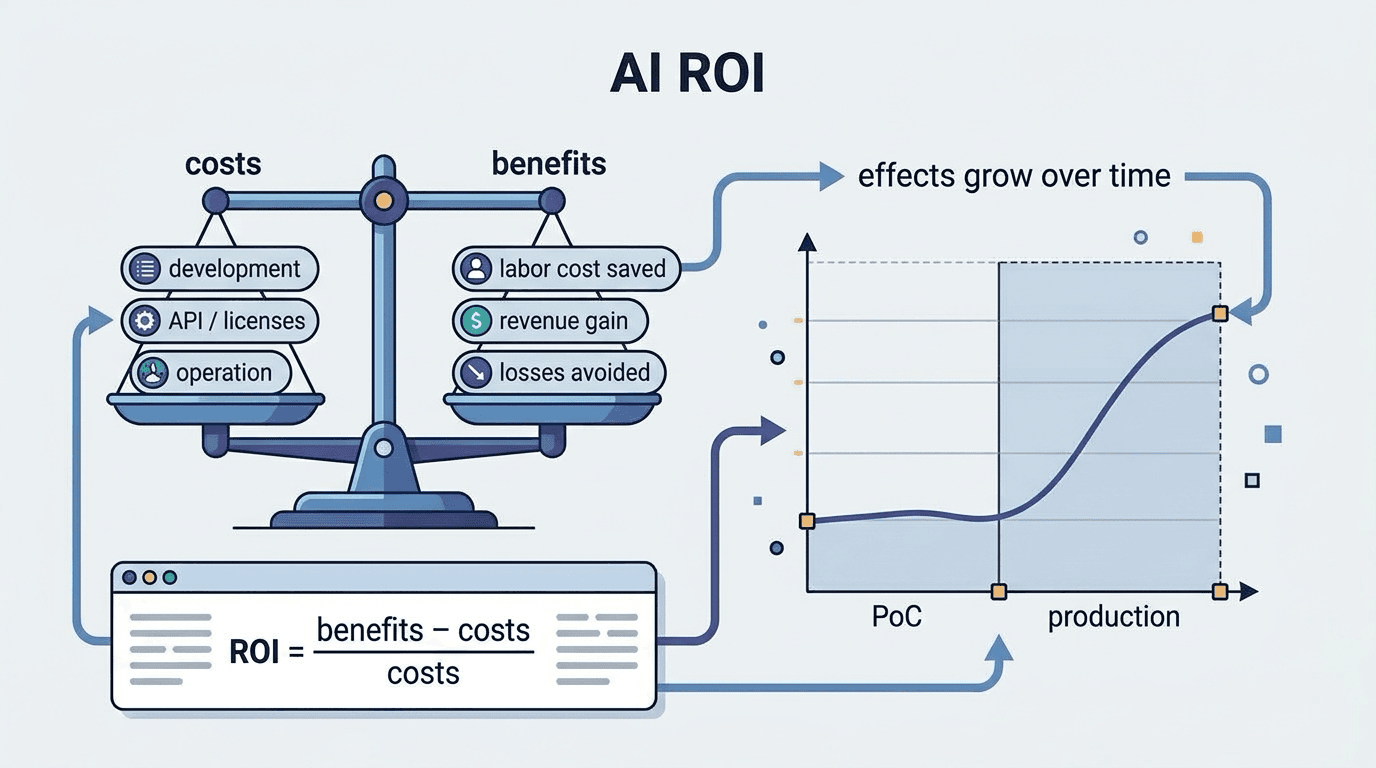
AI ROI is a metric that quantitatively measures the effects obtained — such as operational efficiency improvements and revenue gains — relative to the costs invested in AI implementation and operation.
AI ROI (AI Return on Investment) is a metric that quantitatively measures the effects of operational efficiency improvements and revenue gains relative to the costs invested in AI adoption and operation. Rather than stopping at a qualitative assessment of simply "using AI," it is a concept for numerically grasping whether returns commensurate with the investment are being generated.
Why Measuring AI ROI Is Difficult
Compared to traditional IT investments, calculating AI ROI is not straightforward. The reason is that effects appear in multiple dimensions and with a time lag.
For example, content generation using generative AI and customer service automation via AI chatbots tend to be reflected directly in reduced labor costs. On the other hand, quantifying the avoidance of opportunity losses brought about by predictive maintenance and dynamic pricing requires ingenuity, given the nature of measuring "damage that did not occur."
Furthermore, even when effects are limited at the PoC (Proof of Concept) stage, there are many cases where effects expand exponentially after full-scale deployment, making it easy to arrive at incorrect decisions if judgment is based solely on short-term figures.
Key Components of AI ROI
AI ROI is often calculated by combining the following elements.
- Cost side: GPU costs for model training and inference, maintenance costs for MLOps infrastructure, customization costs such as fine-tuning and LoRA, and training costs for talent development and improving AI literacy
- Benefit side: Reduction in working hours (man-hour reduction), decrease in error rates, improvement in sales and conversion rates, and cost reduction through in-house replacement of BPO (Business Process Outsourcing)
The basic formula is "(monetary value of effects − total AI investment) ÷ total AI investment × 100 (%)", but in practice, the greatest point of discussion is how to design the method for converting effects into monetary values.
Practical Approaches to Improving Measurement Accuracy
Design with KPIs in Mind
ROI measurement should begin not after implementation, but at the design stage before implementation. By aligning with KPIs (Key Performance Indicators), the standard for "what level of improvement constitutes a return on investment" becomes clear. For example, when incorporating an AI agent into a business workflow, setting the frequency of HITL (Human-in-the-Loop) interventions and the number of processed cases as KPIs enables continuous tracking of changes in the automation rate.
Incorporate the Shift Left Mindset
Applying the Shift Left concept to AI ROI measurement is also effective. By detecting problems and measuring effects "early" rather than in "downstream processes," the cost of course-correcting investments can be minimized. Quickly validating an MVP (Minimum Viable Product) and making early decisions to halt additional investment in use cases with limited expected returns also directly contributes to ROI improvement.
Include Governance and Security Costs
Costs that tend to be overlooked in ROI calculations are those for establishing an AI governance framework and risk assessment expenses through AI red teaming. Neglecting countermeasures against erroneous outputs caused by hallucination and prompt injection can significantly damage ROI through recovery costs that arise later. The cost of building AI guardrails should be proactively recorded as a "defensive ROI" line item.
Viewing AI ROI from a Long-Term Perspective
As the concept of the Agentic Flywheel suggests, the effects of AI have the property of accumulating and expanding compoundingly the more they are used. In recent years, Agentic AI and multi-agent systems have begun to be integrated into real business operations, generating complex value creation that goes beyond the automation of single tasks.
In such an environment, rather than pursuing only quarterly ROI figures, a multi-layered evaluation framework is required that also encompasses indirect effects such as improving organizational AI literacy and suppressing Shadow AI. AI ROI is simultaneously "a metric to be measured" and a management tool for continuously improving decision-making around AI investment.
Articles covering this term
- What Is an AI-Native Management Strategy? How to Fundamentally Redesign Your Business ModelFrom "adding AI" to "redesigning with AI." Learn AI-native management transition steps, ERP/FMS integration strategies, and real-world examples from Thai and Japanese companies.
- Winning with a Lean Team Through AI Leverage: Maximizing Output, Not Just Saving TimeUse AI not to cut hours, but to amplify output. Data-backed strategies for lean teams—from startups to elite enterprise units—on maximizing AI leverage for peak productivity.
- Guide to AI Investment Decisions for Thai Businesses — Implementation Priorities Based on ROI Comparisons by IndustryA sector-by-sector guide for Thai B2B companies choosing AI investments. Compare manufacturing, logistics, tourism, healthcare & retail by ROI, complexity, and talent needs.
- How to Measure the Impact of AI Agent Implementation | From KPI Design to Continuous ImprovementPractical guide for implementing AI agents: KPI design, ROI calculation & continuous improvement cycles. Visualize ROI and create compelling reports for management.


Related Terms

AI Observability
An operational practice of continuously monitoring and visualizing the inputs/outputs, latency, cost
BPO (Business Process Outsourcing)
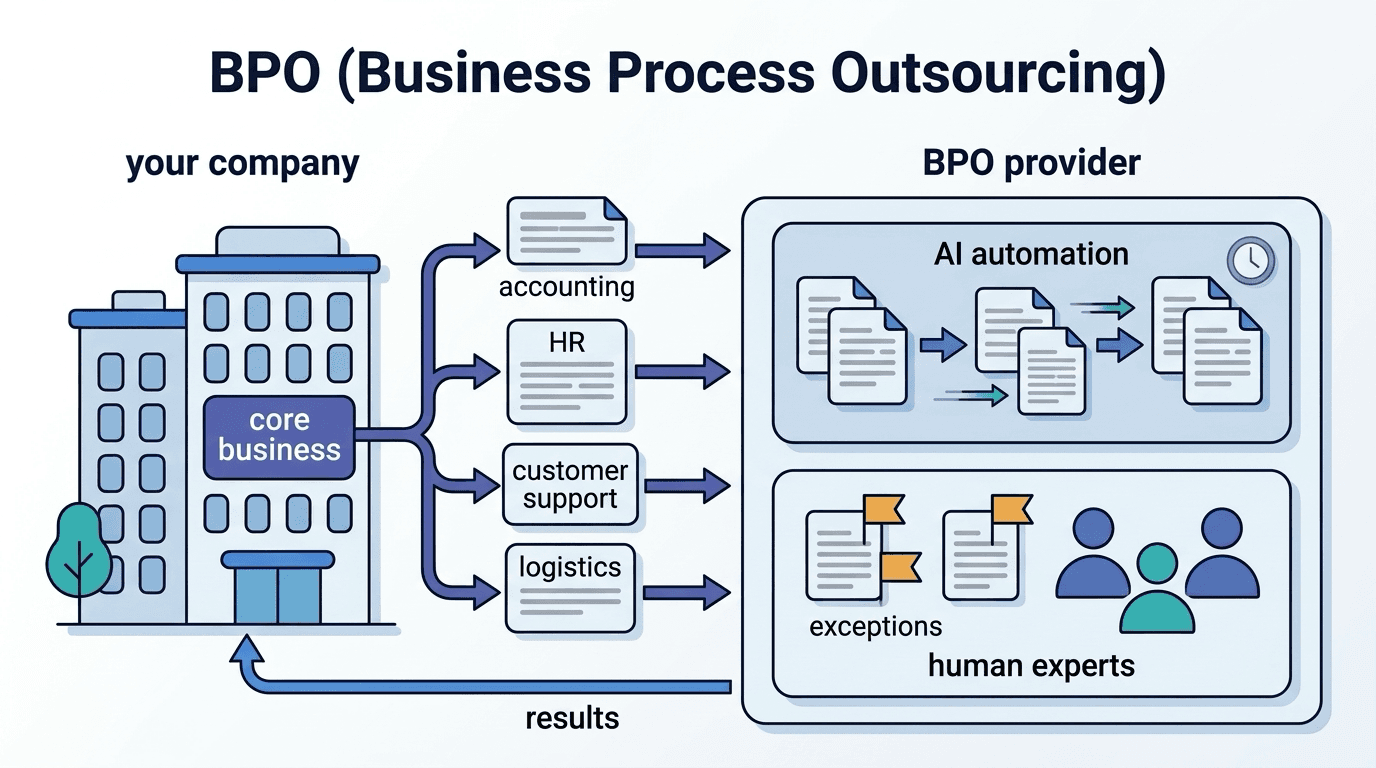
BPO refers to a form of outsourcing in which a company delegates specific business processes to an e

Demand Forecasting AI
Demand forecasting AI refers to a system that analyzes historical sales data and external factors us

ERP (Enterprise Resource Planning)
ERP (Enterprise Resource Planning) is an integrated business management system that centrally manage