How to Measure the Impact of AI Agent Implementation | From KPI Design to Continuous Improvement

You Introduced an AI Agent but Can't See Results — It May Be Because You Lack a KPI Design and ROI Measurement Framework
An AI agent is a system that has an LLM (Large Language Model) at its core and autonomously executes business tasks through tool calls and multi-step reasoning.
Immediately after an implementation project is completed, it is not uncommon to hear, "It's running, but I can't tell what has changed." In most cases, this is because operations began without preparing a KPI design and AI ROI (AI return on investment) measurement framework.
This article is intended for practitioners and project leaders who are operating AI agents in real-world settings, and provides a systematic explanation of KPI design (business automation rate, HITL intervention rate, etc.), ROI calculation (cost reduction type and revenue contribution type), and continuous improvement cycles (from monthly reviews to fine-tuning decisions).
Measuring the effectiveness of AI agents is considerably more challenging than traditional system implementations. The reason is that agents are not "tools that perform fixed processes" but dynamic entities that make judgments and take actions based on the situation. In many cases, simple metrics such as the number of processed items or utilization rates fail to capture their true value. In the following H3 section, we will explain in order the structural differences from conventional evaluation methods, and the reasons why "the feeling of using it" and actual outcomes diverge.
Differences from Conventional System Implementation Evaluation
Traditional system implementation evaluation centered on an acceptance-based approach of "does the functionality work as specified?" However, since the value of AI agents is measured by "how much they contribute to business outcomes," the evaluation criteria are fundamentally different.
- Static → Dynamic: Traditional systems have fixed specifications, whereas AI agents continuously evolve in capability through model updates and prompt improvements
- Binary → Probabilistic: Rather than "works / doesn't work," it is necessary to track "at what level of accuracy does it work correctly"
- One-time Acceptance → Continuous Measurement: Evaluation at the time of implementation is insufficient; regular monitoring on a monthly or quarterly basis is essential
For example, even if an AI chatbot for customer support achieves a "100% response delivery rate," it would be considered a "failure" in terms of business KPIs if it is not providing the answers customers need. It is important to avoid the simplistic equation that a high automation rate equals a good evaluation, and instead make judgments that weigh business risks accordingly.
Structural Causes of the Gap Between "Feeling Productive" and Actual Results
"We use it every day, yet we don't feel like costs have gone down"——this disconnect has structural causes.
Cause 1: Usage volume and business outcomes are two different things An increase in query counts or session counts does not necessarily translate directly into reduced man-hours or lower error rates. Intermediate metrics that bridge activity volume and results are needed.
Cause 2: Optimization is stopping at the local level Even if a specific task is accelerated, if the human work before and after it remains a bottleneck, the overall lead time will not shrink. An end-to-end perspective is indispensable.
Cause 3: The baseline is ambiguous Without numerically recording the state before implementation, it is impossible to accurately measure the degree of improvement.
Cause 4: Qualitative benefits are not being converted into numbers Improvements in decision-making quality and reductions in cognitive load are difficult to quantify in monetary terms and tend to be omitted from reports.
To make outcomes visible, a deliberate design that connects the three layers——usage metrics, business metrics, and financial metrics——is essential.
Checklist of Items to Verify Before Measuring Effectiveness

Even if you try to design KPIs and calculate ROI, the numbers will be meaningless unless the prerequisites for measurement are in place. First confirming three points — "What was the purpose of the implementation?", "What was the state before implementation?", and "Who will use the measurement results?" — is what determines the accuracy of effectiveness measurement. The following H3 sections organize specific checkpoints for each of these three perspectives.
Re-confirmation of Implementation Objectives and Business Challenges
Before beginning effectiveness measurement, it is essential to articulate once again "why this AI agent was introduced." Without a clear understanding of the implementation objectives, there is no way to determine what should be measured.
When re-examining business challenges, organize the following perspectives.
- What problems were you trying to solve: List specific pain points such as processing delays, human errors, and labor shortages
- What effects were anticipated prior to implementation: Uncover original expectations from documentation, such as "reducing workload by ◯ hours per month"
- Which business workflows are actually being used: Identify the processes where the AI agent is involved through operation logs
- Differences in expectations among stakeholders: The metrics to be measured may differ, as management may focus on cost reduction while frontline staff prioritize workload reduction
It is recommended that this review be conducted within three months of implementation.
Baseline (Before) Data Acquisition Status
The accuracy of effect measurement depends heavily on the quality of baseline data collected before implementation. Saying "it feels faster" simply won't hold up in reports to management.
The key data points you'll want to capture are as follows:
- Processing time: Average time required per task
- Volume: Number of tasks processed per day, week, and month
- Error rate / rework rate: Percentage of cases requiring corrections or resubmission
- Staff hours: Person-hours spent on the relevant work
- Costs: Combined total of labor costs, outsourcing fees, and tool expenses
One easily overlooked element is "non-routine costs." Time spent on escalation handling and supervisor approvals must also be included, or your ROI calculations will come out understated. If the data isn't readily available, sampling over a two-to-four-week period is recommended. When recording your baseline, capture not just the average, but also the minimum, maximum, and median values as a set — this will enable more precise comparative analysis later on.
Agreement on Measurement Policy with Stakeholders
The effectiveness measurement framework will fail if left solely to technical staff. Multiple stakeholders—including executive leadership, business units, and the IT department—must reach prior agreement on "what to measure" and "who is accountable."
Key Issues Requiring Alignment
- KPI definitions and priorities: Clarify the order of priority when multiple metrics conflict
- Measurement owners and frequency: Define the division of roles for data collection and aggregation
- Criteria for success or failure: Reach a numerical agreement on "what percentage of the target constitutes success"
For alignment, an effective approach is to create a one-to-two-page summary document called a Measurement Charter, covering the measurement targets, KPI calculation logic, baseline reference date, and reporting cycle. With this foundation in place, discussions around KPI design will also proceed more smoothly.
How Should KPIs for AI Agents Be Designed?

KPI design is a core process that determines the success or failure of AI agent implementation. To move beyond the vague sense that "things have somehow become more convenient" and elevate outcomes into figures that can withstand executive decision-making, it is necessary to define three axes in advance: what to measure, how to measure it, and how frequently to evaluate it. The H3 sections that follow will walk through each topic in sequence—from how to capture quantitative metrics such as task automation rate and processing time reduction, to the unique perspective of HITL (Human-in-the-Loop) intervention rate, and finally to methods for quantifying qualitative effects such as employee satisfaction.
Measurement Methods for Business Automation Rate, Processing Time Reduction, and Error Rate
The first step in designing KPIs for AI agents is to establish a measurement framework covering business automation rate, processing time reduction, and error rate.
Business automation rate is defined as the percentage of total tasks in a given workflow that the agent completes without human intervention.
- Automation Rate (%) = Agent-completed tasks ÷ Total tasks × 100
Workflow tool logs must include a flag that distinguishes whether "the agent executed the final action" or "a human made a correction."
Processing time reduction compares the average time required per task before and after implementation. The key is to measure using timestamps from task receipt to completion, capturing "actual wall-clock time" that includes LLM latency.
Error rate is assessed along two axes: "output quality" and "process quality."
- Output quality errors: The proportion of responses containing hallucinations or misinformation
- Process quality errors: The occurrence rate of tool call failures and timeouts
Since reviewing every case is costly, the recommended approach is to periodically sample a statistically significant number of cases for review. Visualizing these three metrics on a dashboard on a weekly or monthly basis and tracking the delta against the baseline forms the foundation for ROI calculation.
The Concept of Using Human-in-the-Loop Intervention Rate as a KPI
The HITL (Human-in-the-Loop) intervention rate refers to the proportion of all tasks processed by an AI agent that required human intervention. It is gaining attention as a KPI that reflects the "autonomy maturity" of AI agents.
A rate that is too high indicates issues with decision-making accuracy, while a rate that is too low carries the risk of guardrails becoming mere formalities. Simple evaluations along the lines of "the lower, the better" should be avoided.
Key Design Considerations
- Measure by task type: Acceptable intervention rates differ between contract reviews and routine data entry
- Classify and log intervention reasons: Categories such as "insufficient accuracy," "suspected policy violation," and "edge case" help clarify improvement priorities
- Track trends over time: A declining intervention rate driven by continuous improvement itself serves as evidence of that improvement's effectiveness
The intervention rate is more than a simple efficiency metric — it also reflects the balance between reliability and human-AI collaboration. From an AI governance perspective, it is advisable to link regular monitoring to the maintenance of audit logs.
Quantifying Qualitative Effects (Employee Satisfaction and Decision-Making Speed)
"It feels easier now" — that kind of sentiment alone cannot serve as reporting material for management. How well you devise ways to quantify qualitative effects determines the quality of your KPI design.
Quantifying Employee Satisfaction
Regular pulse surveys are the most practical approach. Use the same questions before and after implementation to track score changes.
- "Is the time spent on repetitive tasks appropriate?" (5-point scale)
- "Is the AI agent supporting your work-related decisions?" (5-point scale)
Conduct surveys monthly or quarterly and visualize the results as trend graphs.
Quantifying Decision-Making Speed
Defining this as "lead time from the start of information gathering to approval completion" makes it easier to measure. Extract the data from ticket management tools or workflow system logs. A minimum of 30 comparable cases is recommended; select periods under equivalent conditions to eliminate the effects of organizational changes or seasonal fluctuations.
By multiplying the hours of work saved by the average hourly wage, the qualitative sense of "things getting easier" can be converted into a monetary metric, which can then be incorporated into the ROI calculations covered in the next section.
How to Calculate ROI? Two Formulas

Once you've determined "what to measure" with your KPIs, the next step is to move into the phase of visualizing "whether the results justify the investment" as ROI. Calculating ROI for AI agents can be organized into two formulas: cost reduction type and revenue contribution type. Each approach is explained below.
Cost Reduction ROI Formula
Cost-reduction ROI is a straightforward method that compares the "costs saved" through AI agent implementation against the investment amount.
- ROI (%) = (Cost Savings − Implementation & Operating Costs) ÷ Implementation & Operating Costs × 100
Components of "Cost Savings":
- Labor cost reductions: Work hours before automation × hourly rate × number of people involved
- Error handling cost reductions: Decrease in number of errors × handling man-hours per incident × hourly rate
- Outsourcing/BPO cost reductions: Contract costs for operations replaced by the agent
- Overtime and hiring cost savings: The difference absorbed by the agent when handling increased workloads
"Implementation & Operating Costs" should include all initial development costs, licensing fees, infrastructure costs, maintenance, and internal training costs.
Calculation considerations:
- Unless you verify whether the time saved has actually been redirected to other tasks, the reduction may remain superficial
- It is normal for short-term ROI to appear low, as proficiency costs are added during the 3–6 months following implementation
- Combining this with revenue-contribution ROI enables a more multidimensional evaluation
Sales Contribution ROI Formula
Revenue-contribution ROI is calculated based on the increase in revenue generated by AI agents.
Revenue-Contribution ROI (%)
= (Revenue increase attributable to AI agents − Implementation & operating costs)
÷ Implementation & operating costs × 100
Elements included in "revenue increase":
- Improved conversion rates: Faster inquiry responses and personalization leading to higher lead-to-opportunity conversion rates
- Increased cross-selling and upselling: Higher average transaction value driven by recommendations
- Reduced opportunity loss: Increased orders through 24/7 availability
- More efficient lead nurturing: Shorter sales cycles through automated follow-ups
To isolate the portion of revenue increase attributable to AI agents, control comparison—comparing conversion rates between deals involving AI agents and those that do not—is effective. When a full A/B test is not feasible, a time-series comparison using data from equivalent periods before and after implementation can serve as an alternative.
Since actual figures vary significantly by industry, product type, and implementation scale, ROI calculation based on measured values integrated with your company's CRM data and order management systems is essential.
How to Connect Measurement Results to a Continuous Improvement Cycle?

Measuring effectiveness only has value when it functions as an input for continuous improvement, not as a one-time exercise. Simply observing KPI figures will not improve either the accuracy of AI agents or business outcomes. Embedding a PDCA cycle of measure → analyze → improve → re-measure into the organization is the key to maximizing AI ROI. The following sections explain, in order, how to design monthly reviews and the criteria for deciding when to pursue fine-tuning and retraining.
Dashboard Metrics to Review in Monthly Reviews
In monthly reviews, it is important to narrow down the metrics displayed on the dashboard according to their purpose.
Operational Performance
- Task Completion Rate: The percentage of tasks completed without human intervention. A downward trend is a signal to revisit prompts.
- HITL Intervention Rate: Identify categories with increasing escalations and conduct root cause analysis.
- Average Processing Time: Visualize the reduction relative to the baseline.
Quality & Reliability
- Hallucination Detection Rate: Monthly trend of flags raised by guardrails.
- Error Rate & Retry Rate: Spikes often coincide with LLM API updates.
Cost Efficiency
- Token Consumption & Cost: Calculate the unit cost per number of processed items and update the ROI denominator.
- GPU Utilization: Appropriate range for utilization when operating a local LLM.
For each metric, set thresholds for "Improved / Needs Attention / Requires Action" so that team members can prepare hypotheses for action items before the meeting — this helps prevent reviews from becoming purely ceremonial status reports.
Fine-Tuning and Retraining Timing for AI Agents
When an anomaly is detected during a monthly review, you need to decide when to update the model.
Triggers to Consider for Retraining
- Error rates or incorrect response rates have been trending upward over 3–4 weeks
- The assumptions underlying the training data have changed, such as internal policies, product lineups, or regulatory revisions
- The HITL intervention rate has exceeded the configured threshold
- The number of qualitative comments indicating "responses are off" has surpassed a certain threshold
Not every instance of degradation requires full fine-tuning. First, verify whether the issue can be addressed through prompt engineering, then consider parameter-efficient methods such as LoRA or QLoRA as needed.
Design Guidelines for the Retraining Cycle
- Combine scheduled updates (quarterly) with trigger-based updates
- After retraining, quantify the difference from the previous model through A/B test-equivalent comparative validation
- Manage update history and training data versions using MLOps to track regressions
Commonly Overlooked Measurement Pitfalls

Even if you design KPIs and calculate ROI, leaving measurement "loopholes" unaddressed will cause the numbers to stop reflecting reality. Measuring the effectiveness of AI agents involves unique pitfalls that are difficult to detect with conventional system evaluations. It is not uncommon for organizations to focus on short-term cost reductions while deferring long-term operational costs and governance development. In the next H3, we will take a closer look at two patterns that are particularly easy to overlook in practice.
Patterns of Focusing Only on Short-Term ROI and Missing Long-Term Costs
Judging success solely by the metric of "man-hours reduced" in the early stages of adoption is a pitfall. There are multiple hidden costs that are difficult to capture in short-term ROI.
Long-Term Costs That Are Easily Overlooked
- Increasing model usage fees: Cases where API calls exceed initial estimates as usage grows
- Prompt maintenance man-hours: Revisions required every time a business workflow changes
- Retraining costs: GPU usage fees and data preparation expenses when accuracy degrades
- Hallucination response costs: Labor costs for verification and correction when erroneous outputs are introduced
- Compliance response fees: Modification costs for regulatory compliance
Directly extrapolating cost estimates from the PoC stage to company-wide deployment will result in significant discrepancies. It is important to prepare a TCO (Total Cost of Ownership) covering 6 to 12 months post-adoption in the early stages, and to include maintenance, operation, and improvement costs in the denominator.
Risks of Deprioritizing AI Governance and Audit Log Development
Many cases exist where AI governance and audit log development are deprioritized in favor of focusing on measurement. However, without logs, the reliability of measurement values cannot be guaranteed.
Risks of Deprioritization
- Inability to verify measurement values: KPI figures cannot be retroactively confirmed for accuracy
- Difficulty identifying incident root causes: It is impossible to trace what occurred at which step
- Compliance violations: A growing trend toward mandatory log retention requirements for high-risk AI applications
- Breeding ground for shadow AI: Unauthorized grassroots usage spreads without a governance framework in place
The minimum elements an audit log must include are five: input, output, execution timestamp, presence or absence of HITL intervention, and error codes. When personal information is involved, data must be encrypted and stored in compliance with PDPA and GDPR requirements. Governance development should be regarded as the infrastructure that underpins the accuracy of performance measurement, and a minimum log design should be incorporated from the MVP stage onward.
How to Create an Effectiveness Measurement Report for Executive Reporting

The results of effectiveness measurement only have value when organized in a form that not only field staff but also executives can use for decision-making. Rather than a mere list of numbers, a narrative structure is required that enables judgments such as "should we continue investing?" or "should we move to the next phase?" This section explains the components of executive-level reports and how to present data that drives investment decisions for the next phase.
Items to Include in a One-Page Summary
Management wants "only the information needed to make decisions." The one-page summary should be structured to enable decision-making within 30 seconds.
6 Items to Include
- Implementation objectives and achievement status: Display KPI targets alongside current values to clearly show achievement rates
- AI ROI summary: Present cost savings or revenue contribution as a single figure
- HITL intervention rate trends: Show changes in autonomous processing rates via a monthly graph
- Key risk indicators: Number of hallucination occurrences, number of governance anomaly detections
- Recommended actions for the next phase: Assess current status using three options — "Continue," "Expand," or "Revise"
- Cost comparison table: Concisely compare operational costs before and after implementation
Emphasize figures with a larger font size, and limit graphs to one or two. A traffic light color scheme — "target achieved = green, caution required = yellow, target not met = red" — makes it easy to convey the situation at a glance.
How to Present Data That Drives Investment Decisions for the Next Phase
For management to commit to the next investment, they need forward-looking projections and investment scenarios that show "what happens going forward."
- Three-part structure: Current State → Challenges → Solution: Convey the inevitability of investment in the sequence of "costs already reduced" → "volume of non-automated work remaining" → "target areas for the next phase"
- ROI trend graph: Use a monthly data line chart to visualize the structure of "investment taking effect over time"
- Changes in HITL intervention rate: A declining rate allows you to make a quantitative case for labor cost reduction potential in the next phase
- Scenario comparison table: Consolidate "no investment / maintain current state / expanded investment" into a single slide to explicitly show the "cost of not investing"
Keep slides to 2–3 at most, with details moved to an appendix. Specifying high-volume, high-error-rate, and highly repetitive tasks as priority candidates for the next phase will make investment decisions more concrete.
Frequently Asked Questions

Questions from practitioners working on measuring the effectiveness of AI agents cover a wide range of topics, from KPI design to ROI calculation and determining the right timing for improvements. Here, we have carefully selected the points where people most commonly struggle in the field and provide answers from a practical perspective. The content is compiled to be applicable regardless of the implementation phase or industry, so please review it in light of your own organization's situation.
Which KPIs should you start measuring immediately after implementation?
Immediately after implementation, it is practical to start with metrics that are easy to measure and easy for management to understand.
3 KPIs to prioritize first
- Processing time: Compare the time required for the same task before and after implementation. If you have Before data, measurement is possible from day one.
- Task automation rate: The percentage of tasks completed by the agent without human intervention. If HITL intervention logs are available, this can be aggregated automatically.
- Error rate / rework rate: The percentage of cases that were corrected or rejected by the person in charge.
Financial metrics such as ROI and revenue contribution lack a solid basis in the early stages when data accumulation is insufficient. It is advisable to focus on operational metrics for the first one to two months, then step up to calculating cost-reduction-based ROI around the three-month mark.
How should I determine if the treatment is not working?
It is important to diagnose the "no results" state by dividing it into three patterns.
Pattern 1: Issues with measurement itself — Baseline data not collected, KPI definitions are vague, measurement period is too short (1–2 months is the learning and adoption phase)
Pattern 2: Issues with operation and utilization — Being used for unintended purposes, HITL intervention rate remains persistently high, prompts are not optimized
Pattern 3: Issues with design and scope — AI is not being applied to tasks it excels at, running in production with a PoC configuration
The efficient approach is to first check Pattern 1, and if there are no issues with the measurement foundation, proceed to Patterns 2 and 3. Diagnose in the following order: log review → on-site interviews → scope refinement → KPI reassessment, and continuously accumulate decision-making data on at minimum a quarterly measurement cycle.
Summary: AI Agent Effectiveness Measurement Checklist

The contents of this article are organized as a checklist for immediate practical use.
[Phase 1: Pre-Implementation Preparation]
- The implementation objectives and business challenges have been documented
- Baseline (Before) data has been quantitatively collected
- All stakeholders have agreed on the measurement policy
[Phase 2: KPI and ROI Design]
- Business automation rate, processing time reduction rate, and error rate have been defined as KPIs
- A mechanism for tracking the HITL intervention rate is in place
- A means of scoring qualitative effects has been prepared
- ROI calculation formulas for both cost reduction and revenue contribution types have been determined
- Long-term costs (retraining, operation, and maintenance) have also been estimated
[Phase 3: Operations and Continuous Improvement]
- Dashboard metrics for monthly reviews have been configured
- AI governance policies and audit logs have been established
- Trigger conditions for fine-tuning have been defined
- A one-page summary format for senior management is in place
By linking the three elements of KPI design, ROI calculation, and a continuous improvement cycle, the visualization of return on investment becomes fully functional. It is recommended to first identify one incomplete item on this checklist and begin working on it within the current week.
Author & Supervisor

Yusuke Ishihara
Started programming at age 13 with MSX. After graduating from Musashi University, worked on large-scale system development including airline core systems and Japan's first Windows server hosting/VPS infrastructure. Co-founded Site Engine Inc. in 2008. Founded Unimon Inc. in 2010 and Enison Inc. in 2025, leading development of business systems, NLP, and platform solutions. Currently focuses on product development and AI/DX initiatives leveraging generative AI and large language models (LLMs).
Recommended Articles


Terms related to this article

AI Observability
An operational practice of continuously monitoring and visualizing the inputs/outputs, latency, cost

AI Ready
"AI Ready" is a concept that refers to the state in which a company is fully prepared to immediately
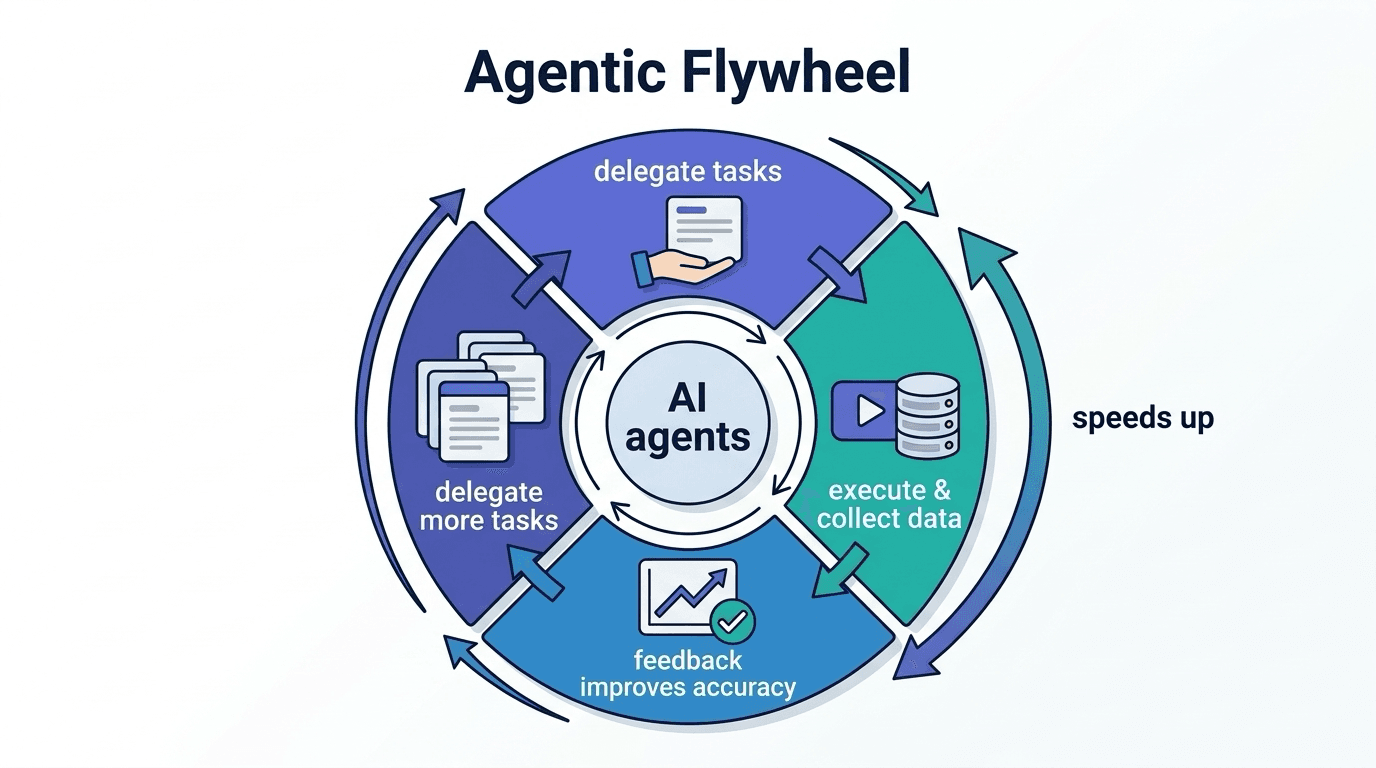
Agentic Flywheel
The Agentic Flywheel is a self-reinforcing growth cycle in which AI agents autonomously execute task