Hallucination (Hallucination)
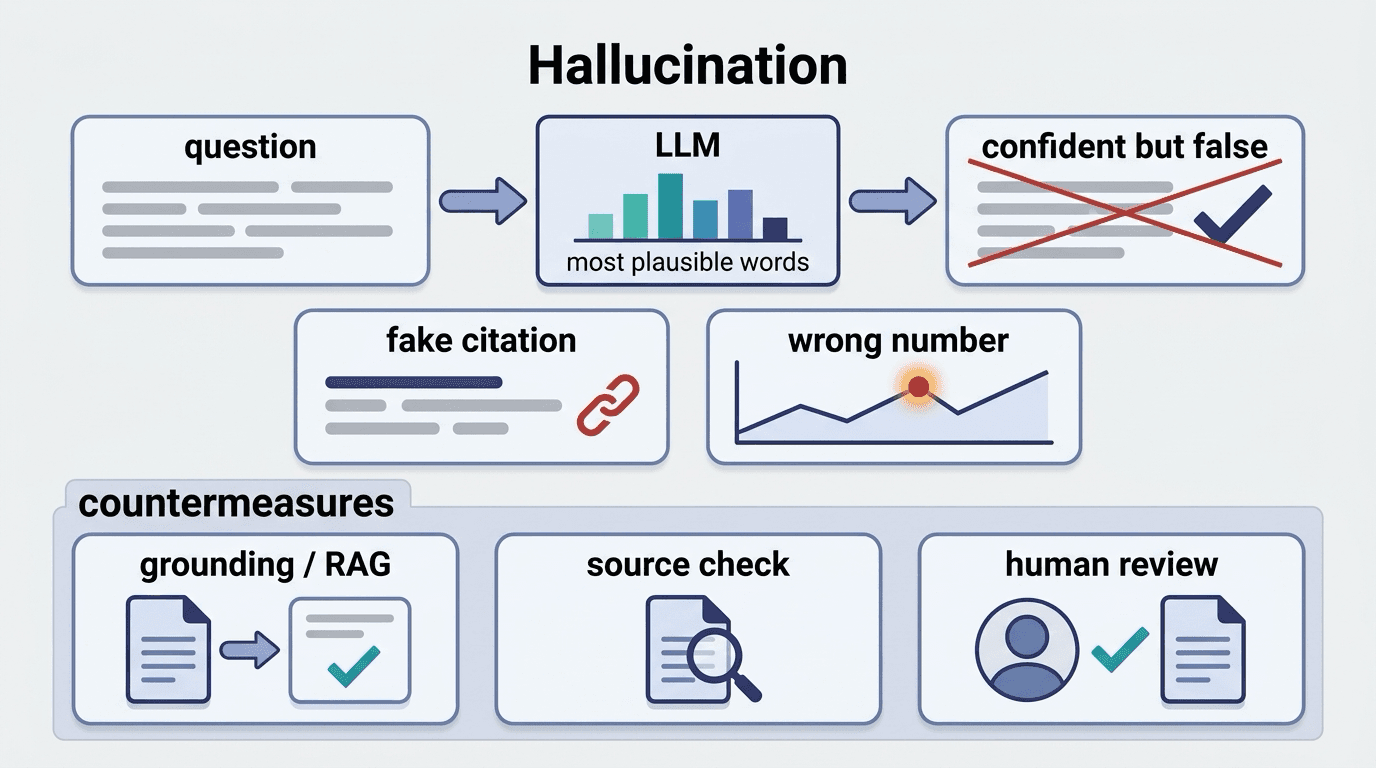
Hallucination refers to the phenomenon in which an AI model generates information that is not based on facts as if it were correct. It stems from the mechanism by which LLMs generate "plausible" text from patterns in training data, and is considered difficult to eliminate entirely.
Why It Is Called "Hallucination"
Just as human hallucinations involve perceiving things that do not exist, AI hallucinations also generate "facts that do not exist." However, unlike human hallucinations in a fundamental sense, LLMs have no mechanism for determining whether something is factual. They simply generate the next most probable token in a chain, and the result may happen to align with reality or may be entirely fabricated.
Typical Patterns
Hallucinations take several characteristic forms. Representative examples include citations of non-existent papers (generating fictitious author names and DOIs), false biographical details attributed to real individuals, and the fabrication of plausible-sounding numerical data.
What makes this particularly troublesome is that hallucinated output is grammatically correct and blends naturally into context. Obvious errors are easy to spot, but the pattern of being "90% correct and 10% false" is what makes detection so difficult.
Mitigation Approaches
The most promising mitigation approach at present is the adoption of RAG (Retrieval-Augmented Generation). Before the model generates a response, it retrieves relevant information from an external knowledge base and uses that information as the basis for its answer, thereby increasing the probability of factually grounded output.
Another direction is the incorporation of HITL (Human-in-the-Loop). By designing a workflow in which humans review AI output, the risk of hallucinations making their way into final deliverables is reduced. In fields such as medicine and law, where the cost of misinformation is high, this combination is becoming the de facto standard.
Articles covering this term
- What is AI Grounding? An Implementation Guide to Fact Verification and Improving LLM Answer Accuracy with Web SearchAI grounding anchors LLM responses to authoritative sources. Learn how RAG and web search reduce hallucinations, plus implementation steps for enterprise deployment.
- What is AI-Native UI? The Design Philosophy of Generative AI Dynamically Creating ScreensExplore AI-native UI: where forms and menus are replaced by AI-generated interfaces. Learn core concepts, design patterns, and real-world business applications.
- AI Governance for Small Teams: Scalable AI Governance for Small and Medium-Sized BusinessesLightweight AI governance frameworks & checklists for SMEs and startups to practically adopt enterprise-grade AI standards—even with limited resources.
- What is LLM-as-a-Judge? A Method for Evaluating AI Output with AI and Implementing Hallucination DetectionLLM-as-a-Judge automates LLM output scoring. Covers Pointwise/Pairwise/Reference, bias mitigation, 4 implementation steps, and how it fits with Observability and Guardrails.


Related Terms
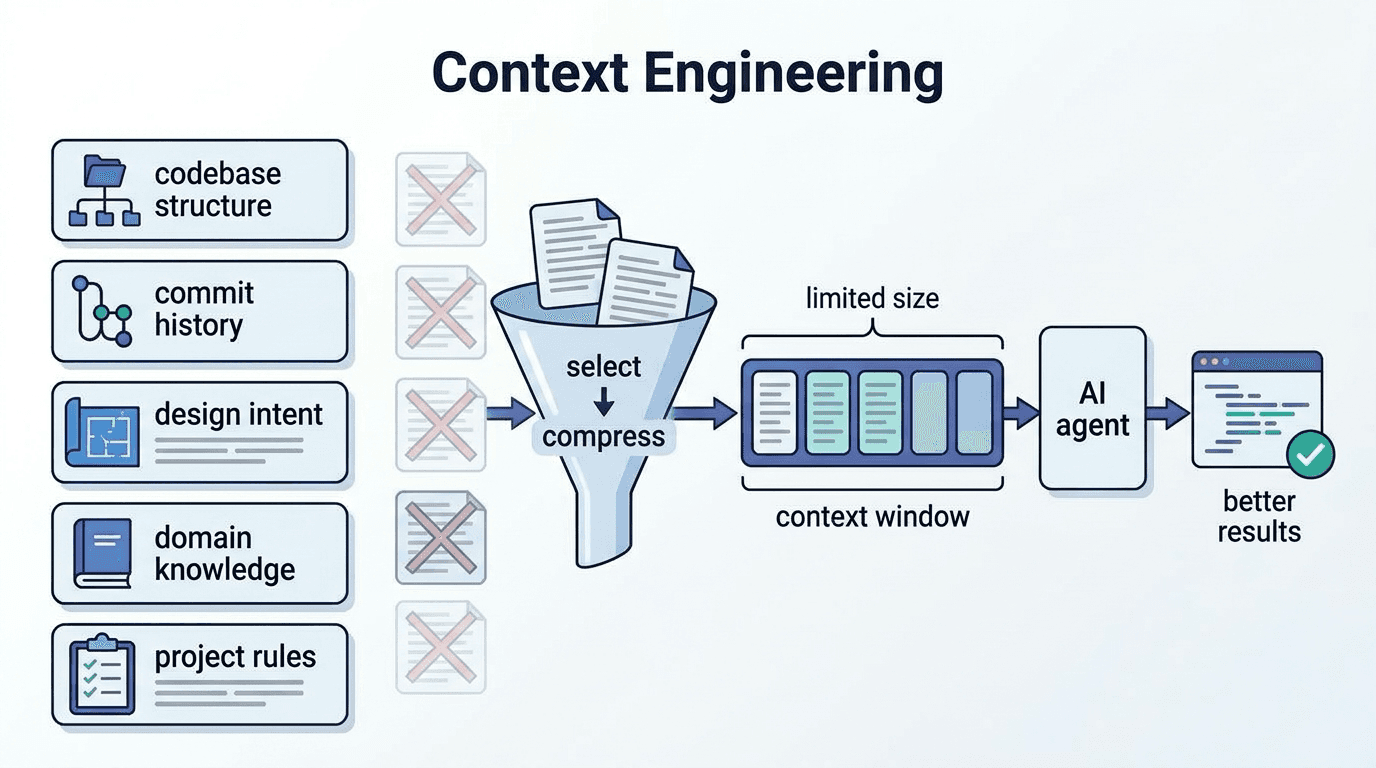
Context Engineering
Context Engineering is a technical discipline focused on systematically designing and optimizing the

System Prompt
A system prompt is an instruction given to an LLM before the start of a conversation with a user, de

AI Red Teaming (AI Red Teaming)
An evaluation method that systematically tests AI system vulnerabilities from an attacker's perspect
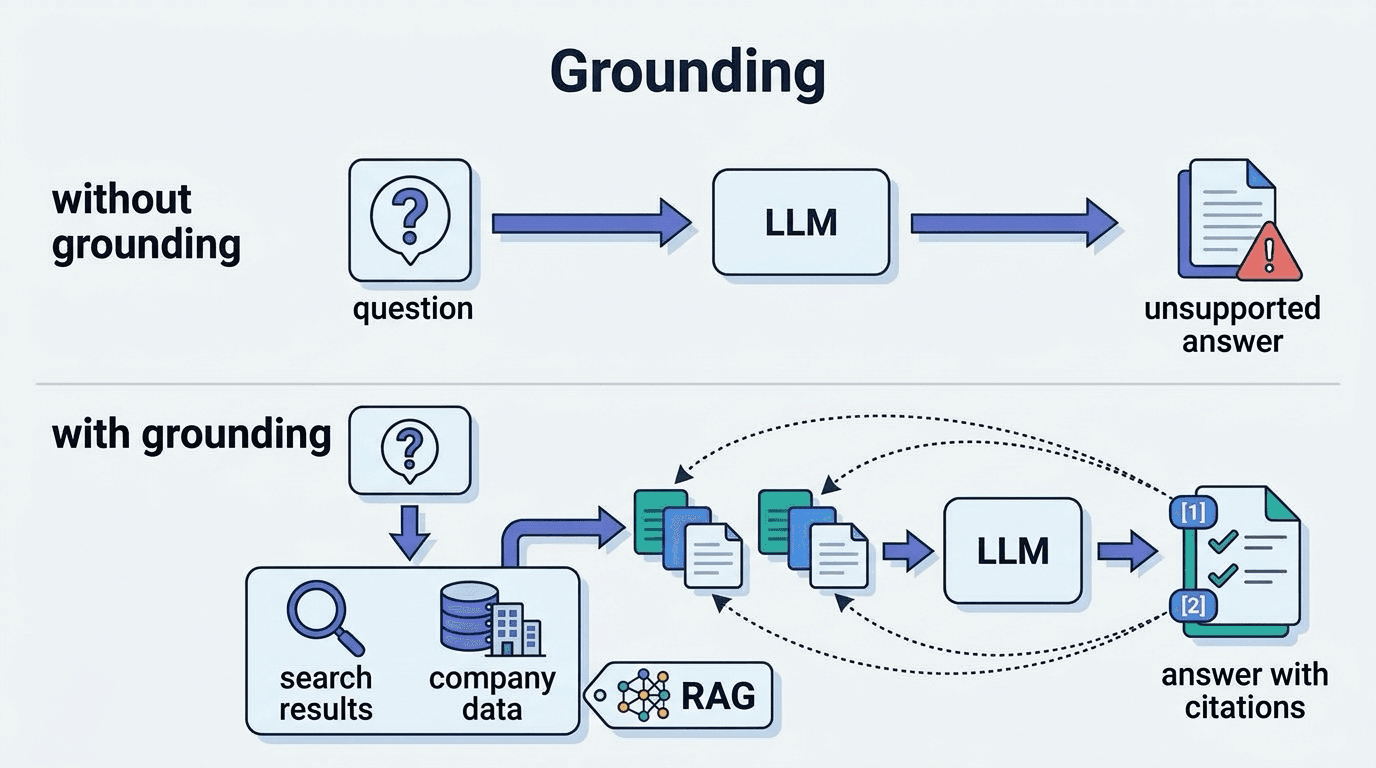
Grounding
A technique that cross-references LLM outputs with external data sources and search results to gener