What Are AI Agents? A Next-Generation AI Utilization Guide for Thai Businesses to Autonomously Automate Operations

Lead
An AI agent (Agentic AI) is an autonomous AI system that, in response to human instructions, independently formulates plans, operates external tools, and completes tasks through its own judgment.
This article explains everything from the fundamental differences between AI agents and conventional chatbots, to the concrete steps Thai companies can take to implement AI agents for business automation. It is aimed at executives and IT professionals who face the challenge of "We adopted AI, but it still won't work without a human operating it" — guiding them toward the next stage of automation that AI agents can deliver.
An AI agent is not "an AI that understands instructions and responds," but rather "an AI that understands goals and takes action." Understanding this distinction is the first step toward taking your company's business automation to the next level.
Differences from Traditional Chatbots
The biggest difference between AI agents and chatbots lies in whether they "answer one question at a time" or "autonomously execute multiple steps toward a goal."
| Aspect | Traditional Chatbot | AI Agent |
|---|---|---|
| Operating Model | One question, one answer (question → response) | Goal-driven (objective → planning → execution → verification) |
| Tool Operation | None (text responses only) | API calls, DB searches, file operations |
| Decision-Making | Fixed responses based on branching rules | Dynamic judgment based on context |
| Error Handling | Escalation (transfer to human) | Attempts self-correction before escalating |
| Scope of Coverage | Within anticipated question patterns | Handles unknown situations through reasoning |
For example, given the request "Please arrange my business trip to Thailand next month," a chatbot would return a link saying "Here is a travel booking site." An AI agent, on the other hand, checks the calendar for available dates, searches for flight and hotel options, presents choices within budget, and completes the booking upon approval——processing all of this as a single, continuous workflow.
In the Thai market, LINE-based chatbots are widely used, but they often remain limited to FAQ responses and standard information delivery. By embedding an AI agent into the "back end" of these LINE chatbots, it becomes possible to upgrade them from mere responders to capable task executors.
Why AI Agents Are Called "Autonomous"
The autonomy of AI agents emerges from a loop structure that repeats four steps: Perceive → Reason → Act → Observe.
- Perceive: Receives user instructions and external environment inputs (incoming emails, data changes, alerts, etc.)
- Reason: Formulates a plan to achieve the goal and determines the next action to take
- Act: Executes actual tool operations such as calling APIs, querying databases, and generating files
- Observe: Evaluates the results of actions and determines whether progress has been made toward the goal and whether any errors have occurred
Repeating this loop until the goal is achieved is the true nature of an AI agent's "autonomy." While conventional AI "returns a single output for a single input," an agent "continuously thinks through its next move until it reaches the goal."
However, "autonomous" does not mean "can be left unsupervised." In practice, a design that incorporates human approval at critical decision points—known as Human-in-the-Loop—is essential. This will be discussed later.
Why Are AI Agents Attracting Attention Now?

Interest in AI agents has accelerated rapidly as the reasoning capabilities of LLMs have reached the level of "task execution" rather than mere "question answering." The timing of technological maturity and the operational challenges facing Thai companies are converging simultaneously.
Evolution of Foundation Models and Improvement of Reasoning Capabilities
The direct factors behind AI agents entering the practical stage lie in three evolutions of Foundation Models.
1. Dramatic Improvement in Reasoning Capabilities
The latest LLMs, such as Claude, GPT, and Gemini, have acquired the ability to "think step by step" (Chain-of-Thought Reasoning). Rather than simply retrieving knowledge to provide answers, they are now capable of multi-step reasoning such as "first check A, then compare it with B, and if condition C is met, execute D."
2. Standardization of Tool Use / Function Calling
Major LLMs now come standard with tool-calling capabilities. This allows AI to directly operate external APIs and databases. Not only "generating responses" but also "actually operating systems" has become achievable without any specialized development.
3. Expansion of the Context Window
The amount of information that can be processed (the context window) has expanded significantly, enabling tasks to be carried out while referencing lengthy operational manuals and multiple related documents simultaneously. This represents a fundamental departure from the era when only short questions could be answered.
Alignment with Thai Companies' Business Automation Needs
Companies operating businesses in Thailand are paying attention to AI agents against a backdrop of challenges unique to this region.
The burden of multilingual support
In Thailand's business environment, Thai, English, Japanese, and Chinese are used on a daily basis. There are many situations where language barriers become a bottleneck — in customer support, internal communications, contract reviews, and more. Because AI agents can handle tasks across multiple languages, they significantly reduce the need to assign dedicated staff for each language.
Structural difficulties in talent acquisition
Bangkok's IT talent market is chronically a seller's market. Securing "bridge talent" — professionals who possess both business domain knowledge and IT skills — is particularly challenging. Since AI agents can incorporate business knowledge in the form of prompts and knowledge bases, they offer a means of moving away from a structure that relies entirely on the skills of individual employees.
Fragmentation of existing systems
Many Thai companies use multiple systems in parallel — accounting software, inventory management, CRM, LINE official accounts, and others — and it is not uncommon for these systems to operate without integration. Because AI agents can operate across multiple systems via APIs, they can replace the manual work of humans who "look at the screen in System A and manually enter data into System B."
AI Agent Utilization Patterns

The most cost-effective starting point for applying AI agents in business operations is replacing "repetitive tasks where humans navigate between systems." Here, we introduce three patterns that are expected to be particularly effective for Thai companies.
Autonomous Customer Support Response
Customer support is the most common entry point for AI agent adoption.
Traditional LINE chatbots were primarily limited to providing templated responses through FAQ matching. By integrating AI agents, the following autonomous capabilities become possible:
- Understanding inquiry content in natural language and automatically classifying it into categories
- Automatically retrieving the customer's past purchase history and inquiry history from the CRM
- Generating response drafts, automatically sending them when confidence is high, and routing them to a human agent for review when confidence is low
- Automatically registering processing requests in internal systems when actions such as returns or exchanges are required
The key distinction lies not just in "providing a response," but in "completing the entire business process." When a customer reaches out saying, "The item I ordered last week still hasn't arrived," the AI agent identifies the order number, checks the delivery status in the logistics system, informs the customer of the cause and estimated arrival time if there is a delay, and escalates to the internal logistics team if necessary — all handled as a single, continuous workflow.
For e-commerce businesses and service industries in Thailand, the volume of inquiries received through LINE Official Accounts tends to be substantial. Automating first-line responses with AI agents is attracting attention as a means of simultaneously improving response speed and reducing the workload on human staff.
Automated Back-Office Operations
Back-office functions such as accounting, HR, and general affairs tend to concentrate tasks that have "clear decision rules but require a lot of manual work" — making them an area where AI agents deliver particularly strong results.
Automating Expense Reimbursement
AI reads receipt images, extracts the amount, date, and category, and automatically enters the data into the expense reimbursement system. It then checks the submission against internal policies (e.g., maximum allowable amount per meal), routing compliant expenses to the approval workflow and flagging non-compliant ones with a request for the employee to provide a reason.
Invoice Processing
When an invoice arrives from a vendor (as a PDF or email attachment), an AI agent reads the contents, matches them against the corresponding purchase order, and — if no discrepancies are found — queues the payment for processing. Currency differences (Thai baht, Japanese yen, US dollars) and VAT calculations are handled automatically as well.
Initial Screening for HR and Recruitment
AI reads through application materials and scores each candidate based on how closely they match the job requirements. Candidates with high scores automatically receive an email to coordinate interview scheduling, with the appointment added directly to the calendar.
What these tasks have in common is that the rules are clear, but the input sources are fragmented — emails, PDFs, images, and web forms. AI agents function as a "translation layer" that absorbs differences in input format and connects them to rule-based processing.
Data Analysis and Report Generation
"Creating the monthly report takes a full day every single time"——this is a common complaint in the administrative departments of companies based in Thailand. Manually extracting data from multiple systems, consolidating it in Excel, and compiling it into PowerPoint is one of the tasks at which AI agents excel most.
The workflow for report automation using AI agents is as follows:
- Automatic activation at scheduled times (end of month, end of week, etc.)
- Data retrieval from each system (accounting, CRM, inventory management, etc.) via API
- Aggregation and analysis executed based on pre-defined KPIs
- Automatic detection of anomalies and trend changes, with comments added
- Report generated according to a template and distributed to stakeholders
The only step requiring human intervention is "reviewing the content of the AI-generated report and adding the interpretation necessary for management decisions." By being freed from the routine tasks of data collection, formatting, and visualization, teams can focus on analysis and decision-making.
In particular, reporting from Thai local subsidiaries to Japanese headquarters involves converting baht-denominated data into yen and summarizing it in Japanese. Because AI agents can handle this entire "currency conversion + translation + report formatting" process in a single workflow, it directly translates into greater efficiency in inter-office reporting operations.
Getting Started with AI Agent Implementation

The golden rule for introducing AI agents is to "start small, confirm results, then scale." Aiming for company-wide deployment from the outset risks bloating requirements and stalling the project before any results are achieved.
Visualization of Business Workflows and Selection of Automation Targets
The first step in implementation is to select a single business process to automate. "It can do anything" is the appeal of AI agents—but that is precisely why choosing the right initial target makes or breaks the effort.
Selection Criteria: Choose a Process That Simultaneously Meets Three Conditions
- Highly repetitive: Occurs daily or weekly, with largely fixed procedures
- Decision rules can be made explicit: Can be documented in a manual or checklist, rather than relying on tacit knowledge
- Data exists in digital form: Inputs are in digital formats such as email, PDF, or forms
A process that simultaneously satisfies all three conditions is the "sweet spot" for AI agent implementation.
Steps for Visualizing the Business Workflow
- Ask the person responsible for the target process to write out, step by step, what they do in a single run of the task
- Classify each step as "Input," "Processing," "Decision," or "Output"
- Make the decision criteria for each "Decision" step explicit
- Separate the steps to be handled by AI from those requiring human judgment
Simply going through this visualization exercise often surfaces discoveries such as "this step was actually unnecessary" or "this decision can be mechanically codified into a rule."
Recommended Pilot Duration and Scope
The initial pilot should be limited to a single process within a single department, with effectiveness measured over a period of two to three months. The three basic metrics to track are "processing time," "error rate," and "human intervention rate." Only after sufficient results have been confirmed in the pilot should the scope be gradually expanded to additional processes and departments.
Design Incorporating HITL (Human Oversight)
The "autonomy" of AI agents is powerful, but it is not realistic to leave all decision-making to AI. Particularly in operations involving high-value transaction approvals, official responses to customers, and legal judgments, final human confirmation is essential.
This design pattern of "AI processes, human confirms" is called HITL (Human-in-the-Loop).
Core Principles of HITL Design
The key is the "AI first, human second" sequence. AI processes the input first, and humans then review and revise the AI's output. Reversing this order — designing the system so that humans process first and AI checks afterward — makes human processing capacity the bottleneck, negating the benefits of automation.
Routing by Confidence Level
By assigning confidence scores to AI outputs and building in a mechanism where high-confidence cases are processed automatically while only low-confidence cases are reviewed by humans, it is possible to significantly reduce human workload while maintaining quality.
For details on HITL design patterns and implementation steps, a systematic explanation is provided in "What is Human-in-the-Loop (HITL)? The Fundamentals of 'Human-Participatory' Design for Embedding AI-Driven Business Automation."
Common Misconceptions and Notes

The most dangerous combination when adopting AI agents is excessive expectations paired with insufficient preparation. Here, we address three common misconceptions that arise during the evaluation process.
Misconception 1: "Bringing in AI agents will immediately reduce labor costs."
AI agents are not tools for "replacing" human work, but for "redistributing" it. The premise is a redesign of operations in which routine, repetitive tasks are transferred to AI while humans focus on work that demands greater judgment. It is rare for costs to drop dramatically right after implementation; typically, a tuning period of two to three months is required before results stabilize.
Misconception 2: "You need advanced technical expertise to implement AI agents."
There is no need to build AI agents from scratch in-house. Foundation models such as Claude, GPT, and Gemini are accessible via API. No-code/low-code agent-building tools are also proliferating, and environments where business-unit staff can build prototypes are becoming increasingly available. That said, designs capable of withstanding production use—covering error handling, security, and audit logging—do require a certain level of technical knowledge.
Misconception 3: "Having AI make decisions on its own is too risky."
This stems from a misunderstanding of the word "autonomous." AI agents deployed in real-world operations are never designed to delegate everything to the AI. As described earlier, a HITL (Human-in-the-Loop) design ensures that human approval is always incorporated at critical decision points. The "autonomy" of AI refers to "the ability to determine and execute the next step without explicit human instruction"—not "the authority to make final decisions without human oversight."
Don't Forget PDPA Compliance
For businesses operating in Thailand, compliance with the PDPA (Personal Data Protection Act) is mandatory. When AI agents process customer data, designs must satisfy PDPA requirements, including clearly stating the purpose of data collection, restricting the scope of use, and adhering to constraints on cross-border data transfers. For more details, please refer to "A Compliance Checklist for Balancing Thailand's PDPA Requirements with AI Utilization."
Frequently Asked Questions (FAQ)

Answers to frequently asked questions about implementing AI agents.
Q1: How much does it cost to implement an AI agent?
Costs vary significantly depending on the configuration. Foundation model API usage is typically pay-as-you-go, fluctuating based on processing volume. During the pilot phase, the main costs are API usage fees and system integration development. Since specific cost estimates depend on the use case and processing volume, we recommend first measuring actual costs through a small-scale PoC. For guidance on how to proceed with a PoC, refer to "What is PoC Development? From the Basics of Proof of Concept to Costs, Process, and Choosing the Right Outsourcing Partner."
Q2: How do I migrate from an existing LINE chatbot to an AI agent?
There is no need to replace the existing chatbot all at once. A practical approach is to first connect an AI agent to the "back end" of the chatbot, routing only inquiries that cannot be handled by scripted responses to the AI agent. From there, gradually expand the AI agent's scope of coverage while confirming its effectiveness.
Q3: Are there AI foundation models that support Thai?
Claude, GPT, and Gemini all support Thai. Since Thai language comprehension accuracy varies by model, it is important to verify accuracy using your own business data. In business environments where Thai, English, and Japanese are mixed, the value of an AI agent capable of processing multiple languages across the board is particularly high.
Q4: What is the difference between an AI agent and a multi-agent system?
An AI agent is a mechanism in which "a single AI autonomously executes tasks." A multi-agent system refers to an architecture in which multiple AI agents are assigned different roles—such as planning, execution, and verification—and made to work in coordination. The sensible approach is to first confirm effectiveness with a single agent, then consider transitioning to a multi-agent setup once complex business workflows become necessary. For details, see "What is Multi-Agent AI? From Design Patterns to Implementation and Operational Know-How."
Q5: What should I be aware of regarding PDPA (Thailand's Personal Data Protection Act)?
When an AI agent processes personal data, it must comply with the PDPA's requirements for "disclosure of processing purposes," "minimal data collection," and "restrictions on cross-border transfers." When using cloud APIs, there is a possibility that data will be sent to servers outside Thailand, which may require obtaining consent for cross-border transfers.
Summary

AI agents represent a pivotal technology in the shift from "AI that answers questions" to "AI that gets work done." While traditional chatbots are limited to scripted responses, AI agents set plans toward goals, operate tools, and complete tasks while verifying results.
For companies operating in Thailand, AI agents can serve as an effective solution to structural challenges such as the burden of multilingual support, difficulty in securing talent, and fragmentation between systems.
The golden rule of implementation is to "start small." Begin with a single workflow in a single department, measure effectiveness through a 2–3 month pilot, and scale gradually. By incorporating human oversight through HITL design and ensuring PDPA compliance, organizations can establish safe and sustainable operations.
Start by mapping out your own business workflows, then pick one process that is "repetitive, has clearly defined decision rules, and exists as digital data."
Author & Supervisor

Yusuke Ishihara
Started programming at age 13 with MSX. After graduating from Musashi University, worked on large-scale system development including airline core systems and Japan's first Windows server hosting/VPS infrastructure. Co-founded Site Engine Inc. in 2008. Founded Unimon Inc. in 2010 and Enison Inc. in 2025, leading development of business systems, NLP, and platform solutions. Currently focuses on product development and AI/DX initiatives leveraging generative AI and large language models (LLMs).
Recommended Articles


Terms related to this article
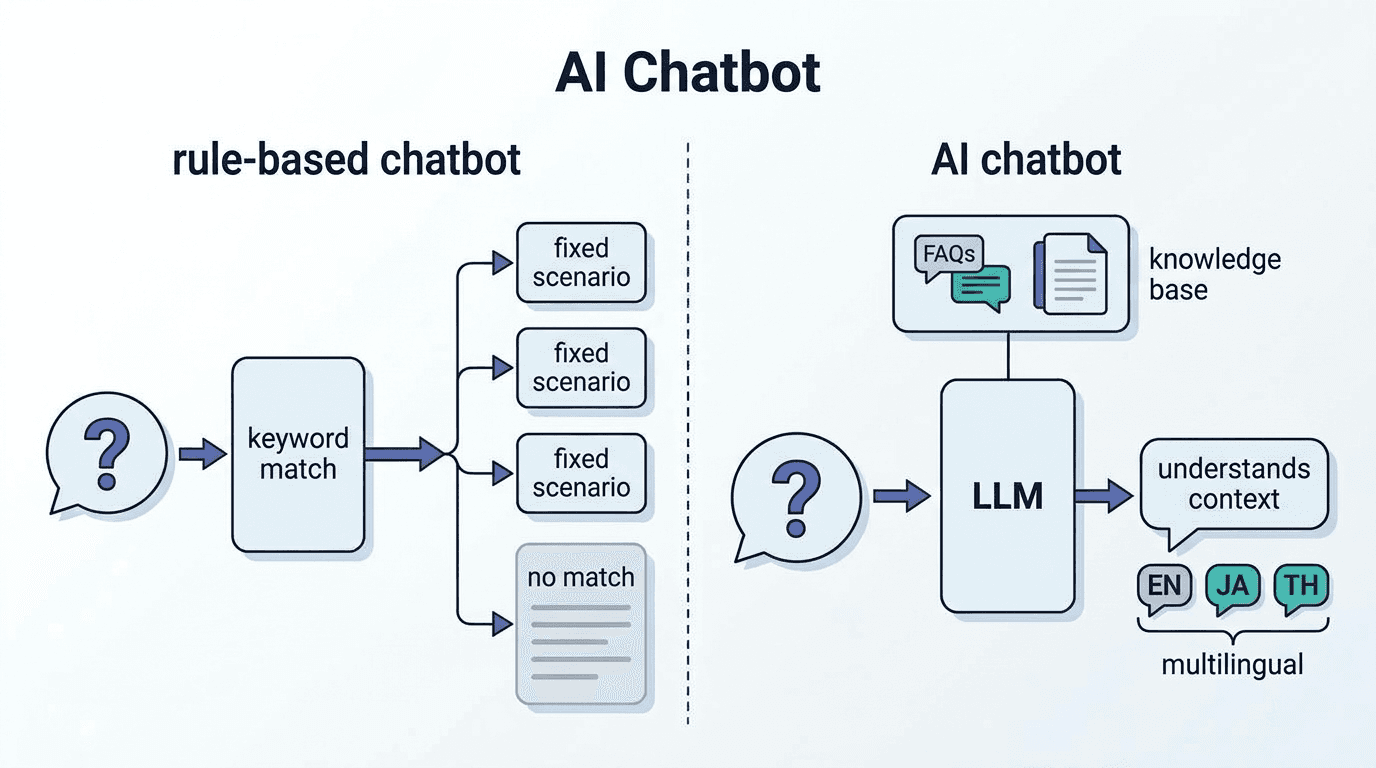
AI Chatbot
An AI chatbot is software that leverages natural language processing (NLP) and LLMs to automatically
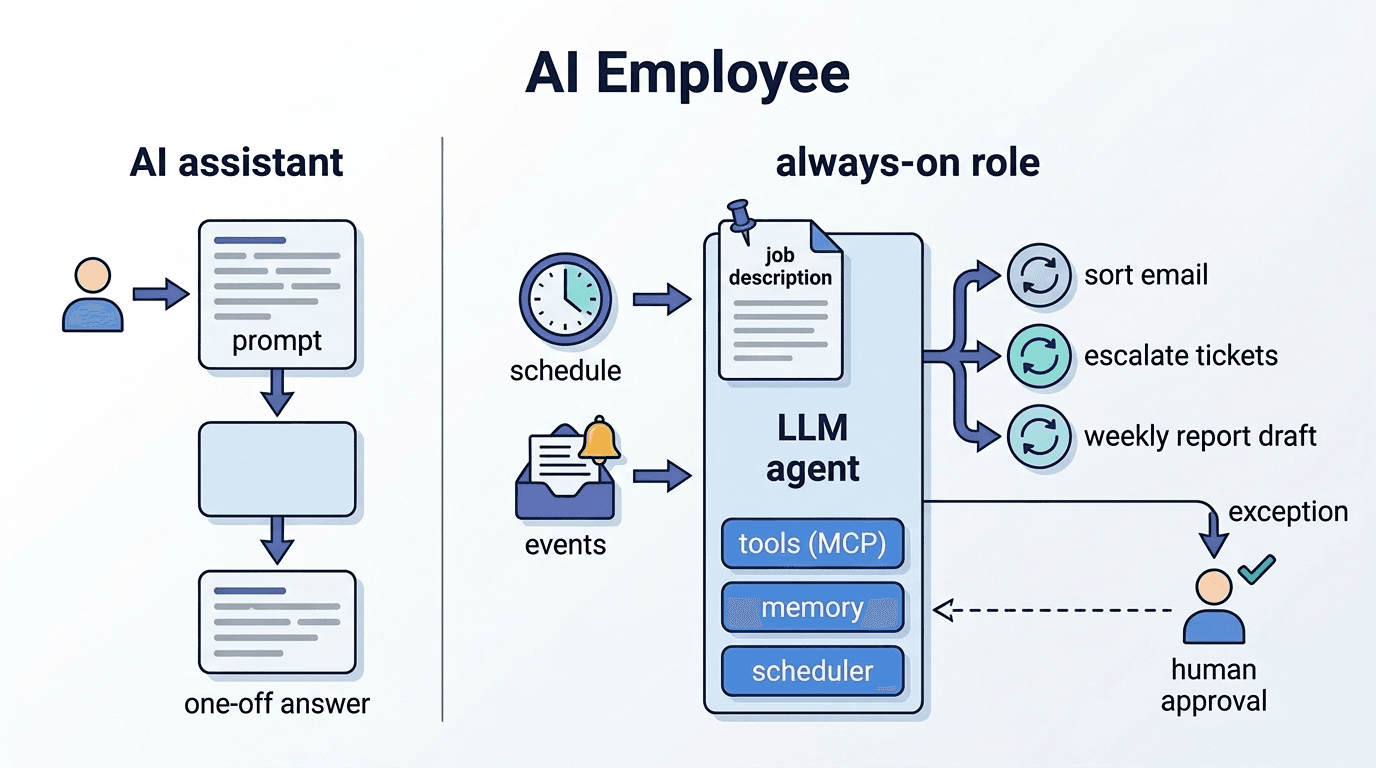
AI Employee (AI Employee)
An autonomous AI agent that takes on a specific business role and continuously performs tasks in the
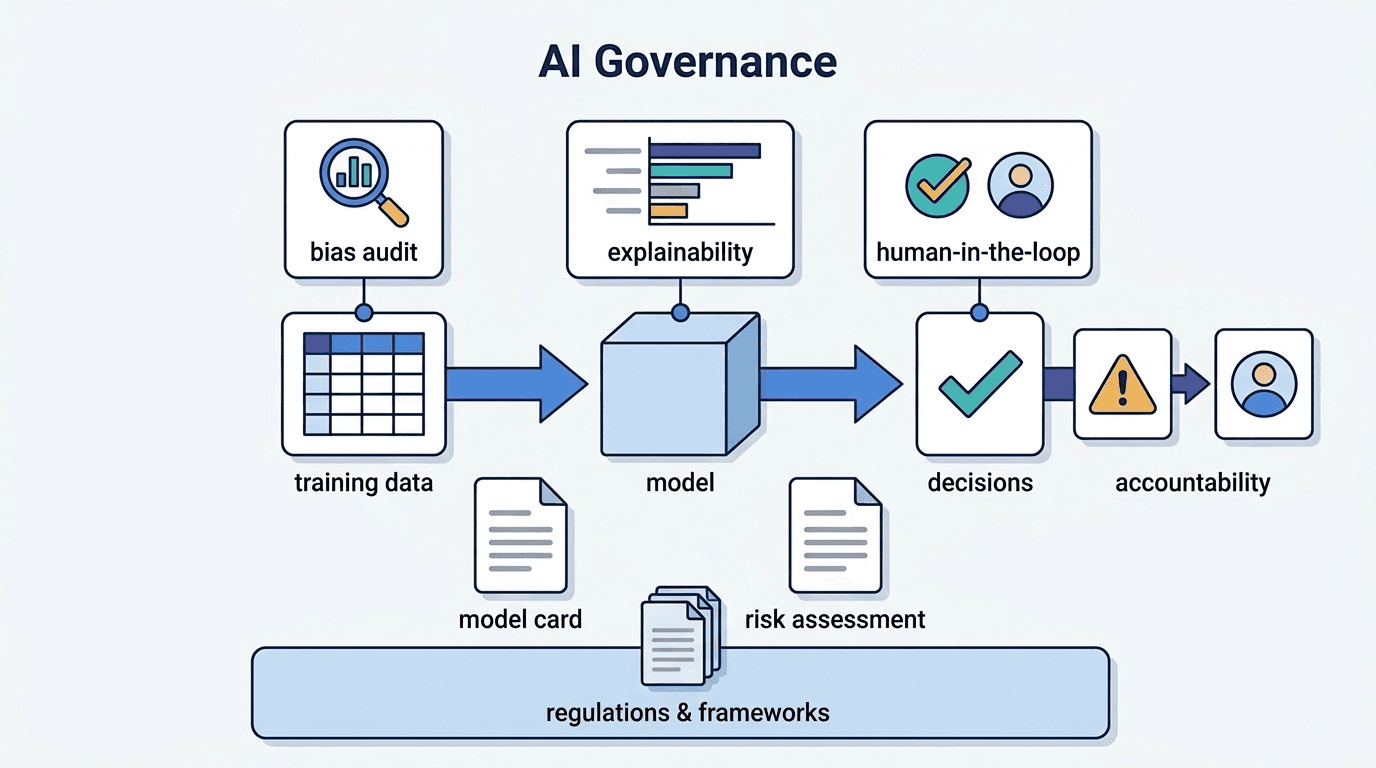
AI Governance
AI governance refers to the organizational policies, processes, and oversight mechanisms that ensure