How Claude Mythos and Fable Are Changing Development — Shifting Verification from "Correct Implementation" to "Correct Work"

Lead
On June 9, 2026, Anthropic released the Claude Mythos class and Claude Fable 5, the generally available model in that lineage. Fable 5 is described as excelling at "long-horizon agentic work," with enhanced capabilities in software engineering, knowledge work, and visual tasks.
What does this generation of models change in practice? A clue lies in the work of the Claude Code team. An engineer on that team has said: "Fable 5 changed how we work on the Claude Code team day to day" and "We used to verify that Claude did the work right. Now we verify that it's doing the right work." This article is aimed at development leads and team managers who regularly use AI coding agents. Drawing on official information, it examines what Claude Mythos / Fable 5 changes about development—and how to design for large-scale delegation without falling into the trap of simply handing everything off.
Claude Mythos is a Claude model class focused on long-horizon autonomous agentic work, and Claude Fable 5 is the high-performance, generally available model in that lineage. Before going further, let's establish what these two are and what has been enhanced, based on official information.
The Mythos Class and Generally Available Model Fable 5
Anthropic made Claude Fable 5 and Claude Mythos 5 available on June 9, 2026. In official terms, Fable 5 is a high-performance, generally available model belonging to the Mythos class—presented as a model anyone can use on a daily basis.
To clarify the naming: it helps to think of "Mythos" as the class (or lineage) and "Fable 5" as the specific model within that lineage made broadly available. Since this article treats this generation as the foundation powering the autonomous execution of Claude Code discussed later, we will primarily refer to Fable 5 going forward.
Enhanced Capabilities and "Long-Horizon Agentic Work"
The key strength Anthropic highlights for Fable 5 is long-horizon agentic work. In addition, enhanced capabilities are described across areas including software engineering, knowledge work, and visual tasks.
The significance of "long-horizon agentic work" lies in the larger scope of tasks that can be handled from a single instruction. Rather than completing a few lines of code, an AI agent can autonomously carry out an end-to-end sequence of work—from interpreting requirements through implementation and verification. This capability is what technically underpins the shifts in verification and ways of working examined in the sections that follow.
How the Claude Code Team Describes the Shift in How We Work
The clearest illustration of how this model generation changes day-to-day practice comes from the Claude Code team's own experience. Thariq Shihipar, an engineer on that team, posted on X (formerly Twitter): "Claude Fable 5 changed how we work on the Claude Code team day to day" and "We used to verify that Claude did the work right. Now we verify that it's doing the right work."
Thariq is introduced as an engineer on Anthropic's Claude Code team, though it is worth noting that these posts are personal accounts and promotional in nature, not official documentation. That said, the sense that the center of gravity in verification is shifting—from "correctness of implementation" to "correctness of the work itself"—aligns with the design of the official features examined in the chapters that follow.
What Does "The Axis of Verification Shifts" Mean?

The shift in the axis of verification refers to a decrease in the weight placed on confirming "correctness of implementation" line by line, and an increase in the weight placed on confirming "whether the right work is being done toward the objective." Neither type of verification disappears entirely. What changes is how humans allocate their limited time between the two.
Traditional Verification: Checking Whether Implementation Is Correct
Traditional verification centered on reading through diffs of AI-written code line by line, checking syntax, types, logic, and test passage. This is verification of "did it build the thing right." During the period when tools were still localized, AI output was at most a few lines or a single function, and it was practical for humans to ensure correctness through review.
At this stage, much of the reviewer's burden stemmed from "not being able to fully trust what the AI wrote." In fact, the comparison article on Claude Code and Codex also cites deploying agent output to production without review as a typical failure. Careful reading of diffs was an effective quality assurance method as long as the output remained small.
New Verification: Checking Whether the Right Work Is Being Done in the First Place
The other type of verification is "is it doing the right work" — checking whether the work being done aligns with the objective and constraints, even if the code itself is not broken. Even if an implementation is technically "correct," it is not "the right work" if what is being built diverges from the purpose or constraints. This is verification that questions the validity of upstream decisions: interpretation of requirements, design choices, and prioritization.
The sentiment quoted at the outset from the Claude Code team — "now I'm verifying whether it's doing the right work" — refers precisely to this upstream verification. The more cohesive tasks can be delegated, as with Fable 5, the greater the weight shifts from tracing code correctness line by line to questioning the direction of what is being built — this sentiment comes from practitioners rather than official documentation, but it is consistent with the design of official features examined in subsequent chapters.
Both Types of Verification Are Necessary — Only the Burden of the Former Decreases
These two types of verification are not a trade-off; they operate at different layers. "Correctness of implementation" has become easier to ensure mechanically than before, through type checking, automated tests, CI, and the mutual verification between agents discussed later. It is therefore primarily the former — "correctness of implementation" — where the human burden is reduced.
"Whether it is the right work," on the other hand, can ultimately only be judged by humans who understand the purpose, context, and constraints. This does not disappear; it remains as the verification that humans should focus on. Note that mechanisms for structurally preventing mistakes before they occur (such as CLAUDE.md, rules, and CI guard configurations) are a separate topic from verification and are covered in detail in harness engineering.
Why This Shift Is Happening Now — The Mechanisms Behind Autonomous Execution

Driving this shift are three mechanisms that have enabled AI to advance "a large, cohesive body of work — including verification — from a single instruction." These are goal-driven execution, mutual verification through sub-agents, and models well-suited to long-horizon tasks. We will examine each in turn based on official information.
"Goal-Driven" Execution That Continues Until Completion Conditions Are Met
/goal is a Claude Code command that, once a completion condition is set, allows Claude to continue working toward that condition without requiring step-by-step instructions. The official documentation (code.claude.com/docs/en/goal) describes it as: "Set a completion condition and Claude will continue working toward it without hand-holding at every step." Claude Code v2.1.139 or later is required.
The idea is straightforward: rather than giving sequential instructions—"do this next, then do that"—you provide the conditions to be met upfront. What determines the quality of the outcome is how precisely those completion conditions are written. No matter how capable the model is, vague conditions will never lead to the "right result." This command is the first entry point into a shift where the focus of verification moves to the design of the conditions themselves.
Workflows Where Multiple Sub-Agents Cross-Verify Each Other (Dynamic Workflows)
Dynamic workflows is a Claude Code feature in which Claude writes a JavaScript script, and that script orchestrates and executes a large number of sub-agents at scale. The official documentation (code.claude.com/docs/en/workflows) lists use cases such as codebase-wide bug sweeps, migrations spanning 500 files, and research where sources are cross-checked against one another.
What is particularly noteworthy is that verification is built into the mechanism itself. The design includes "adversarial verification," in which independent agents critically review each other's findings before reporting. However, this feature is a research preview: it requires Claude Code v2.1.154 or later and a paid plan, and on Pro it must be enabled via /config. It is worth keeping in mind that this is not a feature anyone can simply hand off work to right now—it is an advanced capability with prerequisites. For related design concepts, see also agent orchestration and multi-agent systems.
Model Improvements That Support "Self-Contained Verification"
The models that actually power these features—Fable 5 and others built for long-running tasks—are what make them work. As seen in the previous chapter, Fable 5 excels at long-horizon agentic work, expanding the scope of what can be handled in a single pass. This is precisely why goal-driven features like /goal and "hand it off in bulk" capabilities like Dynamic workflows can function in practice.
Furthermore, the Claude Opus 4.8 announcement describes Dynamic workflows as follows: "Claude plans the work, executes hundreds of parallel sub-agents within a single session (with agents able to run longer in Opus 4.8), verifies the output, and then reports back to the user." The fact that agents can now handle larger units of work in a single pass—and verify their own output before returning it—is the technical foundation of the Mythos / Fable generation that underlies the phenomenon of "verification shifting axis."
How Work Changes — From "Instruction Giver" to "System Designer"

As work begins to proceed in larger, cohesive units, developers' time shifts away from dictating how each step of an implementation should be written, and toward designing what to build, under what constraints, to what extent, and how to verify it. It is a shift from being a director of instructions to being a designer in a collaborative development relationship.
Less Time Spent on Step-by-Step Implementation Instructions
In the past, the central rhythm was: think through each step of the implementation yourself, instruct the agent, and review the diff that came back—a back-and-forth loop. Now, given a set of completion conditions and constraints, an agent can advance through a substantial scope on its own. The time once spent on sequential instruction-giving visibly decreases.
In our own development environment, the center of gravity in reviews is shifting—from "tracing the diff line by line" to "does this change make sense in light of the acceptance criteria and design intent?" There is a growing sense that the question being asked is less about the diff itself and more about whether it is pointing in the right direction relative to the requirements. With less time spent on sequential instructions, there is more room to think carefully about what actually needs to be verified.
More Time Spent Designing Objectives, Constraints, Completion Conditions, and Verification Methods
Time freed from sequential instruction shifts upstream to design. Specifically, this means designing how to provide objectives, background, constraints, completion criteria, and verification methods. In that the quality of context passed to an agent determines outcomes, this is a natural continuation of the movement from prompt engineering to context engineering.
Beyond individual workflows, standardizing this design at the team level also becomes important. Rather than leaving the writing of completion criteria and verification patterns to individual discretion, sharing them through mechanisms like CLAUDE.md, Skills, and Hooks is an approach covered in the Claude Code Team Adoption Guide. Shifting time toward design is not about each person improvising on their own—it is also about making the way you delegate and the way you verify into shared team assets.
The Misconception That "Handing It Off Means It Will Be Done Correctly"

"With Fable 5, you can just hand things off and it'll do them right" is a dangerous misreading. It is true that model capabilities have improved, but that does not mean "no supervision is needed." In fact, the official design places human oversight at the center.
Improved Capability Does Not Mean "No Supervision Required"
Strong summaries you see on social media—"you don't need detailed instructions anymore," "just leave it to the agent"—are best read as promotional anecdotes. What the improvement in capabilities actually means is not "no supervision needed," but rather "the importance of objective design and verification design increases even further."
The reason is simple: if you give an agent the wrong objective, the more capable it is, the faster and more confidently it will head in the wrong direction. A deviation that you might have caught mid-course during manual work can, when the agent proceeds autonomously in chunks, have spread across a wide area by the time you notice it. The more capable the agent becomes, the more the two ends that humans must design—the objective at the entry point and the verification at the exit point—come to matter.
The Premise That Humans Retain Access Control and Final Judgment
This premise is backed not by developer opinion but by the official design. Anthropic's Claude Code product page (anthropic.com/product/claude-code) explicitly states "Human oversight remains central," and explains that the system asks for permission before making file changes or executing commands, and that developers retain full control over what gets committed.
In other words, no matter how autonomously an agent operates, human approval is built into the moment changes are made, and the design ensures that humans ultimately decide what gets shipped. Verifying whether the work is correct and making the final call is not merely a matter of operational mindfulness—it is the intended use case that the tool itself presupposes.
How to Apply This in Practice — Designing for Broad Delegation with Reliable Verification

In practice, a design that achieves both "delegating broadly" and "verifying reliably" is required. The core of this is deciding three things before work begins: input design, verification design, and the shipping decision. Below, each is presented in concrete terms.
Input Design: Providing Objectives, Constraints, and Completion Conditions as a Complete Set
The first is input design. Provide the agent with a complete set of: objective, background, constraints, and completion conditions. Rather than scattered, one-off instructions, the idea is to give all at once — "what for," "under what assumptions," "what must be respected," and "what constitutes done."
For example, when using /goal, the handoff might look like this: "Implement this specification and continue working until all acceptance criteria are met. Do not break existing API compatibility, and if DB schema changes are required, propose them in advance." Here, "don't break existing APIs" and "propose schema changes in advance" are the constraints, while "until acceptance criteria are met" is the completion condition. The more firmly constraints and completion conditions are fixed upfront, the less likely the agent is to go off course even when given a whole chunk of work.
Verification Design: Deciding Acceptance Criteria and Report Format in Advance
The second is verification design. Decide on the acceptance criteria and the format of the report you want before work begins. For example, specifying "after implementation, please report the changed files, implementation details, unresolved items, test results, and any gaps with the specification" makes it easier to review the output from the perspective of "is this the right work?"
Mechanisms like Dynamic workflows — where agents mutually review each other's findings — automate this verification as a first-pass filter. However, that is not a replacement for human verification; it is meant to prepare the groundwork so that humans can focus on final confirmation. The criteria for what constitutes "the right work" still need to be defined by humans.
Shipping Decision: Humans Review the Diff and Unresolved Items Before Deciding
The third is the shipping decision. A human reviews the diff, test results, gaps with the specification, and unresolved items returned by the agent, then decides whether to ship. As noted earlier, the design keeps the developer in control of what gets committed, so this final gate is never skipped.
In particular, changes touching areas where mistakes carry significant impact — authentication, authorization, tenant isolation, billing, and the like — deserve especially careful review, precisely because they were handled as a whole chunk. "Tests are passing" can serve as evidence that "the implementation is correct," but it is not proof that "the right work was done." Checking against the acceptance criteria, understanding what remains outstanding, and then deciding whether to ship or send back — this is where the design of how to delegate comes to a close.
Frequently Asked Questions (FAQ)

From here, we address three questions that frequently come up in practice, focusing on the key points.
Can Small Teams Also Adopt a "Broadly Delegating" Work Style?
The short answer is: yes, it is possible — and in fact, smaller teams tend to see the greatest benefit. In teams with limited reviewers, it is more practical to focus human effort on precisely designing completion conditions and concentrating on verification and final judgment, rather than trying to trace every detail of the implementation.
That said, there are prerequisites. /goal requires Claude Code v2.1.139 or later; Dynamic workflows requires v2.1.154 or later and a paid plan (enabled via /config on Pro), and the latter is currently in research preview. A sensible progression is to first get comfortable working with /goal to hand off completion conditions, then expand to Dynamic workflows as needed.
How Are Security and Access Controls Ensured?
The foundation is secured through permission controls and authorization design. Claude Code is designed by default to request approval before modifying files or executing commands, giving developers control over what gets committed. Even as autonomy increases, the gate at the moment of making changes remains in place.
In addition, rather than having a human watch every step, stability comes from building structures that prevent mistakes——permission rules, CI guards, repository conventions. This structural guardrail design is covered in detail in Harness Engineering.
Which Tasks Should You Start Delegating First?
It is safest to start with tasks where completion criteria can be clearly defined and where the impact of failure is limited. For example, expanding test coverage, routine refactoring or migrations, and cross-cutting investigations are well-suited for practicing delegation in self-contained units, as acceptance criteria are easy to define.
Conversely, tasks where requirements are open to interpretation, or that directly touch critical production paths, are best expanded once the delegation approach has matured. For guidance on deciding which tools to assign tasks to and at what level of granularity, the benchmark data in the Claude Code vs. Codex comparison article is also a useful reference.
Conclusion

The Claude Mythos class and Fable 5, released by Anthropic, excel at long-running agentic work and are steadily changing how development is carried out. The focus of human verification is shifting from "has this been implemented correctly?" to "are we doing the right work in the first place?"——and this shift is being technically supported by completion-condition-driven workflows via /goal, mutual verification between sub-agents through Dynamic workflows, and models well-suited for long-horizon tasks, including Opus 4.8.
However, increased capability does not mean "handing everything off is fine." Even in the official design, human oversight remains central, and humans decide what gets shipped. This is precisely why, in practice, the key is balancing both sides: designing the objective, constraints, completion criteria, and verification method before delegating broadly, while retaining final judgment against acceptance criteria.
We support the design of development and operational processes built around AI agents like these, as well as their adoption in the field. If you would like to work together on designing "which tasks to delegate, and under what completion criteria," please feel free to reach out alongside reviewing the fundamentals of AI agents.
Author & Supervisor

Yusuke Ishihara
Started programming at age 13 with MSX. After graduating from Musashi University, worked on large-scale system development including airline core systems and Japan's first Windows server hosting/VPS infrastructure. Co-founded Site Engine Inc. in 2008. Founded Unimon Inc. in 2010 and Enison Inc. in 2025, leading development of business systems, NLP, and platform solutions. Currently focuses on product development and AI/DX initiatives leveraging generative AI and large language models (LLMs).
Recommended Articles


Terms related to this article
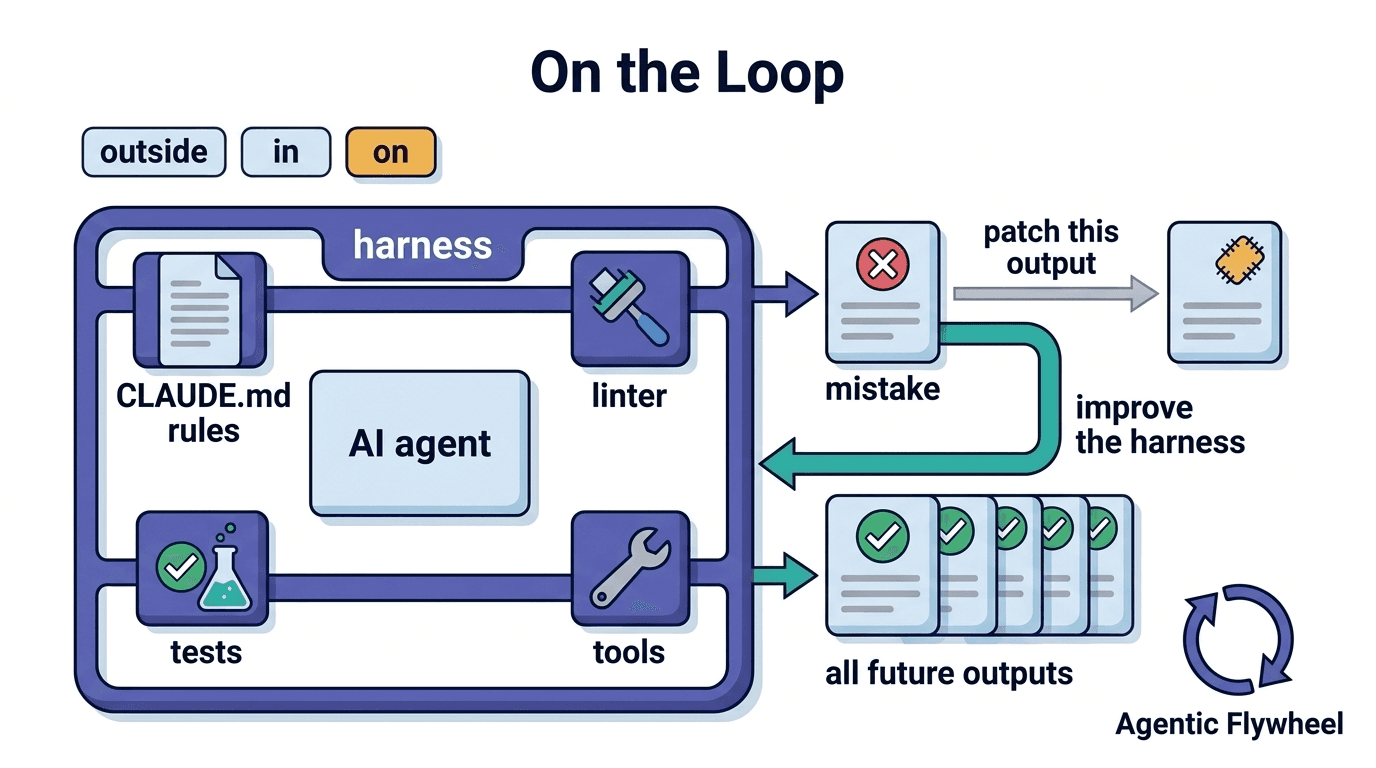
On the Loop
"On the Loop" is a collaboration mode that focuses on improving the harness (operating environment,

Shift Left
Shift Left is a development approach that moves processes such as testing, security checks, and qual
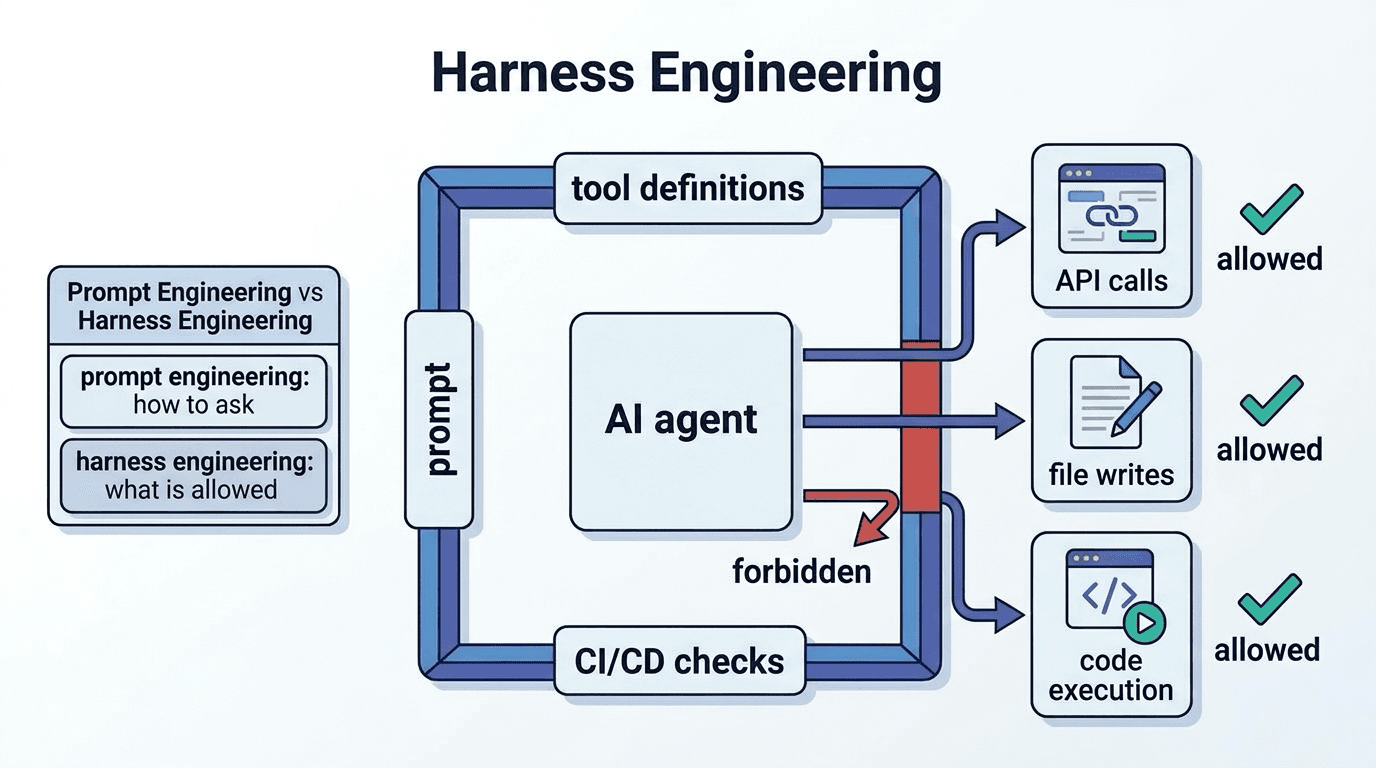
Harness Engineering
Harness engineering is a methodology for designing structural constraints—such as prompts, tool defi