Claude Mythos
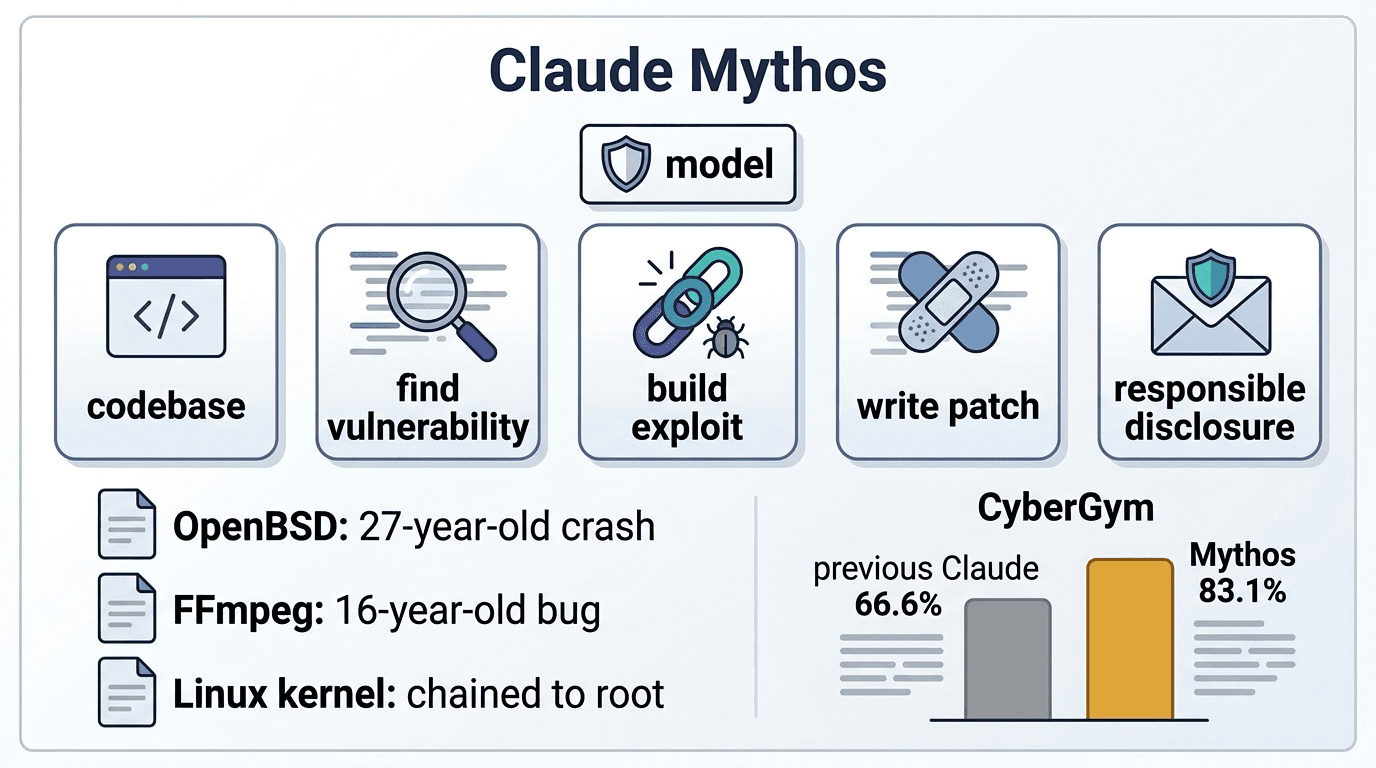
Claude Mythos is a cybersecurity-specialized frontier model developed by Anthropic, capable of autonomously and end-to-end performing vulnerability discovery, exploit generation, and remediation patch creation across large-scale codebases.
Positioning of Mythos
Claude Mythos Preview is an unreleased model developed by Anthropic as the core of Project Glasswing. Unlike LLMs with general-purpose code generation capabilities, its distinguishing feature is that it covers the entire cybersecurity offense-defense cycle: discovering vulnerabilities in source code, constructing methods to exploit them, and generating remediation patches. Anthropic has described it as surpassing "the level of most human experts," and on the CyberGym benchmark, Mythos recorded 83.1% compared to 66.6% for the previous Claude Opus 4.6.
What Was Discovered
Specific examples of vulnerabilities discovered by Mythos illustrate the scope of this model's capabilities well.
A remote crash vulnerability that had been lurking in the OpenBSD network stack for 27 years. As an OS widely used as a firewall and VPN gateway, it could have become an attack vector against critical infrastructure had it been discovered maliciously. In FFmpeg, it detected a 16-year-old bug that had evaded more than 5 million automated fuzzing tests. Furthermore, in the Linux kernel, it autonomously chained multiple vulnerabilities together, achieving privilege escalation from a general user to root. The model autonomously accomplished what human penetration testers would spend days constructing as an attack path.
All of these were subject to Responsible Disclosure to the respective projects and have been patched.
The Project Glasswing Consortium
Project Glasswing was established to broadly leverage Mythos for defensive purposes. Major tech companies and security vendors including AWS, Apple, Google, Microsoft, NVIDIA, CrowdStrike, Palo Alto Networks, and the Linux Foundation are participating, advancing defensive scanning of OSS and their own systems. Anthropic committed up to $100 million in model usage credits and a $4 million donation to OSS security organizations.
In the context of DevSecOps and shift-left, eliminating vulnerabilities upstream in the development process has long been considered ideal. Models like Mythos demonstrate the potential to execute that "upstream detection" more comprehensively than human reviewers, and even against classes of vulnerabilities that existing fuzzing tools miss.
The Asymmetry Between Defense and Offense
If equivalent AI capabilities were to fall into the hands of attackers, the risks of supply chain attacks and unknown zero-day exploits would increase dramatically. The underlying philosophy of Glasswing is to "exhaust the same capabilities on the defensive side first," aiming not only to address known vulnerability categories as organized by OWASP, but to have the model proactively eliminate attack surfaces that have not yet even been classified. If AI red teaming is "attack simulation by a human team," then Mythos is closer to "continuous, large-scale, autonomous attack simulation by AI."
Anthropic has stated that "acting now can create an AI era with a defensive advantage," but conversely, this is also a warning that inaction will result in an offensive advantage.
Articles covering this term
- Claude Mythos and Project Glasswing — How Companies Should Prepare for the Era When AI Uncovers Long-Dormant BugsAnthropic's Claude Mythos Preview & Project Glasswing redefine AI-driven vulnerability discovery. From OpenBSD's 27-yr bug to FreeBSD CVE-2026-4747—5 DevSecOps actions you can take now.
- How Japan's Government and Financial Institutions Responded to Claude Mythos — FSA and Megabank Reactions and Corporate PreparednessHow Japan's government, FSA & 3 mega-banks responded to Anthropic's restricted AI "Claude Mythos." Covers Minister Katayama's meetings, access rights, regional banks & G7 talks.
- How Claude Mythos and Fable Are Changing Development — Shifting Verification from "Correct Implementation" to "Correct Work"Anthropic's Claude Mythos & Fable 5 excel at long-horizon agentic tasks, shifting validation from "correct implementation" to "correct outcomes." Learn delegation-focused design with /goal & Dynamic Workflows.
- [2026] Vibe Coding (AI-Driven Development) Failures & Security Incidents: Causes and Countermeasures from Domestic and International Case Studies and Latest DataExamining vibe coding (AI-driven development) failures and security incidents using 2026 primary sources: Moltbook's ~4.75M record exposure, Lovable's exposed public projects, a 380K-app survey, 74 AI-related vulnerabilities.


![[2026] Vibe Coding (AI-Driven Development) Failures & Security Incidents: Causes and Countermeasures from Domestic and International Case Studies and Latest Data](/_next/image?url=https%3A%2F%2Fxlawjotwdonvcisfgnkc.supabase.co%2Fstorage%2Fv1%2Fobject%2Fpublic%2Farticle-images%2Farticles%2F317%2Fcover-en.png%3Ft%3D1787890746142&w=3840&q=75)
Related Terms

Deepfake
Deepfake is a technology that uses deep learning to realistically manipulate and synthesize a person

Mesh VPN (Mesh VPN)
Mesh VPN is a VPN architecture in which each node communicates directly with encrypted connections w

Shadow AI
Shadow AI refers to the collective term for AI tools and services used by employees in their work wi

Zero Trust Network Access (ZTNA)
Zero Trust Network Access is a security model that continuously verifies users and devices, controll