Guardrails (AI Guardrails)
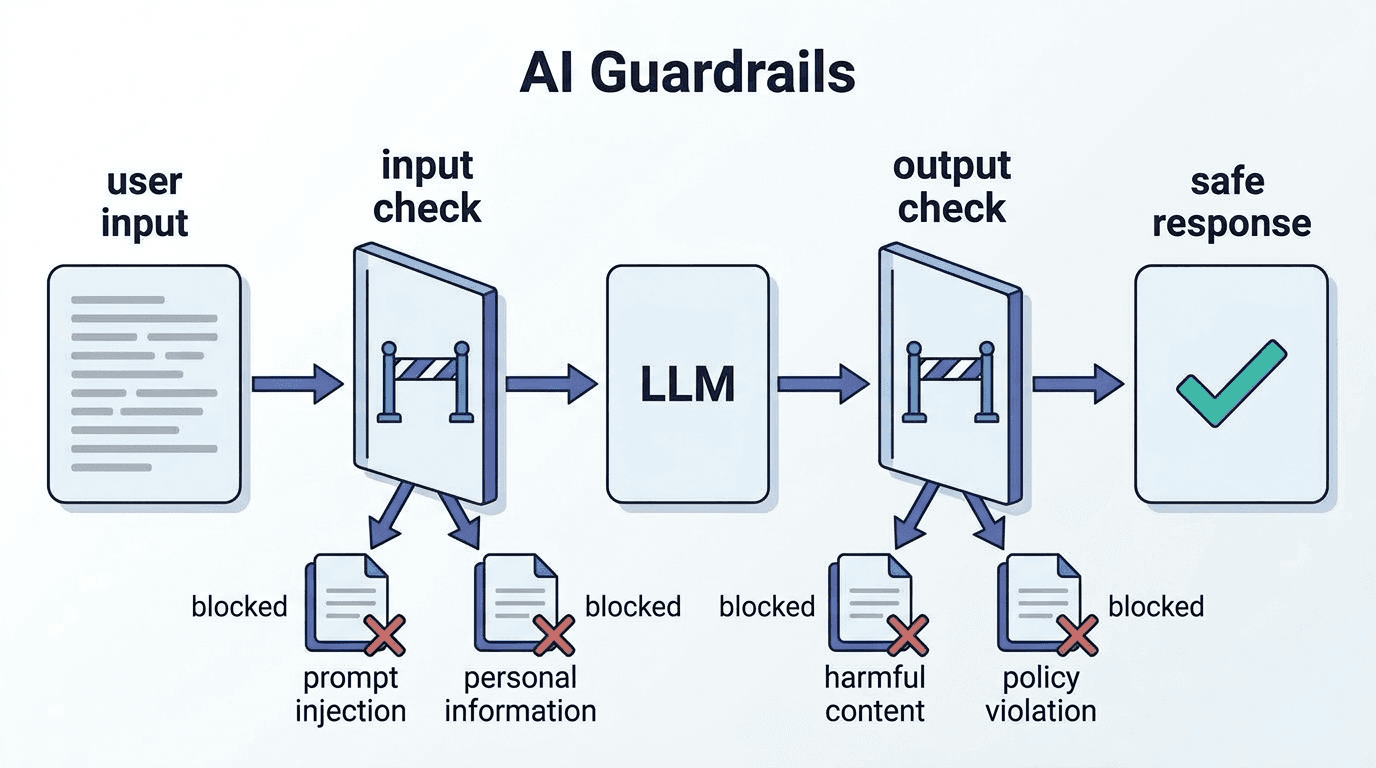
A safety mechanism that monitors LLM inputs and outputs to automatically detect and block harmful content, sensitive information leakage, and policy violations.
What Are Guardrails?
Guardrails (AI Guardrails) is a collective term for safety mechanisms that monitor LLM inputs and outputs to automatically detect and block harmful content generation, sensitive information leakage, and policy violations. Just as roadside guardrails prevent vehicles from veering off course, they keep AI behavior within acceptable boundaries.
Input Side and Output Side
Guardrails function across two primary layers.
Input Guardrails: Inspect user input before it reaches the model. This includes prompt injection detection, personally identifiable information (PII) masking, and topic restrictions (blocking off-topic queries).
Output Guardrails: Inspect model responses before they are returned to the user. This involves filtering harmful expressions, verifying factual accuracy (grounding), and checking for sensitive data leakage.
Implementation Approaches
It is common practice to combine rule-based approaches (regular expressions, keyword lists) with ML-based approaches (classification models, evaluation by a separate LLM). Designing guardrails in alignment with the risk categories outlined in the OWASP LLM Top 10 improves overall coverage.
Operational Pitfalls
Excessive guardrails degrade the user experience. When legitimate work-related queries are incorrectly blocked — so-called "false positives" — users stop using AI tools altogether. Threshold tuning and transparent feedback explaining why a query was blocked are key to effective operation.
Articles covering this term
- AI Guardrails Implementation Guide — How to Design Safety Barriers for LLM ApplicationsProtect LLM apps from prompt injection & hallucinations. Learn guardrail design basics, input/output guards, evaluation, and multi-tenant operations from an implementation perspective.
- AI Agent Guardrail Operations Checklist: Permissions, Review, CI, and Kill Switch DesignChecklist of operational rules to prevent AI agent incidents in production: permissions, human review, CI/testing, and kill switches—use alongside Harness design.
- Emergency Stop Design for AI Agents — A Circuit Breaker Implementation GuideLearn design patterns and implementation steps for circuit breakers and kill switches that automatically detect runaway costs and hallucinations for immediate shutdown.
- What is an AI Gateway? An Implementation Guide for Securely Integrating Multiple LLM ProvidersAI Gateway is a relay layer managing multiple LLM providers via a unified interface. A design and operations guide for implementing cost optimization, failover, and audit logging.


Related Terms

Deepfake
Deepfake is a technology that uses deep learning to realistically manipulate and synthesize a person

Mesh VPN (Mesh VPN)
Mesh VPN is a VPN architecture in which each node communicates directly with encrypted connections w

Shadow AI
Shadow AI refers to the collective term for AI tools and services used by employees in their work wi

Zero Trust Network Access (ZTNA)
Zero Trust Network Access is a security model that continuously verifies users and devices, controll