MVP (Minimum Viable Product)
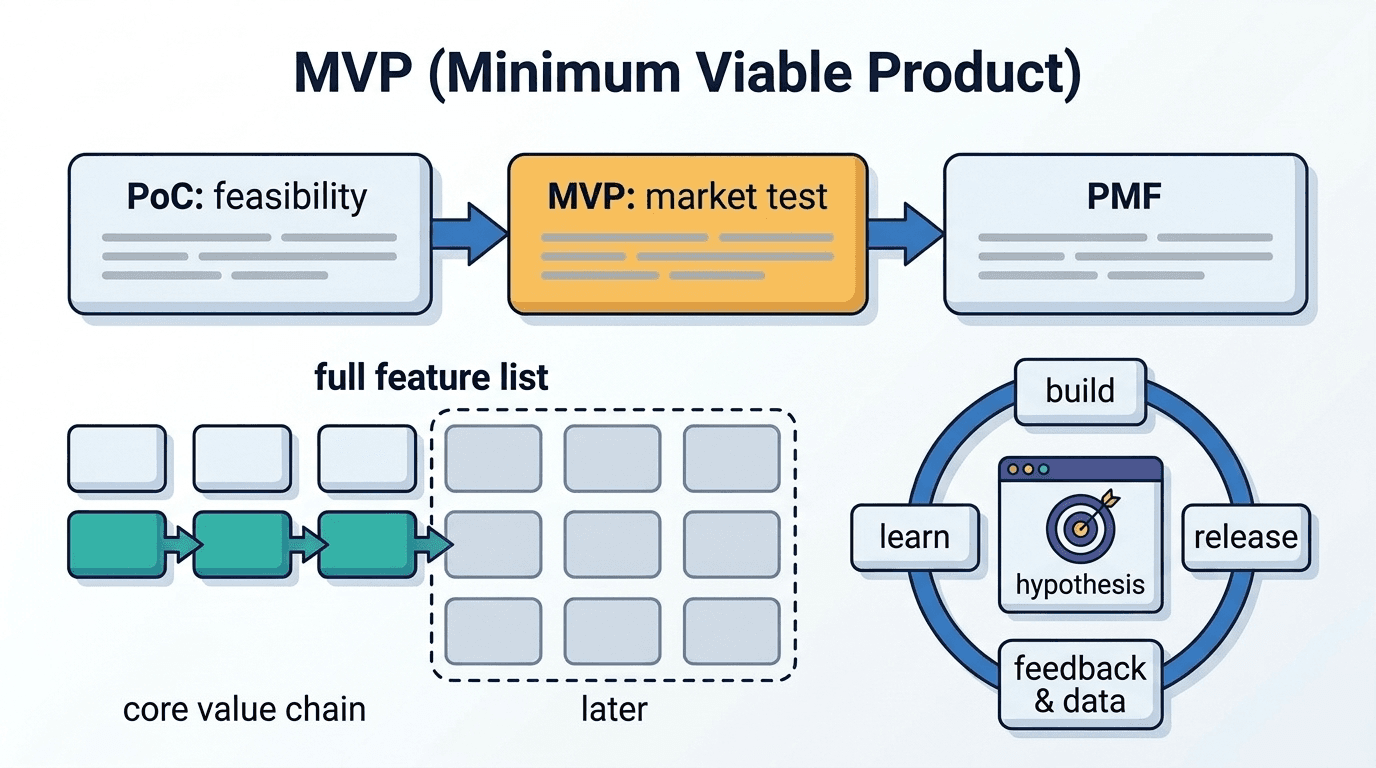
MVP (Minimum Viable Product) refers to an initial product developed with minimal features to conduct market validation. It is built after technical feasibility has been confirmed through PoC, with the purpose of validating PMF.
MVP (Minimum Viable Product) is an initial product developed to validate market fit with minimal functionality. It is a form of phased development approach built primarily to validate PMF (Product-Market Fit), after confirming technical feasibility through PoC (Proof of Concept).
Why "Minimum"?
The greatest risk to avoid in product development is investing time and cost into features that nobody needs. The MVP philosophy attempts to address this problem at its root. Rather than completing a fully-featured product before going to market, only the minimum functionality necessary to validate hypotheses is implemented, and feedback is gathered from actual users.
This approach became widely known in the context of Lean Startup, but its essence lies in "minimizing the cost of learning." The shorter the development period, the smaller the losses when heading in the wrong direction.
Differences from PoC and the Bridge to PMF
PoC and MVP are often confused, but their purposes are fundamentally different. While PoC asks "can we build it?", MVP asks "will it be used?" and "will users recognize its value?" Only after clearing the technical hurdles does one enter the stage of putting questions to the market as an MVP.
What is gained through an MVP is not merely an evaluation of features. It is both qualitative and quantitative data — the context in which users actually use the product, their motivations for continued use, and their willingness to pay. As this data accumulates, the direction toward PMF becomes more concrete.
Key Perspectives for MVP Design
When designing an MVP, it is important to establish clear criteria for what to cut and what to keep. Common failure patterns include the following:
- Cutting too many features and breaking the user experience: Even at a minimum, the chain of core value delivery must be complete
- Starting development with vague hypotheses to validate: An MVP is a means of hypothesis validation, and without first defining what is being validated, the design of KPIs (Key Performance Indicators) will also become inconsistent
- Failing to design a feedback loop: How data will be collected and analyzed after release must be built in ahead of time
In recent years, leveraging Generative AI and AI agents has significantly accelerated MVP development. By adopting approaches such as Vibe Coding, even teams with limited engineering resources are increasingly able to bring prototypes to market in a short period of time.
Operational Thinking for a Successful MVP
For an MVP, the release is not the goal — it is the starting line. What matters is how quickly the cycle of observation and improvement can be turned after release. By combining this with the DevOps philosophy, continuous deployment and measurement mechanisms can be established, turning the speed of learning itself into a competitive advantage.
It is also important not to defer considerations of security and quality. When the word "minimum" becomes a justification for ignoring the principles of Shift Left, the result returns as technical debt during later expansion phases. Even for an MVP, quality assurance mechanisms such as unit testing and acceptance testing should be properly designed from the outset.
Once an MVP has completed market validation, the next step is scaling up and expanding functionality. It is only at that point that the transition begins to a stage where serious investment decisions are made from the perspective of AI ROI (Return on Investment in AI).
Articles covering this term
- PoC Development: Costs, 5-Step Process, and Vendor SelectionPoC development explained: costs, a 5-step process, what to put in PoC requirements, go-live criteria that prevent PoC fatigue, and how to choose a partner.
- **Causes of PoC Failure and Lessons from Real Cases: Designing AI Adoption with Specification-Driven Development (SDD) and Acceptance Test-Driven Development (ATDD)**AI PoC failures often stem from ignoring AI-specific traits—inconsistent outputs, data-dependent performance, no clear pass/fail line—at the planning stage. Learn common failure patterns and how SDD and ATDD fix this.
- AI Observability for Startups: 3 Key Metrics to Monitor FirstAI Observability guide for startups: the 3 key metrics to monitor first under resource constraints, minimal tool setup, and a phased scaling roadmap with implementation examples.


Related Terms
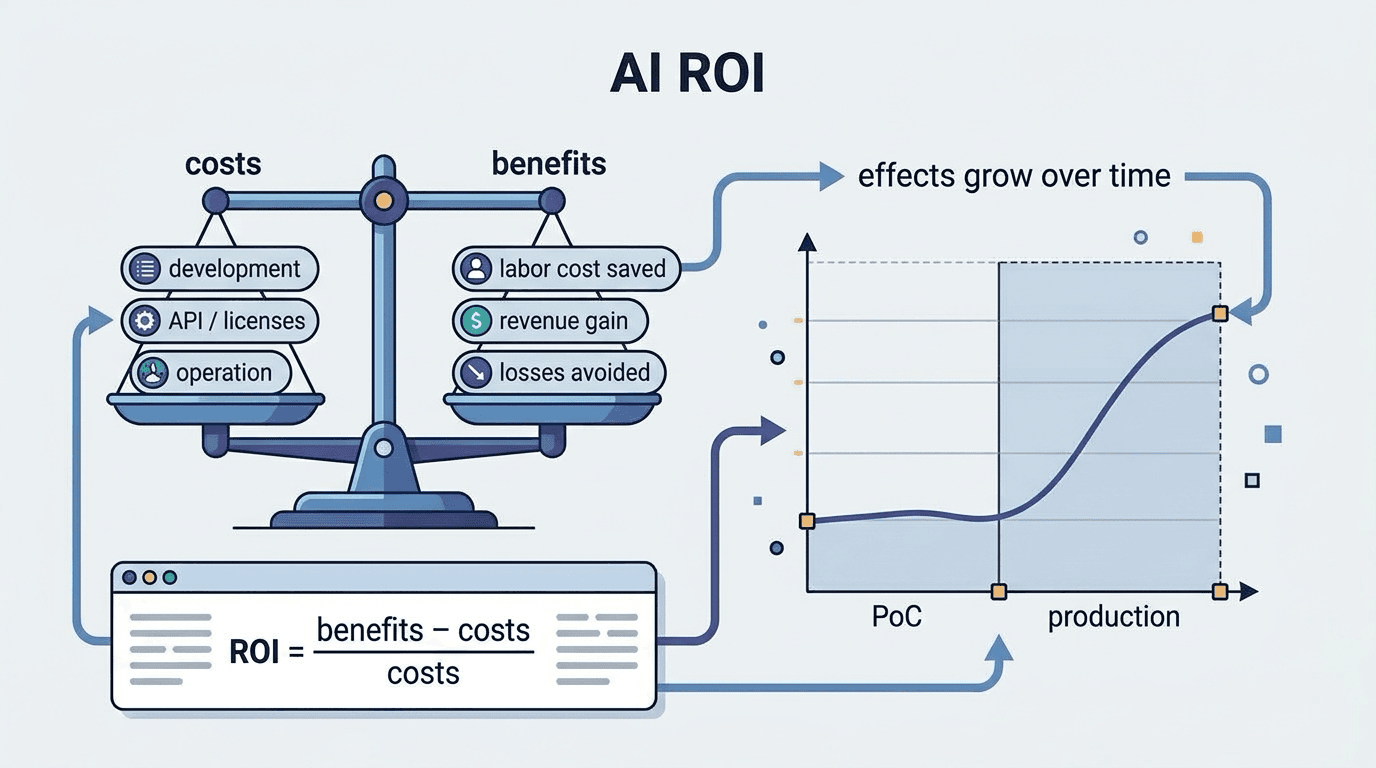
AI ROI (Return on Investment in AI)
AI ROI is a metric that quantitatively measures the effects obtained — such as operational efficienc

AI Observability
An operational practice of continuously monitoring and visualizing the inputs/outputs, latency, cost
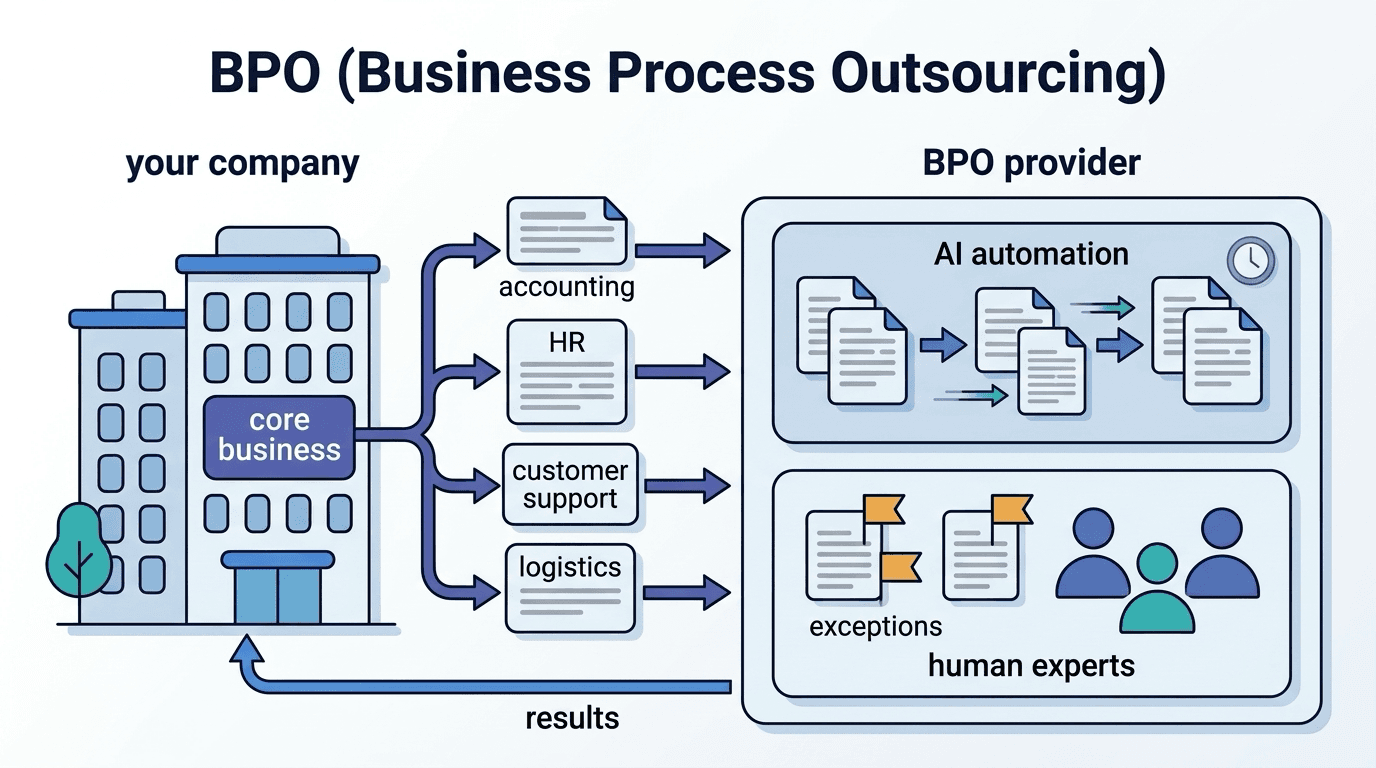
BPO (Business Process Outsourcing)
BPO refers to a form of outsourcing in which a company delegates specific business processes to an e

Demand Forecasting AI
Demand forecasting AI refers to a system that analyzes historical sales data and external factors us