Shadow AI

Shadow AI refers to the collective term for AI tools and services used by employees in their work without the approval of the company's IT department or management. It carries risks of information leakage and compliance violations.
Shadow AI refers to the collective term for AI tools and services used by employees in their work without the approval of the company's IT department or management. Representative examples include using generative AI services such as ChatGPT, Claude, and Gemini through personal accounts for business purposes, and this practice carries inherent risks of information leakage and compliance violations.
Why Shadow AI Emerges
The spread of Shadow AI stems from the gap between the overwhelming convenience of AI tools and the pace at which companies can establish proper governance. Employees have a pressing motivation to improve operational efficiency, and the longer approval processes drag on, the more likely they are to act on a "try it first" basis.
This trend has become particularly pronounced since the rise of generative AI. Tools directly applicable to everyday tasks—such as document creation, code generation, and data analysis—have become available for free or at low cost, creating a situation where IT department oversight cannot keep up. While employees with high AI literacy tend to be more proactive adopters, the variance in risk awareness across organizations also presents a challenge.
Key Risks and Scope of Impact
The risks of Shadow AI can be broadly categorized into three areas.
Information Security Risks By entering business data or customer information into external AI services, there is a possibility that confidential information may unintentionally be used as training data. Prompt injection attacks and the business use of misinformation caused by hallucination are also concerns that cannot be overlooked.
Compliance Risks Under personal data protection frameworks such as GDPR and PDPA, and AI regulatory frameworks such as the EU AI Act, the use of unapproved tools can give rise to legal liability. From an AI governance perspective, an inability to track actual usage patterns also constitutes an organizational risk.
Quality and Reliability Risks Using AI outputs for business decisions without a proper HITL (Human-in-the-Loop) framework in place carries the risk of cascading erroneous decision-making. Approved tools allow for the establishment of guardrails and output quality verification processes, whereas Shadow AI makes this difficult.
Countermeasures: A Paradigm Shift from Prohibition to Governance
While "prohibition" was once the predominant response, thinking is now shifting toward "managed utilization." This reflects a growing recognition that prohibition alone fails to meet employees' productivity needs and instead drives usage underground.
Approaches being adopted as effective countermeasures include the following:
- Maintaining an approved AI tools list and establishing a rapid review process: Creating an environment where employees can easily submit requests and making usage needs visible
- Implementing Zero Trust Network Access (ZTNA): Technically controlling access to unapproved services
- Leveraging local LLMs and edge AI: Achieving productivity gains through configurations that do not send internal data to external parties
- Conducting AI literacy training: Enabling employees themselves to judge what constitutes a risk
The shift-left philosophy discussed in the context of DevSecOps—the idea of incorporating risk management early in the process rather than in later stages—can also be applied to AI usage governance. Building a framework that embeds security requirements from the tool selection stage is the path toward a fundamental resolution of the Shadow AI problem.
For organizations to strategically leverage AI and maximize AI ROI, it is essential to create a structure that channels employees' intrinsic motivation to adopt AI within an appropriate governance framework, rather than suppressing it. Shadow AI is simultaneously a "problem" and a mirror reflecting an organization's AI adoption needs.
Articles covering this term
- AI Governance for Small Teams: Scalable AI Governance for Small and Medium-Sized BusinessesLightweight AI governance frameworks & checklists for SMEs and startups to practically adopt enterprise-grade AI standards—even with limited resources.
- What Is Shadow AI Auditing? How to Detect and Manage Unauthorized AI Tools Used Within Your OrganizationDetect shadow AI (ChatGPT, Gemini) used without approval, and learn the audit process covering risk assessment, policy development, and PDPA compliance.
- 【2026】Latest Trends in AI CybersecurityAs AI adoption accelerates, risks surge from AI-powered attacks and attacks on AI itself. Explore deepfakes, prompt injection, Shadow AI threats, and 3-layer defenses covering technology, operations, and governance.
- What Is an AI-Native Management Strategy? How to Fundamentally Redesign Your Business ModelFrom "adding AI" to "redesigning with AI." Learn AI-native management transition steps, ERP/FMS integration strategies, and real-world examples from Thai and Japanese companies.


Related Terms

Deepfake
Deepfake is a technology that uses deep learning to realistically manipulate and synthesize a person

Mesh VPN (Mesh VPN)
Mesh VPN is a VPN architecture in which each node communicates directly with encrypted connections w

Zero Trust Network Access (ZTNA)
Zero Trust Network Access is a security model that continuously verifies users and devices, controll
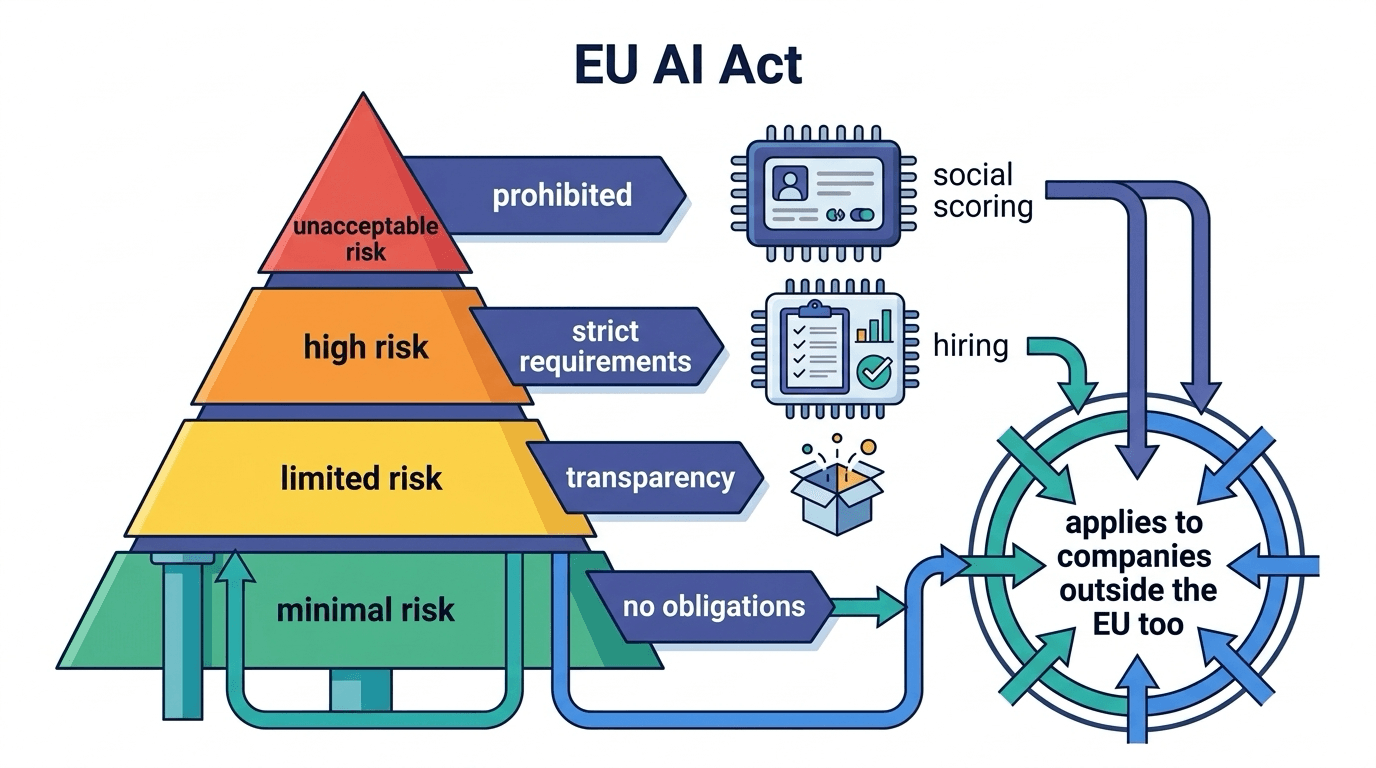
EU AI Act (EU Artificial Intelligence Act)
The EU AI Act (EU Artificial Intelligence Act) is a comprehensive European Union regulation that est