AI Governance
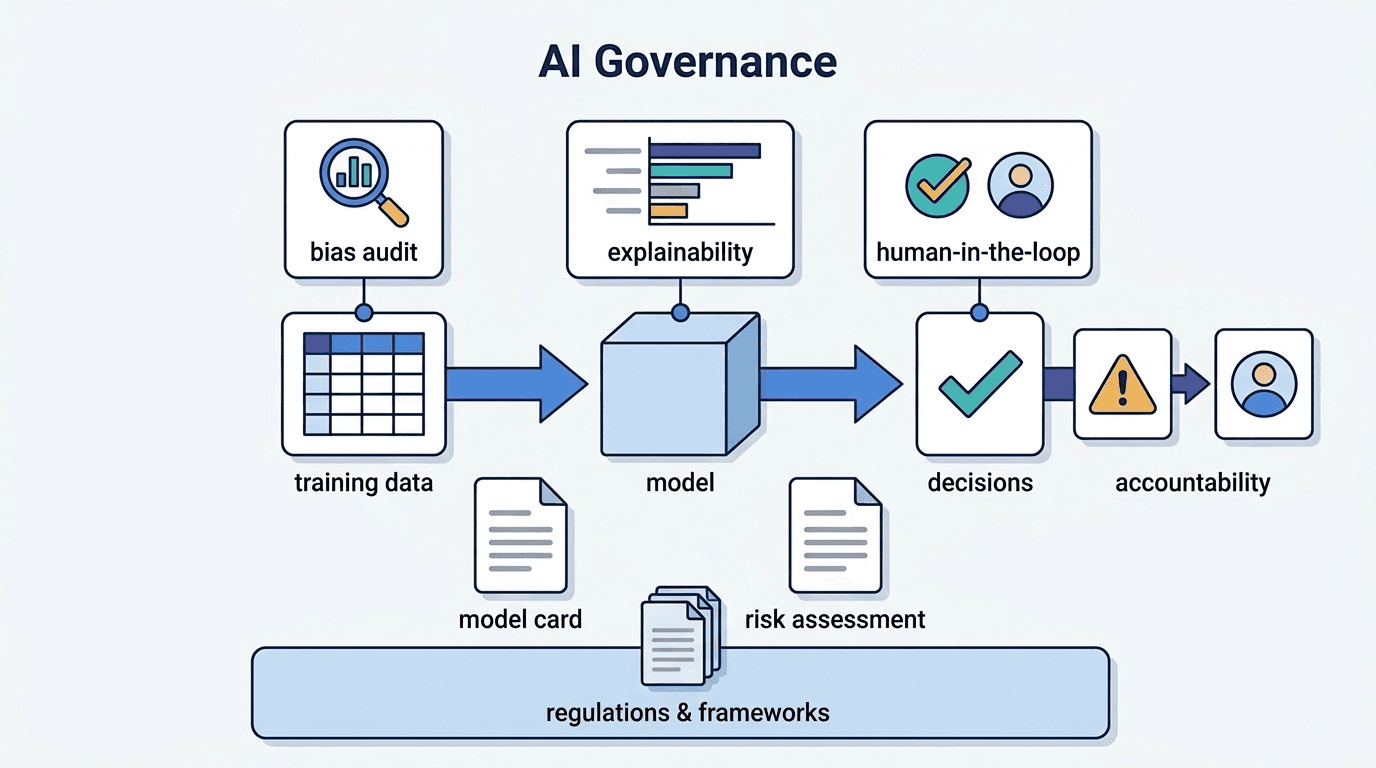
AI governance refers to the organizational policies, processes, and oversight mechanisms that ensure ethics, transparency, and accountability in AI system development and operation.
As AI is increasingly used for business decisions, questions like "Why did this AI make this decision?", "Is there bias?", and "Who takes responsibility?" become unavoidable. AI governance is the framework that prepares answers to these questions from both technical and institutional perspectives.
Specifically, it encompasses bias auditing of training data, ensuring explainability of outputs, human-in-the-loop intervention for final decisions, and responsibility allocation during incidents. Frameworks are being developed across regions: the EU AI Act, Japan's AI Business Guidelines, and NIST AI RMF among others.
Organizational adoption requires more than just policy creation—it demands model card management, risk assessment workflow integration, and regular fairness audits. For companies deploying AI in Thailand and ASEAN countries, ensuring alignment with PDPA (Personal Data Protection Act) is also a critical practical concern.
On the technical side, methods for quantitatively detecting training data bias (Fairness Metrics) and visualizing model reasoning (SHAP, LIME) are in practical use, and governance automation is gradually progressing.
Articles covering this term
- What is AI Governance? A Practical Guide from EU AI Act Compliance to Internal Policy DevelopmentLearn AI governance essentials: EU AI Act overview, risk classification, internal guidelines, and audit frameworks—key insights for practitioners navigating full-scale AI adoption.
- What Is an AI-Native Management Strategy? How to Fundamentally Redesign Your Business ModelFrom "adding AI" to "redesigning with AI." Learn AI-native management transition steps, ERP/FMS integration strategies, and real-world examples from Thai and Japanese companies.
- AI Governance for Small Teams: Scalable AI Governance for Small and Medium-Sized BusinessesLightweight AI governance frameworks & checklists for SMEs and startups to practically adopt enterprise-grade AI standards—even with limited resources.
- AI Automation Bias: Causes and 3-Layer CountermeasuresWhat AI automation bias is, typical failure scenarios, and countermeasures across organization, design and operations: confidence display, HITL and audit logs.


Related Terms

Deepfake
Deepfake is a technology that uses deep learning to realistically manipulate and synthesize a person

Mesh VPN (Mesh VPN)
Mesh VPN is a VPN architecture in which each node communicates directly with encrypted connections w

Shadow AI
Shadow AI refers to the collective term for AI tools and services used by employees in their work wi

Zero Trust Network Access (ZTNA)
Zero Trust Network Access is a security model that continuously verifies users and devices, controll