Agentic Flywheel
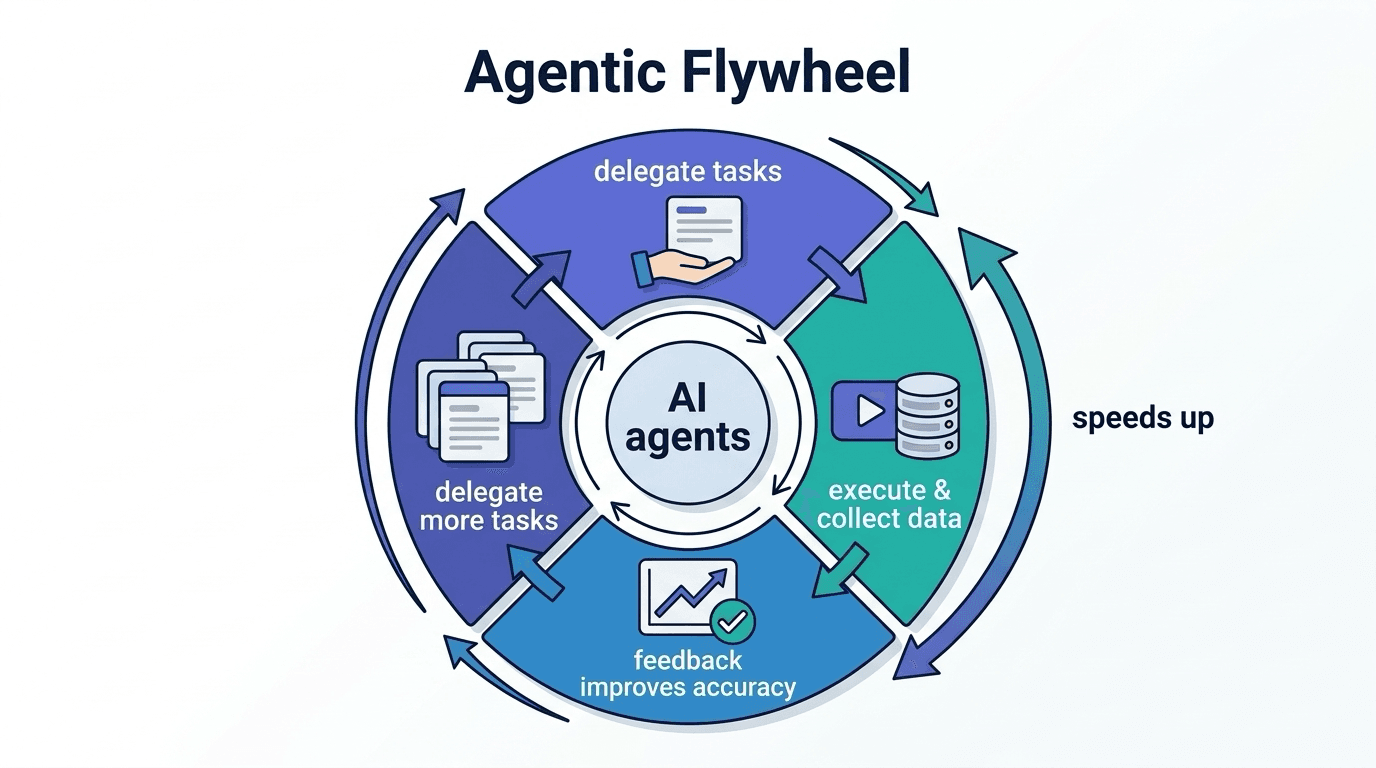
The Agentic Flywheel is a self-reinforcing growth cycle in which AI agents autonomously execute tasks, and the data and feedback generated from those results improve the agents' own accuracy and decision-making capabilities, enabling them to be entrusted with an ever-increasing range of tasks.
The Underlying Question — "Once You Deploy an Agent, What Happens Next?"
The first obstacle companies face after integrating Agentic AI into their operations is the wall of "insufficient accuracy." However, some organizations that have continued running these systems report a phenomenon where the rate of improvement accelerates at a certain point. The concept that structurally captures this acceleration mechanism is the Agentic Flywheel.
The flywheel is originally a mechanical engineering term that entered the business lexicon when Jim Collins adapted it for management strategy in his book Good to Great. Amazon's "selection → customer experience → traffic → increased sellers → selection" loop is the well-known representative example. The Agentic Flywheel applies this structure to the operational improvement cycle of AI agents.
The Structure of the Cycle
The flywheel turns through four broad phases.
① Task Delegation — Humans delegate routine tasks to agents. This is often initially limited to low-risk areas.
② Execution and Data Accumulation — As agents autonomously execute tasks, data on success patterns, failure patterns, and edge cases accumulates. In multi-agent systems, this also includes collaboration logs between agents.
③ Feedback and Improvement — The accumulated data is used to optimize prompts, update RAG knowledge bases, and fine-tune models. Quality reviews via HITL (Human-in-the-Loop) determine the precision of this phase.
④ Expansion of Trust and Delegation Scope — As accuracy improves, trust on the human side is cultivated, and the scope of delegation expands to more complex tasks and those requiring judgment. This loops back to ① and the cycle enters its next revolution.
The key point is that the data accumulated in each revolution becomes the raw material for improvement in the next. In other words, the more the flywheel turns, the lower the cost of improvement and the faster the rate of improvement becomes.
Conditions for Getting It Spinning
The flywheel does not spin automatically. In the author's observation, the initial "push" is the heaviest. In particular, without the following three conditions, the cycle tends to spin without traction.
- Measurable task design: If an agent's output cannot be quantitatively evaluated, the feedback loop cannot function. Rather than "good or bad," concrete metrics such as accuracy rate, processing time, and rework rate should be built in at the design stage.
- Systematizing feedback: An ad hoc operation where reviewers make corrections only when they happen to notice an issue will cause the cycle to break down. It is preferable to embed a review step within the agent orchestration layer so that corrections are automatically reflected in the knowledge base.
- Executive understanding of the "first three months": ROI is difficult to see in the early stages of the flywheel. If it is treated as a PoC (Proof of Concept) with excessive pressure for short-term results, it may be terminated before sufficient data has been accumulated.
The Flywheel in SaaS Products
In the context of product development, the flywheel is often discussed as a growth engine following PMF (Product-Market Fit). In the case of the Agentic Flywheel, by embedding agent functionality into the product itself, it becomes possible to build a product growth flywheel of "user adoption → data accumulation → improved agent accuracy → enhanced user experience → expanded adoption."
This structure is realized by replacing the automation that traditional SaaS achieved through manual configuration and rule-based systems with learning-based agents. The result is a competitive advantage in the form of a product that becomes smarter the more it is used.
Limitations and Caveats
The flywheel is not a cure-all. If the quality of accumulated data is poor, it can fall into a negative cycle of "garbage in, garbage out." Furthermore, if an agent's judgments contain biases, there is a risk that the flywheel will amplify those biases. The design of AI Guardrails and regular human monitoring remain necessary regardless of how fast the flywheel is spinning.
Articles covering this term
- What Is an AI-Native Management Strategy? How to Fundamentally Redesign Your Business ModelFrom "adding AI" to "redesigning with AI." Learn AI-native management transition steps, ERP/FMS integration strategies, and real-world examples from Thai and Japanese companies.
- AI Agents from Pilot to Production: 5 Barriers and FixesThe 5 barriers that stop AI agents from moving from pilot to production, with practical steps for quality control, system integration, governance and ROI.
- What is Service as Software (SaS)? Why SaaS Delivery Models and Pricing Strategies Are Changing in the AI EraService as Software (SaS) is a new model where AI agents autonomously execute tasks, billed by outcomes. Learn how it differs from SaaS and key adoption criteria.
- What is Loop Engineering? The New Standard in AI Agent Design Coming After Prompt EngineeringFrom prompting to designing "loops" where AI works autonomously. We explain Loop Engineering—its meaning, evolution, components, and implementation considerations.


Related Terms
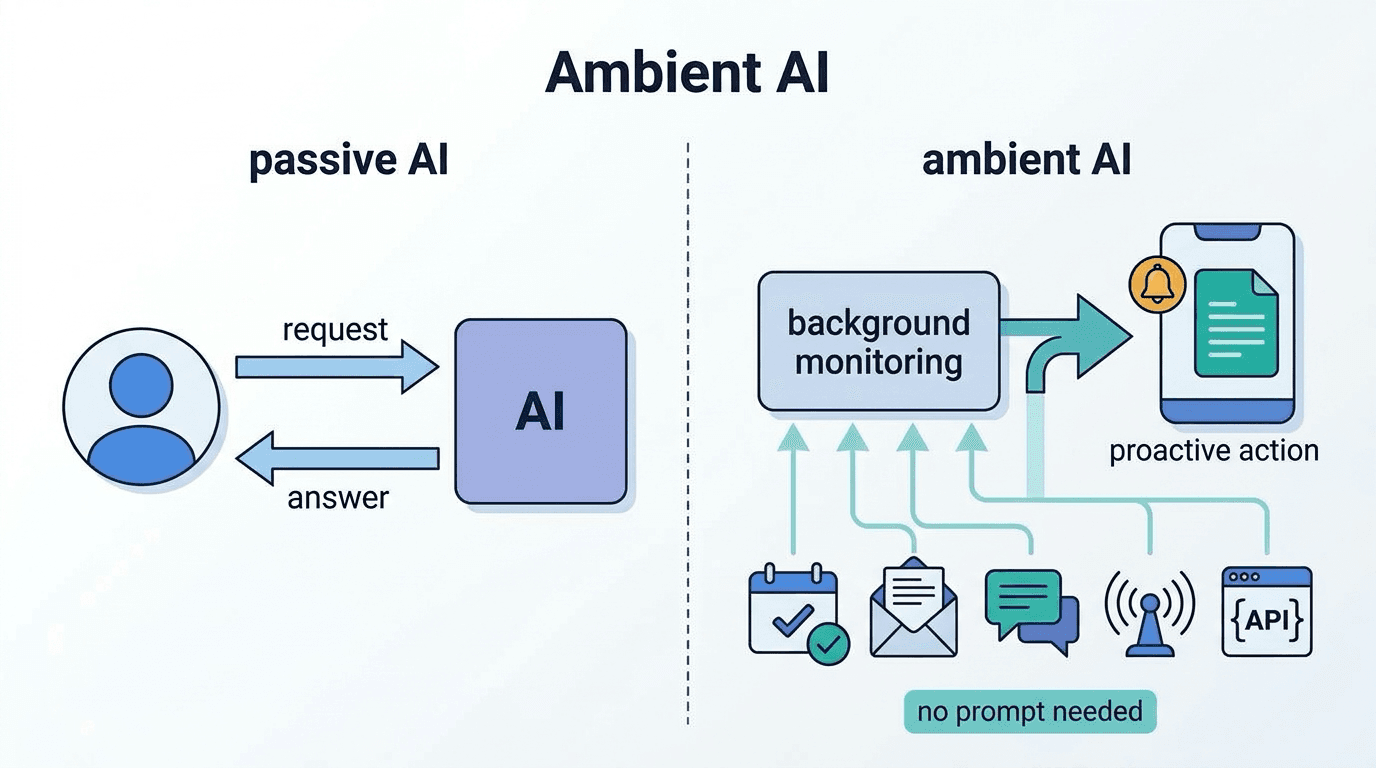
Ambient AI
Ambient AI refers to an AI system that is seamlessly embedded in the user's environment, continuousl
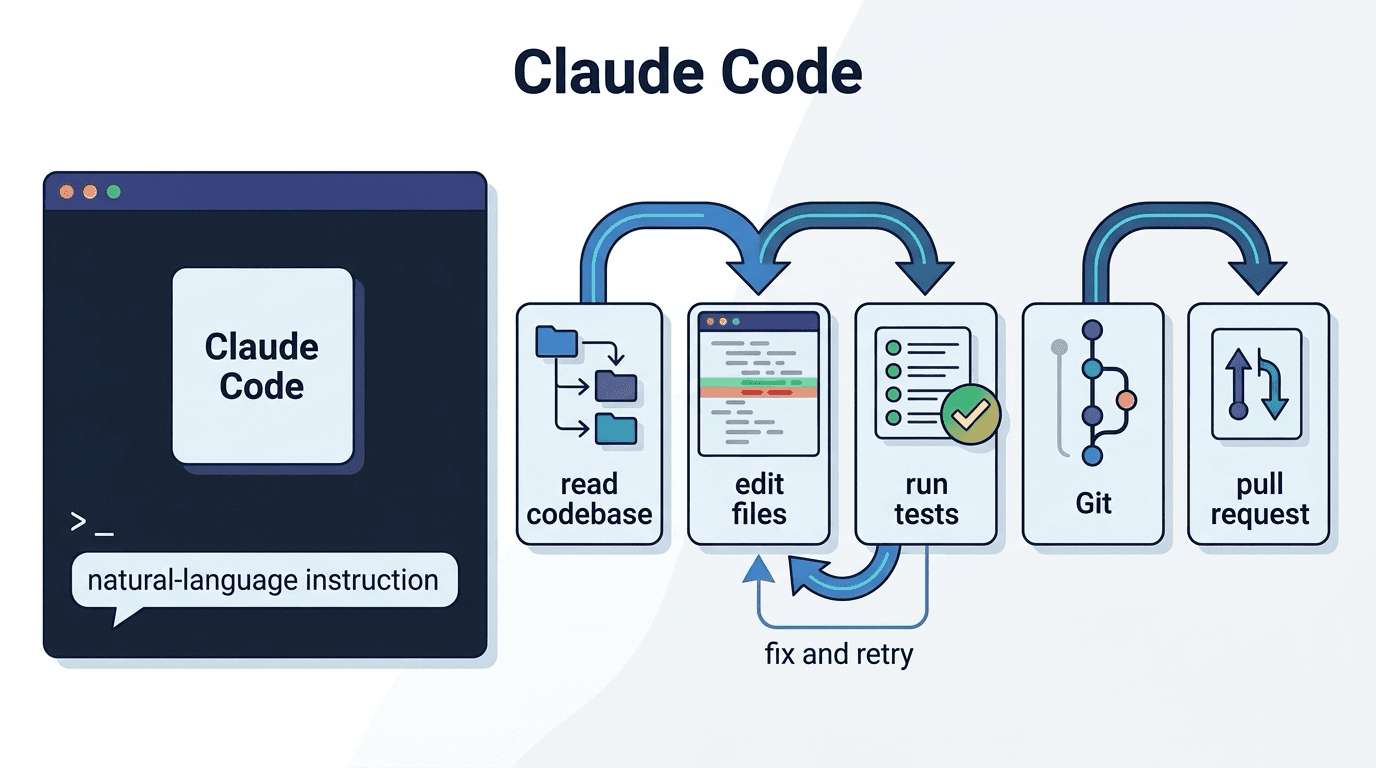
Claude Code
Claude Code is a terminal-resident AI coding agent developed by Anthropic. It is a CLI tool that ena
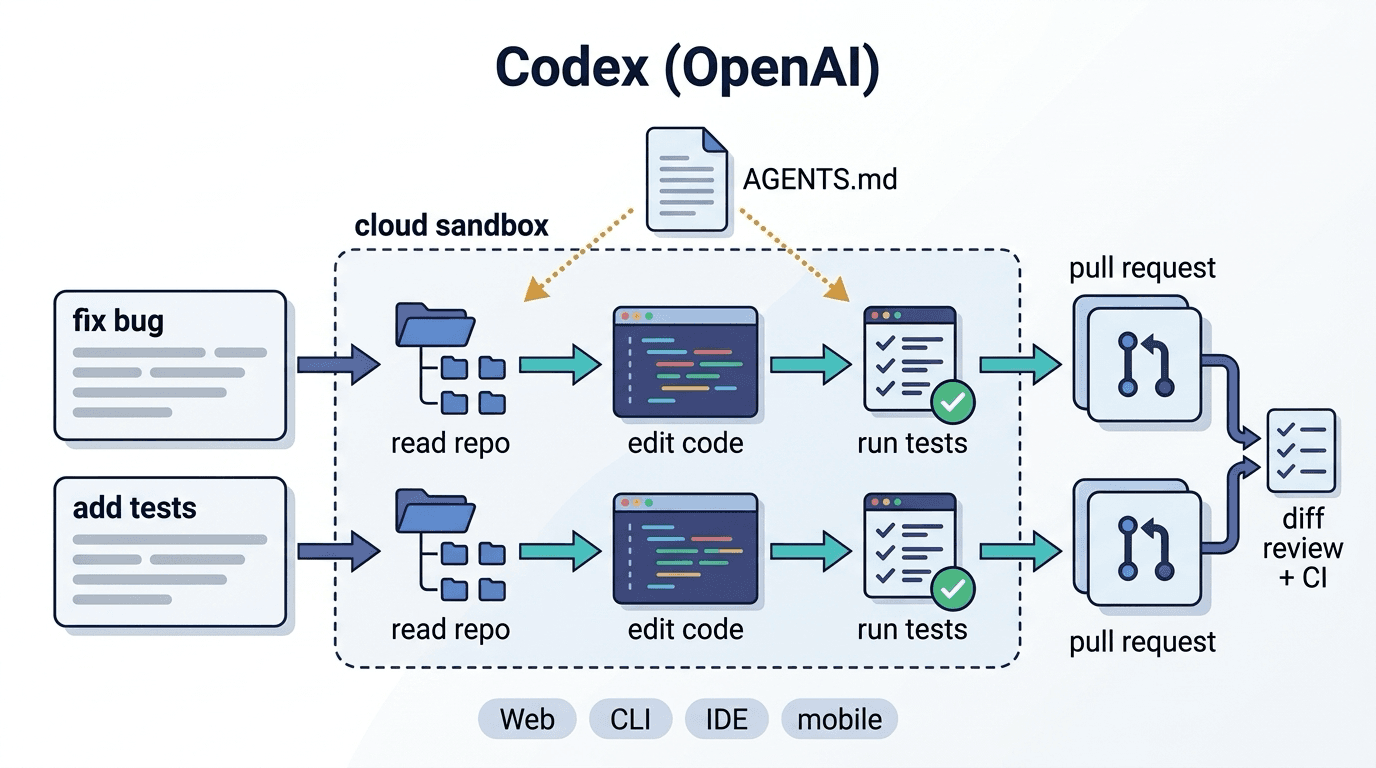
Codex (OpenAI)
Codex is OpenAI's AI coding agent. It reads a repository and carries a task through implementation,
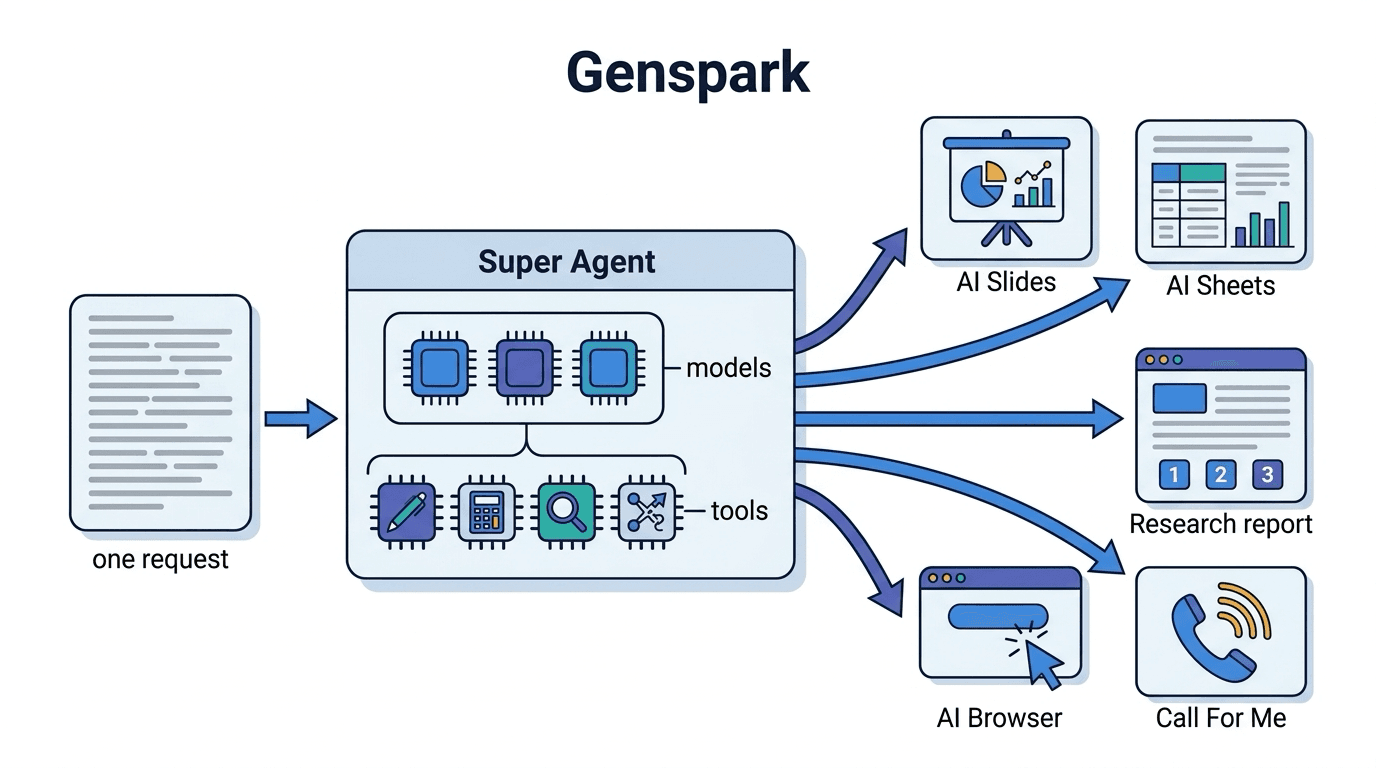
Genspark
Genspark is an AI workspace in which AI agents take on research, slide and spreadsheet creation, and