Offshore Development
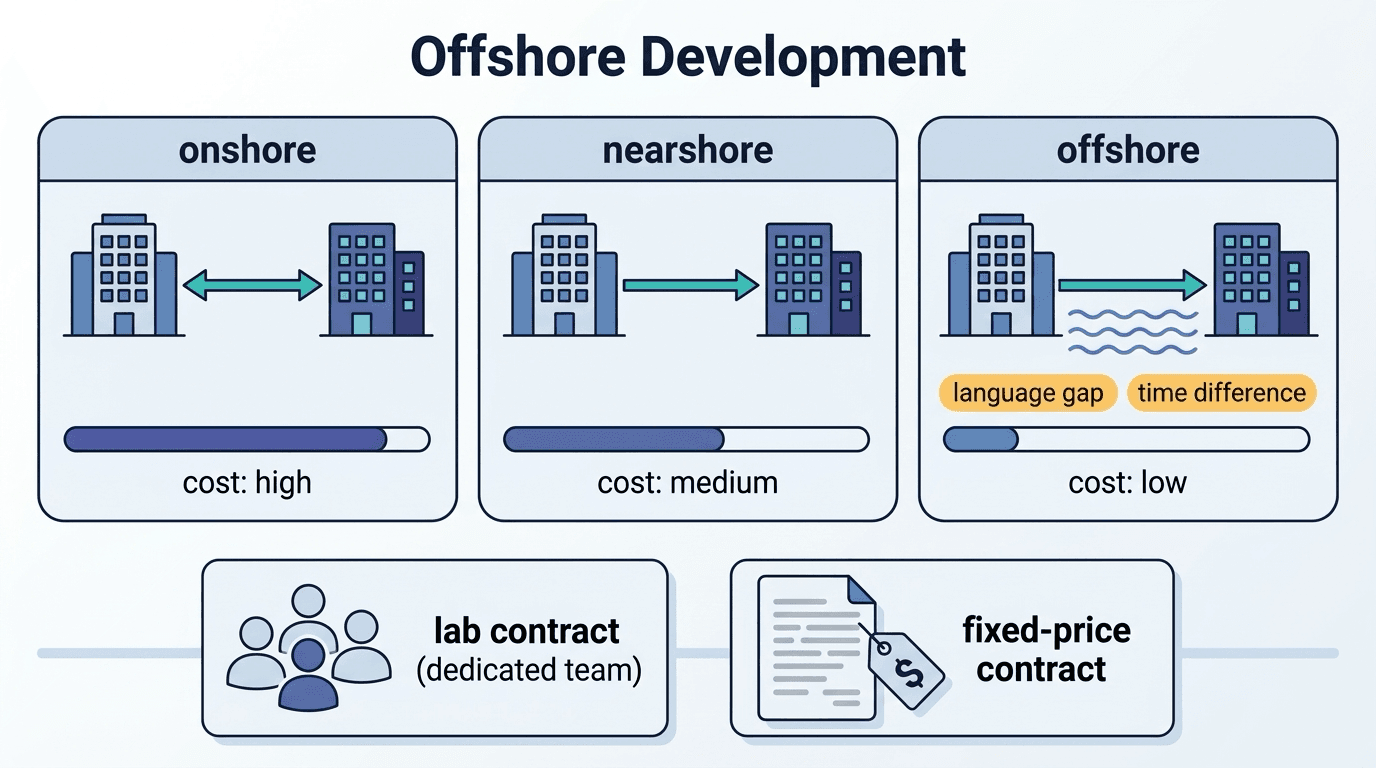
Offshore development is the practice of contracting software and system development to companies or your own subsidiaries overseas, mainly to lower labor costs and to secure engineers who are hard to hire at home.
Offshore development is the practice of contracting software or system development to development companies or your own subsidiaries in other countries. The two main goals are lowering costs by working with engineers in countries with lower labor costs, and securing headcount or skills that are hard to hire at home. "Offshore" literally means "away from the shore," and here it simply describes where the development team is located.
Onshore, nearshore, and offshore
The name changes with the location of the team you contract.
| Model | Where the team is | Cost | Communication |
|---|---|---|---|
| Onshore | A company in your own country | High | Same language and working hours |
| Nearshore | A company in a neighboring country | Medium | Similar time zone, but language and working style may differ |
| Offshore | A company or subsidiary in a distant country | Low (depends on country and role) | Needs deliberate effort on language, time difference, and business culture |
In Japan, "nearshore" usually means outsourcing to regional cities within Japan rather than to a neighboring country, so the word means something different when you work with Japanese clients.
Advantages and disadvantages
Advantages
- Lower cost: For countries and roles with lower rates, many companies pay 30–50% less than for engineers with the same skills in a high-cost market such as Japan
- Easier hiring: You can fill headcount and skills that are scarce at home (mobile, cloud, AI, and so on) with engineers abroad
- Flexible team size: With a dedicated team, it is easy to scale up or down as the workload changes
Disadvantages
- Communication cost: Beyond language, teams differ in how specifications are written and how much must be spelled out, which leads to rework
- Costs that are not in the rate: A bridge engineer (the person who links your side with the development team), your own management time, and travel are billed or spent separately
- Quality and data protection: Without acceptance criteria and a review process, quality varies. Because source code and customer data are handled abroad, access rights and contracts need careful design
Contract models: dedicated team vs. fixed-price project
| Item | Dedicated team (lab model) | Fixed-price project |
|---|---|---|
| How cost is set | Monthly rate × headcount | Total price per deliverable |
| Specification changes | Flexible within the contract period | Each change needs a new estimate |
| Best for | Continuous improvement, new products with unsettled specs | Work with fixed specs and acceptance criteria |
| Client's workload | Stays involved in prioritization and reviews | Focuses on requirements and acceptance |
The dedicated team is usually billed on a time-and-materials basis, while in a fixed-price project the vendor is responsible for delivering a finished result. Which one is cheaper depends on the work, so choose by project length and how likely the specifications are to change.
Main destinations and typical rates
Typical monthly rates per person quoted to Japanese clients are as follows.
| Country | Time difference from Japan | Programmer / junior | Senior engineer | PM / tech lead |
|---|---|---|---|---|
| Vietnam | 2 hours | ¥350,000–400,000 | ¥450,000–550,000 | ¥600,000–720,000 |
| Philippines | 1 hour | ¥300,000–370,000 | ¥400,000–500,000 | ¥550,000–640,000 |
| India | 3.5 hours | ¥300,000–380,000 | ¥400,000–500,000 | ¥550,000–680,000 |
| Thailand | 2 hours | ¥270,000–370,000 | ¥450,000–600,000 | ¥550,000–750,000 |
※ General market rates as of March 2026. They vary by company size, skills, and contract type. A separate bridge engineer adds roughly ¥500,000–700,000 per month.
Vietnam has many Japanese-speaking engineers, but rising rates have almost closed the gap with Thailand. The Philippines has the smallest time difference from Japan and strong English. India has a very deep IT talent pool, but very few Japanese speakers and a larger time difference. For a comparison of quality and risk by country and detailed costs in Thailand, see our offshore development comparison of Thailand, Vietnam, the Philippines, and India.
How to think about cost
Compare quotes by total cost, not by the monthly rate.
Total cost = rate × headcount × duration + bridge engineer + your management time + rework + travel and tools
Even if you pick a low-rate country, the total can end up close to what you would pay at home if you add a separate bridge engineer and keep rebuilding features because the specifications were misunderstood. When you request a quote, ask whether the bridge engineer is included, how many hours per month your side is expected to spend, and who runs acceptance testing.
How to get started
- Set the goal and scope: Decide what to build and what stays in-house (requirements, acceptance, customer contact, and so on)
- Choose a vendor: Check track record, engineer retention, communication in a shared language, and security, then agree on a 1–2 month trial period
- Write down requirements and acceptance criteria: Describe the screens, APIs, and data, and what counts as done. Defining the conditions for acceptance testing up front reduces rework
- Start small: Test the way of working on a PoC or MVP-sized scope before adding people
- Make meetings and handovers routine: Use weekly reviews, code review, and automated tests to make quality visible, and use knowledge transfer to move knowledge in both directions
Common failures and how to avoid them
- Choosing on rate alone: A quote below half the market rate may mean a junior-only team or subcontracting. Ask for the team structure and the profiles of the people assigned
- Passing on specifications verbally: Record every decision in documents and tickets
- Relying on a single bridge engineer: If that person leaves, work stops. Share specifications and review records so several people can follow the status
- Not keeping design documents and tests: Switching vendors then costs almost as much as rebuilding. Make design documents and tests part of the deliverables
- Leaving data protection for later: Keep access to production data to the minimum, check the laws of each country involved when personal data is handled (such as Thailand's PDPA), and state in the contract which AI tools may be used to prevent shadow AI, where the vendor uses generative AI without approval
We cover quality management step by step in quality management for offshore development teams. We offer a dedicated-team model called Laboshare, in which senior engineers in Thailand handle design and review while engineers in Laos handle implementation and testing. You can start with one person for one month.
FAQ
- Q.How much does offshore development cost?
- A.Monthly rates per person quoted to Japanese clients in Vietnam, the Philippines, India, and Thailand are roughly ¥270,000–400,000 for programmers, ¥400,000–600,000 for senior engineers, and ¥550,000–750,000 for project managers. A separate bridge engineer adds about ¥500,000–700,000 per month, so compare vendors by total cost.
- Q.Should I choose offshore or nearshore development?
- A.Offshore suits you if you want the lowest cost or need headcount and skills that are hard to find at home. Nearshore suits you if you want to avoid language and time-zone friction. For work whose specifications change often, what matters most in either case is whether your side can stay involved every week.
- Q.Can small projects be outsourced offshore?
- A.Yes. With a dedicated team you can start with one or two engineers and add people once the way of working is settled. Start with a PoC or a small feature during a trial period, and check quality and communication before handing over larger work.
Articles covering this term
- What Is Thailand-Laos Hybrid Offshore Development? | Balancing Quality and Cost Revealed Through a 4-Country Comparison [2026 Edition]Hybrid offshore development combining Thailand's design expertise and Laos' implementation power. Compare costs, quality & risks vs Vietnam, Philippines & India. Plans from ¥157,000/month.
- Offshore Development Team Quality Management: Practical Approaches to Bridging Communication GapsDiscover the causes of communication gaps in offshore development quality management and practical solutions—covering information sharing, progress tracking, and quality standards.
- Preventing Knowledge Leakage and Establishing a Phased Skill Transfer Process in Offshore DevelopmentWe explain concrete processes and organizational structures to prevent knowledge loss from offshore development team turnover and achieve phased skill transfer beyond language and cultural barriers.
- **Offshore Development Team AI Skill Acquisition: Bridging Learning Gaps When Adopting the Latest Models and Frameworks**
![What Is Thailand-Laos Hybrid Offshore Development? | Balancing Quality and Cost Revealed Through a 4-Country Comparison [2026 Edition]](/_next/image?url=https%3A%2F%2Fxlawjotwdonvcisfgnkc.supabase.co%2Fstorage%2Fv1%2Fobject%2Fpublic%2Farticle-images%2Farticles%2F19%2Fcover-en.png%3Ft%3D1774676523788&w=3840&q=75)


Related Terms
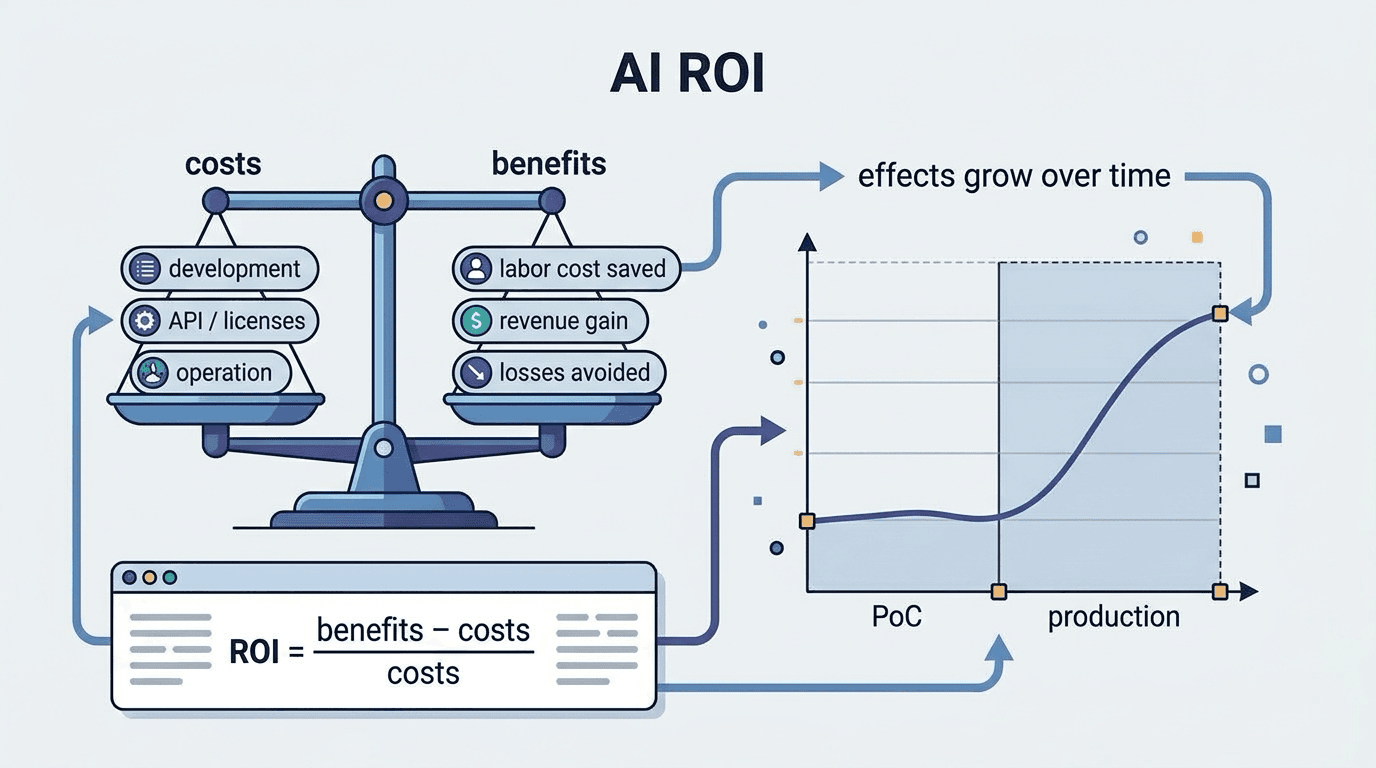
AI ROI (Return on Investment in AI)
AI ROI is a metric that quantitatively measures the effects obtained — such as operational efficienc

AI Observability
An operational practice of continuously monitoring and visualizing the inputs/outputs, latency, cost
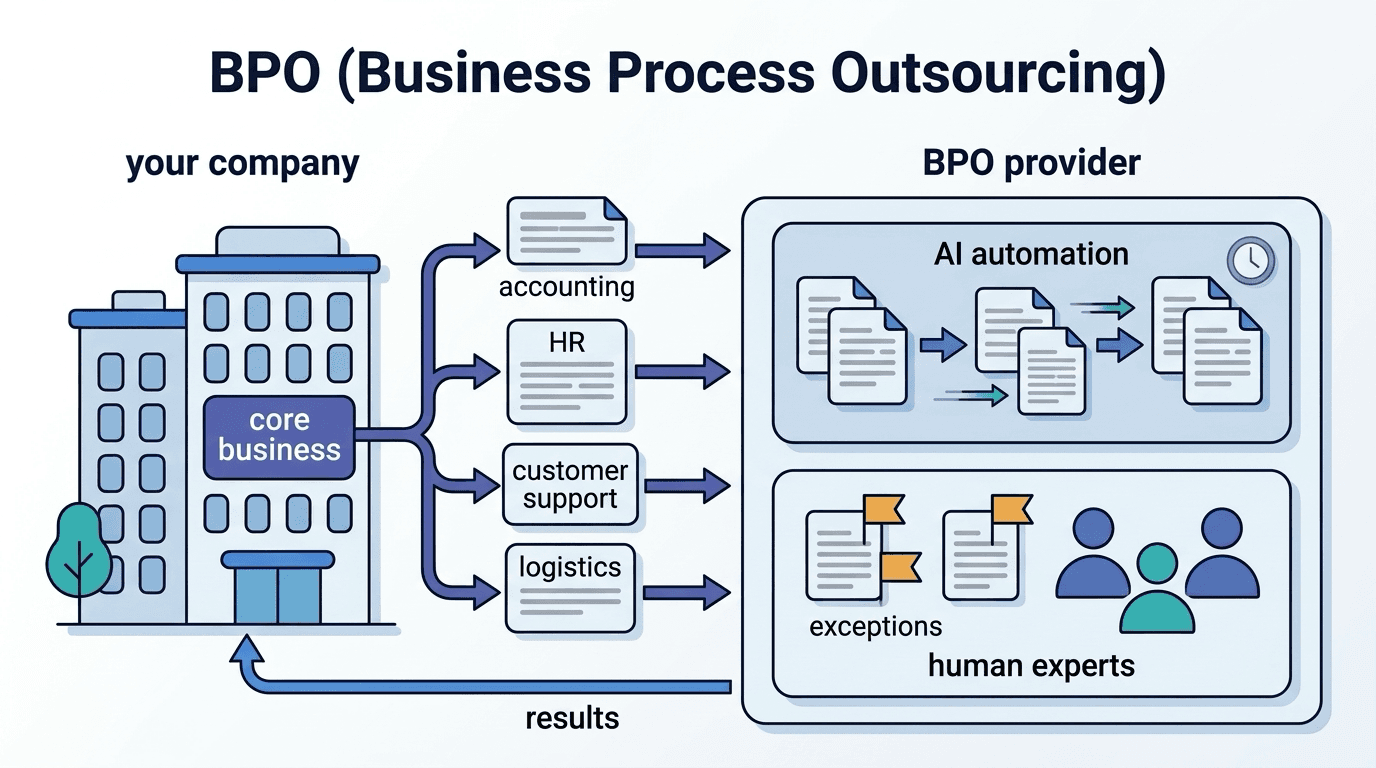
BPO (Business Process Outsourcing)
BPO refers to a form of outsourcing in which a company delegates specific business processes to an e

Demand Forecasting AI
Demand forecasting AI refers to a system that analyzes historical sales data and external factors us