AES-256
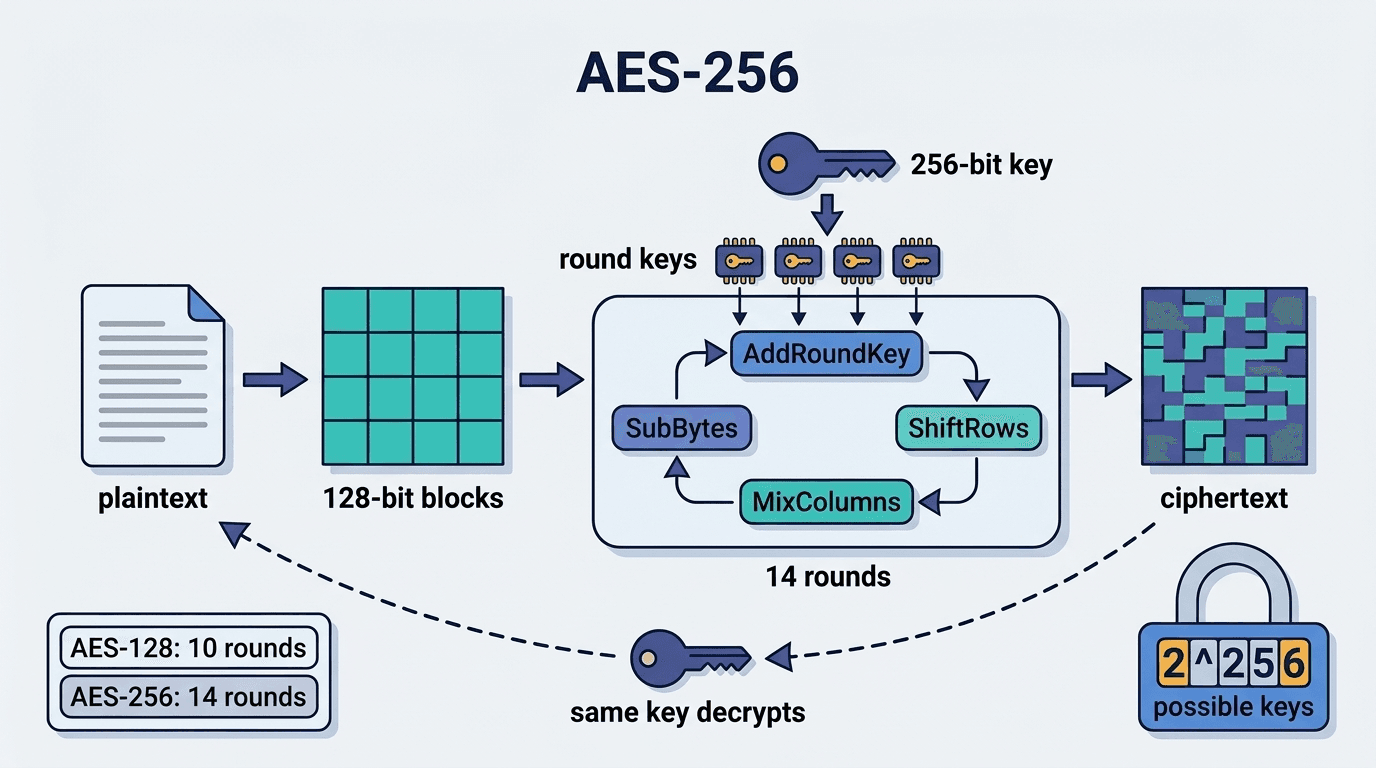
AES-256 is the highest-strength encryption algorithm using a 256-bit key length within AES (Advanced Encryption Standard), a symmetric-key cryptographic scheme standardized by the National Institute of Standards and Technology (NIST).
Positioning in Cryptography
AES (Advanced Encryption Standard) is a block cipher adopted by NIST in 2001 as a Federal Information Processing Standard (FIPS 197). It uses a fixed block length of 128 bits and supports three key lengths: 128, 192, and 256 bits. Among these, AES-256 has the longest key length, requiring 2^{256} attempts for a theoretical brute-force search, making it considered secure for the foreseeable future even against the threat of quantum computers.
It is frequently adopted to protect data where "the impact of a breach would be extremely severe," such as financial institution account data, medical records, and government classified information. AWS S3 server-side encryption (SSE-S3) and Apple's iMessage also use AES-256 by default.
An Intuitive Understanding of How It Works
AES-256 divides plaintext into 128-bit (16-byte) blocks and applies 14 rounds of transformations to each block. Each round combines four operations: byte substitution (SubBytes), row shifting (ShiftRows), column mixing (MixColumns), and round key addition (AddRoundKey). With a 128-bit key, 10 rounds are applied; with a 256-bit key, 14 rounds are applied—the increased number of rounds enhances the cipher's diffusion effect.
When I first started studying cryptography, I assumed "more rounds = slower," but modern CPUs feature hardware acceleration via the AES-NI instruction set, delivering speeds several to more than ten times faster than software implementations. In practice, performance is rarely an issue.
Choosing Between AES-128 and AES-256
From a security standpoint, AES-128 currently provides sufficient strength as well. The choice between the two is often determined by "regulatory requirements" and "future threat models."
- When to choose AES-256: When regulations such as PCI DSS or HIPAA explicitly require 256-bit encryption, or for long-term data storage with an eye toward the quantum computing era
- When AES-128 is sufficient: Temporary encryption of communications (such as TLS session keys) or real-time processing where latency is critically important
It is worth noting that even with a 256-bit key length, poor key management renders it meaningless. In practice, the storage and rotation of keys tends to pose a greater operational risk than the strength of the cryptographic algorithm itself.
Applications in AI and Cloud
In LLM inference APIs, user prompts and responses are encrypted in transit. It is common for AES-256-GCM to be used as the shared key agreed upon during the TLS 1.3 handshake, and the same algorithm is typically adopted for encryption at rest. When data is isolated per tenant under a privacy-by-isolation design philosophy, AES-256 is also standardly used for storage-layer encryption.
Edge AI devices have limited computational resources; however, the number of SoCs with hardware support equivalent to the aforementioned AES-NI is increasing, and the overhead of AES-256 is becoming acceptable even in embedded environments.
Articles covering this term

Related Terms

Deepfake
Deepfake is a technology that uses deep learning to realistically manipulate and synthesize a person

Mesh VPN (Mesh VPN)
Mesh VPN is a VPN architecture in which each node communicates directly with encrypted connections w

Shadow AI
Shadow AI refers to the collective term for AI tools and services used by employees in their work wi

Zero Trust Network Access (ZTNA)
Zero Trust Network Access is a security model that continuously verifies users and devices, controll