OWASP
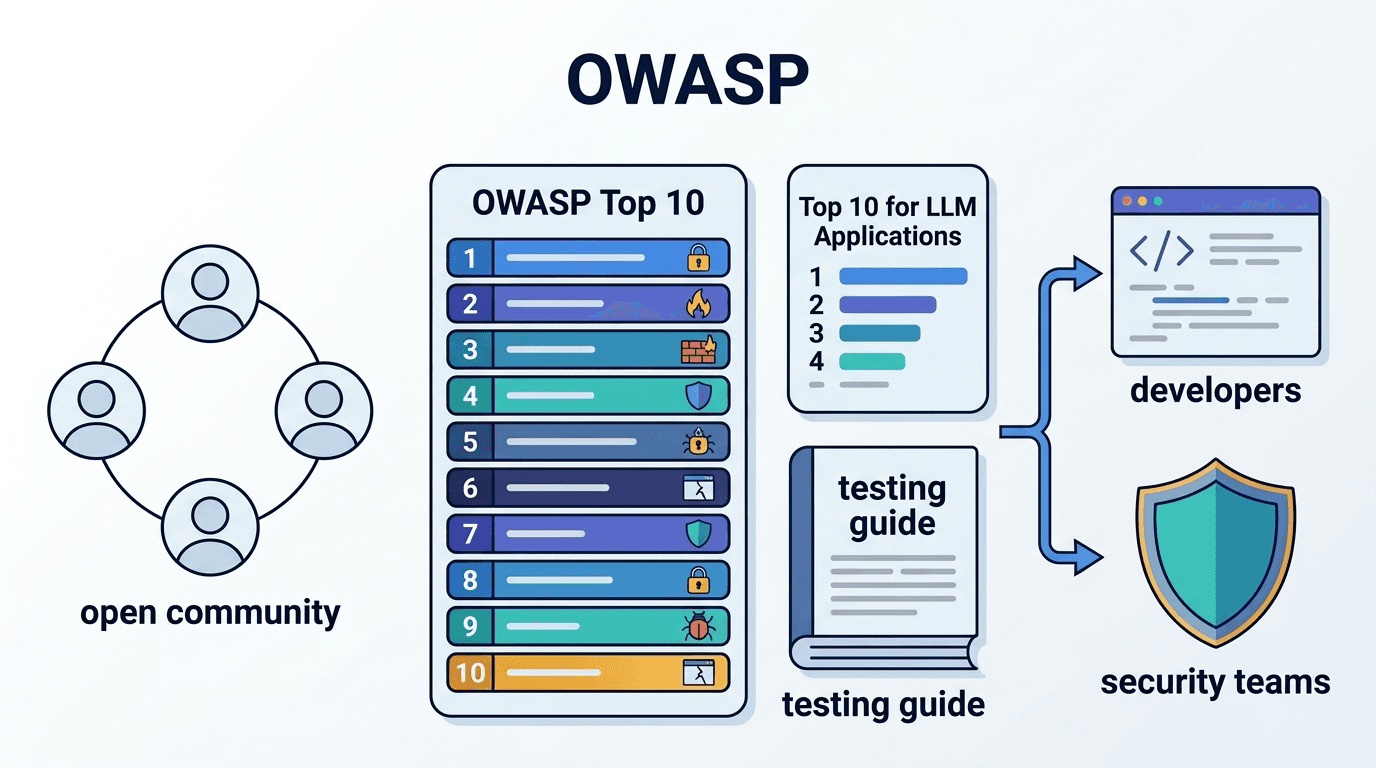
OWASP (Open Worldwide Application Security Project) is an open community project dedicated to improving software security, widely known for its vulnerability risk ranking "OWASP Top 10."
If you have worked in web application security, you have likely encountered the OWASP Top 10. It systematizes vulnerability patterns that developers repeatedly fall into—SQL injection, XSS, authentication flaws—and publishes them as risks to prioritize.
OWASP itself is not a specific tool or vendor but a nonprofit project run by security experts worldwide on a volunteer basis. Beyond the Top 10, it publishes numerous projects including the OWASP Testing Guide, vulnerability assessment methodology (ASVS), and security integration into the development lifecycle (SAMM).
With the spread of generative AI, the OWASP Top 10 for LLM Applications was published. It organizes LLM-specific risks into 10 items, including prompt injection, sensitive information disclosure, and excessive permissions. Unlike traditional web security, inputs are natural language, making attacks that conventional validation cannot prevent a distinctive characteristic.
In the DevSecOps context, integrating OWASP guidelines into CI/CD pipelines to detect vulnerabilities early in the development cycle has become common practice.
Articles covering this term
- 【2026】Latest Trends in AI CybersecurityAs AI adoption accelerates, risks surge from AI-powered attacks and attacks on AI itself. Explore deepfakes, prompt injection, Shadow AI threats, and 3-layer defenses covering technology, operations, and governance.
- Claude Mythos and Project Glasswing — How Companies Should Prepare for the Era When AI Uncovers Long-Dormant BugsAnthropic's Claude Mythos Preview & Project Glasswing redefine AI-driven vulnerability discovery. From OpenBSD's 27-yr bug to FreeBSD CVE-2026-4747—5 DevSecOps actions you can take now.
- What is AI Red Teaming? A Practical Guide to Finding LLM VulnerabilitiesLearn about AI red teaming: methods, tools & techniques to systematically uncover LLM vulnerabilities like prompt injection & jailbreaking for safer AI operations.
- AI Guardrails Implementation Guide — How to Design Safety Barriers for LLM ApplicationsProtect LLM apps from prompt injection & hallucinations. Learn guardrail design basics, input/output guards, evaluation, and multi-tenant operations from an implementation perspective.


Related Terms

Deepfake
Deepfake is a technology that uses deep learning to realistically manipulate and synthesize a person

Mesh VPN (Mesh VPN)
Mesh VPN is a VPN architecture in which each node communicates directly with encrypted connections w

Shadow AI
Shadow AI refers to the collective term for AI tools and services used by employees in their work wi

Zero Trust Network Access (ZTNA)
Zero Trust Network Access is a security model that continuously verifies users and devices, controll