Process Mining
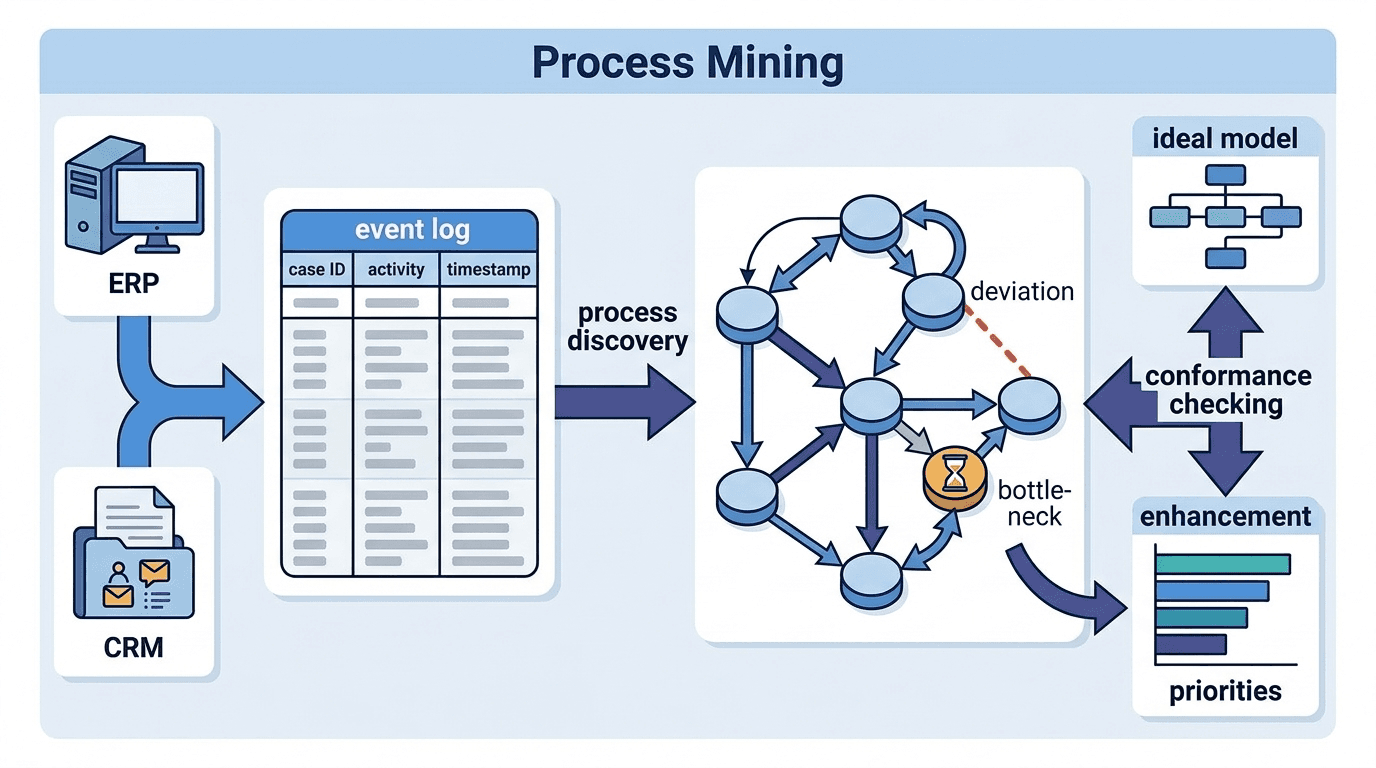
A technique for analyzing event logs from business systems to visualize and improve actual business processes. It automatically detects bottlenecks and deviation patterns, and is used to enhance operational efficiency and strengthen compliance.
Process Mining is a methodology for visualizing, analyzing, and improving actual business processes by analyzing event logs recorded in operational systems. Its defining characteristic is the ability to automatically detect gaps between ideal business flows and reality, and it is applied across a wide range of operational improvement activities—from identifying bottlenecks to detecting compliance violations.
Why Process Mining Is Attracting Attention Now
In traditional process improvement, it was common practice to create process maps based on interviews with staff and manual observation. However, this approach had structural limitations: it was prone to subjective bias from those involved, could only capture samples from specific time periods, and carried high investigation costs.
As operational systems such as [ERP (Enterprise Resource Planning)](slug: enterprise-resource-planning) and CRM became widespread across organizations, day-to-day operational actions began to be automatically accumulated as event logs. Process Mining leverages this log data as "evidence" to reveal the true state of operations without human intervention. In recent years, integration with [Generative AI](slug: generative-ai) has further advanced anomaly detection accuracy and the automation of improvement recommendations.
Three Core Functions
Process Mining is broadly composed of the following functions:
- Process Discovery: Automatically generates a process model from event logs and renders a flowchart of actual operations
- Conformance Checking: Compares the ideal state (reference model) against actual logs to detect deviations and violations
- Enhancement: Overlays performance metrics and frequency data onto existing process models to visualize improvement priorities
Conformance Checking in particular is growing in importance in the context of [AI Governance](slug: ai-governance) and compliance management. In regulated industries such as finance, healthcare, and manufacturing, it is increasingly being adopted as a mechanism for continuously monitoring process deviations.
Key Business Domains of Application
The scope of Process Mining applications is broad. It can be applied to any operation where event logs exist—including optimization of procurement and order management processes, verification of operational quality with [BPO (Business Process Outsourcing)](slug: business-process-outsourcing) partners, and measurement of the effectiveness of Onboarding Automation.
In the context of [Smart Factory](slug: smart-factory), it is used to analyze production line operation logs to visualize wait times and rework at each process stage, and to improve equipment utilization rates in conjunction with [Predictive Maintenance](slug: predictive-maintenance).
It also merits attention from an [AI ROI (Return on Investment)](slug: ai-roi) perspective. Because the effects of operational improvements can be readily quantified by linking them to KPIs (Key Performance Indicators), organizations can maintain accountability to management while sustaining a continuous improvement cycle.
Key Challenges to Address During Implementation
The effectiveness of Process Mining depends heavily on the quality of event logs. In situations where timestamp accuracy is low, Case IDs are not standardized, or logs are distributed across multiple systems, it is not possible to generate accurate process models. A data quality assessment and review of log design prior to implementation are essential.
Furthermore, actually taking improvement actions in response to visualized bottlenecks requires organizational consensus-building and change management. It is important never to forget that Process Mining is ultimately a tool for "presenting facts," and that it is people and organizations who carry out the improvements. Combining it with the [HITL (Human-in-the-Loop)](slug: hitl) approach—designing systems that appropriately connect analytical results to human judgment and decision-making—is the key to generating long-term outcomes.
Articles covering this term

Related Terms
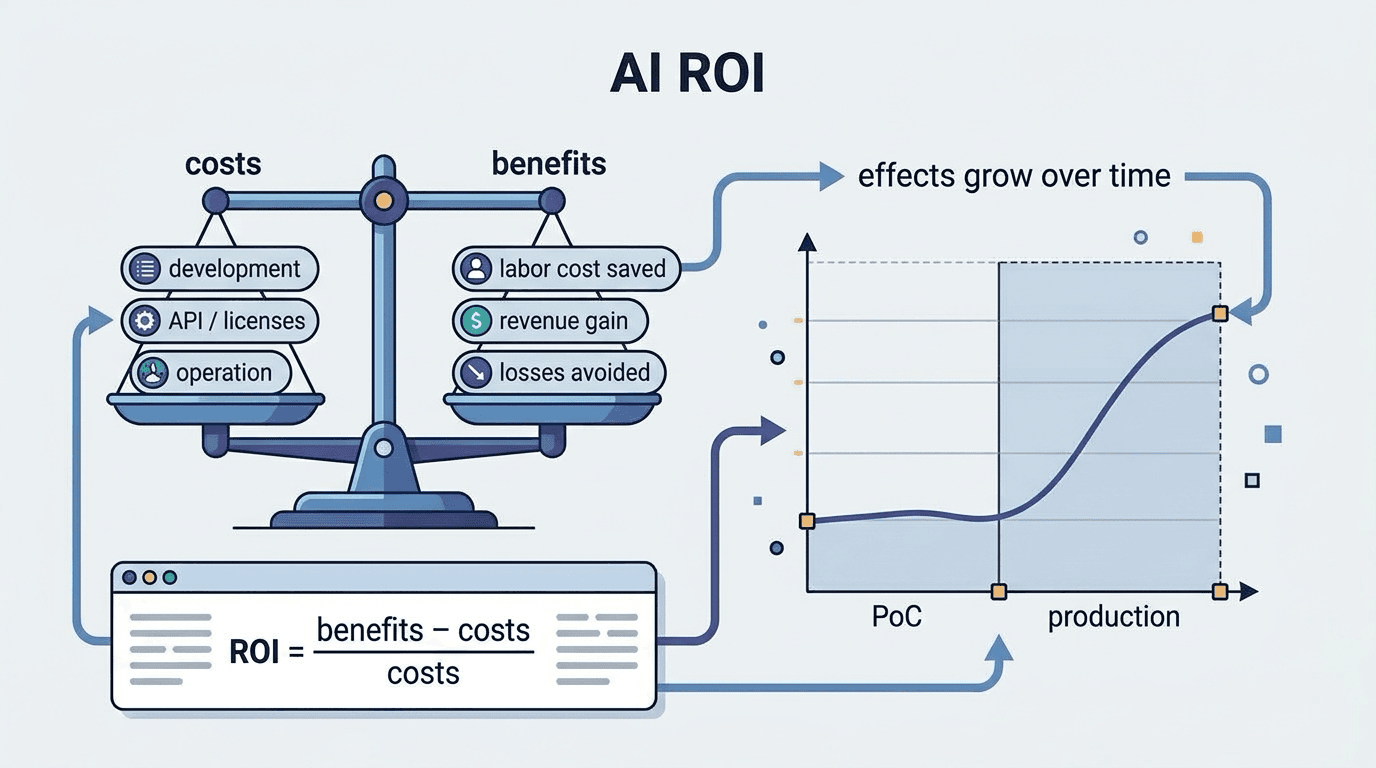
AI ROI (Return on Investment in AI)
AI ROI is a metric that quantitatively measures the effects obtained — such as operational efficienc

AI Observability
An operational practice of continuously monitoring and visualizing the inputs/outputs, latency, cost
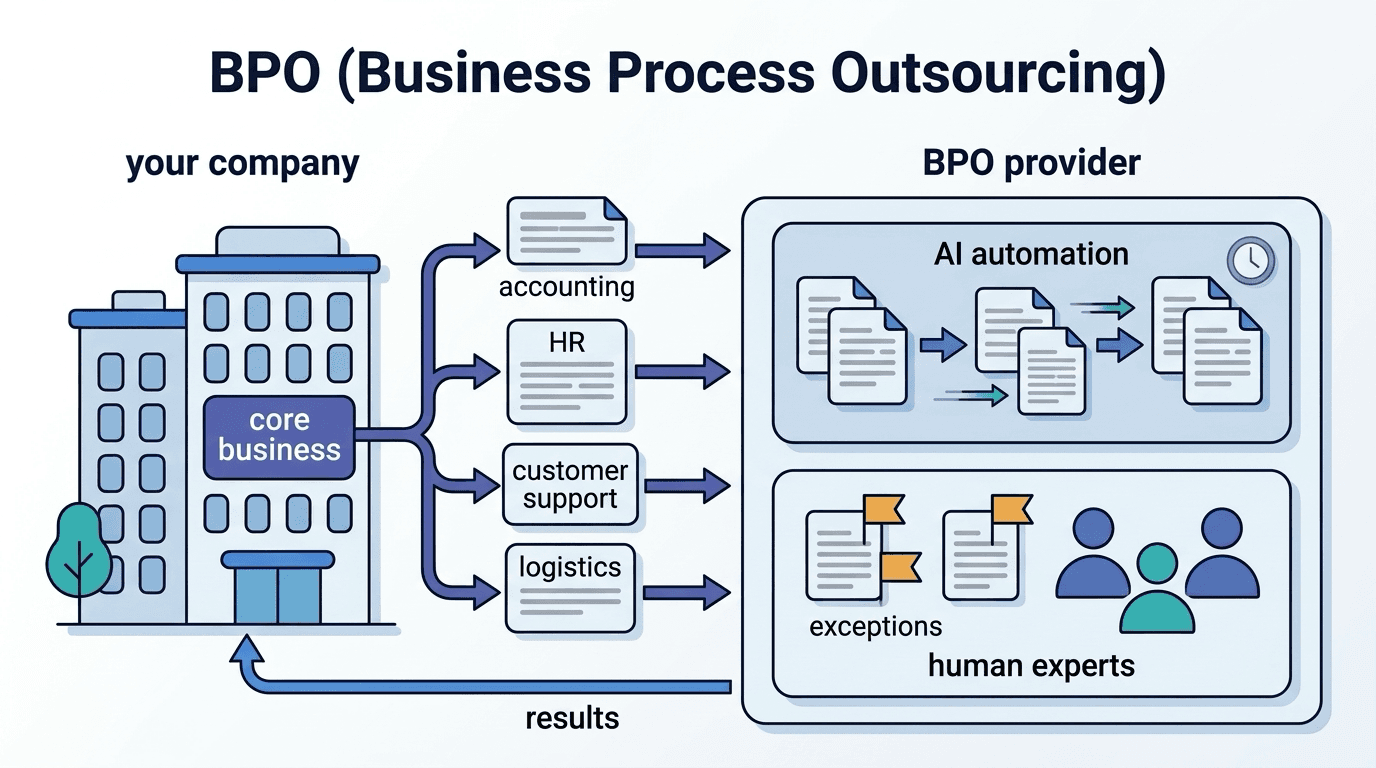
BPO (Business Process Outsourcing)
BPO refers to a form of outsourcing in which a company delegates specific business processes to an e

Demand Forecasting AI
Demand forecasting AI refers to a system that analyzes historical sales data and external factors us