Mesh VPN (Mesh VPN)

Mesh VPN is a VPN architecture in which each node communicates directly with encrypted connections without going through a central gateway. Exemplified by Tailscale, it is used for remote access based on zero-trust principles and secure site-to-site connectivity for offshore development teams.
Mesh VPN
A Mesh VPN is a VPN architecture in which each node communicates directly with others using encryption, without routing traffic through a central gateway. While traditional star-topology VPNs route all traffic through a single aggregation point, a Mesh VPN treats each device or server as a peer node that connects directly to others in a peer-to-peer fashion. This structure eliminates the bottlenecks and single points of failure associated with a central server.
How It Works Technically
Most Mesh VPN implementations are built on the WireGuard protocol. Compared to OpenVPN or IPSec, WireGuard has a smaller codebase, faster handshakes, and handles roaming in mobile environments more gracefully. Each node holds a public/private key pair, and only authorized peers can establish encrypted tunnels with one another.
In terms of authentication and routing, the control plane and data plane are clearly separated. The control plane (e.g., Tailscale's coordination server) handles key distribution and access policy management, while actual data flows directly between peers. Even if the control plane goes down temporarily, existing connections are maintained, resulting in high availability.
Regarding encryption strength, modern cipher suites such as ChaCha20-Poly1305 — adopted by WireGuard — provide robust protection against eavesdropping and tampering on the communication path.
Affinity with Zero Trust
Mesh VPN aligns closely with the principles of Zero Trust Network Access (ZTNA). Traditional VPNs were based on a perimeter defense model — "if you're inside, you can be trusted" — whereas Mesh VPN verifies the identity of each individual node and controls access according to the principle of least privilege. Every device joining the network must pass authentication, and even if one node is compromised, lateral movement can be suppressed.
Key Use Cases
Inter-site connectivity for offshore development teams is a representative example. In offshore development, engineers at a Japanese headquarters and multiple overseas locations such as Vietnam and Thailand need to share the same development environment. By connecting each site's servers and developer workstations via Mesh VPN, geographically distributed teams can access internal resources securely and with low latency.
- Remote access: Employees working from home connect directly to the corporate data center or local LLM inference servers
- Multi-cloud connectivity: Inter-service communication spanning AWS, GCP, and Azure is unified through an overlay network
- IoT and edge device management: Distributed node groups including edge AI devices are managed under a unified policy
- CI/CD pipeline protection: In a DevSecOps context, build agents and production environments are securely isolated from each other
Considerations for Deployment
While Mesh VPN is straightforward to set up, several operational considerations must be kept in mind.
First, there is the management overhead that grows with the number of nodes. When the number of peers is N, up to N×(N-1)/2 connection paths can theoretically exist. Without careful design of Access Control Lists (ACLs), unintended communication paths may emerge. Similar to Shadow AI, the proliferation of rogue nodes that were adopted simply because they were convenient warrants close attention.
Second, dependency on the control plane should not be overlooked. When using a managed service such as Tailscale, a dependency on an external service is introduced. This risk can be mitigated by self-hosting the open-source implementation Headscale, though doing so increases operational burden.
Furthermore, when considered against PDPA (Thailand's Personal Data Protection Act) and other national data protection regulations, routing design — specifically which region's servers traffic passes through — may have direct legal compliance implications. For globally distributed teams, it is advisable to confirm in advance where the control plane's data is physically located.
In recent years, as AI agent architectures — in which AI agents autonomously access APIs and data sources — become more widespread, the need to secure agent communication paths over a Mesh VPN is also growing. In an era where the boundaries between infrastructure and security are becoming increasingly blurred, Mesh VPN is emerging as a compelling option for implementing the principle that "only authenticated nodes, from anywhere, can connect securely."
Articles covering this term

Related Terms

Deepfake
Deepfake is a technology that uses deep learning to realistically manipulate and synthesize a person

Shadow AI
Shadow AI refers to the collective term for AI tools and services used by employees in their work wi

Zero Trust Network Access (ZTNA)
Zero Trust Network Access is a security model that continuously verifies users and devices, controll
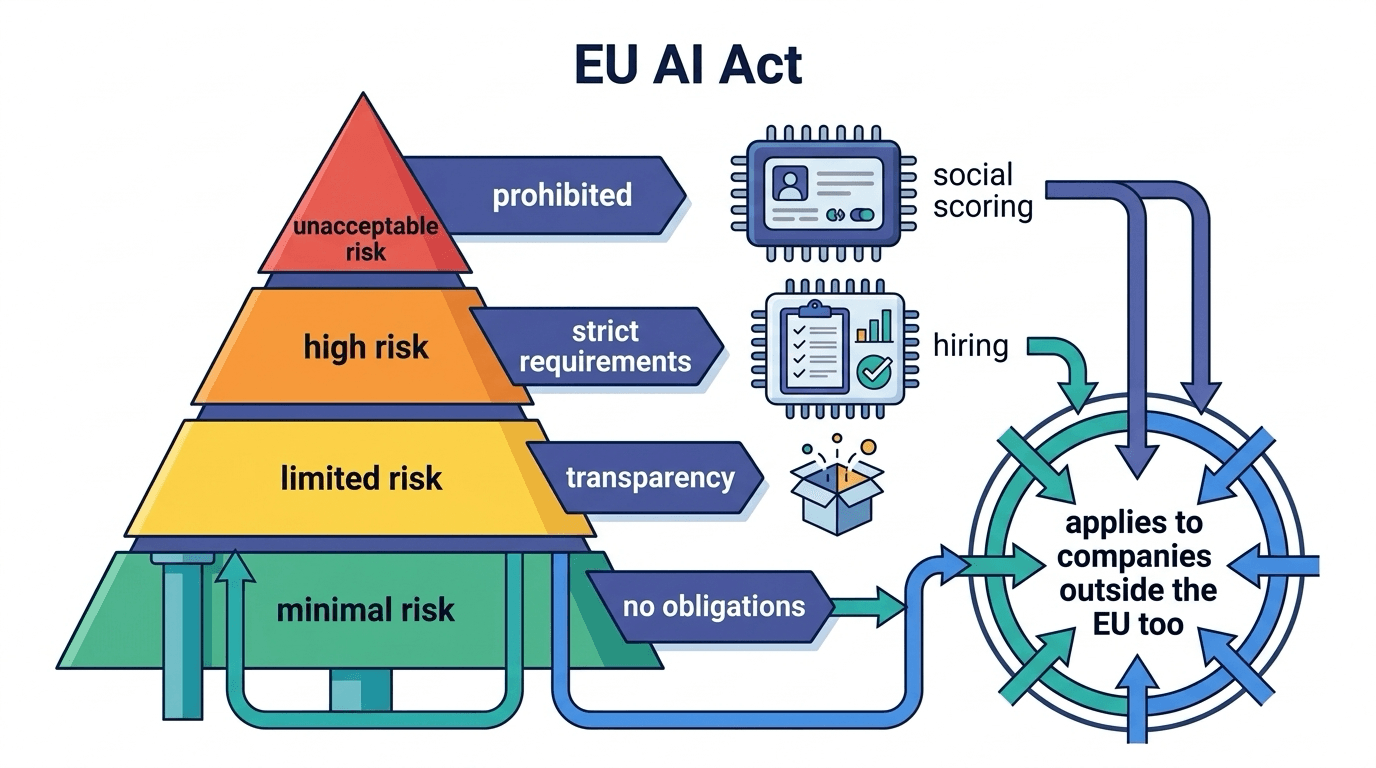
EU AI Act (EU Artificial Intelligence Act)
The EU AI Act (EU Artificial Intelligence Act) is a comprehensive European Union regulation that est