What is AI Grounding? An Implementation Guide to Fact Verification and Improving LLM Answer Accuracy with Web Search

Lead
AI Grounding refers to a set of techniques for substantiating LLM-generated responses with reliable external sources and aligning them with facts. When integrating LLMs into business operations, hallucinations (outputs that deviate from facts) become a risk that directly impacts compliance, customer trust, and the quality of decision-making.
In recent years, the conversation has expanded beyond simply "adding RAG" to how grounding should be positioned within higher-level concepts such as context engineering (designing the information passed to LLMs) and harness engineering (designing the execution environment surrounding LLMs).
This article is intended for AI practitioners at B2B companies and LLM product developers. It covers the definition of AI grounding, key patterns such as RAG, web search, and tool execution, the relationship with context/harness engineering, steps for implementing grounding in business systems, and common misconceptions. By the end, readers will be able to determine which type of grounding is appropriate for their own use cases and what should be implemented at each layer—retrieval, evaluation, and harness.
AI Grounding refers broadly to design patterns that "anchor LLM responses to external information sources." It is not a single technology, but a wide-ranging concept that encompasses retrieval, tool execution, and structured data reference—and is also one of the core elements of harness engineering.
Defining Grounding
Grounding is a technique that bases LLM outputs not solely on trained parameters, but on external data retrieved at inference time—such as internal documents, web search results, and API responses from business systems. The term originates from the phrase "ground a model in evidence," and is also the terminology adopted in API documentation by major vendors including Google, OpenAI, and Anthropic.
Implementation patterns vary widely, but they share the following three characteristics:
- Querying external sources at inference time
- Injecting the retrieved content as context into the prompt
- Presenting citations and references alongside the response
Patterns in which the LLM responds using only its trained knowledge—without satisfying these three points—are referred to as "ungrounded" and are more prone to hallucinations.
In recent years, approaches that perform grounding within multi-agent architectures (such as Agentic RAG), rather than with a standalone LLM, have also become widespread. In this approach, agents autonomously construct retrieval strategies and build responses while querying multiple sources. Even with these new patterns, the underlying principle remains the classical grounding concept of "anchoring responses to external information sources."
Relationship to Hallucination
Hallucination is the phenomenon in which an LLM confidently generates content that deviates from facts, and its causes are multiple—including biases in training data, insufficient context, and over-generation. Grounding addresses the "insufficient context" and "lack of authoritative evidence" aspects of this problem.
It is important to note that grounding is not a technique that eliminates hallucinations entirely on its own. If the retrieved documents themselves are incorrect, erroneous responses will still occur; and LLMs can also generate content that contradicts the cited sources (the "citation consistency" problem discussed later).
For this reason, it is common practice to combine grounding with the following complementary techniques:
- Response consistency checks against retrieved documents (a fact-verification layer using LLM-as-a-Judge)
- Response abstention logic based on confidence scores (confidence-based abstention)
- Continuous quality monitoring through an AI observability infrastructure
- Human review (HITL: Human-in-the-Loop)
In other words, grounding is a necessary condition for hallucination suppression, but not a sufficient one. "Harness engineering," covered in the latter part of this article, is an approach that systematically designs the entire LLM execution environment—including these surrounding elements—with grounding positioned as one layer within it.
Why Grounding Matters Now
The reliability of a business LLM is determined by the quality of its grounding implementation. Whether in regulatory compliance, customer interactions, or internal decision-making, responses lacking a factual basis directly translate into business risk.
Risk of Incorrect Responses in Business Use
Unlike consumer-facing chatbots, the answers produced by enterprise LLMs are directly tied to contracts, transactions, HR decisions, technical designs, and more. If an incorrect response is repurposed as-is in an approval document or a customer proposal, correction costs balloon in downstream processes—or, at worst, it becomes a matter of external credibility.
Hallucinations are particularly prone to surfacing in the following areas:
- Interpretation of internal policies and contract clauses
- Reference to customers' past inquiry histories
- Citation of competitor and market data
- Explanation of technical specifications and API response formats
- Interpretation of laws and regulations, and guidance on procedural requirements
What these areas have in common is that they involve "information the LLM likely did not have at training time, or information that changes rapidly." When asked about information not included in its training data, the LLM constructs and returns a plausible-sounding answer from context—meaning that without a grounding layer, incorrect responses can quietly slip through.
What makes this even more problematic is that LLM output tends to be stylistically uniform, with little to no surface indication of uncertainty. Even poorly supported answers come back in fluent prose, making them easy to overlook even in human review. Alongside grounding, there is a need for mechanisms that make answer confidence visible and suppress low-confidence responses.
Regulatory and Compliance Requirements
AI regulation is advancing globally, and comprehensive frameworks such as the EU AI Act in particular require AI systems classified as high-risk to meet standards of "human oversight," "transparency," and "accuracy." Grounding serves as a critical piece in satisfying these requirements at the implementation level.
Specifically, the ways in which grounding contributes in the context of regulatory compliance are as follows:
- Transparency: The documents underlying a response can be presented to users as cited sources
- Traceability: The IDs of documents referenced during inference can be retained in logs
- Correctability: Updating an incorrect source alone is sufficient to rectify the behavior of all related responses
- Audit readiness: It is possible to retrospectively verify when and which sources were referenced
While requirements vary by region and industry—such as Thailand's PDPA, Japan's amended Act on the Protection of Personal Information, and various industry-specific guidelines—the design principle of "grounding LLM responses in evidence" is broadly shared.
Furthermore, within frameworks that integrate trust, risk, and security management—such as Gartner's AI TRiSM (AI Trust, Risk and Security Management)—grounding is positioned as a prerequisite for both "transparency" and "content anomaly detection."
Key Grounding Patterns
Grounding can be divided into three broad categories based on the type of information source. It is rare for any single category to be sufficient on its own; designs that combine them according to the use case are the norm. More recently, approaches such as Agentic RAG—in which the LLM itself autonomously switches between multiple information sources—have also become widespread.
Document Grounding via RAG and Hybrid Search
RAG (Retrieval-Augmented Generation) is a form of grounding that uses static document collections—such as internal documents, knowledge bases, and product manuals—as its information source. A typical flow is as follows:
- Documents are split into chunks, embeddings are generated, and the chunks are stored in a vector database
- The user's question is mapped into the same embedding space to retrieve similar documents
- The retrieved documents are injected into the LLM's prompt to generate a response
Vector search alone often fails to achieve sufficient accuracy, and hybrid search—combining keyword search methods such as BM25 with vector search—along with score integration via RRF (Reciprocal Rank Fusion), is becoming the standard approach.
In addition, new patterns are emerging, such as GraphRAG, which explicitly models relationships between documents, and Agentic RAG, in which an agent decomposes questions and searches iteratively. GraphRAG constructs a document collection as a knowledge graph and builds responses by traversing relationships between entities, making it well-suited for questions that span multiple documents. In Agentic RAG, the LLM itself plans and executes a search strategy, then evaluates the results to determine whether additional searches are needed.
For grounding design in enterprise LLMs, a practical approach is to introduce these patterns incrementally, in accordance with the complexity of each use case.
Web Search and Real-Time Information Grounding
Web search grounding is an approach in which information that changes in real time—such as the latest news, stock prices, weather, and competitor product pages—is retrieved via a web search API and passed to the LLM. Google's Gemini, Anthropic's Claude, and OpenAI's models each have built-in web search tools, and the grounding functionality can be enabled via API.
The key difference from internal RAG is that the information sources are not managed by the organization itself. The advantages are recency and breadth of coverage; the disadvantages include the following:
- The reliability of search result pages varies
- It is difficult for the system to guarantee the authority of information sources
- Accuracy varies significantly depending on how search queries are constructed
- The information retrieved for the same question can differ depending on timing
For this reason, a practical configuration is to use web search grounding in combination with RAG as a "supplement for up-to-date information," with domain-specific questions prioritizing internal documents in a hybrid setup.
Vendor-provided web search tools can be invoked simply as an API call, but the internal logic for ranking search results and assessing source authority remains a black box. For grounding used in critical business decisions, it is operationally important to retain search results in logs and maintain a state in which they can be reproduced after the fact.
Tool Execution and Structured Data Grounding
Tool-execution grounding is an approach in which SQL queries, API calls, and function calls are passed to an LLM as "tools" that it can invoke as needed, using the results as its grounding. MCP (Model Context Protocol) and the Function Calling APIs offered by various vendors fall into this category.
While document-based grounding handles "information accumulated in the past," tool-based grounding has the significant advantage of being able to handle "current system state." Concrete use cases include the following:
- Retrieving the latest contract status from a customer master to answer inquiries
- Querying an inventory management DB to provide delivery date responses
- Calling business system APIs to execute processes and summarizing the results
- Answering questions that require calculation by executing them in a code interpreter
Tool-execution grounding is powerful, but it also carries the risk of executing incorrect API calls. When passing write-enabled tools, the standard practice is to pair them with AI guardrails and a HITL (Human-in-the-Loop) confirmation layer. A safe roadmap is to start with read-only tools and gradually unlock write operations in stages.
MCP is a mechanism that aims to achieve a state where "the same tools can be used from any LLM client" by standardizing tool connections, and it is gaining traction as a way to make grounding implementations vendor-agnostic.
Relationship to Context and Harness Engineering
Grounding tends to be discussed in isolation, but in practice it must be positioned within the higher-level concepts of "what to pass to the LLM (context engineering)" and "how to structure the execution environment surrounding the LLM (harness engineering)." Clarifying these relationships brings design blind spots to the surface.
Differences from Context Engineering
Context engineering is the discipline of designing what goes into an LLM's context window and in what order. While prompt engineering deals with "the phrasing of user input," context engineering covers the entire context—including the system prompt, retrieved documents, conversation history, tool definitions, and output instructions.
The relationship between grounding and context engineering can be summarized as follows:
- Grounding focuses on "how to retrieve information from external sources"
- Context engineering focuses on "how to arrange and summarize what has been retrieved"
The two are separate layers but are closely intertwined. For example, even if RAG retrieves 50 documents, it is meaningless if they do not fit within the context window. Prioritization, summarization, and re-ranking via a reranker are challenges on the context engineering side.
Additionally, the citation consistency problem—where "the LLM generates content that differs from the source text even while citing it"—is often caused by multiple contradictory documents being mixed into the context. Strengthening grounding alone will not improve accuracy if the context design is sloppy; a perspective that improves both in parallel is necessary.
In practice, rather than treating "having built a RAG pipeline" as the finish line, reviewing design quality in two stages—how to retrieve, and then how to structure the retrieved content before passing it to the LLM—makes it easier to identify room for improvement.
The Role of Grounding in Harness Engineering
Harness Engineering is a concept that has come to be widely discussed with the emergence of tools like Claude Code. It refers to the discipline of systematically designing not "the LLM itself" but "the execution environment (harness) surrounding the LLM." It encompasses all the peripheral elements needed to operate an LLM in a business context: context assembly, tool connections, safety layers, evaluation loops, observability, and more.
Grounding corresponds to the "information source connection layer" within harness engineering and only functions when combined with the other layers. The representative layers are as follows:
- Context layer: Management of system prompts, retrieved documents, and conversation history (context engineering)
- Information source layer: External connections via RAG, web search, and tool execution (grounding)
- Guardrail layer: Prompt injection countermeasures, output filters, and tool execution restrictions
- Evaluation layer: Answer quality assessment via LLM-as-a-Judge, regression evaluation sets
- Observability layer: Trace, cost, and quality monitoring via an AI observability infrastructure
- HITL layer: Human review, feedback collection, and improvement cycles
Viewed from a harness perspective, strengthening grounding alone tends to hit a ceiling in terms of overall reliability. For instance, even if the information source is perfect, an unintended response triggered by prompt injection can cause an incident, and without an evaluation layer, accuracy degradation goes unnoticed. The perspective that "LLM × harness" is what makes a system viable as a business application is the starting point for grounding design.
The individual layers that make up the harness are evolving independently, and the areas each vendor covers differ. A practical approach is to visualize "which layers are weak" for your own use case and reinforce them in order of priority.
Steps for Implementing Grounding in Business Systems
Grounding implementation can be organized into three steps: selecting information sources → designing the retrieval layer → evaluation. Rather than jumping straight into implementation, the quality of upstream design determines the accuracy of downstream processes. Connections to the overall harness must also be designed in parallel.
Identifying Sources and Evaluating Authority
The first step is to clarify "which information sources are considered trustworthy, and why." If you build a RAG pipeline while leaving this ambiguous, you will be unable to isolate the root cause when accuracy issues arise later.
The specific aspects to organize are as follows:
- Information source owner: Who is responsible for updates (department, person in charge, update frequency)
- Level of authority: Is it primary information, secondary information, or community information?
- Scope of application: For which use cases and question categories will this information source be used?
- Update timing: Batch updates or real-time synchronization?
- Access permissions: Company-wide, restricted to specific departments, or subject to confidentiality classifications?
Documenting this as an "information source catalog" will make subsequent operations, audits, and troubleshooting significantly easier. The information source catalog is also important from an AI governance perspective, serving as foundational material when responding to regulatory compliance requirements or audit requests.
During the PoC phase, it is safer to limit information sources to one or two types and expand gradually once operations have stabilized. Feeding in company-wide documents from the start increases search noise and makes accuracy evaluation difficult.
Designing the Retrieval Layer
The next step is to design how to query the identified information sources. For RAG, this centers on selecting a chunk splitting strategy, embedding model, and search algorithm; for tool-based approaches, it involves deciding which APIs and SQL queries to expose to the LLM.
Key points to keep in mind when designing the retrieval layer are as follows:
- Introducing hybrid search: Combine vector search with keyword search methods such as BM25, rather than relying on vector search alone
- Adjusting chunk size: Too short loses context; too long reduces search accuracy
- Metadata filters: Enable narrowing of search scope by department, time period, region, etc.
- Leveraging a reranker: Re-rank the top search results to narrow down the documents passed to the context
- Fallback on failure: Implement controls to prevent the LLM from answering with its pre-trained knowledge when search results return zero hits
The last point—"fallback"—is particularly easy to overlook. A mechanism is needed to inform the LLM when no hits are found in the information sources and to withhold a response. This is also key to avoiding the common misconception that "RAG = grounding is complete." Even with a search pipeline in place, if the LLM "fills in" answers from its pre-trained knowledge for questions that returned no hits, the result is still an ungrounded response.
The retrieval layer is not something you build once and leave alone; it should be designed from the outset as a pipeline that is continuously improved through operation.
Evaluation and Hallucination Detection
The third step is evaluation. The grounding layer is not something that "instantly improves accuracy the moment it is added"—it is a pipeline that requires continuous improvement through operation. From a harness engineering perspective, building in an evaluation layer and an observability layer from the start is a prerequisite for ensuring reliability.
The primary axes to examine in evaluation are as follows:
- Retrieval recall: Are the necessary documents being retrieved correctly?
- Answer-source consistency: Does the generated answer align with the content of the retrieved documents (citation consistency)?
- Answer refusal rate: Is the LLM correctly responding with "I don't know" for questions that cannot be answered from the information sources?
- Hallucination rate: Is unintended fabrication outside the expected scope being introduced?
- Response latency and cost: Do token consumption and processing time meet business requirements?
Evaluation data should be accumulated in an AI observability platform so that regression evaluations can be run each time the model is updated or prompts are changed. A practical approach is to start with manual visual inspection, then gradually incorporate LLM-as-a-Judge (a method in which a separate LLM evaluates answer quality) and human review (HITL).
LLM-as-a-Judge scales better than human review, but since the judging LLM itself carries biases, a calibration step to measure "how closely it agrees with human review" is indispensable at the outset. Once the evaluation layer is in place, the cycle of grounding improvement begins to turn, enabling a state in which the overall quality of the harness is continuously raised.
FAQ
Q1: Are RAG and grounding the same thing?
No. RAG is one implementation pattern of grounding, referring specifically to the approach that uses static documents such as internal company documents as information sources. Grounding is a broader concept that also encompasses web search and tool execution.
Q2: Will adding grounding completely eliminate hallucinations?
No, it will not. Grounding is a technique for compensating for "insufficient context" and "lack of grounding evidence," and only becomes a practically effective means of hallucination suppression when combined with citation consistency checks, answer refusal logic, and human review.
Q3: What is the difference between context engineering and harness engineering?
Context engineering deals with "the content of the context passed to the LLM," while harness engineering deals with "the entire execution environment surrounding the LLM (context, tools, guardrails, evaluation, observability, etc.)." It is easiest to think of the former as one layer within the latter.
Q4: What is the difference between Agentic RAG and conventional RAG?
Conventional RAG completes in a single round trip of "question → retrieval → answer," whereas Agentic RAG operates in an iterative loop in which an agent decomposes the question, plans and executes a retrieval strategy, and decides whether to perform additional retrieval based on the results. It handles complex questions and questions spanning multiple documents well, but at the cost of increased latency and cost.
Q5: Should we implement this in-house or use vendor-provided features?
If internal documents are highly confidential and fine-grained control over retrieval logic is required, in-house implementation is the better fit. If the goal is simply to supplement with up-to-date web information, using the web search grounding features provided by LLM vendors is the faster option. Configurations that combine both approaches are also common.
Q6: When should we start evaluation?
It is recommended to prepare an evaluation dataset of around 50–100 items from the early stages of the PoC. Attempting to build an evaluation infrastructure after the production release means the improvement cycle will not function, and regressions will occur with every model update.
Conclusion
AI grounding is a collective term for design patterns that anchor LLM responses to external information sources and reduce the risk of hallucination. There are three main categories—RAG, web search, and tool execution—and more advanced forms such as Agentic RAG and GraphRAG are now beginning to reach practical deployment.
However, reinforcing grounding alone will cause the reliability of a business LLM to plateau. It is only by designing "how to structure and pass retrieved information" through context engineering, and by establishing "the entire execution environment surrounding the LLM" from a harness engineering perspective, that operationally viable quality is achieved.
When integrating into a business system, it is recommended to proceed with design in the following order:
- Organize information sources and clarify their authority and update responsibilities
- Design the retrieval layer and implement hybrid search and fallback mechanisms
- Design how context is assembled to maintain a structure in which citation consistency does not break down
- Prepare an evaluation dataset and continuously measure retrieval recall and answer consistency
- Develop the entire harness in parallel, including guardrails, observability, and HITL
Grounding is not a technology that eliminates hallucinations on its own; it is more realistic to think of it as the foundation of a framework that is combined with other layers within harness engineering. By designing it in conjunction with surrounding areas such as AI governance, AI observability, and HITL, you can move closer to a state in which a business LLM can be operated with confidence.
Author & Supervisor

Yusuke Ishihara
Started programming at age 13 with MSX. After graduating from Musashi University, worked on large-scale system development including airline core systems and Japan's first Windows server hosting/VPS infrastructure. Co-founded Site Engine Inc. in 2008. Founded Unimon Inc. in 2010 and Enison Inc. in 2025, leading development of business systems, NLP, and platform solutions. Currently focuses on product development and AI/DX initiatives leveraging generative AI and large language models (LLMs).
Recommended Articles


Terms related to this article
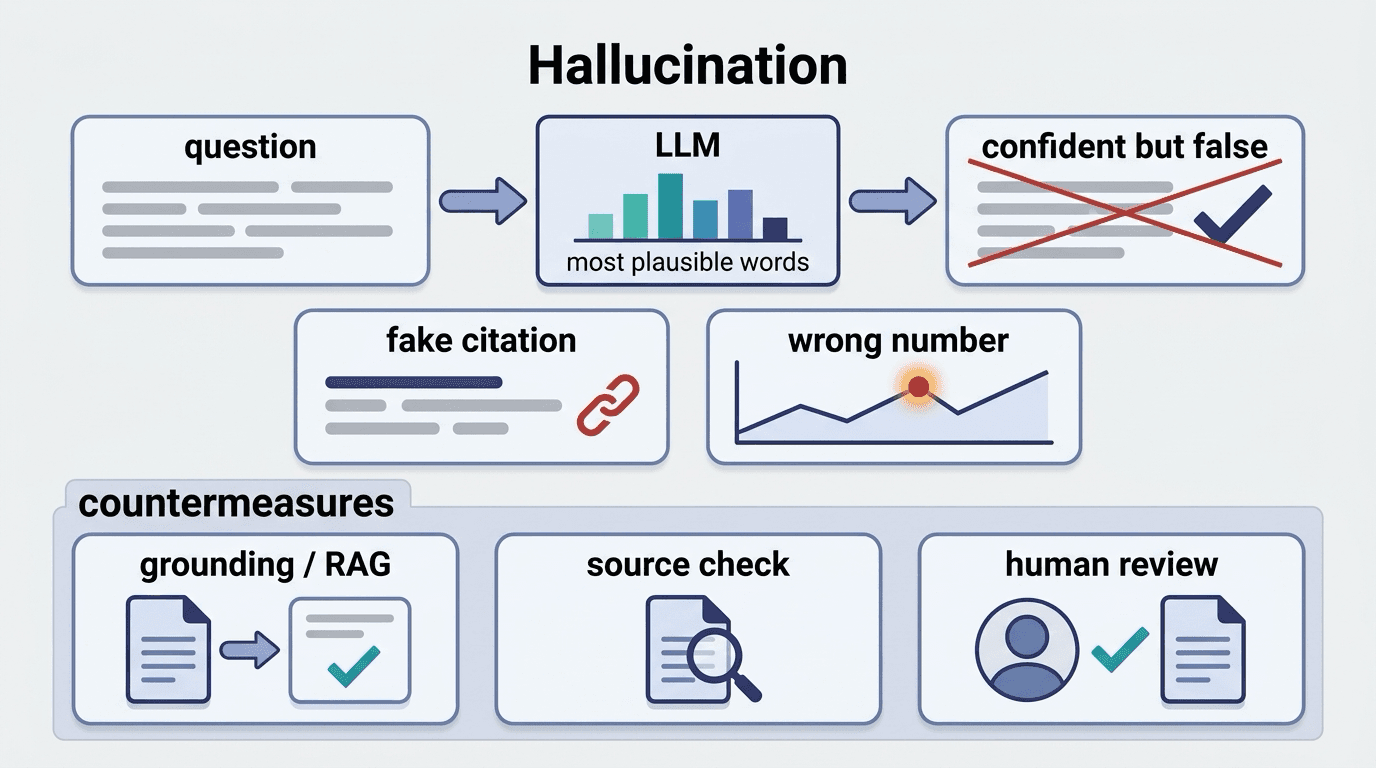
Hallucination (Hallucination)
Hallucination refers to the phenomenon in which an AI model generates information that is not based
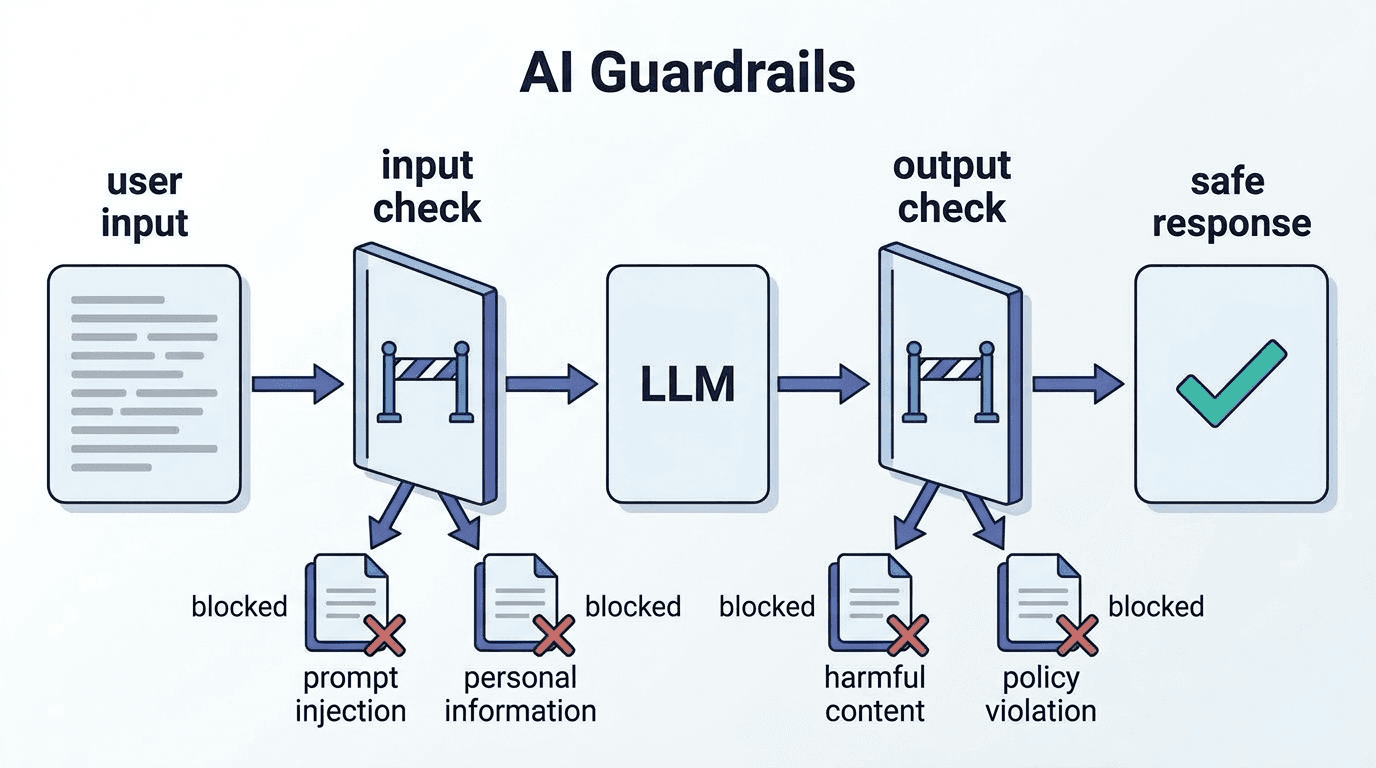
Guardrails (AI Guardrails)
A safety mechanism that monitors LLM inputs and outputs to automatically detect and block harmful co
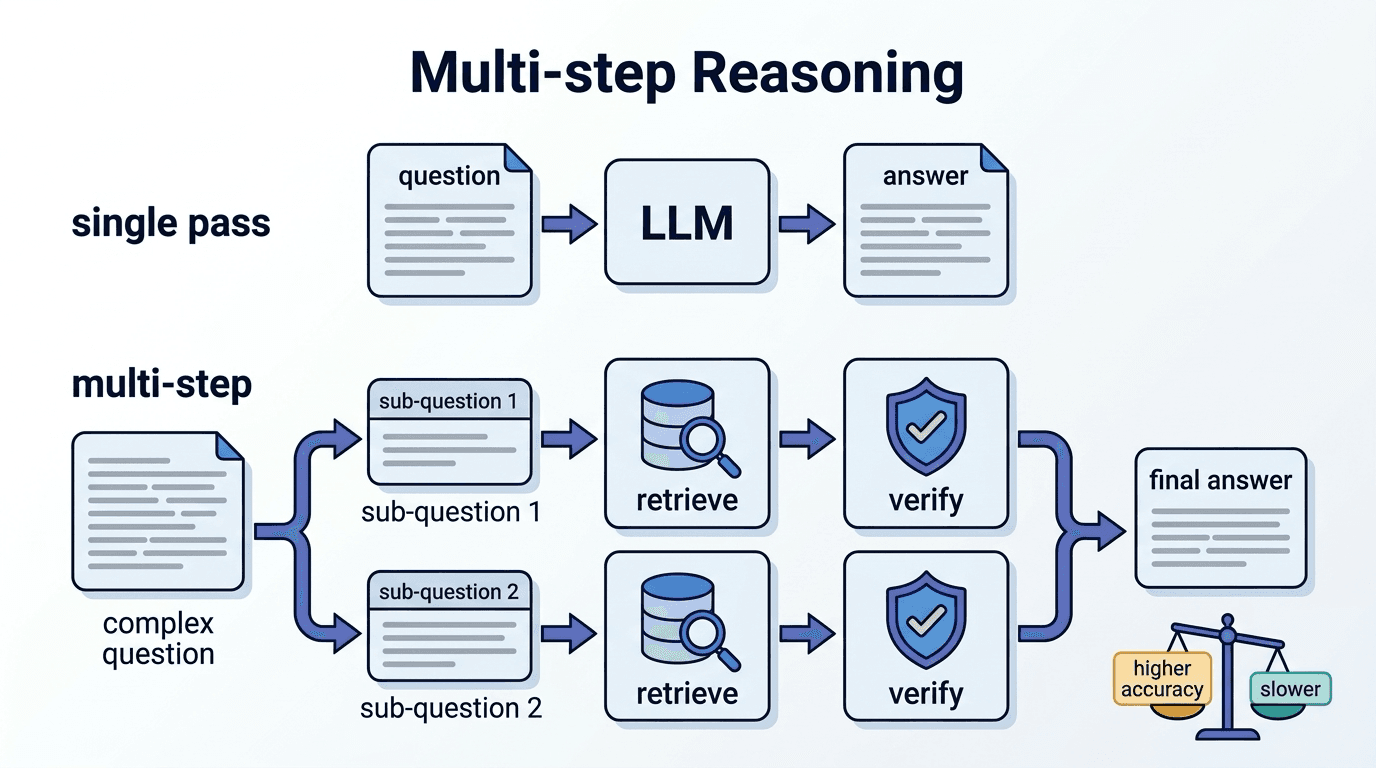
Multi-step reasoning
Multi-step reasoning is a reasoning approach in which an LLM arrives at a final answer not through a