Thailand B2B AI Agent Deployment in Production — A Framework Selection and Multilingual Local Operations Implementation Guide

Lead
Productionizing AI agents in Thai B2B enterprises refers to the process of integrating AI agent frameworks—either Python or TypeScript-based—into existing business systems, with multilingual support and PDPA compliance as prerequisites. This article targets IT departments and DX promotion personnel at Japanese-affiliated and Thai B2B companies in Thailand that are considering AI agent adoption. It compares four frameworks—LangGraph, CrewAI, Mastra, and AutoGen—using evaluation criteria specific to the Thai market, and provides guidance for framework selection. By the end of this article, readers will be equipped to make informed framework selection decisions covering the full journey from PoC to production.
Conclusion: When productionizing AI agents in the Thai market, relying solely on the evaluation criteria found in overseas comparison articles—features, scalability, and community—will lead to poor selection decisions. Three additional criteria must be incorporated: multilingual support, PDPA compliance, and the local engineer landscape.
"Framework comparison articles" from overseas vendors and English-language media are produced in large quantities worldwide, but the vast majority are written with implicit assumptions of a single English language environment, US-standard data regulations, and an abundant supply of Python talent. Thai B2B operations differ significantly from these assumptions: internal communications mix Thai, English, and Japanese; PDPA imposes cross-border restrictions on personal data; and in urban startup environments, TypeScript talent is often easier to hire than Python talent.
Multilingual Requirements and Gaps in Overseas Vendor Documentation
Thai B2B operations routinely involve a mix of Thai-language internal documents, English-language vendor emails, and Japanese-language headquarters reports. AI agents are commonly expected to handle processing flows such as receiving input in Thai, calling external APIs in English, and generating reports for headquarters in Japanese.
Official documentation for overseas frameworks centers on simple, English-only tool-calling scenarios, and best practices for three-language routing or per-language prompt management are rarely addressed. Implementers must build their own three-layer stack—LLM system prompt design, language detection, and post-output translation—and which framework can absorb this burden becomes a critical evaluation criterion.
Thai LLM accuracy evaluation and multilingual localization implementation patterns are covered in What Are AI Agents? A Next-Generation AI Utilization Guide for Thai Companies to Autonomously Automate Business Operations.
PDPA Compliance and Cross-Border Data Constraints
Thailand's PDPA (Personal Data Protection Act, 2019), modeled after the EU GDPR, requires either recognition as a country with an equivalent level of protection or explicit consent for cross-border transfers of personal data. When an AI agent handles customer PII, the mere fact that the LLM API is hosted offshore—in the United States, EU, or Japan—creates PDPA risk.
For any framework under consideration, it is necessary to verify whether practical support exists for integration with self-hosted LLM runtimes and for closed-network deployment on Thailand-based cloud infrastructure (such as True IDC, NTT, or AWS Bangkok). Even if a framework is LLM-agnostic in principle, if its default SDK path is hardwired to a cloud API, significant rework will be required at the time of production deployment.
Encryption implementation and key management approaches for PDPA compliance are detailed in AES-256 Encryption Implementation Guide for Thailand PDPA Compliance.
Thai B2B Suitability of the Top 4 Frameworks (Python-Based)

Conclusion: The Python-based frameworks LangGraph and CrewAI lead in terms of feature maturity, but in Thailand's local engineer hiring market, competition for Python-experienced talent is intense. Evaluation must extend to include talent acquisition for ongoing production operations.
From here, the article moves into an assessment of individual frameworks. We begin with the two Python-based options—LangGraph and CrewAI—evaluated across two axes: functional characteristics and suitability for the Thai market.
LangGraph — Graph Control Stability and Python Talent
LangGraph is an agent-focused library from the LangChain project, characterized by its use of a stateful graph structure to describe workflows. It offers a feature set that meets enterprise requirements—including human-in-the-loop, checkpointing, and streaming responses—and is highly regarded for production readiness in industry comparison articles (Sources: ATNO "10 AI Agent Frameworks You Should Know in 2026"; knowlee.ai "Agentic AI Frameworks Compared 2026").
Practical considerations for adoption in the Thai market:
- Securing Python engineers: Major IT companies and SI vendors in Bangkok have begun locking in Python AI talent at premium rates. For mid-sized companies, the realistic options are headquarters-dispatched staff or a hybrid offshore model.
- Multilingual support: The framework lends itself to designs that branch prompts by language at each graph node, making three-language routing moderately straightforward to implement.
- PDPA: The LangChain ecosystem supports a wide range of LLM providers, and swapping in a Thailand-hosted LLM is achievable through code changes alone.
- Learning curve: A solid understanding of state management concepts is essential. Budget approximately one month for a PoC and two to three months to get a production team up to speed.
CrewAI — Role Definition Clarity and PoC Speed
CrewAI describes multi-agent systems using the abstractions of "roles," "tasks," and "crews (teams)." Team compositions such as a research agent, a writer agent, and an editor agent can be expressed intuitively, and multiple comparison articles rate it as well-suited for standing up a PoC in one to two weeks (Sources: brightdata "Top 14 AI Agent Frameworks in 2026"; ATNO, ibid.).
Practical considerations for adoption in the Thai market:
- PoC speed: Describing roles and tasks in Thai makes it easy to demo to sales teams and obtain internal approval.
- Production concerns: Fine-grained state management and complex branching are weaker than in LangGraph, which can fall short for business-critical workflows.
- Multilingual support: Role descriptions themselves can be written in multiple languages, but managing the language of handoff prompts between roles is a manual process.
- Expected path: Many practical articles recommend a path of "PoC with CrewAI → migrate to LangGraph once production is in sight." This path is equally realistic for the Thai market.
Thai B2B Suitability of the Top 4 Frameworks (TypeScript / Microsoft Stack)

Conclusion: Next.js / Vercel adoption is spreading among Thai web-focused startups, and the TypeScript-first Mastra significantly lowers the barrier to PoC. For large Japanese manufacturers using Microsoft Azure, AutoGen becomes a viable option.
Next, we evaluate the TypeScript-based Mastra and Microsoft Research's AutoGen from a Thai market perspective.
Mastra — Compatibility with Thai Web Companies Strong in Vercel/Next.js
Mastra is a TypeScript-native AI agent, workflow, and RAG integration framework built by the founding team behind Gatsby.js. It is highly regarded in the community for delivering four tiers of memory, first-class MCP support, human-in-the-loop via .suspend() / .resume(), and built-in evaluation capabilities (evals)—all in a single package (Sources: gurusup "Best Multi-Agent Frameworks in 2026"; Mastra official blog).
Practical considerations for adoption in the Thai market:
- Engineer pool: Next.js / TypeScript is the de facto standard among web startups in Bangkok. Because frontend developers can write AI agents without switching languages, the talent acquisition hurdle is clearly lower than with Python-based frameworks.
- Next.js / Vercel integration: If an existing B2B SaaS product runs on Next.js, AI agents can be incorporated into the same codebase, with deployment handled entirely via Vercel or Cloud Run.
- Production maturity: Community maturity is shallower than Python-based alternatives, and best practices for long-term operation are still being established. Mission-critical financial and healthcare workflows should still be approached with caution.
- Multilingual support: TypeScript's type system makes it relatively straightforward to structure multilingual prompts, and three-language routing can be implemented in a fairly clean manner.
AutoGen — Conversation-Driven Approach and the Microsoft Ecosystem
AutoGen (Automated Multi-Agent Generation) is a multi-agent framework developed by Microsoft Research, built around the design philosophy of agents solving problems through "conversation" with one another. AutoGen 1.0 GA was released in February 2026, and official sources as well as multiple media outlets report that it has made a significant shift toward an event-driven architecture (Sources: knowlee.ai, ibid.; Medium "10 AI Agent Frameworks You Should Know in 2026").
Practical considerations for adoption in the Thai market:
- Microsoft Azure / 365 users: Azure adoption is growing among large Japanese manufacturers and financial institutions in Thailand, making the AutoGen + Azure OpenAI combination easier to get approved internally.
- Code generation and technical tasks: AutoGen has strengths in code-generation automation tasks, making it well-positioned to deliver value in internal IT script automation use cases.
- Unpredictability of conversation-driven behavior: The outcomes of inter-agent conversations are difficult to reproduce deterministically, so production workflows require a separately designed output validation layer.
- Learning curve: The API was overhauled with the 1.0 GA release, meaning the majority of sample code from 2025 and earlier no longer works. Working from the latest documentation is a prerequisite.
Multilingual × PDPA × HITL Evaluation Matrix

Conclusion: By re-evaluating through three axes specific to Thai B2B—multilingual support, PDPA compliance, and locally adapted HITL—rather than a generic "feature comparison table," selection criteria become much clearer.
Here, we define three axes not covered in overseas comparison articles and line up four frameworks against them.
Definition of Evaluation Criteria
Three evaluation axes specific to Thai B2B are organized as follows.
- Multilingual routing ease: How easily the framework can be designed to handle Thai, English, and Japanese input/output within a single workflow. Evaluated on three points: "language-specific node branching," "per-language prompt management," and "post-output translation pipeline"
- PDPA / cross-border data compliance: Flexibility to switch LLM providers, difficulty of replacing with a Thailand-hosted LLM, and ease of incorporating data minimization. Emphasis is placed on whether the default configuration poses low PDPA risk
- HITL (Human-in-the-Loop) local fit: Availability of pause/resume functionality for multi-stage approvals, multilingual support for approver notifications, and completeness of audit logs. Evaluated on how well it aligns with Thai approval (ringi) practices
These are assessed relatively, factoring in not just "official features" but also "the amount of custom code required in real-world operations."
Comparison Table: 4 Frameworks × Evaluation Criteria
Relative suitability assessment for Thai B2B (◎ = Strong, ○ = Standard, △ = Weak).
| Evaluation Axis | LangGraph | CrewAI | Mastra | AutoGen |
|---|---|---|---|---|
| Multilingual routing ease | ◎ | ○ | ◎ | ○ |
| PDPA / cross-border data compliance | ○ | ○ | ○ | △ |
| HITL local fit (multi-stage approval) | ◎ | ○ | ◎ | △ |
| Availability of local engineers in Thailand | △ | ○ | ◎ | ○ |
| Existing stack integration (Next.js / Azure / SAP) | ○ | ○ | ◎(Next.js) | ◎(Azure) |
| PoC launch speed | △ | ◎ | ○ | △ |
| Production stability | ◎ | ○ | ○ | ○ |
Note: Ratings are relative comparisons in a Thai B2B context based on publicly available information and community knowledge at the time of writing, and differ from an absolute evaluation of each framework's capabilities. Since AutoGen underwent a major overhaul with the 1.0 GA release, stability ratings are subject to change going forward.
Thai Approval Culture and Fit with Existing Stacks

Conclusion: Thai B2B operations are premised on multi-stage approvals, making it the practical solution to design AI agent decisions as part of an "approval workflow" rather than as "automated execution." The framework's HITL capabilities and connectivity to existing internal systems become the decisive factors in selection.
The "most feature-rich framework" and the "framework best suited to Thai business operations" are not necessarily the same. Final selection should be driven by the organization's decision-making structure and existing technology stack.
How to Implement Multi-Stage Approval Workflows in Each Framework
In Thai B2B business practices, major workflows such as procurement, contracts, and HR approvals typically go through two to four stages of sign-off. A design is needed where, for example, an order proposed by an AI agent is routed sequentially through "Section Manager → Department Manager → Accounting → Final Approver."
Implementation patterns for each framework:
- LangGraph: The checkpoint feature allows each approval stage to be saved and the pending-approval state to be persisted. Multi-stage approvals can be written straightforwardly by configuring graph branches for each approver
- CrewAI: There is no built-in concept of multi-stage approval; it must be custom-implemented via callbacks. This is manageable when approval stages are fixed, but dynamic branching carries a high implementation burden
- Mastra: Pause and resume are handled via the
.suspend()/.resume()API, enabling integration with external approval systems (email, LINE, Slack). A configuration where the approval UI is co-located within a Next.js application is easy to reason about - AutoGen: The v2 API with event-driven architecture makes interruptions and resumptions easier to implement, but official guidance on design patterns is still being developed
The overall design philosophy for approval workflows is covered in What is AI Agent Orchestration? Design and Operations for Coordinating Multiple Agents.
Integration with Existing Stacks (B-Plus / Express / SAP)
The core systems used by Thai B2B companies vary in distribution depending on company size.
- Small and medium-sized (up to ~200 employees): B-Plus, Express, and QuickBooks-based SaaS are common, with limited or REST-only APIs
- Mid-market: SAP B1, Microsoft Dynamics 365, Sansiri Acc-based systems. REST / OData available
- Large Japanese-affiliated manufacturers: SAP ECC / S/4HANA, Oracle EBS. Integration primarily via IDoc / BAPI
Framework fit by scenario:
- When existing systems have REST APIs: Any framework can call them via HTTP client. Differences are minimal
- When deep integration with SAP / Oracle is required: The combination of AutoGen + Azure Integration Services is easier to manage. Internal approval tends to be smoother within Microsoft-aligned organizations
- Web SaaS-centric SMBs: Mastra + Next.js offers the lowest cost end-to-end, from UI to backend. Deploying on Vercel minimizes operational staffing
For designing the automation of ASEAN B2B transactions themselves using AI agents, refer to How to Automate B2B Procurement with AI Agents — A Step-by-Step Guide to Autonomous Supplier Selection and PO Issuance for Thai Manufacturers.
Frequently Asked Questions

Conclusion: As topics unique to the Thai market, we conclude by summarizing "the structural reasons why Mastra is gaining traction" and "the practical realities of switching frameworks from PoC to production."
Q1: What Are the Structural Reasons Behind Mastra's Growth in Thailand?
There are three reasons why Mastra is rapidly gaining visibility as a PoC and production adoption candidate in Thailand.
- Depth of web engineering talent: In Bangkok's IT hiring market, the rate difference between Python AI engineers and TypeScript web engineers is approximately 2–3x. If AI agents can be written in TypeScript, existing web development teams can be converted into AI development teams as-is
- Prevalence of Next.js / Vercel: The vast majority of Thai B2B SaaS startups and LINE-integrated services use Next.js. The advantage of being able to incorporate AI agents into an existing codebase in the same language is significant
- First-class MCP support: Mastra is one of the few TypeScript frameworks that treats MCP (Model Context Protocol) as a first-class citizen, and as standardization of AI Skills advances, this will serve as a tailwind for adoption
However, for mission-critical financial and healthcare applications, Python-based frameworks still hold a maturity advantage, and selecting the right tool by business domain remains necessary.
Q2: Is Switching Frameworks When Moving from PoC to Production Realistic?
The path of "CrewAI for PoC → LangGraph for production" is recommended in multiple industry comparison articles, but here we outline the practical considerations for taking this path in Thai B2B contexts.
- Code asset reusability: Prompts, tool definitions, and evaluation datasets can be reused, but agent structure and state management will need to be rewritten. Expect an overall reuse rate of roughly 30–50%
- Team handover costs: A PoC team accustomed to CrewAI's role-based descriptions will need 1–2 months to become proficient with LangGraph's state graph model
- Alternative: Choose a production-ready framework from the start: Starting with LangGraph or Mastra from the PoC stage eliminates migration costs entirely. For projects that are not under pressure to deliver short-term results, this is the more rational approach
The phased migration strategy from AI agent pilot to production is covered in How to Move AI Agents into Production? Practical Steps from Pilot to Scale.
Summary — Framework Selection Guidelines for Thai B2B

When selecting an AI agent framework for Thai B2B, grounding the decision in "organization, talent, and existing stack" rather than feature comparisons is less likely to lead to a poor fit. Applying the evaluation criteria from generic overseas comparison articles as-is tends to surface mismatches during the production phase.
Key takeaways from this article:
- Do not decide based solely on "features," "scale," and "community" as presented in overseas comparison articles
- Always add the three axes specific to Thai B2B (multilingual routing / PDPA / local HITL compliance) to your evaluation criteria
- SMB web-centric companies: Mastra + Next.js offers the lowest cost from PoC through to production
- Mid-market and large enterprises using Microsoft: AutoGen + Azure OpenAI makes internal approval easier to obtain
- Mission-critical operations requiring complex state management: LangGraph for stable production use
- Projects needing rapid internal approval via short-term PoC: Launch with CrewAI in 1–2 weeks, and plan an early migration to LangGraph if production deployment is intended
- Multi-stage approvals and existing stack integration are decisive factors in selection and should be evaluated before feature comparisons
For overall design of AI agent implementation in Thai B2B operations, individual consultations on framework selection, and inquiries about the journey from PoC to production, please feel free to contact us.
Author & Supervisor

Yusuke Ishihara
Started programming at age 13 with MSX. After graduating from Musashi University, worked on large-scale system development including airline core systems and Japan's first Windows server hosting/VPS infrastructure. Co-founded Site Engine Inc. in 2008. Founded Unimon Inc. in 2010 and Enison Inc. in 2025, leading development of business systems, NLP, and platform solutions. Currently focuses on product development and AI/DX initiatives leveraging generative AI and large language models (LLMs).
Recommended Articles


Terms related to this article
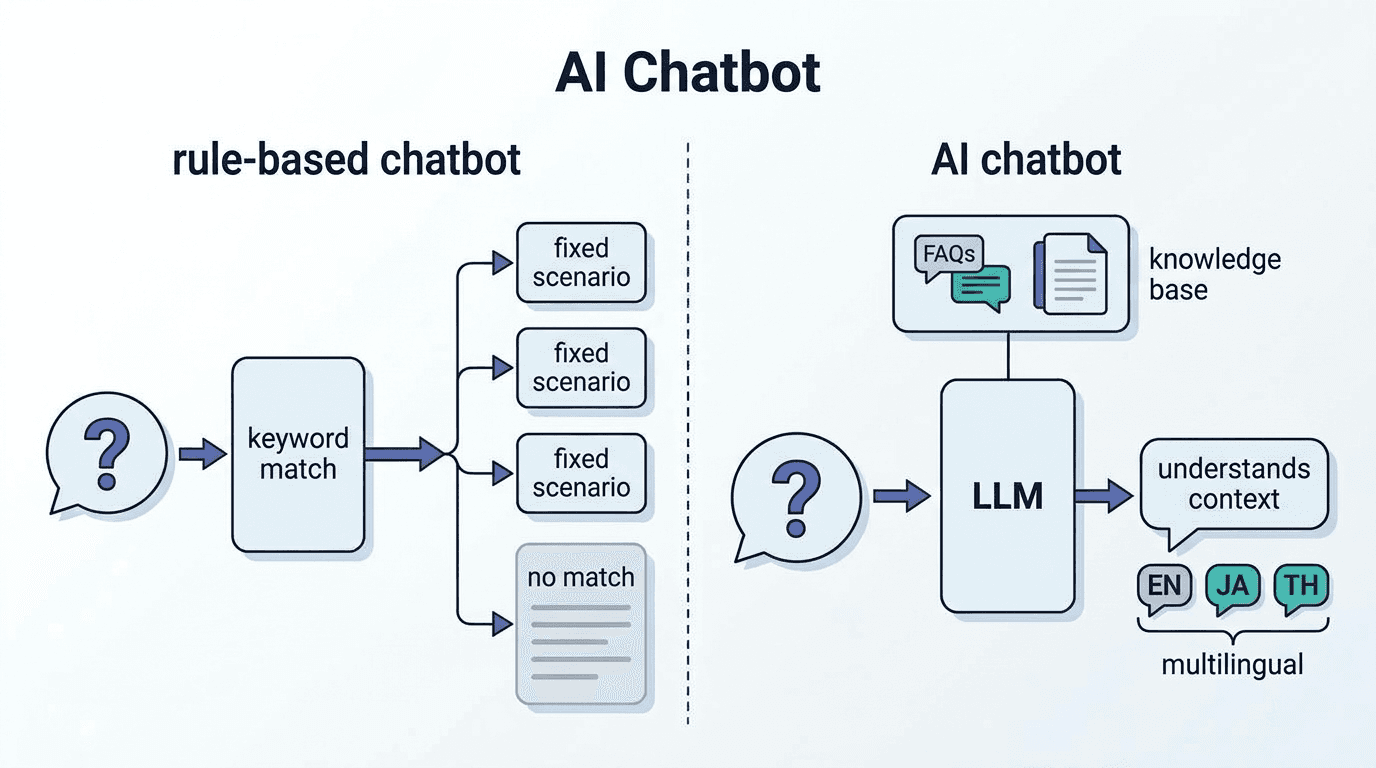
AI Chatbot
An AI chatbot is software that leverages natural language processing (NLP) and LLMs to automatically
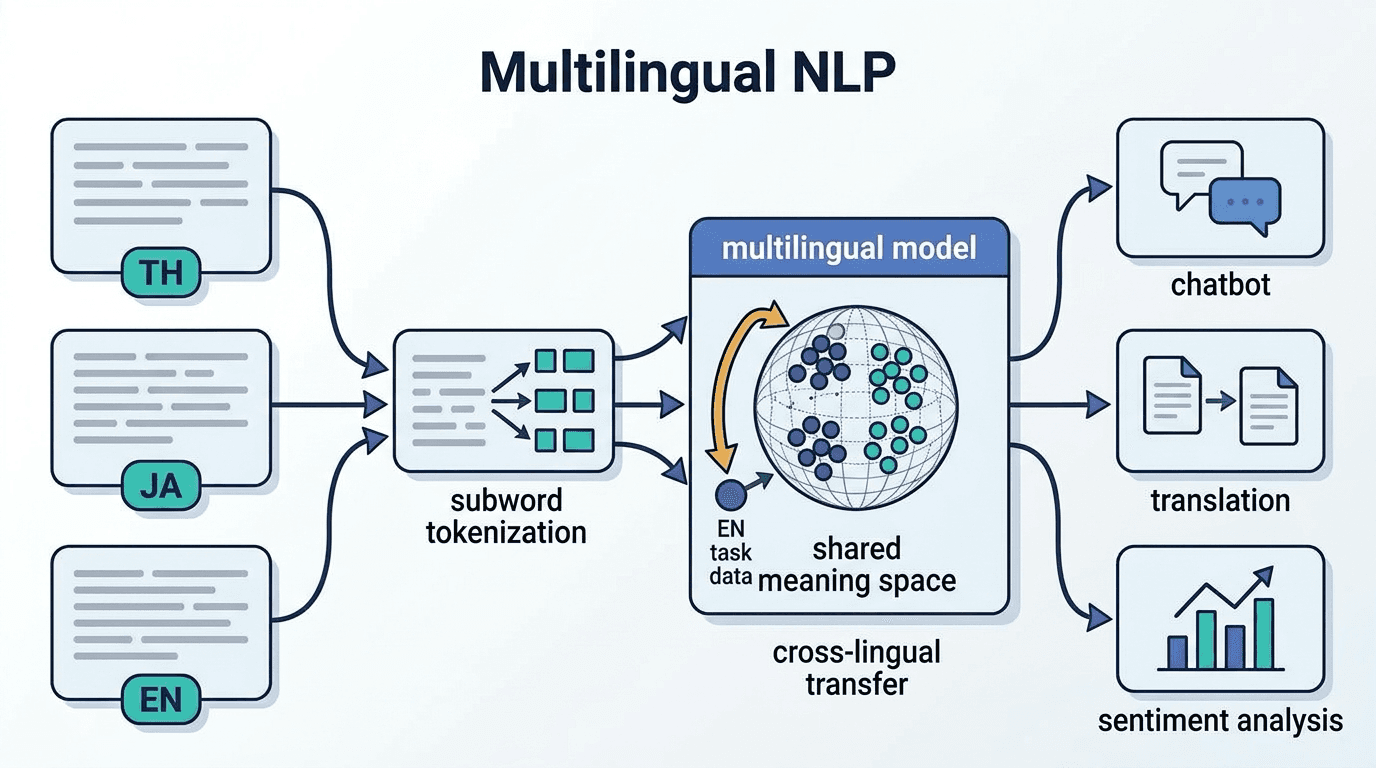
Multilingual NLP (Multilingual Natural Language Processing)
Multilingual NLP is a natural language processing technology capable of analyzing and generating tex
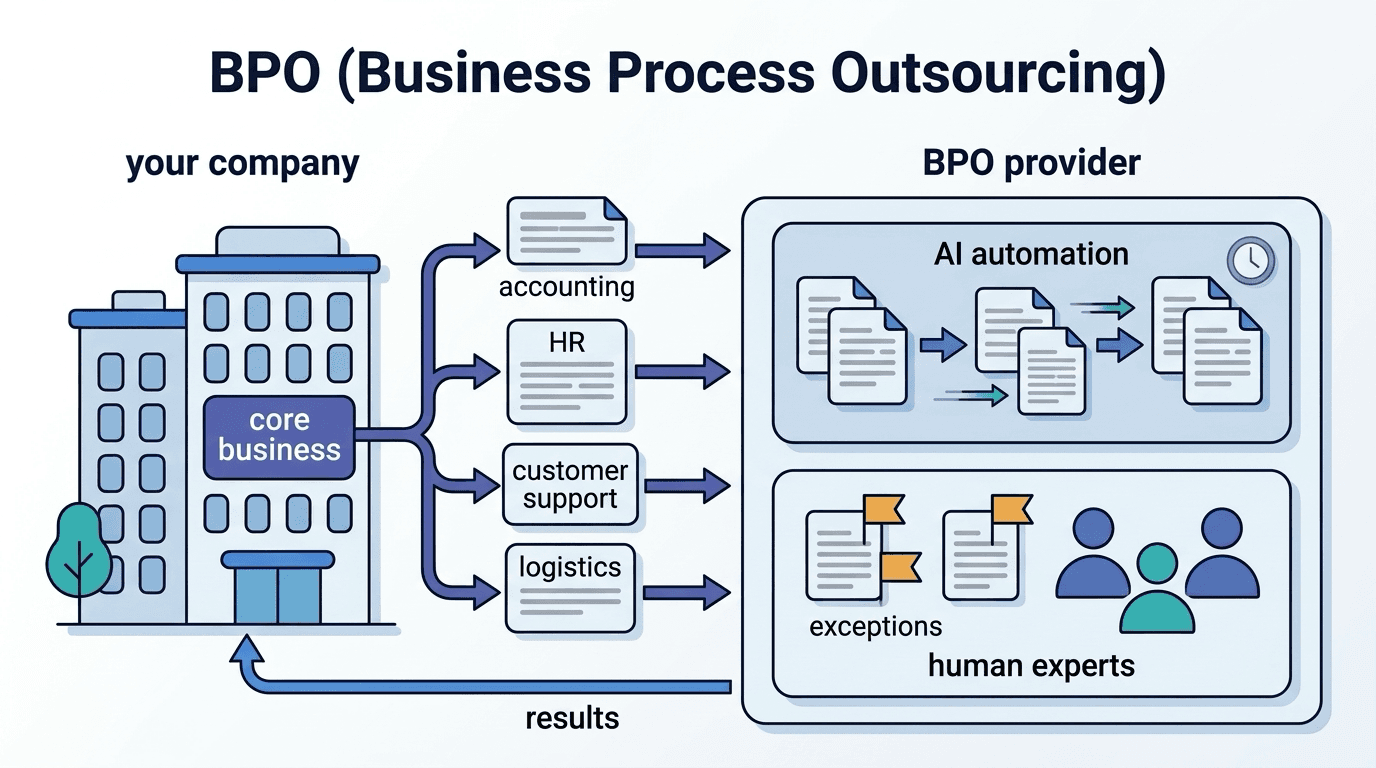
BPO (Business Process Outsourcing)
BPO refers to a form of outsourcing in which a company delegates specific business processes to an e