Practical Guide to Multi-Agent Orchestration Design

Lead
Multi-agent orchestration is a design approach in which multiple AI agents with divided responsibilities are coordinated to automatically handle complex tasks that a single agent cannot manage alone. The key considerations are how to design the division of responsibilities among agents, communication and state management between agents, and failure handling. This article targets engineers and technical leads with experience building LLM-based workflows, and explains in implementation-ready detail — from deciding on a configuration and selecting communication methods, to avoiding common pitfalls and monitoring and evaluating in production. It organizes the essential design principles to grasp before selecting a framework, along with concrete decision criteria.
The essence of a multi-agent configuration lies not in placing all responsibility on a single massive prompt, but in having a "conductor" coordinate a group of agents with divided responsibilities. First, it is worth understanding the structural differences from a single-agent setup, the division of roles between orchestrator and workers, and the use cases each approach suits.
Structural Differences from Single-Agent Systems
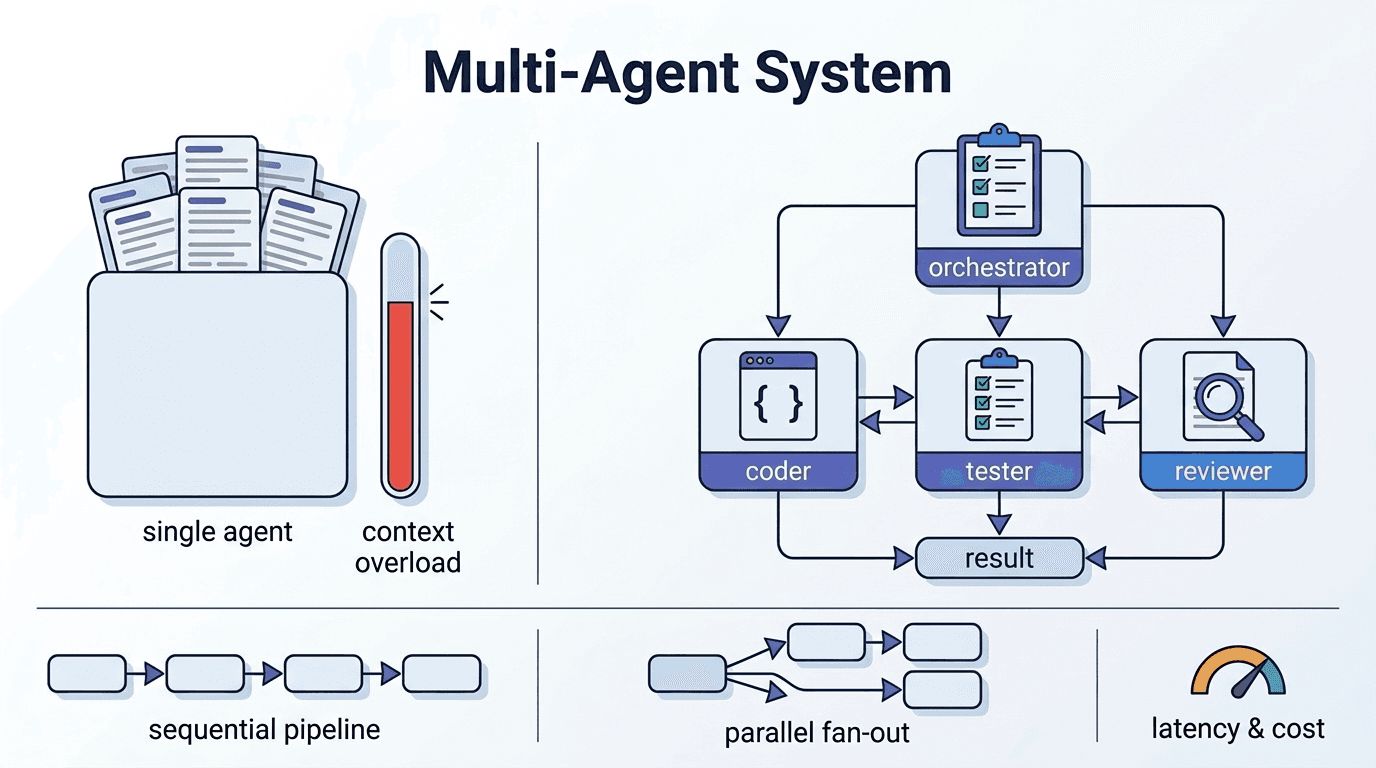
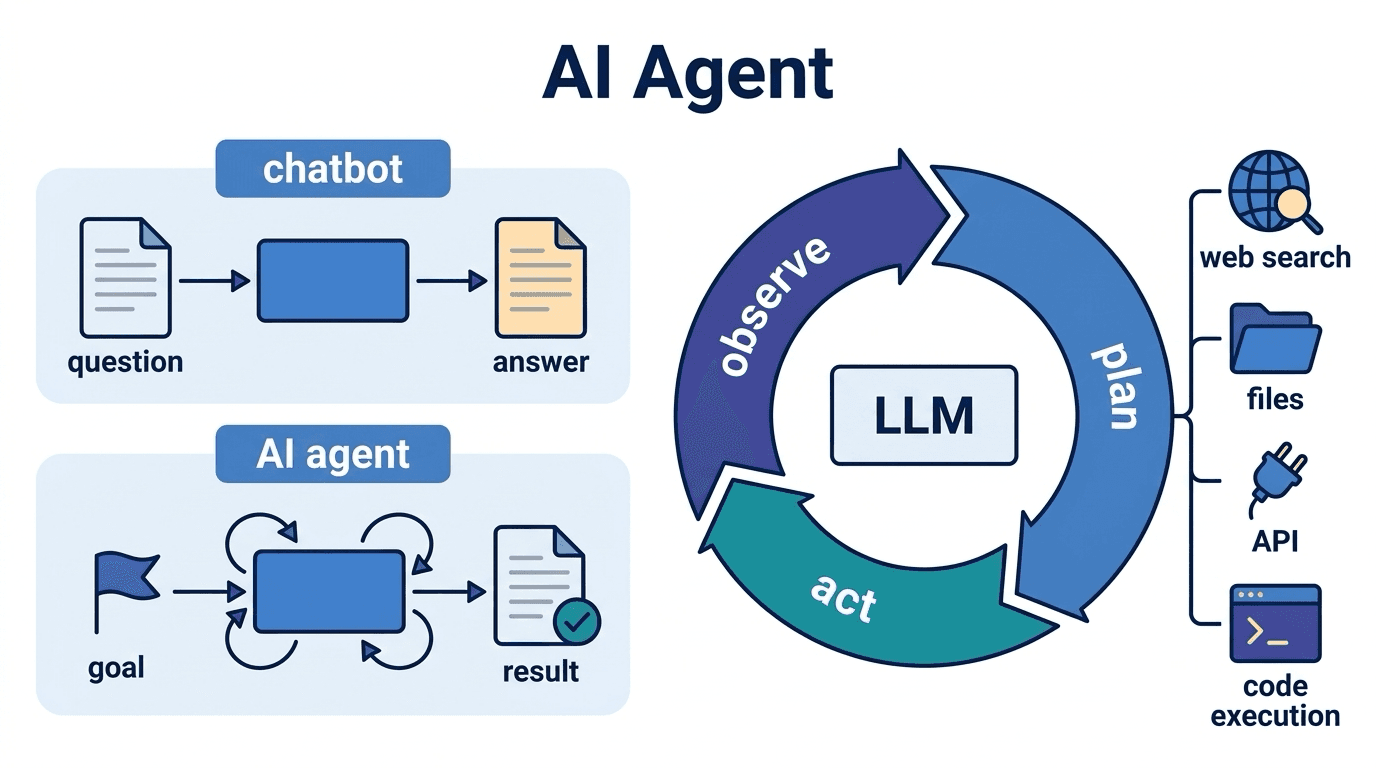
In a single-agent setup, one model runs a reasoning loop while calling tools, handling a task from start to finish on its own. While simple and easy to manage, as the information and steps involved increase, everything no longer fits within a single context, and decision-making becomes inconsistent. A multi-agent configuration is closer in concept to replacing this with a "team of specialists." Agents with divided responsibilities — such as a research agent, an implementation agent, and a review agent — are prepared, each focusing on its own context and role. The advantages are that each agent's prompts and tools can be kept focused, independent processes can run in parallel, and individual components can be swapped out easily. On the other hand, it introduces the need to design "team management" — who is responsible for what, how information is passed between agents, and how failures are handled. Understanding the tradeoff — gaining more capability than a single agent at the cost of increased structural complexity and operational overhead — is the starting point.
Role Division Between Orchestrator and Worker Agents
The orchestrator-worker pattern is the most fundamental configuration in multi-agent design. The orchestrator receives the overall task and is responsible for decomposing it into subtasks, assigning them to appropriate workers, and integrating results to make final decisions. Workers handle the limited subtasks they are given using their specialized tools and prompts, then return results. The key criterion for dividing roles is to clearly separate the layer that oversees the whole and makes decisions from the layer that focuses on individual work. Concentrating too much business logic in the orchestrator causes it to bloat, while giving workers too much decision-making authority undermines overall consistency. When tasks are complex, a hierarchical structure in which workers coordinate further subordinate agents may be used (for an overview of coordination patterns, see also What is AI Agent Orchestration? Design and Operation for Coordinating Multiple Agents). What matters is that each agent's responsibilities are scoped tightly enough to be stated in a single sentence — "what it receives as input and what it is responsible for outputting." Agents with ambiguous boundaries make subsequent communication design and debugging more difficult.
Representative Use Cases and Application Domains
"Should my task use a multi-agent setup in the first place?" — this is a question worth pausing on before diving into design. Multi-agent configurations are effective when a task can be clearly decomposed into subtasks, each requiring different expertise or tools. Specific examples that are well-suited include research that involves gathering and integrating information from multiple sources, content generation with distinct stages such as research, writing, and proofreading, combinations of code generation with independent review, and support handling that routes inquiries to the appropriate party based on content. Conversely, applying a multi-agent setup to single-turn processes or straightforward, linear tasks only adds communication overhead and complexity without a worthwhile return. A useful rule of thumb is to ask: "Would a human team divide this into roles?" Forcibly splitting work that one person would naturally handle alone results in something slower and more fragile. Identifying the right domain of application determines the overall cost-effectiveness of the design.
What Prerequisites Should Be Confirmed Before Starting Design?

Before getting started, there are three things you need to nail down: whether the task can be decomposed, which models to use and at what cost, and whether your team has the necessary skills and environment in place. If these remain unclear when you begin implementation, you'll likely end up rebuilding the entire architecture from scratch later. Let's go through each one in turn.
Assessing Task Decomposability and Determining Granularity
The first hurdle is determining whether the target task can truly be broken down into subtasks, and at what level of granularity to split it. The benchmark for decomposition is that each subtask should be able to have its inputs and outputs defined independently and have its success or failure judged on its own. If the granularity is too coarse, responsibilities concentrate in a single agent and it becomes no different from a single-agent setup; if too fine, the handoffs between agents multiply, inflating latency and cost. Here are some guidelines for making the call: if there are strong dependencies between subtasks and the order is fixed, don't force a split—consolidate them into a single workflow. If subtasks can run in parallel independently, or if they require different areas of expertise, separate them into distinct agents. For example, a straightforward serial process like "research → summarization," where the output of one step simply becomes the input of the next, doesn't necessarily need to be split across multiple agents. Choosing not to force a multi-agent structure on a task that can't be decomposed—or where decomposition offers little benefit—is itself a perfectly valid design decision.
LLM Model Selection and Cost Estimation Approach
A common pitfall in model selection is defaulting to "just use the highest-performing model for every agent." In practice, however, this is often the primary driver of skyrocketing costs and latency. Because multi-agent systems involve a higher number of calls, the standard approach is to assign different models to different agents. Assign a high-performance model to the orchestrator, which oversees the whole system and handles complex reasoning, and assign lightweight, fast models to workers responsible for routine extraction and formatting. The basic approach to cost estimation is to add up: "expected number of agent calls per task × input/output token volume per call × model unit price." In architectures where agents call one another, the number of calls can easily balloon beyond expectations, so set an upper limit to prevent runaway behavior. Note that model pricing is subject to change, so treat any specific figures as reference values at the time of writing and be sure to check the latest pricing (for concrete strategies on reducing token usage, see the LLM Cost Optimization Guide).
Required Team Skill Sets and Environment Setup
"What kind of team structure can actually make this work?" is just as important a prerequisite as technology selection. Multi-agent development calls not only for prompt design and an understanding of LLM behavior, but also for general backend competencies such as asynchronous processing, distributed systems, and observability—because the more agents you add, the more the system takes on the character of a distributed system. On the infrastructure side, you'll want to build in a logging and tracing foundation capable of tracking each agent's inputs, outputs, and tool calls from the very beginning. Without it, diagnosing the root cause of bugs involving multiple agents becomes extremely difficult. You'll also need a validation environment where you can reproduce and compare behavior before going to production, as well as version control for prompts and configurations. If your team lacks these competencies, it's more realistic to avoid aiming for a large-scale architecture right away—start with a small setup of two or three agents, accumulate operational know-how, and then expand. Balancing technical ambition with your team's level of expertise is the key to avoiding a stalled project.
How to Design Agent Configurations

Architecture design is easier to organize when approached in the following order: define each agent's responsibilities using a task graph, determine the orchestrator's routing logic, and standardize the format of data passed between agents. Here, we break this down into three steps and walk through the design process at a level of detail that can be translated directly into implementation.
Step 1: Creating a Task Graph and Defining Agent Responsibilities
The starting point of design is to diagram the processing flow as a "task graph." A task graph is a directed graph connecting each processing node with the inputs and outputs (dependencies) flowing between them — similar to a recipe workflow chart. It makes clear at a glance which tasks must be completed first and which can run in parallel. Each node in this graph is then mapped directly to an agent's responsibilities. When defining a node, it helps to write out four points in a single sentence each: "input," "output," "tools used," and "success criteria." Any node whose responsibilities cannot be captured in a single sentence is evidence that the granularity is still too coarse, and splitting it should be considered. Conversely, nodes that are consecutive with nearly identical inputs and outputs should be considered for merging. The advantage of graphing is that it forms the foundation for subsequent communication design and error handling. Once it is clear which nodes data flows between, communication paths and the scope of impact on failure can be systematically identified. Consolidating the overall picture into a single diagram at the outset greatly reduces rework later.
Step 2: Designing the Orchestrator's Routing Logic
Next, design the routing that determines "which workers the orchestrator calls, in what order, and under what conditions." There are broadly two approaches. The first is deterministic routing, which fixes the processing order according to the dependencies in the task graph. This suits workflows with established procedures, produces predictable behavior, and is easy to debug. The second is a dynamic approach in which the orchestrator itself (an LLM) looks at the input and selects the next agent on the fly. This is flexible, but increases the risk of incorrect selections and makes behavior harder to predict. In practice, a hybrid approach — fixing the skeleton deterministically while delegating only the branching points to LLM judgment — tends to be the most manageable. When adopting dynamic routing, explicitly limit the available choices to prevent unintended transitions. Additionally, always set a cap on the number of calls and transitions to guard against situations where the same worker is called repeatedly without stopping. Routing is the "control flow" of the entire system, and its clarity determines the stability of the whole.
Step 3: Unifying Inter-Agent Interfaces and Data Schemas
Connecting agents solely through free-form natural language may work at first, but as scale increases, mismatches in handoffs will start causing breakdowns. Establishing a "structured schema" contract for inputs and outputs upfront leads to a more robust system in the long run. Each agent's output should conform to a predefined format (for example, a specific set of JSON fields), and the receiving side processes data on the assumption of that format. The schema should include not only the processing results, but also metadata such as a status indicating success or failure, confidence in the decision, and error details — this makes downstream control easier. Free-form natural language exchanges appear flexible at first glance, but accumulated parsing failures and interpretation mismatches make debugging difficult. With a common schema in place, output validation can be performed mechanically, and outputs that violate the format can be detected early and retried. For more on mechanisms that standardize inter-agent communication, What are AI Agent Protocols (MCP · A2A)? is also a useful reference. Unifying interfaces is unglamorous work, but it makes swapping out agents and testing easier, and has a significant impact on the overall maintainability of the system.
How to Implement Inter-Agent Communication and State Management

For communication and state management, the three pillars of design to keep in mind are: the synchronous or asynchronous communication method, how state shared between agents is maintained, and how tool execution results are handed off. How carefully this is built out will greatly affect scalability and fault tolerance in production.
Choosing Message Queue and Asynchronous Communication Patterns
The design of inter-agent communication changes depending on whether synchronous or asynchronous communication is used as the foundation. Synchronous communication is a direct call in which the caller waits for a result — the implementation is simple and the flow is easy to follow. It is sufficient when the number of agents is small and processing is sequential. Asynchronous communication, on the other hand, exchanges messages via a message queue, allowing the sender and receiver to be loosely coupled. Here is a guideline for choosing: if you need to run multiple workers in parallel, if processing times are long and timeouts are a concern, or if you want to prevent a partial failure from halting the entire system — these requirements call for asynchronous communication. Inserting a queue absorbs sudden spikes in load and makes it easier to reprocess failed messages. However, going asynchronous introduces new considerations such as ordering guarantees and handling duplicate processing, so making everything asynchronous where it is not needed only adds complexity. The approach that avoids over-engineering is to start with synchronous communication and extract only the paths that genuinely require concurrency or fault tolerance into asynchronous ones.
Design Guidelines for Shared Memory and Distributed State Management
When multiple agents reference and update the same information, the question of where to place state becomes a problem. There are two broad approaches. One is to pass each agent's results as messages, carrying state along with them. The other is to place a shared store (an in-memory cache or database) as a "blackboard," where each agent reads from and writes to it. The blackboard approach makes it easy for many agents to share the same context, but introduces risks such as write conflicts from concurrent access and reading stale values. The design principle is to minimize shared state and clearly define what constitutes the source of truth (a single source of truth). If each agent is allowed to maintain its own arbitrary state, it becomes impossible to determine which is the most current. Concentrating updates in a specific agent while having others focus solely on reading is also an effective division of roles. By adhering to the principle of "don't multiply state, don't distribute it, keep updates to a single source," consistency becomes easier to maintain even in distributed environments.
Passing Tool Call Results as Context Between Agents
When an agent calls a tool and passes the results to the next agent, "what to hand off and to what extent" determines both quality and cost. Naively stuffing all raw tool output into the context causes token counts to balloon, increasing cost and latency, while burying the critical information and degrading accuracy. It is tempting at first to think "passing everything is the safe choice," but in practice, "passing only what is necessary" tends to produce better results. Practical techniques include summarizing tool output before passing it on, storing large data bodies in an external store and passing only a reference ID, and extracting only the fields the downstream agent will use. Additionally, keeping a structured record of which tool was called with which input and what result was returned makes it easier for downstream agents to reconstruct context and simplifies debugging. Treating context as a finite resource and deliberately selecting what information to hand off is a prerequisite for stable multi-agent operation.
How to Avoid Common Design Mistakes and Failure Patterns

The failures that occur most frequently in multi-agent systems can be grouped into three categories: agent runaway (infinite loops), prompt injection, and latency and cost increases caused by excessive decomposition. All of these can be addressed with preventive measures built in at the design stage. We will examine mitigation strategies for each in turn.
Detecting and Preventing Agent Loops and Infinite Recursion
In configurations where multiple agents call one another, circular dependencies such as "A calls B, and B calls A again," as well as infinite loops that repeat the same processing indefinitely, can occur. This is the most critical failure to guard against, as it directly leads to runaway costs and unresponsive systems. The basic approach is to maintain multiple layers of protection. First, set a hard limit on the total number of agent invocations or orchestration iterations, and forcibly terminate execution when that limit is exceeded. Second, monitor state transitions to detect cycles by checking whether the same agent is being called consecutively with the same input. Third, verify at each iteration whether processing has advanced beyond the previous step, and halt if no progress has been made. Designing the task graph as a directed acyclic graph (DAG) to eliminate cyclic structures from the outset is also effective. When dynamic routing is used, cycles cannot be entirely ruled out, so a combination of limits and detection serves as a practical safeguard. Since a "never-stopping" situation can always occur, it is essential to put safety mechanisms in place proactively.
Prompt Injection Risks and Guardrail Design
"What if malicious instructions targeting an agent are embedded in externally provided data?"—This question becomes far more serious in multi-agent systems. If external data retrieved by one agent—such as a web page, document, or tool response—contains malicious instructions, subsequent agents that receive it can be hijacked, and the damage can cascade. Guardrails should be established at multiple layers. First, clearly distinguish between externally sourced data and trusted instructions provided by the system, and structure the system so that external data is never interpreted as instructions. Next, restrict each agent's permissions to the minimum necessary, preventing it from executing tools or operations it does not legitimately need. Requiring human approval before critical operations and validating output before passing it downstream are also effective checkpoints. Rather than relying on a single line of defense, protecting at each stage—input, permissions, and output—is key to preventing cascading damage (see AI Guardrails Implementation Guide for implementation patterns).
Latency and Cost Increases from Excessive Agent Splitting
The idea that agents become more capable the more you divide them is a trap. In practice, an overly fragmented configuration increases handoffs between agents, and with each handoff, the overhead of model calls and communication accumulates, driving up both latency and cost. At first, it may feel cleaner to divide things finely by role, but once in operation, you often find that agents doing almost nothing are simply relaying work — a clear waste. The way to avoid this is to evaluate splitting decisions by asking: "Does this separation offer a clear benefit — concurrency, specialization, or reusability?" Any split that cannot be justified should be consolidated. As a rule of thumb, if an agent is essentially passing its input to the next agent with little modification, it can likely be merged with its neighbor. The fewer agents there are, the easier tracking and debugging becomes. Start with the minimum viable configuration, and only split where bottlenecks or requirements become clearly defined — that is the most direct path to avoiding over-engineering.
How to Monitor and Evaluate for Production Deployment

Production multi-agent systems don't end at "it works." They require a continuous mechanism for visualizing and evaluating where things get stuck and how accurately each agent is performing. The two pillars of operation are identifying bottlenecks through tracing and assessing quality at the individual agent level.
Visualizing Bottlenecks Through Tracing and Log Design
Bugs and latency in multi-agent systems involve multiple agents and tool calls, making it impossible to trace the root cause just by looking at logs. The key is tracing. Think of a single task execution as one "trace," with each agent call and tool execution recorded as nested "spans" within it — essentially a visualization of the processing flow as a time-ordered hierarchical tree. By capturing elapsed time, inputs and outputs, token consumption, and success or failure in each span, you can immediately see which agent is consuming the most time and where failures are concentrated. For implementation, standard instrumentation such as OpenTelemetry, combined with LLM-focused observability tools like LangSmith or Langfuse, makes it easier to analyze at the agent and prompt level. Critically, these should be built in from the early design phase rather than added as an afterthought. For a broader picture of production operations, What is AI Observability? is also a useful reference. Establishing consistent trace granularity from the start means that when problems arise, you can pinpoint the cause with data rather than guesswork.
Setting Quality Evaluation Metrics per Agent
If you only look at whether the system as a whole is working correctly, you won't know which agent is dragging things down. Evaluation is most effective when done at two levels: end-to-end and per-agent. First, measure at the system level whether the final output meets the objective of the task. Then, for each individual agent, track metrics such as the rate at which it returned the expected output for a given input (task success rate), whether outputs conform to a defined schema, whether it is generating incorrect information, and what its latency and cost look like. The standard approach is to prepare a dataset of expected inputs and outputs — a golden set — and run it on a regular basis. When the quality of outputs is difficult to judge mechanically, you can also use another LLM as a scorer, though the validity of those judgments should be periodically verified by a human. When each agent's weaknesses are visible as numbers, it becomes clear where improvements are needed, leading to an overall lift in system quality.
Author & Supervisor

Yusuke Ishihara
Started programming at age 13 with MSX. After graduating from Musashi University, worked on large-scale system development including airline core systems and Japan's first Windows server hosting/VPS infrastructure. Co-founded Site Engine Inc. in 2008. Founded Unimon Inc. in 2010 and Enison Inc. in 2025, leading development of business systems, NLP, and platform solutions. Currently focuses on product development and AI/DX initiatives leveraging generative AI and large language models (LLMs).
Recommended Articles


Terms related to this article

Agent Orchestration
A mechanism that controls task distribution, state management, and coordination flows among multiple
Multi-Agent System
A multi-agent system is an architecture in which multiple AI agents divide roles and coordinate with
AI Agent
An AI agent is an AI system that autonomously formulates plans toward given goals and executes tasks