What Is AI Agent Orchestration? Design and Operations for Coordinating Multiple Agents

Lead
AI agent orchestration is a control layer that governs the execution order, role allocation, data handoff, and exception handling of multiple autonomous agents. It is a design domain for constructing long-running tasks and cross-functional workflows—tasks that a single agent cannot handle alone—in a safe and observable manner.
This article is intended for business owners, tech leads, and PdMs who are considering production deployment of AI agents, both internally and externally. By the end, you will have a clear, unified understanding of four points: (1) the problems orchestration solves, (2) key design patterns, (3) elements that must be considered during implementation, and (4) the sequence for moving from PoC to scale.
The conclusion comes first. The moment you try to integrate AI agents into business operations, "how you design the coordination of multiple agents" matters more than "how hard you work to make a single agent smarter." If you run a PoC while overlooking this, you will fall into the classic trap: the demo works, but you cannot move it into production.
Orchestration is the design domain that transforms AI agents from "smart, single-purpose tools" into "components of a business system."
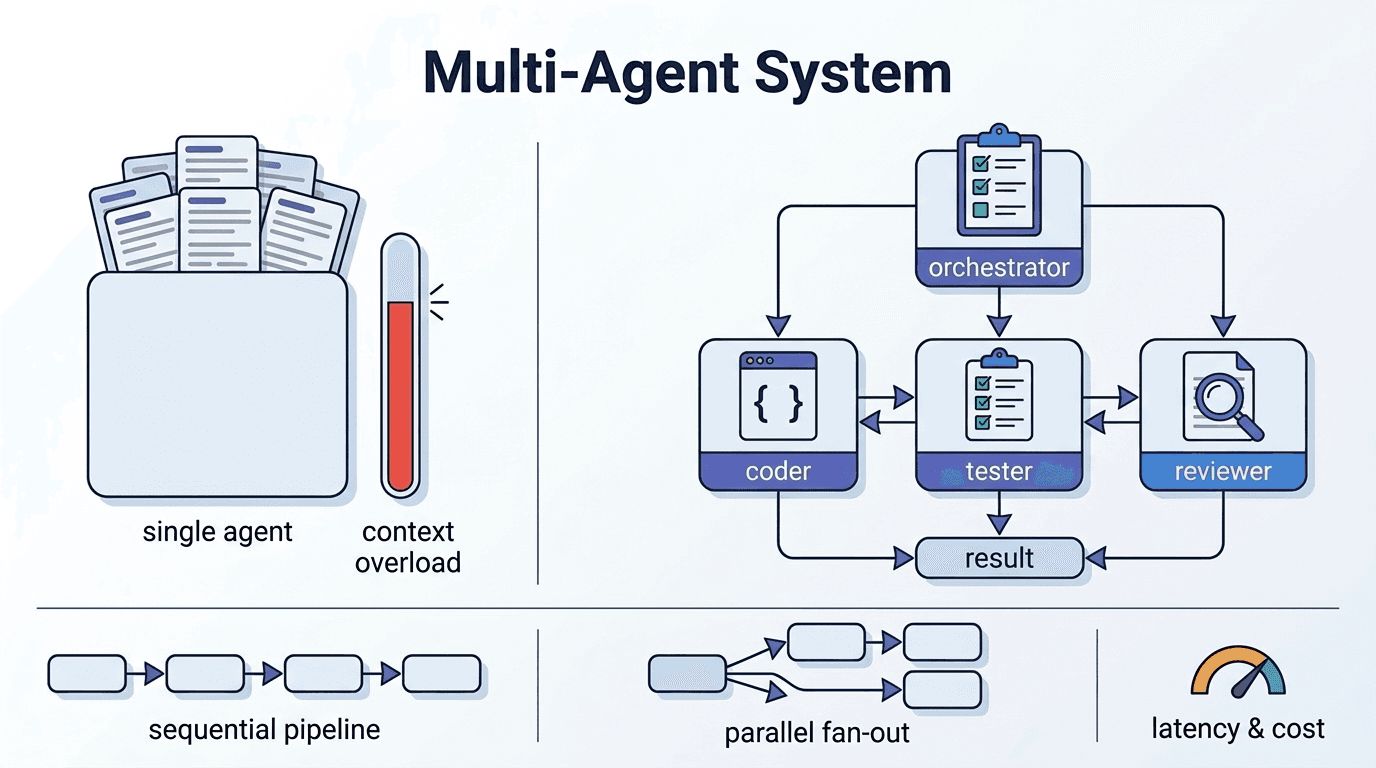
Just as an orchestra conductor coordinates the performance of individual instruments, an orchestrator manages the activation sequence and data flow among multiple agents (planner, researcher, writer, reviewer, etc.). It refers to the external control layer that binds agents together, not to the capabilities of the agents themselves. The key perspective to grasp first is this idea of "designing the outside."
Defining Orchestration
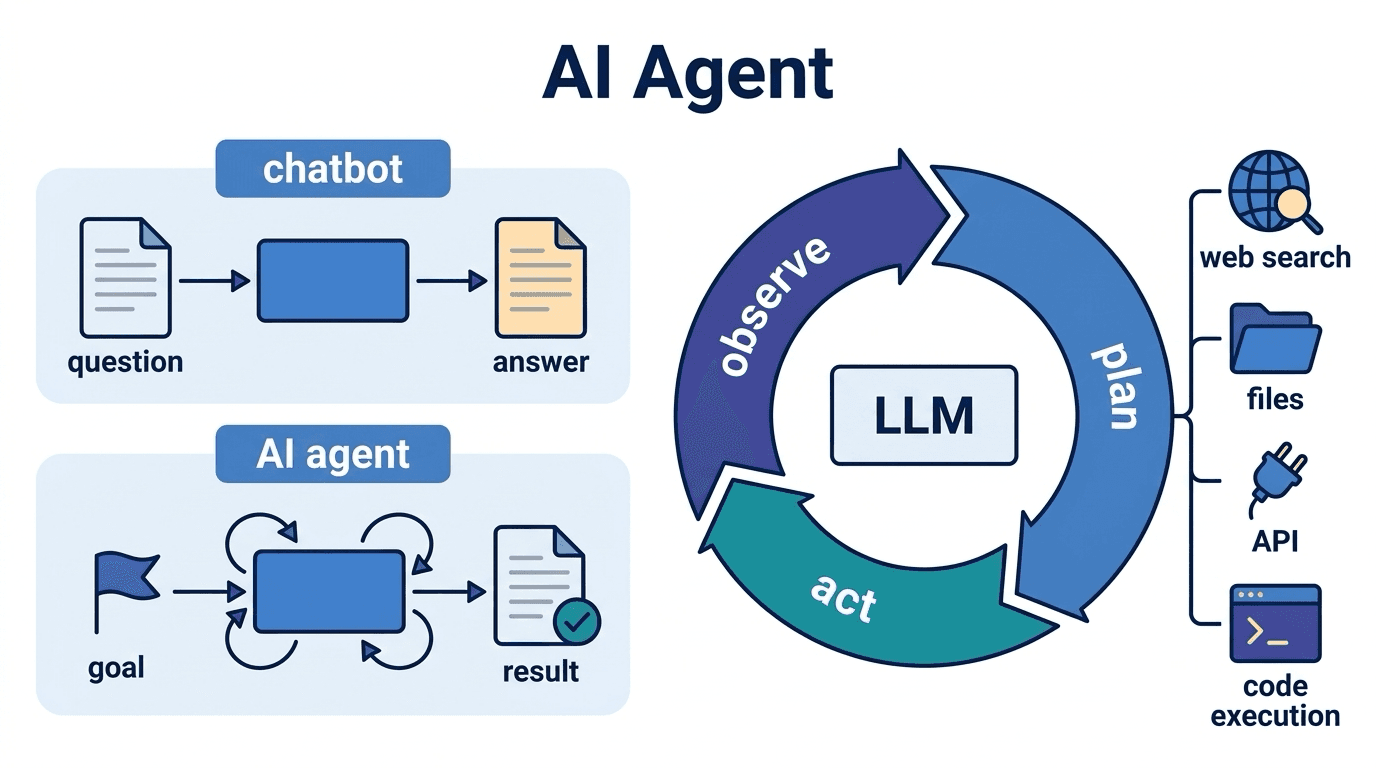
AI agent orchestration is a control layer that centrally governs, across multiple agents and tools: (1) control of execution order, (2) handoff of input/output data, (3) retries and fallback paths on failure, and (4) determination of termination conditions. An individual agent is "an autonomous unit that reasons about and executes tasks," but real-world business operations consist of chains in which multiple such units are connected. Orchestration means fixing these chains into a reproducible and observable form.
There are three key points in this definition. First, orchestration is a layer independent of "agent intelligence." Even a smart agent cannot be integrated into business operations if orchestration is weak. Second, the essence lies in explicitly defining the boundary between deterministic and probabilistic parts. The portions where the LLM makes judgments are intentionally left non-deterministic, while job initiation, termination, and sequencing are fixed deterministically. Third, human-in-the-loop (HITL) intervention points are included in the design from the outset. "Controlled autonomy," not full autonomy, is the practical solution.
Differences from Multi-Agent Collaboration
While multi-agent collaboration is centered on the idea of "having multiple agents exist," orchestration is centered on the idea of "operating multiple agents as a business system." The two are similar, but their design focus differs.
| Perspective | Multi-Agent Collaboration | Orchestration |
|---|---|---|
| Primary focus | Communication and coordination among agents | Control of the overall workflow |
| Key concerns | Protocols, messages, roles | Sequencing, retries, HITL, observability |
| Main viewpoint | Research- and protocol-oriented | Business implementation-oriented |
| Responsibility on failure | Absorbed among agents | Aggregated by the orchestrator |
"Multi-agent systems" as a research domain treat coordination protocols as the design target. Orchestration, as covered in this article, targets the implementation layer for integrating such agents into business systems. The two are complementary, and both perspectives are necessary in production deployments.
For related reading, see also What is Multi-Agent AI? and What are AI Agent Protocols (MCP · A2A)?.
Why Orchestration Is Needed Now

Efforts to build a "smarter single agent" are reaching saturation, and the bottleneck has shifted to coordination between agents.
Until recently, the competition was about crafting better prompts to make agents smarter. Today, the capability gap between foundation models has narrowed, and the primary battleground for differentiation has moved to how agents are combined. At the same time, demand from the business side has grown beyond "responding to one-off queries," pushing toward workflowization capable of long-running execution.
Limitations of Single Agents
When attempting to run operations with a single agent, you quickly run into three walls. The first is the context length limit. Cramming long-term task history, reference materials, and tool definitions all into a single prompt causes input tokens to balloon, and inference costs and latency degrade linearly. Furthermore, as context grows longer, LLMs tend to follow instructions less accurately.
The second problem is the inability to separate responsibilities. Delegating research, summarization, counterargument, and final review to a single agent creates a structure where the agent reviews its own output, making errors difficult to detect. Third, there is the problem of granting tool permissions too broadly. An agent with all permissions suffers greater damage from attacks such as prompt injection.
These issues cannot be solved by making the agent smarter. Dividing roles, isolating context, and minimizing permissions — all of these must be implemented at the orchestration layer.
Pressure to Integrate into Business Processes
Requests from the business side have shifted from "answer intelligently in chat" to "replace business processes." Specifically, the demand is for execution-type workflows such as the following:
- Extract cases from incoming emails → cross-reference core systems → request approval from the person in charge → issue purchase orders after approval
- Retrieve data from multiple SaaS platforms for monthly reports → detect anomalies → format → distribute to stakeholders
- Classify customer inquiries → search knowledge base → draft initial responses → determine escalation
These involve "multiple steps," "multiple systems," and "multiple decision points." They cannot possibly be realized by the "intelligent responses" of a single agent alone — state management between steps, exception handling, and human approval mechanisms are all essential. At our company, we believe that the more this kind of business-embedded requirement increases, the more the design quality of the orchestration layer — rather than the agent itself — determines the success or failure of a project.
Key Design Patterns for Orchestration

Understanding design patterns upfront helps avoid the rework of rebuilding configurations that don't fit your requirements later.
The three representative patterns are Planner-Executor, Supervisor/Manager, and Event-Driven/Pub-Sub. Real-world projects often end up as a hybrid of these, but choosing a starting pattern is the first step in design.
| Pattern | Key Characteristics | Suitable Use Cases |
|---|---|---|
| Planner-Executor | Separates planning and execution roles | Tasks that can be decomposed in advance |
| Supervisor / Manager | A directing agent selectively calls subordinate agents | Tasks where the responsible party changes based on input |
| Event-Driven / Pub-Sub | Reacts asynchronously in response to events | Workflows triggered by external events |
Planner-Executor Pattern
The Planner-Executor pattern is a simple two-tier structure in which (1) a Planner agent decomposes an input task into subtasks, (2) an Executor agent executes each subtask in sequence, and (3) the results are integrated once all subtasks are complete.
There are two advantages. Because task decomposition and execution are separated, it is easy to optimize costs by using a more careful model only for the planning stage and running execution with a lightweight model. In addition, since the Planner's output (the plan) is preserved as text, an audit log of the business process is naturally produced.
There are also disadvantages. Because the system relies heavily on the plan created by the Planner at the outset, it is vulnerable when assumptions change midway through. A decision must be made either to incorporate a dynamic re-planning mechanism alongside it, or to extend it to the Supervisor pattern described later. For teams just beginning to introduce AI agents, our company recommends starting with this pattern as a point of departure.
Supervisor / Manager Pattern
The Supervisor/Manager pattern is a structure in which a higher-level directing agent calls upon a group of lower-level specialized agents as needed. Whereas Planner-Executor relies on advance planning, this pattern determines which agent to call next through sequential, on-the-fly judgment.
| Perspective | Planner-Executor | Supervisor / Manager |
|---|---|---|
| Planning Timing | In advance | Each time |
| Suitable Tasks | Patterned tasks | Tasks that branch based on input |
| Behavior on Failure | Recreate the plan | Reassign to a different agent |
| Ease of Debugging | Relatively easy | Somewhat difficult |
This pattern is well-suited to operations like customer support, where the handoff destination changes to a "billing representative," "technical representative," or "contract representative" depending on the nature of the inquiry. On the other hand, since the Supervisor itself tends to become a black box, the design must always preserve decision logs — recording why a particular agent was called.
Event-Driven / Pub-Sub Pattern
Event-driven architecture is an asynchronous configuration in which an agent is triggered by an "event" from an external system or an upstream agent. A message broker (message queue or Pub-Sub) acts as an intermediary, so agents do not call each other directly but instead interact through events.
There are three key advantages. First, because agents are loosely coupled, a failure in one is less likely to cascade to others. Second, retry logic, delayed processing, and priority control can all be handled collectively by the broker. Third, scaling long-running workflows is straightforward. On the other hand, initial setup costs are higher, and debugging requires knowledge of distributed systems.
In SaaS environments where business events (orders, inquiries, payment completions, etc.) occur continuously, this architecture is essentially required to handle high volumes of processing. Conversely, for one-off requests such as internal knowledge search, it tends to be overkill.
Essential Elements for Implementation

Regardless of which pattern you choose, three concerns must always be designed for: job management, HITL, and observability and cost.
These exist on a separate layer from the agent's core logic, but they determine the quality of production operations. Leaving them until later tends to produce projects where the demo works but the system cannot be shipped to production.
Job Queues and Retry Control
LLM API calls are made over a network, and rate limits, timeouts, and transient errors occur on a routine basis. If you ignore this reality and treat them as synchronous RPC calls, the system will inevitably break in production.
The fundamental implementation requirements are as follows.
- Job queue: Enqueue each agent invocation and have workers consume it. This allows processing to resume from where it left off even after a restart.
- Retry with exponential backoff: Automatically retry transient failures. However, tools with side effects (email sending, payments, etc.) must use an idempotency key.
- Dead-letter queue: Move jobs that have failed N times to a separate queue so that a human can review them.
- Timeout design: Always set an upper time limit on agent execution to prevent infinite loops if an LLM goes haywire.
Double execution of side-effect tools in particular is prone to becoming a business incident. Accidents such as the same invoice being sent to the same customer twice frequently occur due to flawed retry implementations.
Incorporating HITL (Human-in-the-Loop)
Running a fully autonomous agent in a business context is not a realistic solution. You need to design upfront where humans will be inserted into the process. HITL is the core mechanism for "controlled autonomy."
There are three key implementation points for HITL. First, selecting approval points. Requiring approval at every step degrades operational efficiency. Narrow down approval points using three axes—importance, reversibility, and cost—(reversible, low-risk operations are automated; irreversible, high-risk operations require approval). Second, the approval UI channel. Whether to use Slack, email, or an internal dashboard should be determined by the workflow of the business users involved. A flow that requires opening a dedicated tool just to approve something will not stick. Third, state management during approval wait. A mechanism is needed to hold the agent in a "waiting state" and resume it upon an approval event. This becomes a core function of the orchestration layer.
For further reading, see also What is Human-in-the-Loop (HITL)?.
Observability and Cost Management
With AI agents, it is far harder to see "whether they are running," "whether they are running correctly," and "how much they are costing" compared to traditional software. Because observability is difficult to retrofit, it must be built into the design from the start.
| Observation Item | Purpose | Primary Implementation Method |
|---|---|---|
| Agent execution logs | Debugging and auditing | Record each agent's inputs, outputs, and reasoning |
| Token consumption | Cost management | Record token count and model type per invocation |
| Latency | UX and SLA monitoring | Measure processing time per agent |
| Error rate | Quality degradation detection | Track failure and retry rates as a time series |
| Business KPIs | ROI validation | Record approval rates, error rates, and human intervention rates per business unit |
From a cost management perspective, effective techniques include using different models for the Planner and Executor, caching long prompts, and reusing results for frequently occurring patterns. Since specific pricing fluctuates, always check the latest pricing pages of each LLM provider before going to production.
For further reading, see also What is AI Observability? and LLM Cost Optimization Guide.
Implementation Steps

Rather than building a massive architecture premised on company-wide rollout, choosing a single business process and seeing it through to completion is ultimately the fastest route.
Orchestration design sounds complex when discussed in the abstract, but once a concrete use case is defined, the necessary components naturally narrow down. We recommend proceeding in the following two stages.
Use Case Selection
The first business process you select should ideally meet the following four criteria. First, the current workflow is documented (it does not run on tacit knowledge alone). Second, it has roughly two to five decision points (too few means simple automation suffices; too many prolongs the PoC). Third, the damage caused by errors is minor and recoverable (irreversible operations should be excluded from the outset). Fourth, quantitative impact can be measured—such as time saved or volume processed (without visible results, internal buy-in will not last).
Three types of processes are better avoided: (1) highly personalized tasks that rely heavily on individual employees' implicit judgment, (2) high-risk tasks involving personal information or financial transactions, and (3) tasks already running well on existing deterministic rules. Choosing a use case that is "flashy but low in impact" often leads to a PoC that succeeds but stalls at the scaling stage.
Transitioning from PoC to Scale
Taking a PoC configuration directly into production will almost certainly break things. Listing the elements to be added at the scaling stage at the time the PoC concludes makes the transition far more realistic.
- Job queue and retry mechanism (in-memory handling may suffice for a PoC, but persistence is mandatory in production)
- Observability dashboard (moving from raw PoC log output to a dashboard that surfaces business KPIs)
- Access control and tenant isolation (a single tenant may work for a PoC, but permission boundaries are required in production)
- HITL approval UI (formalizing what humans were handling informally behind the scenes during the PoC into a proper approval workflow)
- Cost alerts (a mechanism to halt billing in the event of runaway execution)
Rather than having all of these in place before going live, the practical approach is to prioritize based on the risk profile of the use case and build them out in order of necessity. We have adopted an operational rule in which these five items are turned into a checklist at the end of the PoC, and production release does not proceed until every item is addressed.
For further reading, see How to Move AI Agents into Production and How to Measure the Impact of AI Agent Deployments.
Frequently Asked Questions (FAQ)

This section addresses the most frequently asked questions we receive from business executives and tech leads at operating companies.
Q1. How does orchestration differ from workflow engines such as n8n or Apache Airflow?
Traditional workflow engines are designed on the premise of executing predetermined steps deterministically. AI agent orchestration, by contrast, involves non-deterministic judgment by an LLM. The two are not mutually exclusive. A practical architecture combines them: deterministic steps are handled by a conventional workflow engine, while steps requiring AI-based judgment are handled by an agent orchestrator.
Q2. Should we use a framework (LangGraph, CrewAI, AutoGen, etc.) or build our own?
Using a framework has advantages in terms of learning cost during the PoC stage, but for production use, three factors must always be evaluated: controllability, fault isolation, and dependency risk. The more complex the business requirements, the more the implementation will deviate from the framework's standard behavior, and it can become reasonable to build a thin custom wrapper instead. We recommend starting with a simple in-house implementation that minimizes library dependencies, then selectively incorporating parts of a framework as needed.
Q3. Who is responsible when something goes wrong?
In production operations, this is a significant issue from both a contractual and an operational standpoint. The technical answer is to build in auditable logs, clear ownership of human approvals, and restrictions on irreversible operations. On the contractual side, it is common to include language explicitly stating that a human makes the final decision. The more fully autonomous a system claims to be, the more risk shifts to the business side—making a responsibility design premised on HITL the practical choice.
Q4. How should we decide between building in-house versus outsourcing?
A useful rule of thumb is to let the location of domain knowledge guide the decision. Areas where business understanding is difficult to transfer externally are better suited to in-house development, while general-purpose orchestration infrastructure is a good candidate for external engagement. Even when working with an external partner, maintaining a structure in which an internal owner with business knowledge participates in weekly reviews is what sustains results over time.
Conclusion

AI agent orchestration has emerged as a critical design domain for production quality, against the backdrop of a shift in focus from "making individual agents smarter" to "embedding multiple agents into business operations." The key takeaways from this article are summarized below.
- Orchestration is the outer control layer that governs agent execution order, data handoff, exception handling, and termination conditions
- The three primary patterns are Planner-Executor, Supervisor/Manager, and event-driven. Start by selecting a pattern
- The essential implementation components are a job queue, HITL, observability, and cost management—all required independently of how capable the agents themselves are
- Begin with a single use case. Before taking a PoC configuration into production, complete the five additional items on the checklist
The phase of "building smart agents" is drawing to a close, and the phase of "turning smart agents into business systems" is now in full swing. We are entering an era in which the ability to invest in orchestration design will determine the gap in outcomes from AI adoption.
We provide end-to-end support from business requirements definition through PoC to production operations. If you would like to have an initial discussion about integrating AI agents, please feel free to get in touch.
Author & Supervisor

Yusuke Ishihara
Started programming at age 13 with MSX. After graduating from Musashi University, worked on large-scale system development including airline core systems and Japan's first Windows server hosting/VPS infrastructure. Co-founded Site Engine Inc. in 2008. Founded Unimon Inc. in 2010 and Enison Inc. in 2025, leading development of business systems, NLP, and platform solutions. Currently focuses on product development and AI/DX initiatives leveraging generative AI and large language models (LLMs).
Recommended Articles


Terms related to this article

Agent Orchestration
A mechanism that controls task distribution, state management, and coordination flows among multiple
Multi-Agent System
A multi-agent system is an architecture in which multiple AI agents divide roles and coordinate with
AI Agent
An AI agent is an AI system that autonomously formulates plans toward given goals and executes tasks