What Is the Democratization of AI Agents? A Citizen Development Guide for Business Departments to Build In-House with No-Code

Lead
The democratization of AI agents refers to the movement that enables non-IT business department staff to build and operate AI agents suited to their own work using no-code/low-code tools.
This article is intended for business department leaders who want to accelerate on-site automation, and for information systems and DX promotion staff who support in-house development. It explains the mechanisms of citizen development, the risks and governance design that arise from democratization, and the implementation steps for establishing in-house development—in that order. By the end, you will have a clear picture of "who to entrust with what, and where to place guardrails to proceed safely."
The democratization of AI agents is a shift that moves the central role of AI utilization from "IT departments building and distributing" to "business departments building for themselves." We begin by defining the terminology and clarifying the differences from conventional in-house and outsourced development.
Defining Democratization and Citizen Development
Democratization refers to opening up technologies and tools that were previously only accessible to specialists, making them available to a broader range of people. In the context of AI agents, this means enabling on-site staff to assemble AI agents—previously implemented by engineers—without writing any code.
The people who take on this role are called "citizen developers," and their activities are referred to as "citizen development." Those who understand their work best—in accounting, HR, sales, customer support, and other departments—create small automations themselves. Examples include an agent that categorizes inquiry emails and drafts initial responses, or an agent that generates draft versions of routine reports.
The key point is that the subject here is not an "application" but an "agentic AI." Rather than simple input forms or macros, these are agents that, when given an objective, determine the steps needed, call the appropriate tools, and execute them—and the fact that non-engineers can now define such agents is the greatest distinction from conventional no-code tools.
Differences from Traditional In-House and Outsourced Development
Traditionally, developing business systems involved two options: in-house development by the IT department, or outsourcing to a vendor. In both cases, engineers handled everything from requirements definition through design, implementation, and testing, while business departments played the role of "the side that submits requests."
Citizen development changes this dynamic. Business departments—the ones with the most needs—now also become the ones who build.
| Perspective | IT In-house / Outsourced | Citizen Development |
|---|---|---|
| Builder | Engineers | Business department staff |
| Requirements communication | Via specifications (prone to a game of telephone) | Stakeholders shape it directly |
| Speed to start | Waits in the development queue | Can be tried the same day the idea arises |
| Best suited for | Company-wide core systems; processes requiring high reliability | Department-specific, small-scale, fast-changing operations |
| Primary risks | Cost and time | Inconsistent quality and security |
What is important is that citizen development does not "replace" in-house or outsourced development. IT departments continue to handle core systems and processes requiring high reliability, while citizen development picks up the small-scale automations at the operational level—thinking of it as a division of roles is the most practical approach.
Why Agent Democratization Is Accelerating Now

The acceleration of democratization is driven by the fact that IT department supply cannot keep up with demand, while no-code platforms and integration technologies have reached a level where "even non-engineers can build." We will examine this from both the demand side and the supply side.
IT Department Bottlenecks and In-House Development Needs on the Front Lines
At many companies, requests for AI adoption are piling up beyond the capacity of IT departments. On the ground, there are countless specific needs—"I want to automate this routine task"—but IT departments cannot work through all of them in their development queues. As a result, anything below the highest-priority items sits untouched for months.
This wait time breeds frustration on the ground and an internal demand to "figure it out ourselves." Research firm forecasts also suggest that the proportion of business applications embedding task-specific AI agents will grow significantly over the next few years, with business units themselves expected to take on part of that role.
Democratization is drawing attention as a practical solution to bridge this supply-demand gap. Rather than having the IT department build everything, the shift is toward a division of labor in which the organization provides a framework that lets the business side build, along with a safe foundation, while the IT department focuses on maintaining that foundation and handling governance.
Maturation of No-Code/Low-Code Platforms and MCP
What is technically enabling democratization is the maturation of no-code/low-code agent builders and standardized mechanisms for connecting to external systems.
Until recently, enabling an AI agent to "reference internal data" or "operate core systems" required custom implementation—firmly in the domain of engineers. However, as protocols that standardize tool connectivity (such as MCP (Model Context Protocol)) have spread, it is becoming possible to simply select a pre-built connector and have an agent securely connect to CRMs, chat tools, and internal knowledge bases.
Builder tools have also evolved so that agents can be defined simply by combining triggers, steps, available tools, and output destinations on screen. Without writing a single line of code, users can declare "what to do, in what order, and with which tools"—and it is this ready foundation that has made in-house development by non-engineers a realistic prospect.
Overview of Citizen Development

Citizen development cannot run on "business units building things" alone. The fundamental model is to divide what is built in-house, what is delegated, and what the IT department supports—then operate everything on a shared foundation (platform). We will look at the division of roles and how builder tools work.
Scope of Business Units and Role Division with IT Departments
Successful democratization efforts typically take a hybrid form, balancing "central control" with "distributed ownership at the business level." It is a two-tier structure in which the center (the IT department or a CoE: Center of Excellence) provides the foundation and rules, while business units build individual agents on top of it.
- Scope handled by business units (citizen developers): Small-scale automation confined to their own department's operations—inquiry classification, draft generation, routine report creation, data entry, and other processes where mistakes are recoverable.
- Scope handled by the IT department / CoE: Providing approved tool connectors and templates, managing data access permissions, maintaining audit logs, reviewing and approving releases, and delivering training and support.
The key to this division is "the IT department retains control over data and permissions, while the business side is given freedom to assemble the logic." What is handed to the business side is, strictly speaking, safe components; the business side decides which components to use and how to combine them. The design philosophy behind the foundation also aligns with harness engineering, which prevents mistakes through structure rather than relying on individual caution.
How Template and Agent Builders Work
Non-engineers can build agents because builder tools hide "the hard parts." A typical agent builder lets users combine roughly the following elements on screen:
- Trigger: When it runs (on email receipt, button press, scheduled time, etc.)
- Instructions (prompt): What it should accomplish
- Available tools: Data it can reference and actions it can invoke (only those pre-approved by the IT department are listed)
- Output destination: Where results are sent (chat, spreadsheet, ticket, etc.)
Commonly used patterns are also distributed as "templates." For example, a user can copy an "initial inquiry response template" and make minor adjustments to match their department's terminology and classification rules. Rather than building from scratch, modifying an approved template is the established approach for achieving both quality and speed.
When users want to chain multiple steps or agents together, that design enters the domain of AI agent orchestration. The safe approach is to start with a single function and expand to multi-agent workflows once comfortable.
Risks and Governance Design Arising from Democratization

The biggest pitfall of democratization is when "anyone can build" slides into "anyone can build whatever they want." Use least privilege and approval flows to structurally suppress shadow AI and excessive permissions. Design risks and countermeasures together.
Risks of Shadow AI and Excessive Permissions
When democratization advances without order, agents that the IT department has no visibility into proliferate on the ground. This is "shadow AI." The representative risks are as follows.
- Data leakage: Confidential information is inadvertently passed to external generative AI services.
- Excessive permissions: Because people want to "just get it running," broad permissions are granted, leaving agents able to reach data and operations they should never touch.
- Quality inconsistency: Agents are embedded into workflows without validation, and incorrect outputs slip into decision-making.
- Siloing and black-boxing: Only the person who built the agent knows how it works, and when they leave or transfer, no one can maintain it.
These problems do not stem from bad builders — they stem from a foundation with no guardrails. Excessive permissions in particular can instantly amplify the damage of an incident, making it the highest-priority risk to address. A systematic treatment of threats common to AI agents in general is covered in AI Governance.
Designing Least Privilege and Approval Flows (Guardrails)
The foundation for suppressing shadow AI and excessive permissions is to "increase freedom on the ground while structurally blocking only dangerous operations."
- Strict least privilege: Grant agents only the minimum data access and operations required for the task at hand. Do not make broad permissions the default. This design principle is explained in detail in AI Agent Permission Design (Least Privilege).
- Approval flows (publication gates): When promoting an agent from "personal experiment" to "department-wide operation," require a review by the IT department or CoE. Always verify what data is being accessed and whether anything is being sent externally.
- Human-in-the-loop (HITL): For operations that are difficult to reverse — such as sending, finalizing, or payment — require human approval rather than allowing automatic execution. Human-in-the-Loop (HITL) is a useful reference for thinking through where to draw that line.
- Visibility and audit logs: Make it possible to see at a glance who has built which agents and what data they are accessing.
Guardrails are not a constraint on the people doing the work — they are safety fences that mechanically signal "danger beyond this point." It is precisely because the fence exists that people can experiment freely within it.
Implementation Steps for Embedding In-House Development

Democratization does not take root from a top-down mandate alone. Select the right tasks, build the foundation and provide training, then measure results and scale horizontally — start small and expand in three stages. Here is a realistic approach.
Selecting Target Processes and Starting Small
The first hurdle is deciding which tasks to start with. The more of the following conditions a task satisfies, the higher the likelihood of early success.
- The procedure is reasonably well-defined, with few decision branches
- Sensitivity is low, and mistakes are recoverable (internal-facing tasks, draft-stage work, etc.)
- Volume is sufficient for the impact to be felt concretely
- The person who will build the agent has a genuine sense of ownership
Conversely, choosing tasks such as finalizing contract amounts, sending automated messages to customers, or processing large volumes of personal information as your starting point means that the cost of an incident is high and internal trust is easily lost. The standard approach is to begin with tasks that are "repetitive but recoverable if something goes wrong."
Rather than rolling out broadly, start with a small proof of concept. Focus on a single department and a single task, and record success rates, hours saved, and the number of human interventions required. What matters here is not "how many times it worked" but "how failures occur." Identify which steps cause problems and what kinds of exceptions bring the process to a halt, then prepare for those in production.
Building Governance Foundations, Training, and Template Preparation
Alongside a small start, lay the groundwork that can withstand horizontal expansion. Opening things up to the field without that foundation in place will cause the shadow AI problem mentioned earlier to multiply rapidly.
- Maintaining approved tools and templates: Prepare connectors that field teams can use safely, along with ready-to-copy templates.
- Centralized management of permissions and data access: Have the IT department control who can access which data, and hand field teams only the components they need.
- Training: Teach not just how to use the tools, but the practices that must be followed—such as "don't share confidential information," "don't grant broad permissions," and "go through a review before publishing." Sharing proper practices is more effective than tool training alone.
- Support desk: Provide a place where people can ask questions when they get stuck, and prevent field teams from becoming isolated.
For an approach to aligning standards across the entire team, the concepts covered in Claude Code Team Adoption, which addresses internal standardization of development tools, can be applied here. The key is the order of operations: prepare the rules and templates first, then let people build freely within that structure.
Measuring Impact and Scaling Horizontally
Don't treat building as the finish line—measure the results and use them to inform the next decision. Horizontal expansion without measurement turns into "growing things vaguely," and only costs and risks balloon. There are two broad categories of metrics to track:
- Value metrics: Hours saved, reduction in processing time, number of cases handled, field team satisfaction.
- Health metrics: Number of active agents, review pass rate, near-miss incidents (excessive permissions, incorrect outputs).
For the measurement framework itself, Measuring the Impact of AI Agent Adoption is a useful reference. The basic principle of horizontal expansion is "take what worked and distribute it to other departments." Package the templates and operational rules that proved effective in one department so that neighboring departments can replicate them. Copying a proven pattern is far faster and produces more consistent quality than having each department experiment from scratch.
Common Misconceptions

Many companies that stumble with democratization start from the misconception that "no-code means safe" or "if we leave it to the field, it will run itself." Here is one representative misunderstanding worth addressing.
The Misconception That "Anyone Can Build Safely with No-Code"
The assumption that "no-code is safe because you're not writing code" is a dangerous one. What no-code removes is the difficulty of implementation—not the difficulty of judgment.
For example, deciding which data an agent should be allowed to access, what can be passed to an external generative AI, and which operations may be executed automatically—these are all judgments that, if made incorrectly, lead directly to data leaks or erroneous operations, regardless of whether code is involved. If anything, no-code increases the pool of "people who can build things," which also expands the number of opportunities for judgment errors to occur.
That is precisely why democratization and governance must always go hand in hand. Opening things up to the field comes only after "safe components, the practices to follow, and guardrails to stop dangerous actions" are in place. Conversely, once that foundation is established, no-code can genuinely deliver on the promise of safe building. The gap between "anyone can build" and "anyone can build safely" is bridged not by the tools, but by the foundation.
Frequently Asked Questions (FAQ)

Q. How is AI agent democratization different from RPA or no-code tools?
RPA and traditional no-code tools excel at "repeating a defined procedure accurately," but the procedure itself is fixed in advance by a person. What sets AI agent democratization apart is that you provide a goal, and the agent decides on the steps and how to use the tools. This makes it more flexible because judgment is involved, but it also increases the importance of guardrail design.
Q. Do you need IT department approval to start citizen development?
Small experiments can be started at an individual's discretion, but once something moves into operational use, involvement from the IT or information systems department is essential. If data access permission management and pre-release reviews are handled entirely within the field team, the risks of shadow AI and excessive permissions increase. The basic model is: "you're free to experiment, but operations must go through a gate."
Q. Which department is the best place to start?
Departments that handle work with defined procedures and low stakes for mistakes—such as inquiry response, routine report creation, and data entry—are well suited. Customer support and back-office functions tend to be the easiest starting points. Conversely, work involving financial finalization or external communications is better expanded after the foundation is in place.
Conclusion

The democratization of AI agents refers to the movement that enables business units to build and operate agents on their own using no-code/low-code tools. This trend is being driven by two factors: IT departments are unable to keep up with demand, while standardized connectivity protocols and agent builders have reached a level where "even non-engineers can build them."
The key is to always pursue democratization and governance together. IT departments retain control over data and permissions, while the assembly of logic is opened up to frontline teams. By putting guardrails in place—least privilege, pre-deployment review, HITL (Human-in-the-Loop), and audit logs—and then starting with small workflows, measuring results, and scaling successful patterns across the organization, the vision of "anyone can build safely" in-house development becomes a reality.
Our company supports organizations in building the foundation and designing the governance frameworks needed for business units to develop AI capabilities in-house. If you are unsure which workflows to start democratizing first, we recommend beginning with a joint inventory of your target processes.
Author & Supervisor

Yusuke Ishihara
Started programming at age 13 with MSX. After graduating from Musashi University, worked on large-scale system development including airline core systems and Japan's first Windows server hosting/VPS infrastructure. Co-founded Site Engine Inc. in 2008. Founded Unimon Inc. in 2010 and Enison Inc. in 2025, leading development of business systems, NLP, and platform solutions. Currently focuses on product development and AI/DX initiatives leveraging generative AI and large language models (LLMs).
Recommended Articles


Terms related to this article
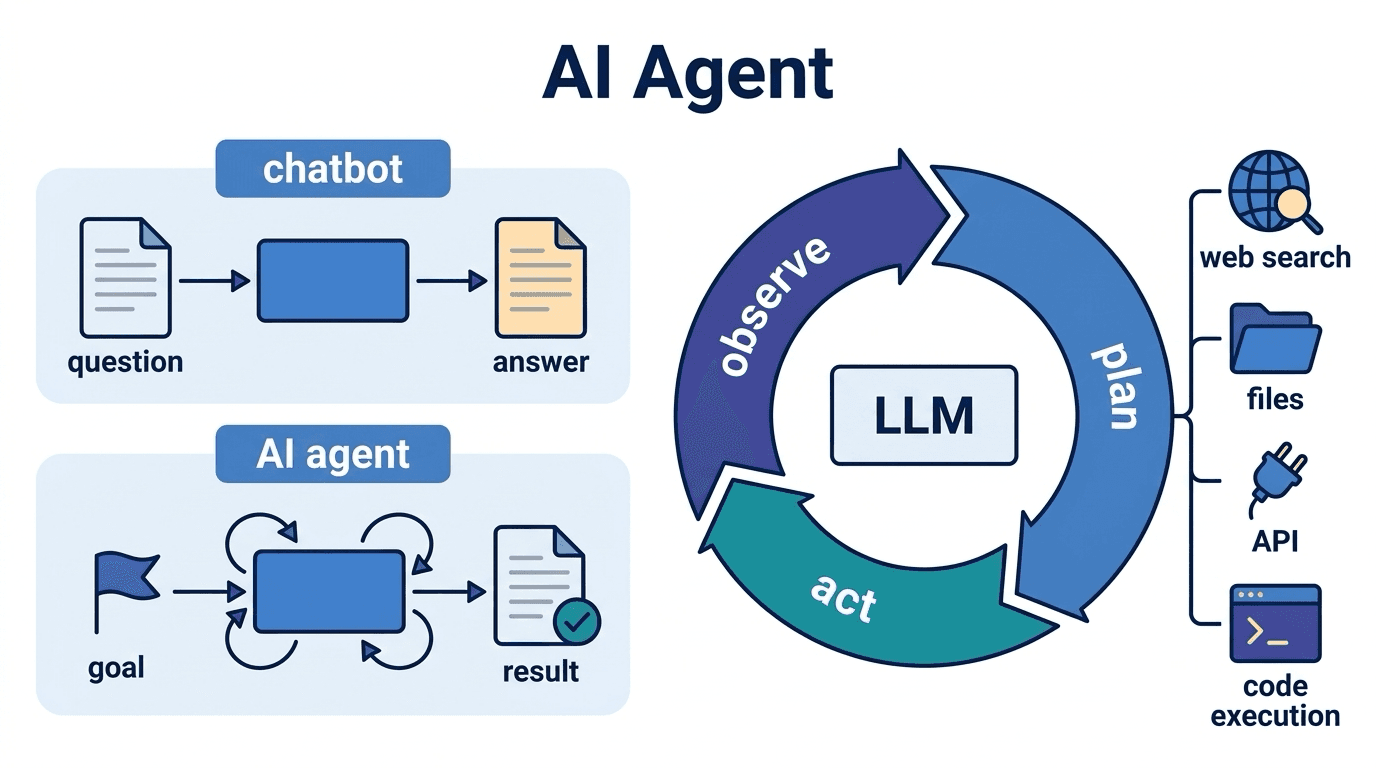
AI Agent
An AI agent is an AI system that autonomously formulates plans toward given goals and executes tasks
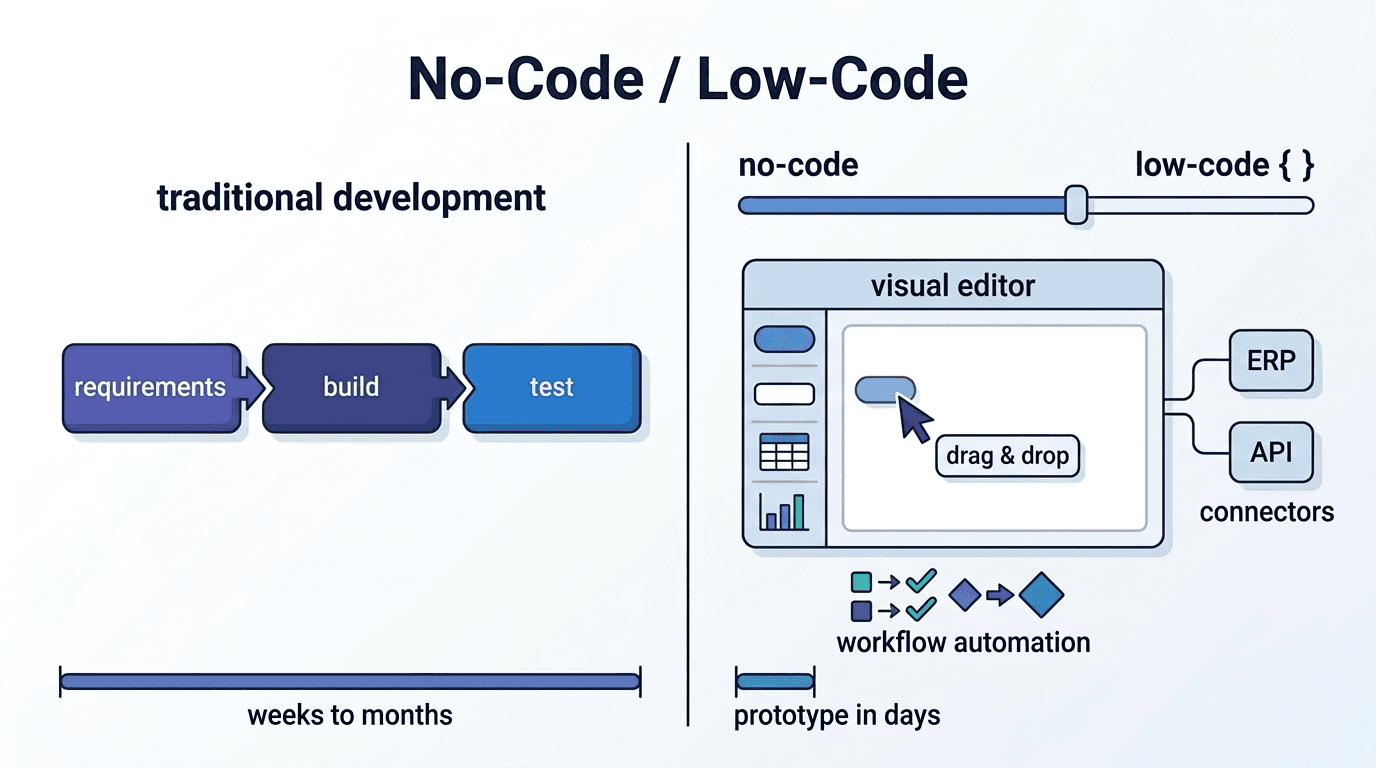
No-Code/Low-Code Development
No-code/low-code development is a development approach that minimizes the need for programming exper
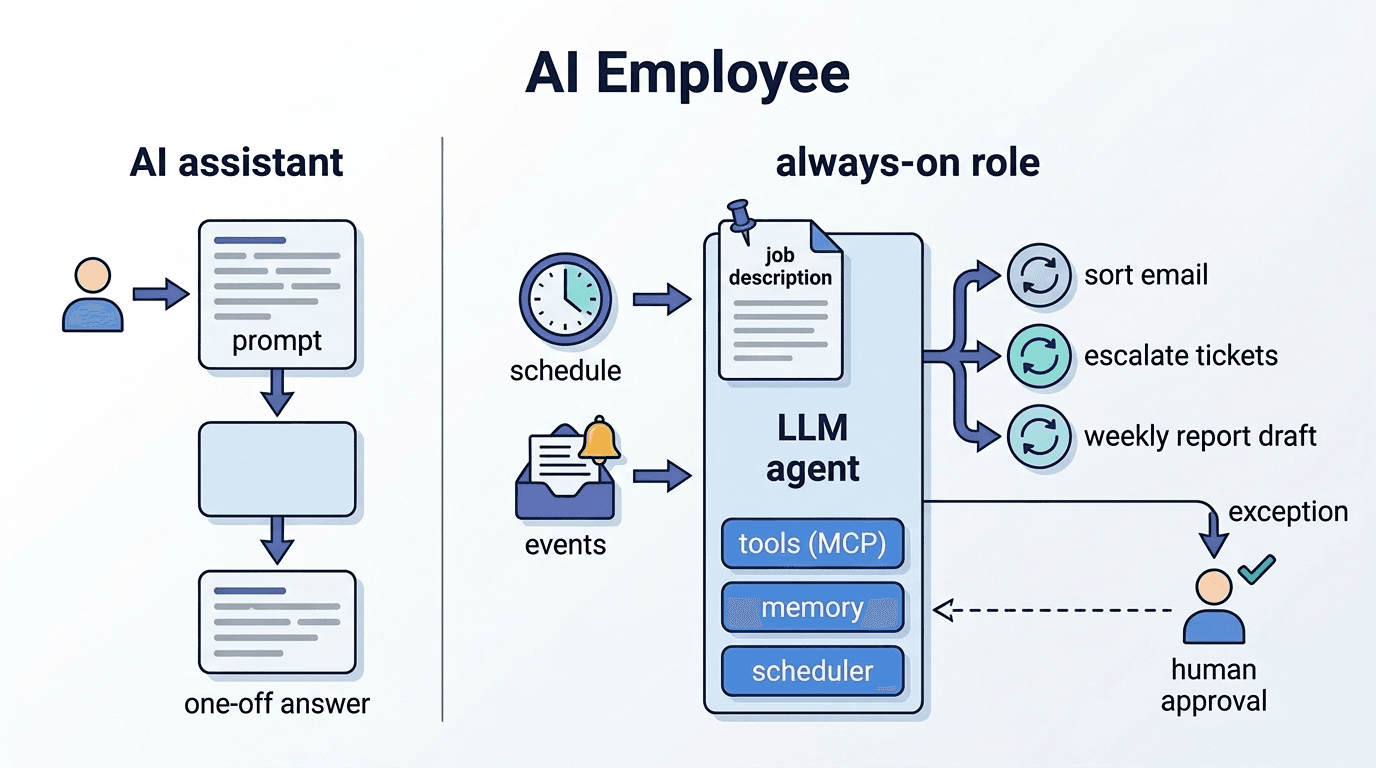
AI Employee (AI Employee)
An autonomous AI agent that takes on a specific business role and continuously performs tasks in the