AI Agent Governance Framework Implementation Guide — Oversight Design to Prevent Agent Drift

What Is an AI Agent Governance Framework?
An AI Agent Governance Framework is a supervisory and control system designed to prevent unintended deviations (agent drift) in environments where AI agents act autonomously.
As the production deployment of multi-agent systems accelerates, "drift"—where agents act beyond their granted authority or quietly deviate from their objectives—has become a serious business risk. Major regulations, including the EU AI Act (Regulation (EU) 2024/1689) and NIST AI RMF 1.0, have begun explicitly mandating human oversight of agents.
This article is intended for information systems departments and AI promotion personnel, and explains the design and implementation of a governance framework in four steps. By reading through the selection of supervision models, guardrail implementation, drift detection, and security integration in order, you can build the foundation for explainable and secure agent operations.
Conclusion: The more autonomous AI agents become, the greater the risk of unintended deviation—and operating without governance directly leads to operational disruptions and legal liability.
In environments where agents autonomously call external tools and execute multiple tasks in sequence, new risks arise that cannot be adequately addressed by conventional AI monitoring methods. This section provides an overview of the background and regulatory trends.
Operational Risks Caused by Agent Drift
Agent drift refers to the phenomenon in which an AI agent gradually deviates from its originally configured goals, procedures, and constraints, continuing to take unintended actions. At first, it is easy to assume that "if an agent operates autonomously, the cost of human verification drops to zero"—but in practice, it is precisely the absence of oversight that accelerates drift, and cases have been reported where no one notices until the damage becomes apparent.
Business risks arise primarily across the following three layers:
- Cascading decision errors: In multi-agent systems, small judgment errors by upstream agents tend to propagate downstream, causing the final output to deviate significantly.
- Self-expansion of authority: Agents call tools or APIs that were never originally intended in order to achieve their goals, creating risks of data leakage and unauthorized operations.
- Accountability gaps: When drift occurs, it becomes impossible to trace which agent and which step initiated the deviation, making audit responses extremely difficult.
Of particular concern is that drift manifests not as a "sudden runaway" but as an "accumulation of gradual deviations." Individual steps may appear normal, yet when viewed across the entire task graph, the outcome has strayed far from the original goal—this type of structural risk is increasingly surfacing after systems go into production.
When building a governance framework, a "shift-left" approach—embedding control points at the design stage rather than reacting after drift has occurred—is the most effective strategy. [What is Multi-Agent AI?
Excessive Agency and the Boundaries of Autonomous Action
The question "Are we delegating too much to agents?" repeatedly surfaces in multi-agent system design. Excessive Agency refers to a state in which an AI agent possesses authority, capabilities, or autonomy beyond what is necessary to achieve its business objectives.
The problem is that over-provisioning of authority often occurs not intentionally, but "for convenience." Granting broad permissions during early development to facilitate debugging and then moving to production without revision, or failing to review the permission scope each time an agent skill is added—these accumulated operational habits gradually blur the boundaries of autonomous action without anyone noticing.
The decision-making criteria can be organized as follows:
- When an agent handles read-only information gathering tasks, the design principle is to not grant permissions for writing, deletion, or external transmission.
- When an agent completes processing across multiple systems, approval gates should be established at each step, with control points where humans can intervene explicitly defined.
- When the scope of a task's impact is irreversible (data deletion, external ordering, contract execution, etc.), rules must be established that prohibit autonomous execution and require HITL (Human-in-the-Loop).
OWASP's LLM security guidelines also identify Excessive Agency as one of the top risks, and recommend applying the Principle of Least Privilege.
Agent Oversight Obligations Under the EU AI Act and NIST AI RMF
"Which risk category does our agent fall under?"—proceeding to production without being able to answer this question risks regulatory compliance costs ballooning after the fact.
Reviewing international regulatory trends, the primary oversight obligations can be summarized along the following two axes:
Requirements of the EU AI Act (Regulation (EU) 2024/1689)
Adopted on June 13, 2024, and published in the Official Journal of the European Union on July 12 of the same year, the EU AI Act mandates Human Oversight for high-risk AI systems. The specific requirements are as follows:
- Implementation of mechanisms that allow humans to intervene and halt agents in real time when they act autonomously
- Log preservation and explainability to continuously monitor output reliability
- Conducting Conformity Assessments for high-risk use cases
Requirements of NIST AI RMF 1.0
Published on January 26, 2023, NIST AI RMF 1.0 (with the latest Playbook updated on March 27, 2026) calls for a structure that continuously evaluates and manages agent risk through four functions: GOVERN, MAP, MEASURE, and MANAGE.
How to Establish Prerequisites for Framework Development

Conclusion: Before beginning governance design, it is essential to establish three foundations: authority, logging, and organizational structure.
Prior to design, conduct an inventory of three elements: the agent's permission scope, the observability infrastructure, and the governance owner. Without this prerequisite in place, subsequent steps are prone to becoming mere formalities.
Inventorying AI Agent Permission Scopes and Agent Skills
When beginning to build a governance framework, many teams tend to think, "Let's start by putting together policy documents." In practice, however, first taking inventory of what permissions agents currently hold and what they are capable of doing significantly improves the precision of the design.
Inventorying the permission scope means listing out the access rights, operational permissions, and external API connections held by each agent. Specifically, the following items should be reviewed.
- Data access permissions: Read-only, or does access extend to writing and deletion?
- External system integrations: The types of APIs, tools, and databases that can be called, and the scope of operations permitted
- List of Agent Skills: The actions each skill can execute and their impact range (limited to local, or extending to external services)
- Delegation relationships between agents: In a multi-agent system, which agents can delegate tasks to other agents?
It is not uncommon for an inventory to reveal cases of Excessive Agency. When the practice of "granting broad permissions for convenience" accumulates, the blast radius in the event of agent drift expands. It is important to redesign in accordance with the principle of least privilege, granting each skill only the permissions it requires.
The inventory results should be recorded as part of an AI Bill of Materials (AI-BOM) and a practice of updating it with every change should be established, making it available for subsequent security reviews and red teaming as well.
Preparing an AI Observability Infrastructure and Log Collection
Whether a governance framework functions effectively depends entirely on whether agent behavior can be made visible. Defining oversight rules without first establishing an AI Observability infrastructure makes it difficult to detect drift or trace accountability.
The types of logs that need to be maintained vary depending on the agent's level of autonomy. In a configuration where a single agent handles routine tasks, collecting three data points—system prompts, inputs/outputs, and tool call history—is often sufficient. In a multi-agent system where multiple agents operate in a chain, the scope of what must be recorded needs to be expanded to include inter-agent communication logs, execution traces of the task graph, and the reasoning behind each step's decisions.
The minimum collection items to cover are as follows.
- Input/output logs: Store prompt and response pairs with timestamps
- Tool call logs: Records of access to external APIs and databases, along with return values
- Error and exception logs: Failed actions, retry counts, and reasons for stopping
- Context window utilization: Trends in token consumption (useful for detecting early signs of unbounded resource consumption)
The storage destination for logs should be designed in accordance with compliance requirements. For operations where outputs containing personal information may be generated, a design that masks the logs themselves before storage is required.
Furthermore, to leverage collected logs in governance audits, it is important to store them in a format that enables Data Lineage tracking.
Identifying Stakeholders and Governance Owners
Even when the call goes out to "build a governance framework," it is not uncommon for work to proceed with ambiguity around who ultimately holds responsibility.
Without a governance owner in place, decisions regarding changes to agent permissions and incident response are left unresolved, causing delays in action. Before building the framework, it is necessary to organize the stakeholders involved and clarify the axis of decision-making.
Key stakeholders to identify
- Governance Owner (Executive Sponsor): Bears accountability for overall agent operations. Often filled by the head of the IT department or a CIO-level executive
- AI Lead: Serves as the bridge between technical and business requirements. Leads risk assessments for each use case
- Legal/Compliance: Manages conformance with the EU AI Act and NIST AI RMF, as well as contractual liability
- Business Unit Owner: The operational owner of the processes the agent handles. The first to grasp the business impact when drift occurs
- Security: Responsible for validating the appropriateness of permission scopes and establishing incident response procedures
Fixing roles with a RACI matrix
Simply listing stakeholders is not enough. For each governance activity (permission change approvals, log reviews, incident response, etc.), it should be made explicit in a RACI matrix who falls under R (Responsible) / A (Accountable) / C (Consulted) / I (Informed).
Step 1: How to Design a Supervision Model

The first question to ask when designing an oversight model is a single one: "How autonomously should this agent be allowed to operate?" Increasing autonomy speeds up processing, but it also raises the risk of unexpected behavior directly impacting operations. Proceeding with implementation while leaving this tradeoff undefined will result in having to retrofit governance after the fact.
Thinking through it in the following order helps prevent gaps in the design: first, determine the level of human involvement; next, design at which points in the task graph controls will be inserted; and finally, give it concrete form as an approval flow.
Choosing Between Human-in-the-Loop, Human-on-the-Loop, and Human-outside-the-Loop
At first, it's tempting to think "having humans approve every step makes it safe," but in practice, selectively applying supervision models based on the nature of the task is more effective at balancing risk reduction with operational efficiency.
The three supervision models are defined as follows:
- HITL (Human-in-the-Loop): A human explicitly approves before the agent executes an action. Applied to high-risk, irreversible operations (e.g., sending contracts, writing to external APIs).
- On the Loop: The agent operates autonomously while humans maintain the ability to monitor and intervene in real time. Suited for medium-risk, repetitive tasks (e.g., data transformation, automated internal notifications).
- Outside the Loop: The agent operates fully autonomously, with humans only reviewing logs after the fact. Limited to low-risk, fully reversible tasks (e.g., read-only data aggregation).
The two axes for deciding which model to apply are "irreversibility" and "scope of impact."
| Decision Axis | HITL | On the Loop | Outside the Loop |
|---|---|---|---|
| Irreversibility | High | Medium | Low |
| Scope of Impact | Broad (external/customers) | Medium (internal systems) | Narrow (read-only) |
Singapore's "Model AI Governance Framework for Agentic AI" (Version 1.
Designing Control Points for Agent Orchestration Based on Task Graphs
A task graph is a representation of the dependency relationships among tasks executed by an agent, expressed as a directed acyclic graph (DAG). Designing in advance which nodes on this graph should serve as control points is the core of governance in agent orchestration.
When designing control points, it is effective to use "reversibility" and "scope of impact" as the key decision axes. For processes with high reversibility and limited scope of impact—such as data reads or searches—the agent may be permitted to execute autonomously. For irreversible processes with a broad scope of impact—such as external API calls, payment processing, or file deletion—human approval or a pause gate should be inserted.
The main points that should be designed as control points are as follows:
- Entry gate: At the time the task graph is initiated, verify that the input parameters fall within the authorized scope.
- Branch nodes: At points where conditional branching changes the execution path, place checks to confirm there is no deviation onto unintended paths.
- External system integration nodes: Restrict callable APIs and tools via a whitelist to prevent Excessive Agency.
- Exit gate: Upon task completion, verify via a grounding check that the output results fall within the expected specification range.
In multi-agent systems, chains occur in which sub-agents call other sub-agents.
Defining Approval Flows and Escalation Conditions
"The agent autonomously hit an external API and confirmed an order on its own"—to prevent such situations, pre-defining approval flows and escalation conditions is essential.
Approval flows are designed around the axes of task scope of impact and reversibility. Specifically, the following three tiers are effective:
- Automatic execution (no approval required): Read-only or reference operations; tasks with localized impact that can be immediately rolled back.
- Asynchronous approval (On the Loop): Writes to external services; processing where amounts or quantities exceed a certain threshold. The responsible party reviews after the fact and sends back for revision if issues are found.
- Synchronous approval (In the Loop): Highly irreversible operations such as contract execution, external transmission of personal information, or changes to production environments. The agent halts processing until approval is obtained.
Escalation conditions are less likely to have gaps when defined using the following triggers:
- When a trust score falls below a threshold (indicating increased hallucination risk)
- When the number of steps executed exceeds the expected count on the task graph
- When errors from external tool calls occur consecutively
- When the data being processed is determined to fall under a confidential classification
Automating the escalation path in the order of "immediate halt → notification to the responsible party → ticket creation in an incident management tool" helps prevent response gaps.
Approval flows are not something you design once and leave alone. Incorporating an operational cycle that revisits and updates conditions whenever the agent's permission scope or business processes change is the key to continuously suppressing agent drift.
Step 2: How to Implement AI Guardrails and Prompt Firewalls

Even if control points are established through supervision design, without an actual mechanism to "stop" things at the input/output level, it remains an empty plan. Prompt injection, unintended propagation of outputs, grounding failures—none of these can be prevented by policy documents alone. This section walks through concrete implementation steps for making control points effective, including the use of NeMo Guardrails and grounding checks.
Input/Output Controls: Countermeasures Against Prompt Injection and Indirect Injection
In guardrail design, it's tempting to think "inspecting only the output side is sufficient," but in practice, control at the input stage functions as the first line of defense. Output filters are ultimately a last-resort safety net; once malicious instructions have entered the model's reasoning process, the difficulty of maintaining control increases substantially.
In configurations where AI agents integrate with external tools and data sources, it is important to note that the attack surface for prompt injection expands significantly. Direct injection is a technique that embeds malicious instructions in user input, whereas indirect injection plants attack commands in external content retrieved by the agent (e.g., web pages, documents, API responses), and tends to be more difficult to detect.
The main implementation points for input/output control are as follows.
Implementation Example of Policy Enforcement Using NeMo Guardrails
NeMo Guardrails is an open-source guardrail framework that allows you to declaratively define policies for LLM inputs and outputs. By combining YAML-based configuration files with a dedicated DSL called Colang, you can control agent behavior without modifying code.
The approach to policy enforcement varies depending on the agent's level of autonomy. For an On the Loop configuration with an approval flow, it is common to combine "blocking responses to prohibited topics" with "escalation notifications." For fully automated Outside the Loop configurations, it is generally preferable to prioritize "automatic output correction (rewriting)" and "automatic shutdown with a retry limit."
The specific implementation steps are as follows.
Grounding Checks to Prevent Output Handling Deficiencies
There are many situations where on-site personnel are unsure whether it is acceptable to pass an agent's generated output directly to a downstream system.
A grounding check is a mechanism that automatically verifies whether an agent's output is grounded in the referenced context (RAG-retrieved documents, system prompts, and tool call results). It functions as the last line of defense against Improper Output Handling.
In terms of implementation, there are three main aspects to verify.
- Grounding consistency check: Score which parts of the retrieved documents correspond to the claims in the output, and hold or regenerate the output if it falls below a threshold
- Scope deviation detection: Structurally verify whether the output indicates actions outside the agent's granted permission scope (e.g., a data write request by a read-only agent)
- Hallucination suppression: Flag any proper nouns or numerical values in the output that do not exist within the information in the context window
As an implementation pattern, the approach of placing NeMo Guardrails' output rails at the end of the chain to automatically evaluate output before passing it to the production system is widely used. Evaluation results are recorded in logs and forwarded to an AI observability platform, enabling integration with drift detection as described in the next step.
Step 3: How to Detect and Correct Agent Drift

Conclusion: Because agent drift left unaddressed leads directly to operational damage, detection and correction mechanisms must be designed before going live.
Countermeasures are built across three layers: real-time monitoring via AI observability, monitoring metric design, and automated shutdown and rollback procedures following anomaly detection.
Real-Time Anomaly Detection via AI Observability
It is tempting to think that detecting agent drift is sufficiently handled by reviewing logs after the fact, but in practice, asynchronous batch monitoring often means deviations are not noticed until they have already expanded—making real-time observation the more effective approach for minimizing damage.
AI Observability refers to a mechanism that continuously measures and visualizes an agent's reasoning process, tool calls, and intermediate outputs. Unlike conventional APM (Application Performance Monitoring), a key characteristic is that it also targets semantic deviations (unintended output drift and out-of-scope actions) for detection.
The main observation points for real-time anomaly detection are as follows.
- Sudden spike in tool call frequency: Trigger an alert when the expected number of calls is exceeded, suppressing Unbounded Consumption
- Context Window utilization rate: Since inference accuracy tends to degrade as the limit is approached, set a threshold and configure automatic notifications
- Decline in output confidence score: Combined with a Grounding Check, route outputs whose scores fall below the standard to an isolation queue
- Anomalous patterns in agent-to-agent (A2A) communication: Detect requests to unexpected agents and repeated failure responses
From an implementation standpoint, an architecture that collects traces as structured logs and records agent actions at the span level is effective.
Designing Monitoring Metrics for Hallucination and Goal Deviation
When designing monitoring metrics, failing to decide "what to measure" upfront tends to result in an accumulation of vast amounts of logs while anomalies go undetected.
Because hallucinations and goal deviations differ in nature, it is important to design separate, independent metric sets for each.
Key metrics for hallucination monitoring
- Grounding score: When using RAG, quantify the match rate between the output and reference documents using cosine similarity or similar measures
- Factual consistency rate: Automatically verify whether the numerical values and proper nouns in the final output match the results retrieved from external APIs or databases
- Self-contradiction detection rate: Count the number of times an agent makes contradictory claims within the same session
Key metrics for goal deviation (agent drift) monitoring
- Task scope deviation rate: The proportion of actions executed by the agent that fall outside the scope defined in the task graph
- Abnormal tool call frequency: The number of times consecutive calls to the same tool or unexpected tool combinations occur
- Trend in goal achievement rate: A sudden drop in the achievement rate over a short span may indicate prompt degradation or external data contamination
Threshold settings for metrics vary by use case. For compliance-oriented tasks where hallucination tolerance is low, it is effective to set a strict grounding score threshold, while for exploratory research tasks, allowing a wider tolerance for goal deviation rate is a practical approach.
Automatic Shutdown and Rollback Procedures After Drift Detection
After detecting drift, many teams find themselves hesitating between "should we stop immediately, or wait and see?" This hesitation is a classic pattern that delays response and amplifies damage. The solution is to automate the "detect → stop → rollback" sequence and narrow down in advance the points where human judgment is required.
Designing Auto-Stop Triggers
Define the following conditions in advance and trigger an immediate stop when any threshold is exceeded.
- When the anomaly score exceeds the configured threshold N consecutive times
- When an external API call is directed to an endpoint outside the allowlist
- When the execution path of the task graph deviates from an approved path
It is recommended to use two stop modes: a "hard stop (immediate forced termination)" and a "soft stop (halt acceptance of new tasks while allowing in-progress tasks to continue to a safe interruption point)." A hard stop is appropriate for operations with a high risk of data corruption; a soft stop is appropriate for stateless processes.
Rollback Procedure
- Revert the agent's state snapshot to the most recent "verified healthy checkpoint"
- Issue compensating transactions for already-executed external actions (DB writes, API submissions, etc.)
- Propagate a stop notification to affected downstream agents and systems
- After rollback is complete, hold off on restarting until root cause analysis (RCA) is finished
Gate Conditions Before Restart
Resuming operation should require approval only after completing the following steps: identifying the cause of the drift → correcting the system prompt or guardrails → re-validating in a staging environment.
Step 4: How to Integrate the Security Layer

Even with guardrails and oversight models in place, gaps will remain. From an attacker's perspective, the "seams" in governance are precisely the most exploitable points.
What is needed, therefore, is a mindset that weaves security into the structure itself rather than treating it as an add-on option bolted onto the framework. Concretely, this means continuously evaluating risk in alignment with AI TRiSM, and using an AI-BOM to make the components of an agent visible and traceable—ensuring that changes and shifts in dependencies are never overlooked. In addition, red teaming should be conducted on a regular basis to proactively surface unexpected behaviors and vulnerable pathways.
These are not independent measures. Only when they function as a mutually reinforcing, multi-layered structure can the reliability of agents be genuinely guaranteed at a production level.
Alignment with the AI TRiSM Framework and AI BOM Management
It is tempting to assume that bolting on security measures after the fact is sufficient, but in AI agent environments, the AI TRiSM (AI Trust, Risk, and Security Management) approach—which integrates trust, risk, and security from the design stage—is in practice far more effective.
AI TRiSM manages agent risk systematically across the following four axes.
- Trust: Visualize the basis for agent decisions using AI explainability (XAI) and ensure accountability to stakeholders
- Risk: Continuously evaluate risks such as Excessive Agency and the Confused Deputy Problem
- Security: Embed countermeasures against prompt injection and memory poisoning into the operational cycle
- Management: Maintain a mechanism that re-executes risk assessments whenever policies are changed or models are updated
As the foundation for making this management cycle function, maintaining an AI Bill of Materials (AI-BOM) is essential. The AI-BOM should record the following information.
Vulnerability Validation Through AI Red Teaming and Leveraging Bug Bounties
A governance framework is not sufficient with "design-time correctness" alone; it only becomes effective once its resilience has been verified against real attack scenarios. AI red teaming is a practical verification method that deliberately destabilizes agent behavior from an adversarial perspective in order to surface unexpected privilege escalations and vulnerabilities to prompt injection.
The primary areas of verification are as follows.
- Direct and indirect injection: Verify whether the system prompt can be overwritten via external data sources
- Excessive Agency: Test whether it is possible to bypass control points in the task graph and invoke unintended external APIs
- Memory poisoning: Inject misinformation into the agent's long-term memory and measure the impact on subsequent tasks
- Confused Deputy Problem: Attempt privilege escalation by exploiting delegation flows to other agents
It is effective to calibrate the depth of verification according to the organization's maturity level. For organizations that have not yet established internal red teaming, the practical approach is to begin with boundary testing aligned with the OWASP LLM Top 10, and then supplement with an external bug bounty program once the necessary infrastructure is in place.
Author & Supervisor

Yusuke Ishihara
Started programming at age 13 with MSX. After graduating from Musashi University, worked on large-scale system development including airline core systems and Japan's first Windows server hosting/VPS infrastructure. Co-founded Site Engine Inc. in 2008. Founded Unimon Inc. in 2010 and Enison Inc. in 2025, leading development of business systems, NLP, and platform solutions. Currently focuses on product development and AI/DX initiatives leveraging generative AI and large language models (LLMs).
Recommended Articles


Terms related to this article

Agent Orchestration
A mechanism that controls task distribution, state management, and coordination flows among multiple

Shadow AI
Shadow AI refers to the collective term for AI tools and services used by employees in their work wi
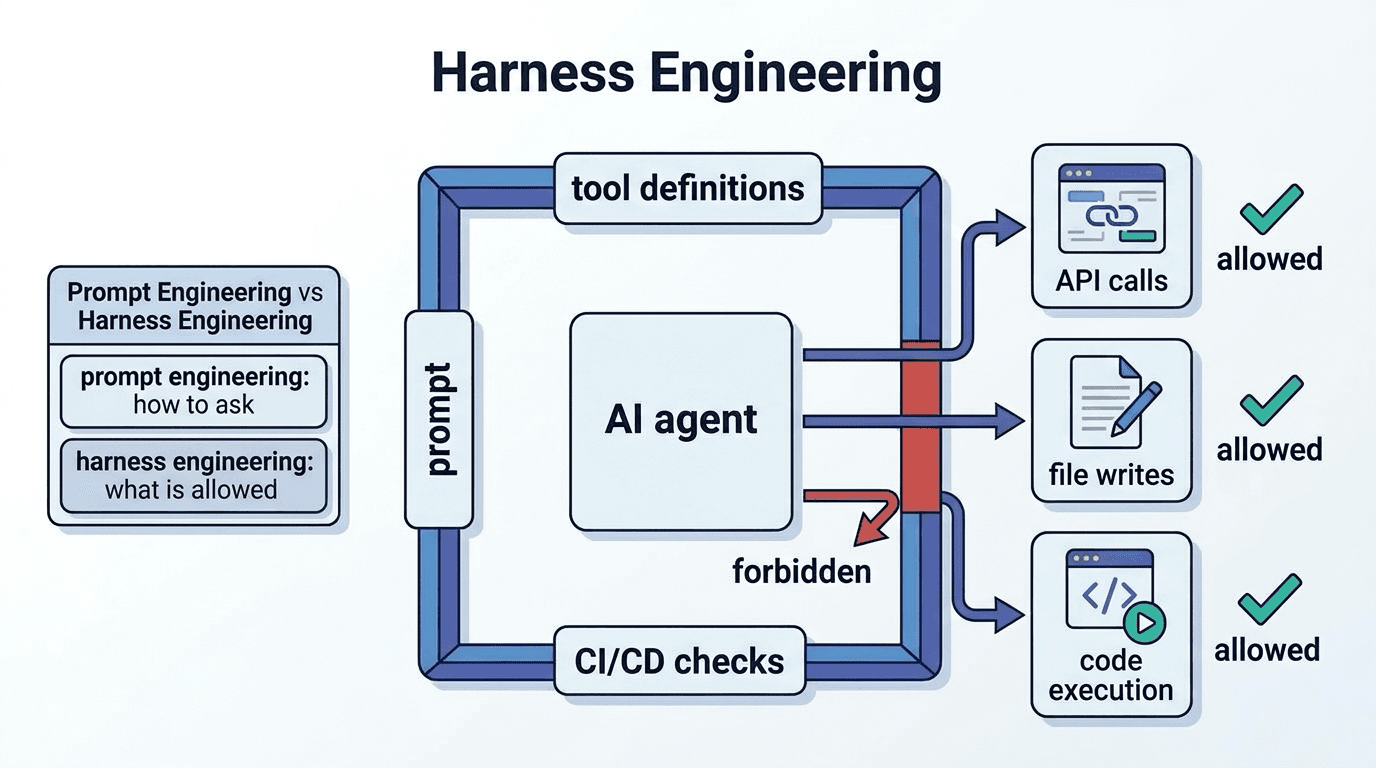
Harness Engineering
Harness engineering is a methodology for designing structural constraints—such as prompts, tool defi