AI Governance for Small Teams: Scalable AI Governance for Small and Medium-Sized Businesses

Lead
AI governance refers to the collective set of policies, processes, and controls that organizations use to operate AI systems safely, fairly, and transparently. With the widespread adoption of generative AI tools, opportunities for small and medium-sized enterprises (SMEs) and small teams to leverage AI for business automation and decision-making support are rapidly expanding.
However, organizations without dedicated AI personnel or compliance departments tend to face more visible challenges, including the proliferation of shadow AI, data breach risks, and regulatory violations. Compliance with AI-related regulations such as the EU AI Act and the PDPA (Thailand's Personal Data Protection Act) is not a concern exclusive to large enterprises.
This article provides a lightweight checklist and implementation steps for building a minimum viable governance framework, aimed at SMEs and small teams operating with limited resources.
Conclusion: SMEs with limited resources are especially vulnerable to severe damage from shadow AI and regulatory violations, making early governance development essential.
As AI adoption in business operations grows, unregulated use within SMEs tends to create gaps in internal controls. From the perspectives of regulatory compliance, risk management, and maintaining trust, establishing a minimum viable framework is a pressing need.
Shadow AI Risks and the Need for Internal Controls
It is easy to initially assume, "We don't use any unauthorized tools," but in reality, many organizations have reported cases where frontline staff begin using generative AI services without authorization in order to improve operational efficiency. This is the phenomenon known as shadow AI.
The reason shadow AI is dangerous lies in the fact that data is being transmitted externally without the organization's knowledge. The primary risks are as follows:
- Confidential information leakage: Prompts containing customer data or proprietary internal knowledge may, depending on the terms of service, be used to train the model
- Compliance violations: Sending data containing personal information to external services without authorization risks violating the PDPA (Thailand's Personal Data Protection Act) and other personal data protection laws
- Degradation of quality and reliability: Tools without guardrails can introduce inaccurate outputs (hallucinations) into business operations, undermining the quality of decision-making
Many SMEs feel that "managing this is difficult without a dedicated IT person." However, the first step in internal control is not building a complex system — it is establishing a clearly documented AI usage policy that specifies which AI tools may be used, by whom, and for what purpose.
By including at minimum the following three elements in the policy, organizations can eliminate the breeding ground for shadow AI:
- A whitelist of approved tools and explicit identification of prohibited tools
- A definition of data types that must not be entered (personal information, trade secrets, etc.)
- A clear reporting route and response flow in the event of a violation
Shadow AI does not tend to be resolved simply by prohibition; rather, it naturally decreases when convenient, officially sanctioned alternatives are provided.
Navigating Regulations: EU AI Act, PDPA, and Beyond
Regulatory compliance is often perceived as "a problem only for large enterprises," but SMEs are already within the scope of existing regulations.
The EU AI Act (Regulation (EU) 2024/1689) entered into force on August 1, 2024, with the majority of its provisions becoming fully applicable on August 2, 2026. Since organizations that provide or use AI for users within the EU may be subject to the regulation regardless of company size, SMEs engaged in cross-border e-commerce or global SaaS should verify their obligations at an early stage.
Thailand's Personal Data Protection Act (PDPA) similarly applies to any business handling the personal data of individuals residing in Thailand, regardless of whether the business is domestic or foreign. When AI chatbots or demand-forecasting AI systems process customer data, obtaining consent, clearly stating the purpose of use, and setting data retention periods are required. For more details, please also refer to Thailand PDPA Compliance Checklist for AI Integration.
A practical approach to prioritizing regulatory compliance is to assess based on the following criteria:
How Governance Requirements Differ Between Large Enterprises and SMEs
"When we tried to implement a large-enterprise governance framework as-is, just creating the documentation took several months" — this is a sentiment frequently heard from SMEs on the ground.
The level of granularity and the priorities required for governance differ fundamentally between large enterprises and SMEs. The key differences can be summarized as follows:
- Presence of dedicated personnel: Large enterprises can establish AI ethics committees or appoint a Chief AI Officer, whereas in SMEs, existing members taking on these responsibilities concurrently is the practical reality
- Type and scale of risk: Large enterprises have a broad social impact footprint, making compliance with regulations such as the EU AI Act a top priority. For SMEs, the relatively greater risks are mishandling of personal information and information leakage due to shadow AI
- Depth of documentation: Large enterprises require detailed records for audit purposes, whereas for SMEs, a concise, single-page policy that clearly shows "who uses what and for what purpose" tends to be more functional in practice
NIST AI RMF 1.0 (published January 2023) and ISO/IEC 42001:2023 are designed to be applicable regardless of organizational size. However, these are reference standards, and SMEs are not required to cover every item. A practical approach is to narrow down the controls to be applied based on the organization's scope of AI use and risk level.
AI Governance Checklist for Small Teams

Conclusion: AI governance for small and medium-sized businesses functions by covering at minimum three areas: "policy," "data management," and "tool selection."
Below, we organize the checklist items that small teams should prioritize into three categories. Details on each item are explained in the H3 sections that follow.
Policy Checklist (Formalizing AI Usage Rules and Prohibitions)
It is tempting to think "let's create a detailed policy document before we start using AI," but in practice, it is easier to establish adoption by first publishing a concise AI usage policy of about one page and revising it as you go.
For the policy development check, please confirm the following items at a minimum.
- Explicit list of approved tools: Clearly document a list of AI tools and services approved for internal use, and prohibit the use of unapproved tools for business purposes. This is the first step toward eliminating the breeding ground for shadow AI.
- Concrete prohibited actions: Describe prohibited behaviors at the action level, such as "do not enter confidential or personal information into external AI services" and "do not send generated output directly to external parties."
- Use-case permission classifications: Organizing permissions by use case—such as internal document creation, code assistance, and customer support—into a table with "permitted / conditionally permitted / prohibited" reduces the cost of judgment.
- Accountability: Clearly designate a final reviewer (responsible person) for AI-generated output, and incorporate the Human-in-the-Loop (HITL) principle into the policy.
- Revision cycle: Specify a regular review schedule within the policy—such as once every six months—to prevent it from becoming a formality.
For the format of the policy, editable tools such as an internal Wiki or Notion are recommended over PDF. Set it up alongside an operational workflow that ensures all staff are notified with each update.
A good benchmark for completion is: "Can a new employee read this in 10 minutes and make a judgment call?" Overly complex policies go unread and become a cause of a culture that tacitly tolerates shadow AI.
Data Management Checklist (Data Governance and Data Lineage Review)
When integrating AI into business operations, insufficient data quality and traceability not only degrades model output accuracy but also makes it impossible to maintain an audit trail for regulatory compliance. The data management check is a process that underpins the foundation of a governance framework.
The main checklist items to verify are as follows.
- Data location and classification: Distinguish between personal information, confidential information, and public information, and create an inventory of which data is being input into AI systems.
- Data lineage recording: Maintain a traceable state of where training data and inference-time input data originated and how it was processed.
- Retention periods and deletion rules: Formally document retention periods and disposal procedures for data referenced by AI.
- Access control verification: Restrict the scope of data accessible to AI tools based on the principle of least privilege.
It is practical to calibrate the level of data lineage implementation based on the team's situation. If there is a dedicated data engineer in-house, it may be worth considering the introduction of a data catalog tool. However, for a small team of just a few people, simply starting with a spreadsheet to manage an inventory of input data is sufficient to ensure a minimum level of traceability.
Additionally, if you are using external AI SaaS tools, always check the service's terms of use to determine whether your company's data will be used for training that service's models. Understanding the scope of data processing before agreeing to the terms of service helps prevent problems down the line.
Model and Tool Selection Checklist (AI Guardrails and Model Cards Review)
"Is this AI tool really not sending our business data externally?"—if this question arises after deployment, it may already be too late. Developing the habit of checking model cards and guardrails at the model and tool selection stage significantly reduces risk in later processes.
Main checklist items to verify
- Confirming the existence of a model card: Check whether the provider publishes a model card. Prioritize selecting models that clearly document an overview of training data, use-case restrictions, and known biases.
- Presence of AI guardrails: Verify whether filtering for harmful output and protections against prompt injection are built in. Consider whether an external guardrail layer such as NeMo Guardrails can be added.
- Data transmission destinations and privacy policy: When calling a model via API, check the terms of use to determine whether input data will be used for training. Always verify this before sending prompts that contain personal information or trade secrets.
- License and commercial use terms: Even when using open-weight models internally, confirm whether commercial use is permitted. License violations carry direct legal risk.
- Vendor security certifications: Check whether the vendor holds third-party certifications such as SOC 2 Type II or ISO/IEC 27001.
Operational tips for small teams
If there is no dedicated person in charge, a practical approach is to compile the above checklist into a single spreadsheet at the time of tool selection and use it as an attachment to the deployment request.
Checklist Details: How to Define Policies and Assign Roles

Conclusion: Even without a dedicated person in charge, policy and role allocation function simply by documenting "who decides what and how."
To translate the checklist into actual operations, the key lies in the content of the AI usage policy and the design of role assignments. The next H3 section will walk through, in order, the elements to include in the policy, how to design roles for staff with concurrent responsibilities, and the criteria for HITL judgment.
Five Essential Elements of an AI Usage Policy
When creating AI usage policies, the initial instinct is often to "build a rulebook that covers every prohibition." In practice, however, a single-page document focused on five simple elements tends to achieve higher adoption rates in the workplace and is easier to sustain operationally.
By incorporating the following five elements at a minimum, even a small team without a dedicated person in charge can create a functional policy.
① Purpose of Use and Scope of Application Clearly specify which AI tools may be used for which tasks. Defining the scope in writing—such as "limited to operational efficiency purposes" or "no input of confidential data"—is the starting point.
② List of Prohibited Actions and Cautionary Behaviors Explicitly state prohibitions such as unauthorized input of personal or confidential information, use of Shadow AI for business purposes, and external sharing of AI outputs without verification. If "what must not be done" remains ambiguous during operation, accountability becomes unclear when an incident occurs.
③ Data Handling Rules Establish classification criteria for data that may be entered into AI tools (public, internal use only, confidential), and provide a reference table showing which AI tools may be used for each classification. From a Data Governance perspective, it is also recommended to maintain operational records of Data Lineage for input data.
④ Human-in-the-Loop (HITL) Application Criteria Distinguish between tasks where AI output may be used as-is and those that must always be reviewed and approved by a human. It is generally standard practice to require mandatory human review for outputs related to customer responses, contract drafts, and financial data.
Designing an AI Governance Role That Works with a Dual-Hat Structure
Very few small and medium-sized enterprises can afford a dedicated AI governance officer. The practical solution is a role design that assumes a concurrent-duty arrangement.
To make a concurrent-duty structure work, it is important to clearly define roles by separating them into "responsible party" and "operational staff."
Primary Roles of the Responsible Party (AI Governance Owner)
- Final decision-making authority for approving and revising AI usage policies
- External response management when a serious incident occurs
- Periodic review of the governance framework (approximately once per quarter)
Primary Roles of Operational Staff (AI Governance Officer)
- Initial screening of applications for new AI tool and model adoption
- Updating checklists and communicating them internally
- Recording and consolidating incident logs
For organizations with 20 or fewer employees, it is acceptable for one person to serve as both the responsible party and operational staff. However, for organizations exceeding 50 employees, it is preferable to assign one operational staff member per department, with the responsible party managing across departments.
The most common failure for concurrent-duty staff is "priority conflicts with their primary responsibilities." To prevent this, it is effective to explicitly include AI governance workload in operational plans in advance and to fix a monthly standing meeting (approximately 30 minutes) on the calendar.
It is also essential to prepare role definition documents and checklists as formal documentation in anticipation of knowledge transfer when a staff member is reassigned or leaves. Preventing over-reliance on individuals is the single most important key to sustaining governance continuity in small teams.
Human-in-the-Loop (HITL) Decision Criteria and Operational Workflow
"Can we use AI output as-is, or should a human review it?"—If this decision criterion remains ambiguous when operations begin, irreversible mistakes are likely to occur later.
The key to designing HITL (Human-in-the-Loop) is not to have humans check every output, but rather to focus human involvement exclusively on high-risk decisions. If the cost of review is too high, staff in the field will end up simply repeating a hollow approval process.
Guidelines for When HITL Is Required
- When the output involves actions that are difficult to reverse, such as direct customer notifications, contracts, or credit decisions
- When output containing personal information or confidential data is to be sent externally
- When the scope of impact from a hallucination would be broad (e.g., legal documents, medical information)
- When an AI's trust score or confidence level falls below a defined threshold
Conversely, for use cases with limited scope of impact and low correction costs—such as generating internal summaries or drafting routine reports—it is often acceptable to skip the approval step and proceed with automation, as explained in What Is Human-in-the-Loop (HITL)? The Fundamentals of "Human-Participatory" Design for Establishing AI-Driven Business Automation.
Key Points for Implementing the Operational Flow
- Trigger Definition: Document the criteria above and reflect them in tool settings and system prompts
Checklist Details: How to Ensure Risk Assessment and AI Observability

Conclusion: Even for small and medium-sized enterprises, establishing a minimal framework for risk assessment and AI observability enables early detection and mitigation of real-world harms such as hallucinations and prompt injection.
Operational risks associated with AI frequently become apparent only after deployment. This section covers three topics in order: hallucination countermeasures, AI observability, and incident response flows.
Addressing Hallucinations and Prompt Injection
Hallucinations and prompt injection are the two most frequently encountered risks in AI governance practice. The initial assumption is often that "choosing a high-accuracy model will solve the problem," but in reality, the design of operational safeguards on the implementation side is what makes the difference—not just model quality.
Fundamentals of Hallucination Countermeasures
A hallucination refers to the phenomenon in which an LLM confidently outputs information that is factually incorrect. Typical impacts in small and medium-sized enterprises include the introduction of misinformation into customer-facing documents and incorrect responses in internal knowledge bases. The key countermeasures are the following three points:
- Thorough Grounding: Leverage RAG (Retrieval-Augmented Generation) to anchor responses to internal documents and verified data sources
- Establishing HITL (Human-in-the-Loop): Implement a flow that requires a human to perform a final review of any output related to customer touchpoints or decision-making
- Automating Grounding Checks: Use scripts to periodically verify that outputs are consistent with their referenced sources
Fundamentals of Prompt Injection Countermeasures
Prompt Injection is an attack in which malicious input overwrites the System Prompt, causing the AI to behave in unintended ways.
Selecting and Implementing AI Observability Tools
When selecting AI Observability tools, the first question to ask is: "What do I want to monitor?" In some cases, simply collecting logs is sufficient, while in others, hallucination detection and latency tracking are also required. The appropriate level of granularity varies significantly depending on your objectives.
Key Criteria for Tool Selection
- When using API-integrated generative AI: Lightweight tools that can record and visualize LLM input/output logs (e.g., open-source equivalents of LangSmith or Helicone) offer excellent cost-effectiveness.
- When operating on your own servers or internal network: Since data cannot be sent externally, you need to select an observability platform that supports self-hosting.
Minimum Monitoring Items to Cover
- Input/output logs: Records of prompts and responses. These serve as the starting point for incident investigations.
- Latency and error rates: Abnormal delays or sudden spikes in errors are signs of model degradation or attacks.
- Hallucination detection: Incorporate grounding checks to flag outputs that deviate from factual information.
- Cost tracking: Visualize token consumption to detect budget overruns early.
Deployment Steps for Small Teams
The most practical approach is to start with a minimal configuration that feeds LLM inputs and outputs into your existing logging infrastructure (such as CloudWatch or Datadog). For dashboards, prioritize alert settings that "notify when an anomaly is detected," and defer report building for later.
Building an Escalation Flow for AI Incidents
"When the AI returns an incorrect answer, I don't know who to report it to" — this is a concern frequently heard in small team environments. Without an escalation flow in place, there is a risk that incidents go unaddressed while the damage continues to grow.
An escalation flow tends to work well when designed around the following three stages:
- Stage 1 (Detection & Recording): The person who notices an anomaly in AI output or a suspected data breach records the date, content, and scope of impact in an incident log. A dedicated form or shared spreadsheet is sufficient.
- Stage 2 (Initial Assessment): The person concurrently serving as AI governance lead assesses the severity within 24 hours, classifying it as "minor / moderate / critical." If classified as critical, immediate reporting to management and temporary suspension of the relevant AI tool should be considered.
- Stage 3 (External Response): For incidents involving personal information, there may be an obligation to notify the supervisory authority within a specified deadline under the PDPA (Thailand's Personal Data Protection Act) or domestic personal information protection laws. It is important to include contact information for legal counsel and external advisors directly within the flow.
Key points to keep in mind when designing the flow:
- Store the contact list (responsible parties, external advisors, tool vendors) in the same location as the flow itself.
- Document assessment criteria in advance so that anyone can make consistent judgments.
- Conduct quarterly drills in a role-play format to verify the flow's practical effectiveness.
Even without a dedicated SOC (Security Operations Center) like those found in large enterprises, simply establishing a three-tier assessment framework and a contact list can significantly reduce delays in initial response.
Common AI Governance Mistakes SMEs Make

Conclusion: Well-intentioned "deploy first, think later" approaches create risks that are difficult to undo.
There are several typical patterns of AI governance failure in small and medium-sized enterprises. A "figure it out as we go" mindset tends to breed Shadow AI and documentation that exists in name only.
The Shadow AI Breeding Ground That Starts with "Just Use It"
"Let's try it first and deal with problems as they come" — this attitude is not uncommon in small teams. However, that seemingly small first step can easily become a breeding ground for Shadow AI.
Shadow AI refers to AI tools that are independently adopted and used by employees on the ground without approval from the IT department or management. A typical example is when employees paste customer data or internal documents directly into a generative AI tool registered under a personal account in order to improve work efficiency. It is also not uncommon for multiple staff members to individually sign up for free-tier AI services with no one verifying the data handling policies, or for AI-integrated workflows built with No-Code/Low-Code Development tools to go into production without being recorded in the IT asset register.
Initially, these practices tend to be overlooked as "individual ingenuity," but in reality, risks that the organization should be managing are quietly accumulating. Rather than responding after a problem occurs, consolidating the entry point for usage requests into a single channel will significantly reduce long-term costs and reputational risk.
The starting point for addressing this is establishing a simple AI tool usage request flow.
Case Studies: When Over-Documentation Stalls Operations
There are cases where the good intention of "let's get things properly organized" paradoxically causes governance to become a mere formality.
When there is too much documentation, those responsible give up on keeping it updated, resulting in a "decorative rulebook" that no longer reflects reality. The following patterns have been reported particularly in small teams:
- Approval flows are too complex, causing staff to resort to unofficial tools (which itself becomes a breeding ground for Shadow AI)
- AI usage policies exceed 30 pages and become a dead letter that no one reads
- The structure requires a full review with every change, causing updates to stall for six months or more
The purpose of documentation is not to "prove that it was put in place," but to "enable staff to act without hesitation."
For teams of fewer than 10 people, a concise 1–2 page AI usage policy is sufficient. For organizations of around 50 people with multiple departments, a structure that adds thin, department-specific supplementary guides tends to work well. Adjusting the level of documentation granularity to match the organization's scale is key to sustainable operation.
The following three practical measures are effective:
- Create a one-page quick reference that covers only "prohibited actions" and "recommended procedures"
- Keep the policy itself unchanged and manage use-case-specific FAQs in a separate file (this reduces how often the main document needs to be updated)
- Design the structure from the outset so that a 15-minute quarterly review is all that is needed
Governance documents that are "concise and actually used" protect the organization better than those that are "comprehensive but never read." The approach best suited to small and medium-sized enterprises is to start with the minimum viable structure that staff can reference, and expand it incrementally as needed.
Overlooked Blind Spots in AI Governance

Conclusion: Even after policies and operational workflows are in place, two blind spots tend to remain: procurement channels for external tools and workforce development.
Even when internal rules are established, blind spots such as third-party AI tools and insufficient employee literacy are often overlooked. The following H3 section will explore these two points in concrete detail.
Supply Chain Attacks and Third-Party AI Tool Risk Management
Third-party AI tools act as "invisible doors" that have deep access to business data, even though the organization has not developed them directly. A supply chain attack is a method of introducing malicious code or data contamination through trusted tools or libraries, and smaller businesses tend to have fewer resources for verification and are less likely to notice when they have been compromised.
The following are typical cases where risk is elevated:
- Adoption of unvetted plugins and extensions: Plugins published on the marketplaces of no-code/low-code development platforms vary in the reliability of their providers
- Connecting external data sources to RAG pipelines: If data ingested into a vector database via external APIs or crawlers is contaminated, it can lead to RAG poisoning
- Outsourcing data processing to AI SaaS: There have been reported cases where organizations overlook contractual clauses stating that input prompts and business data may be used for model training
The fundamental approach to addressing these risks is to adopt a "ask before you use" mindset. Specifically, verify the following:
The Importance of Embedding AI Literacy Training into Your Organization
AI literacy education must be designed not as a one-time training event, but as a mechanism that is continuously embedded within the governance framework.
It is easy to assume at first that "teaching people how to use the tools is enough," but in practice, without sharing a common standard for risk judgment, there is no end to cases where employees unknowingly begin using shadow AI or paste confidential information into prompts. Developing both technical proficiency and a sense of ethics and risk awareness is what strengthens the effectiveness of governance.
When integrating this into a small team's structure, keeping the following three stages in mind will make it easier to sustain:
- Foundational understanding (for all staff): Cover the minimum risks everyone should know—such as hallucination, prompt injection, and handling of personal information—in approximately 30 minutes of onboarding materials
- Role-specific deep dives (for responsible personnel): Provide AI governance leads and development team members with content that goes deeper into concepts such as the NIST AI RMF and ISO/IEC 42001, as well as incident response workflows
- Regular updates (for all staff): Given the rapid pace of generative AI evolution, establish a quarterly forum for sharing new risk cases and updates to internal rules
The key to making education stick is embedding it into existing business workflows. For example, simply adding a checklist item such as "Has the responsible person completed AI literacy training?" to the process for adopting a new AI tool can go a long way toward preventing education from becoming a mere formality.
Frequently Asked Questions (FAQ) on AI Governance

Q1. Is AI governance really necessary for small and medium-sized businesses?
Regardless of size, any organization that uses AI in its operations needs governance. The proliferation of shadow AI and unintentional leakage of personal information occur in small and medium-sized businesses as well. The EU AI Act will become fully applicable in large part on August 2, 2026, and companies involved in the EU market will be required to comply regardless of their size. Even establishing a minimum usage policy and risk assessment can significantly reduce the risk of reputational damage and regulatory penalties.
Q2. If there is no dedicated person in charge, who should be responsible for AI governance?
If appointing a dedicated person is not feasible, a practical approach is to have an existing IT systems manager or a general affairs or legal staff member take on the role concurrently. What matters most is clearly documenting "who has decision-making authority," because when roles remain ambiguous, incident response is delayed. Referencing the GOVERN function outlined in NIST AI RMF 1.0 (published January 26, 2023) and documenting at least the decision-making flow will help the arrangement function even with a concurrent staffing model.
Q3. How much does it cost to establish AI governance?
The primary costs are human resources spent on policy formulation, education, and review, rather than tool procurement. The cost of AI literacy training and drafting usage policies can be kept down by building on existing internal documents and developing them incrementally. While obtaining ISO/IEC 42001:2023 (published December 18, 2023) certification is optional, creating a lightweight version tailored to your organization's scale by referencing the standard's requirements is a cost-effective approach.
Q4. What should be done when a hallucination occurs?
The fundamental countermeasure is to establish a human-in-the-loop (HITL) process in which a human performs a final review of AI outputs. After an incident occurs, use logs to trace which prompts or input data were the cause, and reflect the findings in preventive measures within the system prompt and AI guardrails. Accumulating incident records also contributes to the continuous improvement of governance.
Q5. What is the difference between AI governance and data governance?
Data governance refers to efforts to establish data quality, management, and access controls, while AI governance covers the entire lifecycle of AI system development, operation, and monitoring. The two are closely related: without proper data lineage in place, it becomes impossible to trace the basis for an AI model's decisions, which undermines the effectiveness of AI governance. For small and medium-sized businesses, it is efficient to develop both together, starting with clarifying where data resides and what it is used for. For more details, please also refer to What is AI Governance? A Practical Guide from EU AI Act Compliance to Internal Rule Development.
Author & Supervisor

Yusuke Ishihara
Started programming at age 13 with MSX. After graduating from Musashi University, worked on large-scale system development including airline core systems and Japan's first Windows server hosting/VPS infrastructure. Co-founded Site Engine Inc. in 2008. Founded Unimon Inc. in 2010 and Enison Inc. in 2025, leading development of business systems, NLP, and platform solutions. Currently focuses on product development and AI/DX initiatives leveraging generative AI and large language models (LLMs).
Recommended Articles


Terms related to this article
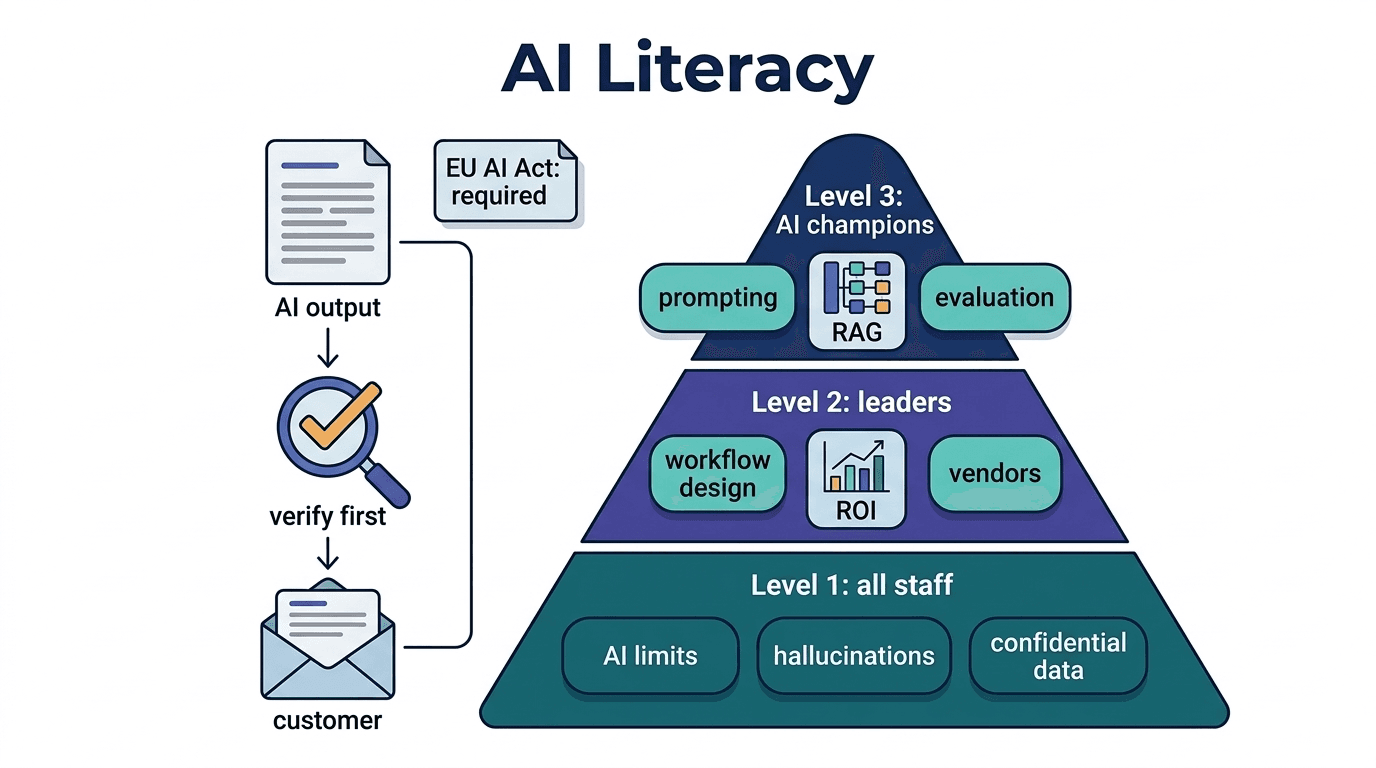
AI Literacy (AI Literacy)
Knowledge and skills to understand the basic concepts, limitations, and risks of AI, and to appropri

AI TRiSM (AI Trust, Risk, and Security Management)
AI TRiSM is a collective term for frameworks that systematically ensure the trustworthiness, risk ma

AI Observability
An operational practice of continuously monitoring and visualizing the inputs/outputs, latency, cost