What is an AI-Ready Data Foundation? Conditions for AI-Usable Business Data and the 3-Layer Model

We built a DWH, set up BI, and loaded internal documents into RAG — yet AI still can't answer business questions correctly. The problem isn't "insufficient data" but "not being AI Ready."
An AI Ready data infrastructure is a data infrastructure that has been prepared to a state where AI can understand the context of business operations, make judgments based on trustworthy data, within the scope of granted permissions, while showing its reasoning, and connect those judgments to the next human action.
What we want to emphasize here is that this is not about building a data warehouse (DWH), setting up BI dashboards, or ingesting internal documents into RAG. Those are part of being AI Ready, but they are not the whole picture.
This article is aimed at data, IT, and DX professionals who are working to advance the use of AI agents and generative AI in their organizations, as well as practitioners who have hit the wall of "we have the data, but we can't get AI to work properly." The goal is that by the time you finish reading, you will be able to assess what your organization's data infrastructure is lacking, using the concrete framework of three layers and five requirements.
In a word, AI Ready is not a state where AI "can generate answers," but a state where AI "can produce the right answers for business." The difference may seem small, but in production use it becomes a decisive distinction. Let's start by organizing this difference from three angles.
"Giving Data to AI" and "AI Ready" Are Not the Same
In many workplaces, AI Readiness is understood as "making data accessible to AI." Consolidating data in the cloud, making it referenceable via API, vectorizing documents to enable search — these are indeed necessary steps.
However, being able to pass data and being able to use it correctly are two different things. If you let AI reference a table, it will return numbers. If you let it search documents, it will generate plausible-sounding text. The question is whether those answers can withstand scrutiny as business judgments.
An AI Ready state means that, in addition to data being physically accessible, the following conditions are met: (1) the data is trustworthy, (2) its meaning is defined, (3) who can access what is controlled, and (4) the basis for any given answer can be traced after the fact. Accessibility is merely the entry point.
AI Writing SQL and Delivering Correct Business Answers Are Two Different Things
With the evolution of generative AI, the task of writing SQL from natural language has become largely automated. But AI being able to write SQL and AI being able to correctly answer business questions are entirely different capabilities.
For example, even if you give AI only a table definition, the following kinds of business context cannot be read from the schema:
- Is "revenue" tax-exclusive or tax-inclusive? Does it include returns and cancellations?
- Which customer ID and contract ID should be treated as the authoritative record?
- Among the different KPI definitions used by each department, which is the official definition?
- Are sales, customer support, and management using the same words with different meanings?
When AI operates without this context, it tends to return SQL and explanations that look plausible on the surface while producing answers that are off-target as business judgments. What makes this particularly troublesome is that precisely because the output looks plausible, errors are hard to notice.
In fact, companies providing data analytics platforms have also noted that database schemas alone lack the logic for calculating metrics and the definitions of business processes, and that a separate layer of "semantic definitions" must be provided. A schema is structure — not meaning.
Why "AI Ready" Is Being Asked About Now
The reason the term AI Ready has suddenly taken on greater weight is that the consumers of data are expanding from humans to AI agents.
While humans were the ones looking at BI, even if data was somewhat fragmented, staff could compensate with their own memory and manual effort. Tacit knowledge such as "this figure is tax-inclusive, so be careful" or "this customer is linked to that contract" served as glue inside people's heads.
But when you try to deploy AI agents in sales, customer support, management, and back-office functions, this tacit knowledge suddenly stops working. AI has no human memory, and the number of times it accesses data is orders of magnitude greater than a human's. Startups and mid-sized companies in particular tend to accumulate tools — product databases, CRMs, spreadsheets, chat tools, documents, ticket management systems, and more — faster than they can be organized, leaving fragmentation unaddressed. AI Ready is also an effort to build that "glue that humans used to provide" directly into the data infrastructure itself.
The 3 Layers That Make Up AI Readiness

An AI-Ready data foundation is easiest to understand when broken down into three broad layers. The key takeaway is that AI Readiness is not a question of technology stack, but rather a question of building up three layers: data preparation, semantic enrichment, and governance.
| Layer | Role | Representative Mechanisms |
|---|---|---|
| Layer 1: Data Preparation | Building trustworthy data | Medallion (Bronze/Silver/Gold), data quality validation |
| Layer 2: Semantic Enrichment | Conveying the meaning of data to AI | Semantic models, metrics layer, data catalog, ontology |
| Layer 3: Governance & Operations | Enabling safe, sustained use | Access control, masking, audit logs, data lineage, observability |
Layer 1: Creating Trustworthy Data (Medallion Bronze/Silver/Gold)
The first requirement is building trustworthy data. This means consolidating data scattered across product databases, CRMs, billing systems, support ticket histories, usage logs, spreadsheets, and more, then shaping it into a form that can withstand analytical and AI workloads.
The approach best suited for this is the "Medallion Architecture," originally championed by Databricks and now widely adopted. It is a framework for refining data in stages: Bronze retains raw data in its original form; Silver handles cleansing, deduplication, type conversion, joining, and validation; and Gold shapes the data into business-ready formats such as KPIs, departmental reports, and executive metrics.
Even in the age of AI, this unglamorous work of data preparation never becomes unnecessary. If anything, the more AI is involved in business decisions, the more critical data freshness, accuracy, granularity, history, and reproducibility become. AI does not question the data it is given. That is precisely why quality before ingestion determines the quality of output. Skipping preprocessing and feeding raw data directly to AI means that any distortions in that data are transferred as-is into the responses.
Layer 2: Giving Data Meaning (Semantic Models and Ontology)
The next requirement is making the meaning of data interpretable by AI. The primary mechanisms for this are semantic models, metrics layers, data catalogs, and ontologies.
These are not mere table inventories — they define business meaning. What is a customer? What is a contract? What is revenue? What is an active user? They also formalize how departments, representatives, opportunities, contracts, billing, and support tickets relate to one another, and who owns the official definition of each metric.
What truly matters to AI is not the volume of data itself, but the meaning, relationships, constraints, and business rules embedded in that data. Without this layer, AI has no choice but to infer meaning from table names and column names. Conversely, when metric definitions are centralized and consistently referenced by downstream BI tools and AI systems alike, AI can interpret data in terms that closely mirror human business language. The reason so many companies are rolling out "centralized metric definitions" and "semantic model + ontology" initiatives in quick succession is that they recognize this layer as the decisive factor in AI accuracy.
Layer 3: Using Data Safely (Governance and Operational Monitoring)
In an AI-Ready data foundation, it is not enough for data to simply be "usable." It must be "safely usable."
Particularly important are: per-user access controls, masking of personal and confidential information, data update frequency and freshness, data quality monitoring, traceability of response rationale, logs of which data AI accessed, detection of pipeline failures and delays, and human review with feedback loops.
When AI agents enter business workflows, the frequency and pathways of data access increase dramatically compared to traditional BI. For this reason, it becomes critical that access control and audit logging are enforced consistently at the data foundation level, rather than being implemented solely on the application side. When permissions are built out separately for each application, gaps will inevitably emerge somewhere.
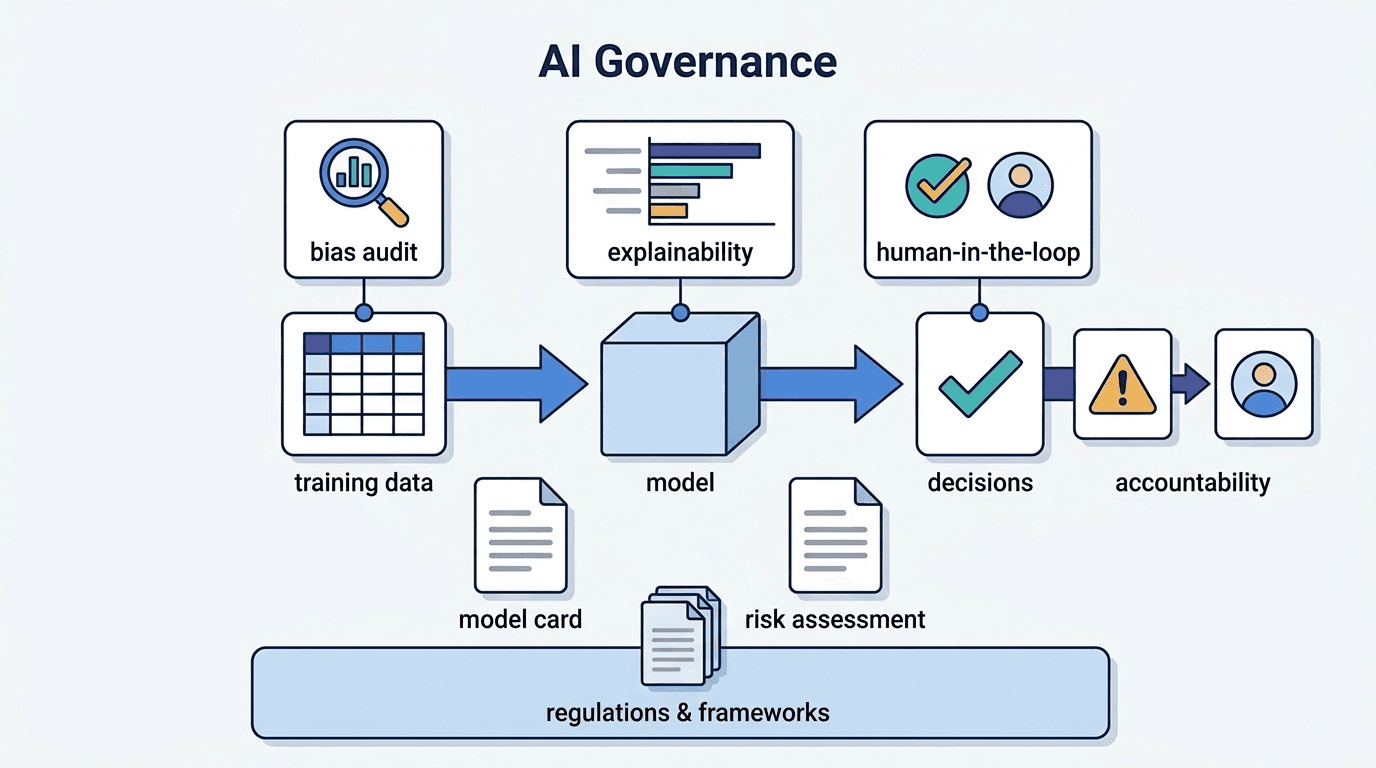
This is where the concept of observability becomes essential. OpenTelemetry defines observability as "the ability to understand the internal state of a system from its outputs." Making it possible to trace pipeline delays, quality degradation, and AI response rationale from system outputs is a prerequisite for deploying AI in business operations. For more detail, see AI Governance and EU AI Act Compliance.
How to Connect Structured and Unstructured Data

In a data foundation built for the AI era, structured data alone — such as revenue figures and contracts — is insufficient. The "why" behind business decisions most often lies dormant within unstructured data. How the two are connected is what separates an AI-Ready foundation from one that is not.
The Context Behind Business Decisions Lives in Unstructured Data
Structured data such as sales figures, contracts, usage logs, and inquiry counts are important. However, the information that explains why things turned out that way almost always lives on the unstructured data side. Deal notes, chat discussions, specifications, meeting minutes, support history, lost-deal reasons, customer interviews, proposal documents, contracts, case studies — the list goes on.
For example, even if you have the structured fact that "cancellations have increased," you cannot understand the reason without reading through deal notes and support histories. Numbers show what happened, but they don't explain why it happened. If you want AI to support business decisions, you cannot afford to ignore this unstructured data that holds the "why."
Simply Loading Data into RAG Is Not Enough
So does feeding unstructured data into RAG solve the problem? That alone is not enough. Getting documents into a vector database and making them searchable is a starting point, not the goal.
What truly matters is connecting unstructured data to structured data and linking it to business entities such as customers, contracts, deals, owners, products, and KPIs. If it is unclear which customer and which deal a particular deal note belongs to, the AI cannot place the text it retrieves through search into the correct context.
Improving accuracy also requires careful engineering of the search itself. Techniques such as hybrid search, which combines vector search with full-text search, and agentic RAG, which iterates between retrieval and reasoning, are effective — but they all presuppose that unstructured data is connected to business entities. Many RAG accuracy problems stem not from search technology itself, but from this lack of connection. Common pitfalls are summarized in RAG implementation failure patterns.
5 Requirements for an AI Ready Data Foundation

The three layers covered so far can be distilled into five requirements that can be assessed in practice. To state the conclusion upfront: whether or not you are AI Ready comes down to whether these five points are in place — trust, meaning, connection, access control, and traceability.
| Requirement | Description |
|---|---|
| 1. Trustworthy data | Cleansing, deduplication, missing-value management, history management, reprocessability |
| 2. Business terminology and KPI definitions | Centralized management of official definitions for revenue, customers, contracts, active rates, etc. |
| 3. Structured and unstructured data connection | Linking DWH, documents, conversation logs, and inquiry histories at the business-entity level |
| 4. Access control and governance | Role-based access control, masking, audit logs |
| 5. Traceability and operational monitoring | Answer provenance, data lineage, pipeline monitoring, feedback loops |
If even one of these five is missing, the whole system tends to break down. For instance, even if you have trustworthy data (Requirement 1), the AI will misinterpret it without defined meaning (Requirement 2). And even with defined meaning, you cannot safely expose the data without access control (Requirement 4). Mapping your current state against this table and identifying which requirements are underdeveloped is the first step toward becoming AI Ready.
How BI Will Change: From BI You Go to See, to BI That Notifies You

Once an AI Ready foundation is in place, the very nature of BI changes. The center of gravity shifts from passive BI — where people go to look at dashboards — to active BI, where AI detects changes and proactively surfaces them.
Proactive / Action-Oriented Insights
Traditional BI required humans to open a dashboard, spot anomalies, investigate causes, and figure out the next action. Everything started with "a person going to look."
On an AI Ready foundation, the AI itself can take the initiative. It detects changes in KPIs, explains the magnitude and abnormality of those changes, investigates related factors, presents the underlying data and documents, suggests next actions, and notifies the relevant team members when needed — all as a continuous flow. The fact that a new generation of data visualization tools is positioning itself around "proactive insights" and "action-oriented BI" reflects an anticipation of exactly this shift. BI is transforming in character from something you look at to something that acts.
Don't Let "Sales Have Dropped" Be the End of the Story
There is, however, one important point to keep in mind. Simply sending a chat notification that says "sales have dropped" is nothing more than an alert bot. The real value lies in what comes after.
Which KPI changed, compared to which time period, by how much, in which segment, why it may have happened, what data and materials support that reasoning, and who should do what — only when an AI can explain all of this can it truly be said to have supported a decision.
Consider, for example, an AI agent for management support. What is required is a workflow that detects changes in KPIs, determines whether they represent normal variation or anomalies, examines which segments are affected, reviews related events across sales, support, and product, organizes causal hypotheses, proposes next actions, hands off tasks to the responsible parties, and accumulates results as feedback. Making this work requires far more than a DWH alone. It demands a comprehensive foundation that includes semantic definitions, a data catalog, operational knowledge, RAG, access control, audit logs, and a feedback loop. This is precisely what it means for an AI-Ready data infrastructure to move closer to an "operational foundation that supports judgment and execution" rather than simply "a foundation for dashboards."
Our Perspective: A Realistic Path to AI Readiness for Mid-Sized Companies

Finally, I would like to share a practical approach that has emerged from our work supporting AI adoption. There is no need to build a perfect foundation from the start. However, getting the order wrong can lead to significant rework down the line.
Even With a Small Start, Don't Defer Semantic Modeling
When we receive inquiries about implementing AI agents, the initial expectation is almost always "we just want to connect our data to AI." That sentiment is understandable. But the first thing we verify is not the volume of data or the number of connections — it is whether basic terms such as "revenue" and "customer" have a single, agreed-upon definition across the organization.
If AI is connected before this alignment is in place, it will freely mix figures that differ from department to department, generating answers that create more confusion than clarity. For this reason, we recommend that even in a small-scale start, the second layer — semantic definition of terms and KPIs — should never be deferred. It is fine to begin with a single business domain. However, within that domain, term definitions, data connections, and access permissions should be designed together from the outset. Even if the scope is narrow, all layers should be covered, however thinly — this is the practical sequence that minimizes rework.
The Roles Required of Future Data Professionals
AI is likely to automate at least some tasks such as writing SQL, implementing ETL, and building dashboards. That does not mean data professionals will become unnecessary. Rather, the center of gravity of their role will shift from implementation toward design, governance, and evaluation.
More specifically, this includes work such as: designing the right KPIs, defining business terminology, ensuring data quality, designing the scope of data that AI is permitted to reference, developing semantic models and ontologies, verifying the basis for AI-generated answers, monitoring the behavior of pipelines and AI agents, and acting as a bridge between business units and AI systems to drive improvement. In other words, the data professional of the future will increasingly resemble not a mere implementer, but a data architect, a guide for AI adoption, and a governance designer all at once. The more tasks that can be delegated to AI, the greater the value of the judgment that determines what to delegate and what to keep in human hands.
Frequently Asked Questions

The following is a compilation of questions frequently asked in consulting engagements regarding AI-Ready data infrastructure.
Q1. Does Building a DWH Make You AI Ready?
No. A DWH is only part of the foundation for AI Readiness. Even with a DWH in place, if definitions of business terminology and KPIs (semantic layer), as well as access permissions and data lineage (governance), are missing, AI cannot be used effectively in business operations. It is safest to think of a DWH as a necessary condition, but not a sufficient one.
Q2. Can Internal Documents Be Leveraged by AI Just by Adding RAG?
It is partially possible, but accuracy tends to plateau with that alone. Making documents searchable via RAG is just a starting point — what truly makes a difference is connecting unstructured data to business entities such as customers, contracts, and deals. Without that connection in place, AI cannot place search results in the correct context. For more details, refer to RAG Implementation Failure Patterns.
Q3. I Want to Start Small — What Should I Tackle First?
We recommend narrowing your focus to a single business domain (e.g., sales or customer support) and designing the "terminology and KPI definitions," "data connections," and "access permissions" for that domain as a complete set from the outset. The scope can be small — the key is to cover all three layers, even if thinly. If you defer the semantic layer and permissions to a later stage, you will likely need to rebuild the entire structure down the line.
Conclusion

An AI-Ready data foundation is not simply a state in which data can be handed off to AI. It is a state in which AI can understand business context, make well-grounded decisions based on trustworthy data, operate within the bounds of defined permissions, and connect its outputs to the next human action.
Achieving this requires three layers — Layer 1 for organizing data, Layer 2 for providing meaning, and Layer 3 for enabling safe use — along with five requirements: trust, meaning, connectivity, permissions, and traceability. DWH, BI, and RAG do not individually constitute AI Readiness; it is only through their combination as a whole that AI Readiness is achieved.
The data foundations of the future will evolve from infrastructure built merely for "visualization" into operational infrastructure that supports AI agents in making judgments, offering recommendations, and taking action. Start by assessing your organization's current state against the three layers and five requirements, and identify where the gaps lie. We also provide support in designing and building data foundations with AI adoption in mind.
Author & Supervisor

Yusuke Ishihara
Started programming at age 13 with MSX. After graduating from Musashi University, worked on large-scale system development including airline core systems and Japan's first Windows server hosting/VPS infrastructure. Co-founded Site Engine Inc. in 2008. Founded Unimon Inc. in 2010 and Enison Inc. in 2025, leading development of business systems, NLP, and platform solutions. Currently focuses on product development and AI/DX initiatives leveraging generative AI and large language models (LLMs).
Recommended Articles


Terms related to this article
AI Literacy (AI Literacy)
Knowledge and skills to understand the basic concepts, limitations, and risks of AI, and to appropri

Demand Forecasting AI
Demand forecasting AI refers to a system that analyzes historical sales data and external factors us
AI Governance
AI governance refers to the organizational policies, processes, and oversight mechanisms that ensure