No-Code/Low-Code Development
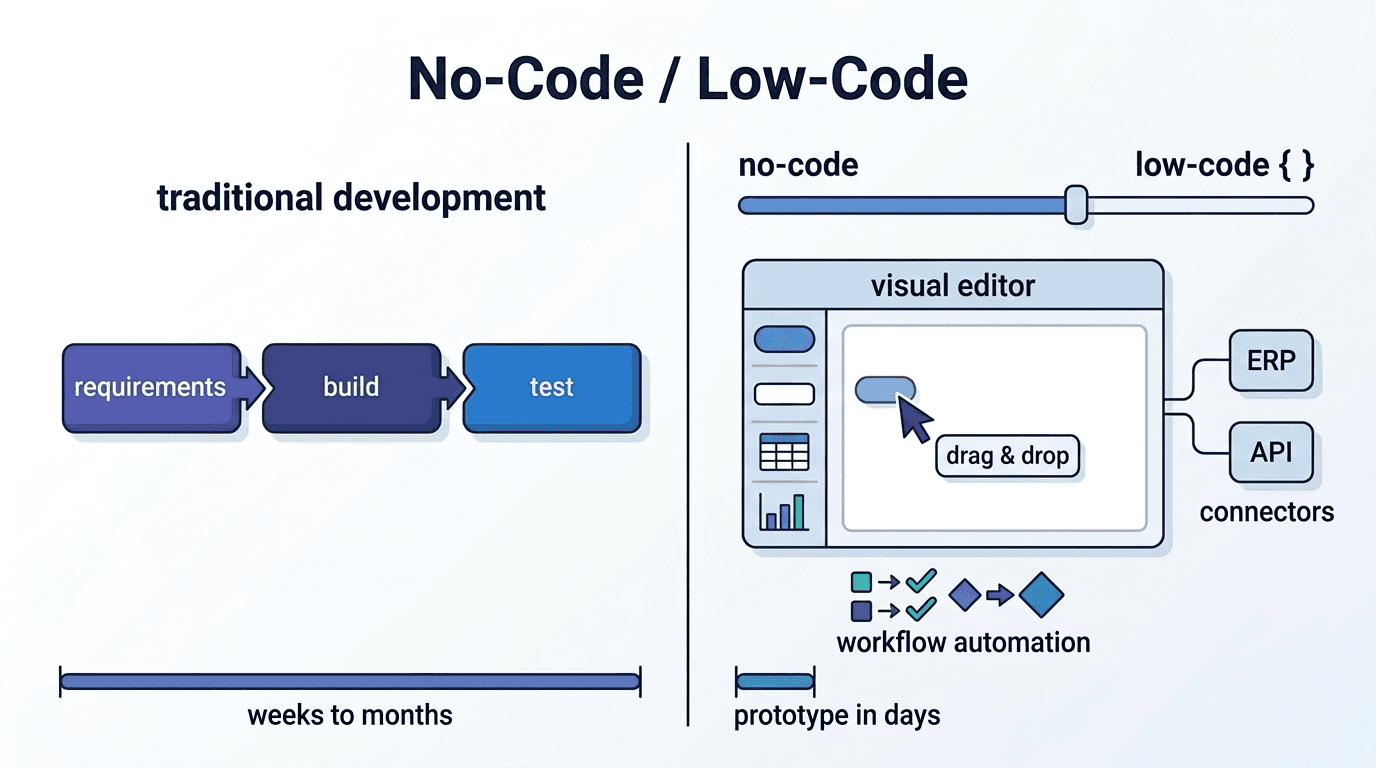
No-code/low-code development is a development approach that minimizes the need for programming expertise, enabling applications to be built through visual interfaces and configuration-based operations. It is utilized for promoting DX (Digital Transformation) and accelerating PoC (Proof of Concept).
No-Code/Low-Code Development refers to a development approach that minimizes the need for programming expertise, enabling applications to be built through visual interfaces and configuration-based operations. The term encompasses both "no-code," which allows development without writing any code at all, and "low-code," which allows code to be used supplementarily as needed. It is widely adopted in contexts aimed at accelerating DX promotion and PoC (Proof of Concept).
Why It's Attracting Attention Now
As the shortage of engineers becomes increasingly serious, the rise of "Citizen Developers"—business-side personnel who can build systems themselves—has accelerated. Business applications that traditionally required weeks or months to complete through the cycle of requesting specialist engineers, defining requirements, implementing, and testing can now produce working prototypes within days using no-code/low-code platforms.
This trend also aligns well with the concept of Shift Left. The idea of moving the development process earlier in order to detect and resolve problems sooner connects naturally with the rapid prototyping enabled by no-code/low-code.
Key Features and Mechanisms
At the core of no-code/low-code platforms are the following sets of capabilities:
- Visual Editor: Allows UI components to be placed via drag-and-drop, with screen transitions and conditional branching defined visually
- Connectors and Integration: Enables configuration-based integration with ERP (Enterprise Resource Planning) systems and external APIs
- Workflow Automation: Allows business processes such as approval flows and data transformation to be assembled through a GUI
- Templates: Pre-built templates organized by industry and use case eliminate the need to design from scratch
In the case of low-code, these capabilities are supplemented by extension points where custom logic can be written as scripts, making it easier to accommodate complex requirements.
Scenarios Where Adoption Is Expanding
The following are representative scenarios where no-code/low-code development proves effective:
PoC and Prototype Validation: Quickly giving shape to new service ideas and gauging market response. It is an effective means of building an MVP (Minimum Viable Product) in a short period of time, and can significantly reduce the cost of validating PMF (Product-Market Fit).
Business Process Automation: Well-suited for mid-scale automation of internal workflows—such as application and approval flows or routine report generation—that do not warrant outsourcing to BPO (Business Process Outsourcing). Workflow automation tools such as n8n also fall within this category.
Integration with AI: In recent years, an increasing number of platforms have incorporated integration capabilities with Generative AI and AI Agents, making it possible to build chatbots and automate document processing at low cost.
Risks and Considerations Not to Overlook
Given its high convenience, caution is required from a governance perspective. When business departments independently proliferate their own applications, "Shadow IT" problems—similar to those of Shadow AI—are prone to occur. There are cases where data locations become unclear, or where systems go into production without security policies being applied.
Additionally, vendor lock-in to a platform's vendor is a challenge that cannot be ignored. Configurations that rely heavily on a specific service increase migration costs in the future. From a DevSecOps perspective, it is advisable to incorporate an organizational review process to ensure that applications built with no-code/low-code also meet the security standards set forth by OWASP.
Furthermore, in order to accurately measure AI ROI (Return on Investment in AI), it is necessary to evaluate both the labor-saving effects achieved through in-house development with no-code/low-code and the associated license costs and maintenance burden together. As the barrier to development is lowered, consciously investing in the design of operations and management is the most direct path to sustainable adoption.
Articles covering this term
- What is AI-Native UI? The Design Philosophy of Generative AI Dynamically Creating ScreensExplore AI-native UI: where forms and menus are replaced by AI-generated interfaces. Learn core concepts, design patterns, and real-world business applications.
- What Is the Democratization of AI Agents? A Citizen Development Guide for Business Departments to Build In-House with No-CodeDemocratizing AI agents: business teams building agents in-house with no-code/low-code. Learn citizen development, governance, permission design, and how to embed internal development.
- PoC Development: Costs, 5-Step Process, and Vendor SelectionPoC development explained: costs, a 5-step process, what to put in PoC requirements, go-live criteria that prevent PoC fatigue, and how to choose a partner.
- AI Governance for Small Teams: Scalable AI Governance for Small and Medium-Sized BusinessesLightweight AI governance frameworks & checklists for SMEs and startups to practically adopt enterprise-grade AI standards—even with limited resources.


Related Terms

E2E Test
E2E testing (End-to-End testing) is a testing methodology that simulates user interactions to drive
Acceptance Testing
Acceptance testing is a testing method that verifies whether developed features meet business requir

SSM (AWS Systems Manager)
AWS Systems Manager (SSM) is an AWS managed service for centrally operating and managing EC2 instanc

ATDD
ATDD (Acceptance Test-Driven Development) is a development methodology in which the entire team defi