Deepfake

Deepfake is a technology that uses deep learning to realistically manipulate and synthesize a person's face, voice, and video, and is regarded as a cybersecurity threat enabling attacks such as phishing scams and impersonation attacks.
Deepfake refers to a technology that uses deep learning to realistically manipulate and synthesize a person's face, voice, and video, and is regarded as a cybersecurity threat in the form of phishing scams, impersonation attacks, and similar exploits.
Technical Mechanisms
At the core of deepfakes are deep learning architectures such as GANs (Generative Adversarial Networks) and autoencoders. GANs pit two models against each other — a "generator" and a "discriminator" — to produce fabricated video footage so convincing it is indistinguishable from reality. Beyond face swapping, the technology enables voice synthesis synchronized with lip movements and control over facial expressions and gaze. In recent years, the rapid advancement of Generative AI has created an environment in which even general users can produce high-quality content at low cost.
In the audio domain, a technique known as "voice cloning" has become widespread, making it technically possible to reproduce a specific individual's voice from just a few dozen seconds of audio samples. By combining video and audio, it has become possible to create footage that makes real executives or politicians appear to say things they never said, and actual fraud cases have been reported.
Impact on Cybersecurity
The reason deepfakes are considered particularly dangerous is that they fundamentally undermine conventional authentication and trust models.
- Sophistication of Business Email Compromise (BEC): Cases have been confirmed in which video calls impersonating the faces and voices of senior executives are used to instruct staff to make fraudulent transfers.
- Impersonation attacks: Exploited as a means of bypassing systems that use facial recognition for identity verification.
- Increased precision of phishing scams: Video messages disguised as trusted individuals are used to lure targets into downloading malware or entering credentials.
- Manipulation of public opinion and disinformation: Misuse in political contexts damages societal trust itself.
As the concept of Zero Trust Network Access (ZTNA) suggests, the principle of "never trust what you see" is becoming increasingly important. From an AI governance perspective, deepfakes are also positioned under the EU AI Act as subject to transparency obligations, with regulatory requirements such as mandatory disclosure and labeling of deepfake content now being introduced.
Current State of Detection Technology and Countermeasures
As a countermeasure against deepfakes, research into forensic detection models is advancing. The mainstream approach involves using machine learning to detect subtle artifacts such as blinking patterns, skin texture, and unnatural light reflections. However, generation technology and detection technology are engaged in a constant arms race, with the risk that improvements in generation quality will perpetually outpace detection capabilities.
The following organizational countermeasures are considered effective:
- Multi-factor authentication workflows, such as callback verification, for critical decisions (e.g., fund transfers, information disclosure)
- Advance validation of impersonation attack scenarios through AI Red Teaming
- Cultivating a culture of skepticism through AI Literacy training for employees
- Embedding digital watermarks and provenance information into video and audio content
Incorporating the concept of HITL (Human-in-the-Loop) into organizational processes — designing systems in which humans exercise judgment over AI-generated content — is also a practical approach to minimizing harm.
Future Outlook
As the quality of Video Generation AI continues to improve, the deepfake threat is expected to expand further. At the same time, international standardization of content authentication (such as C2PA) and stricter terms of use by generative AI providers are also progressing, and we are entering a phase in which countermeasures must be pursued across three layers: technology, regulation, and literacy.
Articles covering this term
- What is C2PA? The Digital Authentication System That Verifies the Authenticity of AI-Generated ContentExplore how C2PA (Content Credentials) verifies content provenance and detects tampering in the deepfake era, including implementation and EU AI Act compliance.
- 【2026】Latest Trends in AI CybersecurityAs AI adoption accelerates, risks surge from AI-powered attacks and attacks on AI itself. Explore deepfakes, prompt injection, Shadow AI threats, and 3-layer defenses covering technology, operations, and governance.
- What Is Shadow AI Auditing? How to Detect and Manage Unauthorized AI Tools Used Within Your OrganizationDetect shadow AI (ChatGPT, Gemini) used without approval, and learn the audit process covering risk assessment, policy development, and PDPA compliance.
- How Thai SMEs Can Reduce Marketing Costs with Generative AILearn how Thai SMEs cut SNS & EC content costs with generative AI. Practical steps for creating images, videos & text for LINE & TikTok.


Related Terms

Mesh VPN (Mesh VPN)
Mesh VPN is a VPN architecture in which each node communicates directly with encrypted connections w

Shadow AI
Shadow AI refers to the collective term for AI tools and services used by employees in their work wi

Zero Trust Network Access (ZTNA)
Zero Trust Network Access is a security model that continuously verifies users and devices, controll
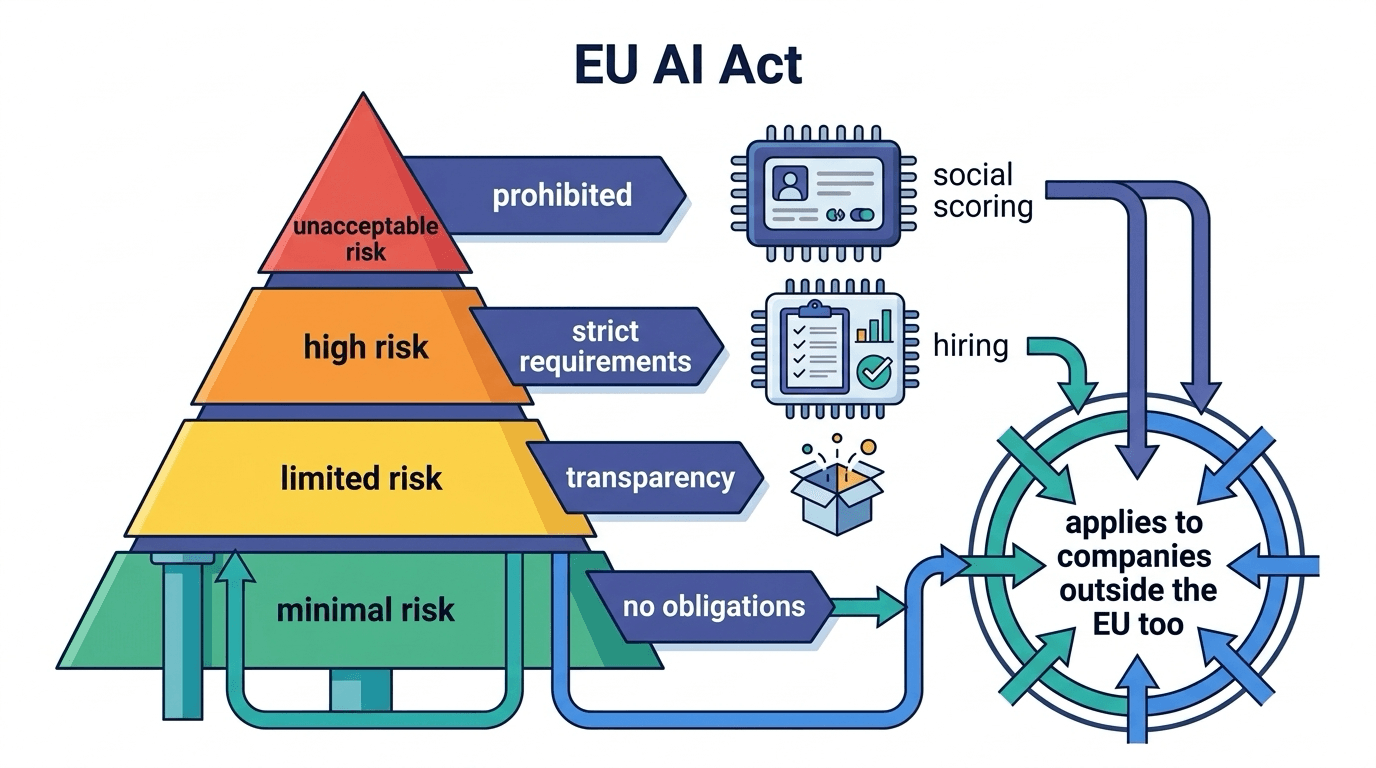
EU AI Act (EU Artificial Intelligence Act)
The EU AI Act (EU Artificial Intelligence Act) is a comprehensive European Union regulation that est