Zero-Day Vulnerability
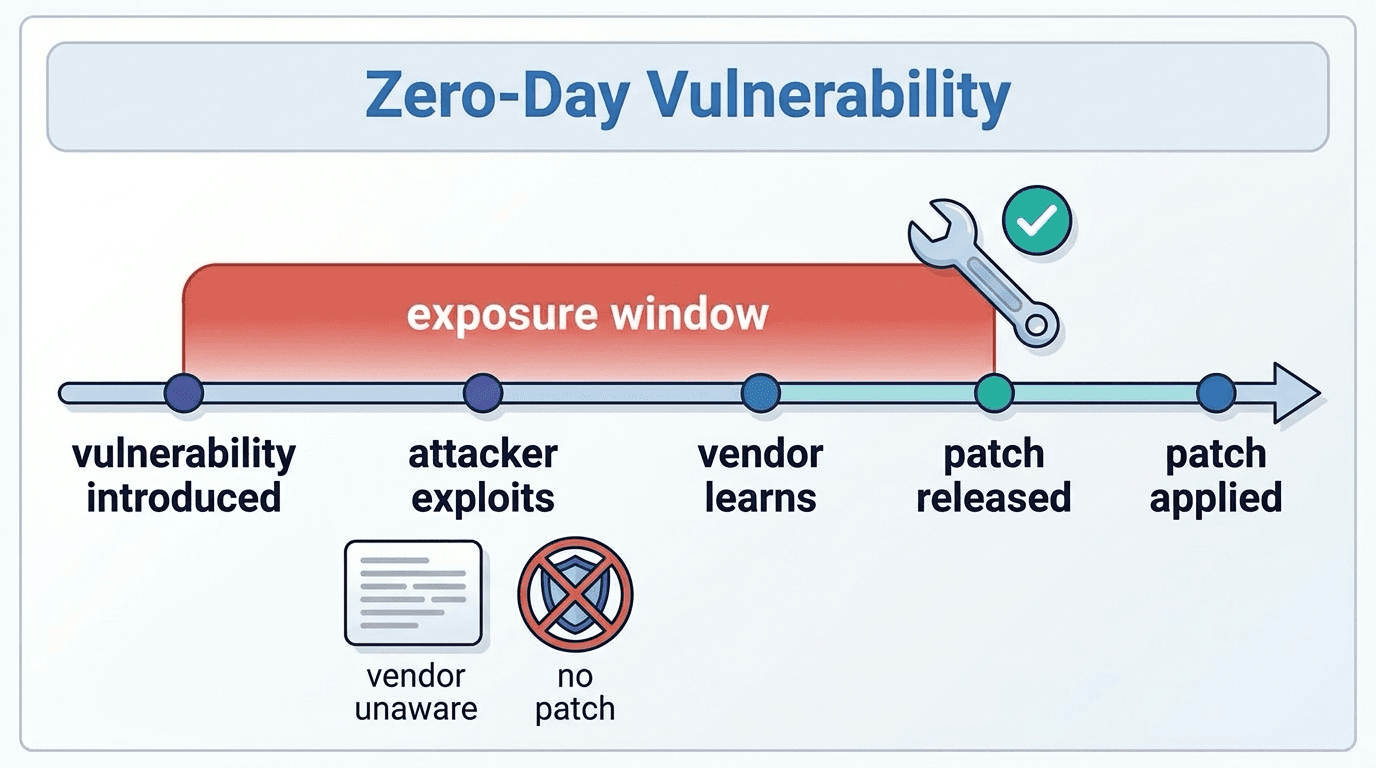
A zero-day vulnerability is an unpatched vulnerability that exists before it is recognized by the software developer or security community, referring to a state in which virtually no defensive measures exist until a patch is provided.
What "Zero Days to Fix" Means
A vulnerability that is exploited while the number of days between its discovery and the availability of a patch is "zero"—meaning no fix yet exists—is called a zero-day vulnerability. In a standard security response cycle, the process flows as follows: "a CVE is disclosed → a patch is distributed → users apply it." With a zero-day, however, not even the first step of this cycle has begun. For defenders, it is essentially being told to dodge a bullet whose existence they don't even know about.
The Economics of Discovery and Exploitation
Zero-day vulnerabilities exist within a unique marketplace. Nation-state actors and cybercriminal groups may pay hundreds of thousands to millions of dollars for undisclosed vulnerability information. By contrast, the reward for responsibly reporting such a vulnerability to the defensive side through a bug bounty program is often only a fraction of that amount. This economic asymmetry is the structural reason why zero-days tend to flow toward black markets.
Many of the web application vulnerability categories organized by OWASP follow well-known patterns, but zero-days sometimes fall into categories that have yet to be defined. As illustrated by the remote crash bug that lay dormant in OpenBSD for 27 years, the longer a vulnerability goes undiscovered, the broader its potential impact—and the more it can serve as a launchpad for supply chain attacks.
How AI Is Reshaping the Zero-Day Battlefield
The fact that Claude Mythos discovered thousands of zero-days in Project Glasswing demonstrates that AI is fundamentally transforming the speed and scale of vulnerability discovery. Traditionally, the primary means of discovery were fuzzing, static analysis tools, and human penetration testers—methods that faced inherent limitations in coverage due to constraints of time and cost.
If large-scale AI-driven scanning is deployed by defenders first, there is a possibility that vulnerabilities can be patched before they are ever exploited as zero-days. Conversely, if attackers gain access to equivalent AI capabilities, the mass production of zero-days could become a reality. Efforts to quantitatively measure a model's offensive capabilities through benchmarks such as CyberGym serve to visualize where we currently stand in this "AI arms race."
Articles covering this term
- Claude Mythos and Project Glasswing — How Companies Should Prepare for the Era When AI Uncovers Long-Dormant BugsAnthropic's Claude Mythos Preview & Project Glasswing redefine AI-driven vulnerability discovery. From OpenBSD's 27-yr bug to FreeBSD CVE-2026-4747—5 DevSecOps actions you can take now.
- What Is GLM-5.3? Defending Enterprises in the Age of Automated Attacks by Freely Available AIGLM-5.3 is the AI NIST rated as the most cyber-capable open-weight model yet. Based on Anthropic's findings and real attacks, learn what changed and defenses to review first.
- AI Development Supply Chain Attacks 2026 — A Defense Guide Against Model Poisoning, Dependency Packages, and SaaS BreachesBased on 2026 cases like Hugging Face model poisoning and SaaS breaches, this implementation guide covers AI BOM, least-privilege OAuth, and sensitive secret management for AI developers.
- [2026] Vibe Coding (AI-Driven Development) Failures & Security Incidents: Causes and Countermeasures from Domestic and International Case Studies and Latest DataExamining vibe coding (AI-driven development) failures and security incidents using 2026 primary sources: Moltbook's ~4.75M record exposure, Lovable's exposed public projects, a 380K-app survey, 74 AI-related vulnerabilities.


![[2026] Vibe Coding (AI-Driven Development) Failures & Security Incidents: Causes and Countermeasures from Domestic and International Case Studies and Latest Data](/_next/image?url=https%3A%2F%2Fxlawjotwdonvcisfgnkc.supabase.co%2Fstorage%2Fv1%2Fobject%2Fpublic%2Farticle-images%2Farticles%2F317%2Fcover-en.png%3Ft%3D1787890746142&w=3840&q=75)
Related Terms

Deepfake
Deepfake is a technology that uses deep learning to realistically manipulate and synthesize a person

Mesh VPN (Mesh VPN)
Mesh VPN is a VPN architecture in which each node communicates directly with encrypted connections w

Shadow AI
Shadow AI refers to the collective term for AI tools and services used by employees in their work wi

Zero Trust Network Access (ZTNA)
Zero Trust Network Access is a security model that continuously verifies users and devices, controll