Sentinel-2
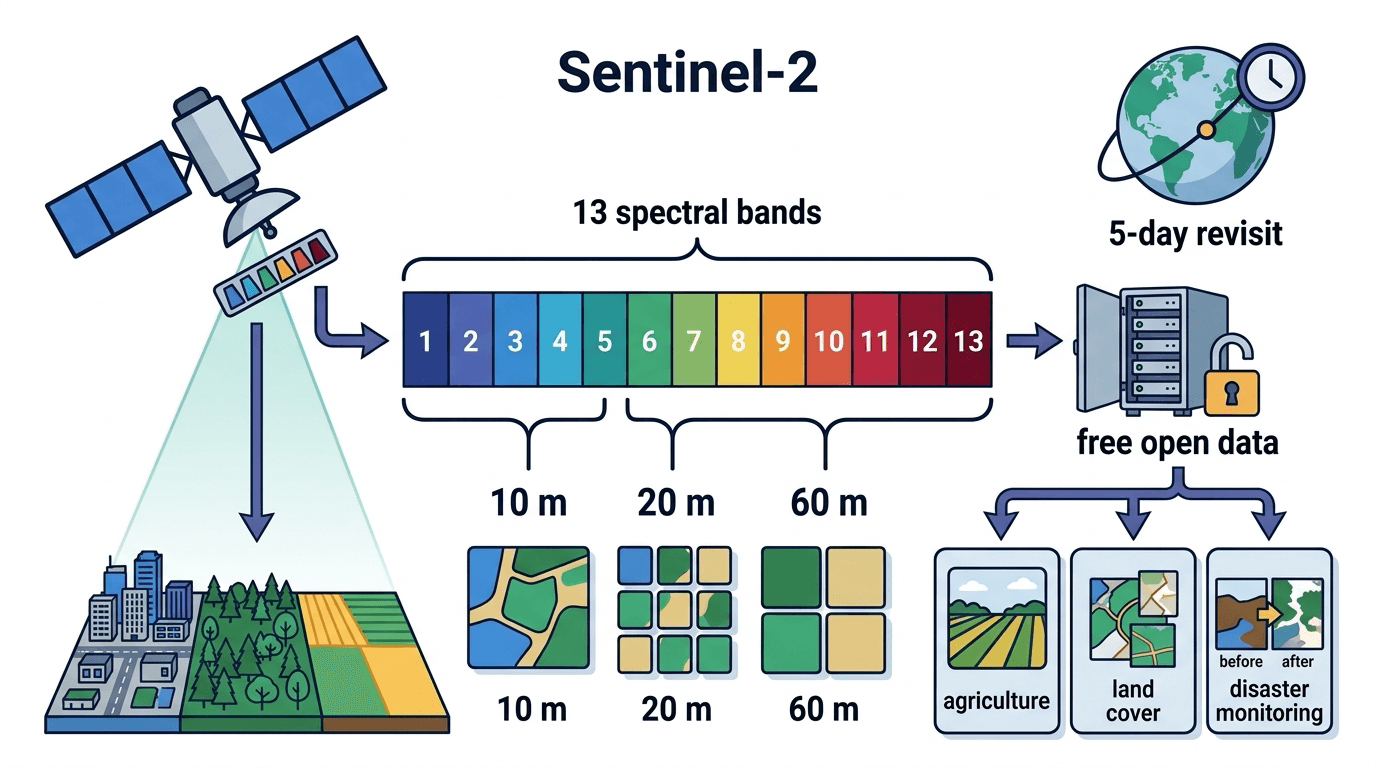
Sentinel-2 is an Earth observation satellite of the Copernicus program led by ESA (European Space Agency). It acquires multispectral imagery in 13 bands spanning the visible to shortwave infrared range at resolutions of 10–60 m, and continuously observes land areas with a revisit cycle of approximately 5 days. It is widely used for cropland and vegetation monitoring, land cover classification, and pre/post-disaster comparison, with data made fully open and freely available.
Sentinel-2 is an optical satellite operated under ESA's (European Space Agency) Copernicus Earth observation program. Two satellites, Sentinel-2A and Sentinel-2B, operate as a pair, continuously imaging land areas near the equator at a frequency of approximately 5 days. Data is provided fully open and free of charge, making it available for a wide range of uses from research applications to integration into commercial products.
Observation Specifications and 13-Band Configuration
The sensor covers 13 bands ranging from visible light (blue, green, red) to near-infrared (NIR) and shortwave infrared (SWIR), with resolutions at three levels: 10m, 20m, and 60m. Four bands — B02, B03, B04, and B08 — are acquired at 10m resolution, making them well-suited for detailed surface analysis. SCL (Scene Classification Layer) and CLD (cloud probability) are also provided as part of the dataset, making cloud masking relatively straightforward.
A representative index is the NDVI (Normalized Difference Vegetation Index). The formula is (B08 − B04) / (B08 + B04), where higher values indicate more vigorous vegetation. It is widely used for monitoring crop growth conditions and detecting forest change.
Choosing the Right Product Level
Data is provided at two levels.
- Level-1C: TOA (Top of Atmosphere) reflectance prior to atmospheric correction. Unless there is a specific reason, this level is not used for surface analysis.
- Level-2A: Atmospherically corrected surface reflectance. This is the standard product for virtually all analysis scenarios, and is available as
sentinel-2-l2athrough the Copernicus Data Space API.
When in doubt, choose L2A.
Data Access Methods and Costs
The most convenient approach is to use Copernicus Browser. You can set area, date, and cloud cover filters in the browser and download data in GeoTIFF format. When code-based processing is required, it is common practice to build an automated pipeline that retrieves data via the Copernicus Data Space Ecosystem API or the Google Cloud Public Dataset.
The data itself is free, but it is worth noting that processing large numbers of tiles in the cloud will incur separate costs for compute, storage, and data transfer.
Basic Processing Workflow in Python
Using rasterio, you can directly read downloaded L2A tiles (in .jp2 format). A workflow that loads B04 and B08 as numpy arrays, calculates NDVI, and saves the result as a GeoTIFF can be completed in around 30 lines of code. By additionally combining this with scikit-learn's KMeans, you can also experiment with simple land cover clustering into categories such as forest, water bodies, and urban areas (though the interpretation of each cluster requires separate analysis).
Related Terms
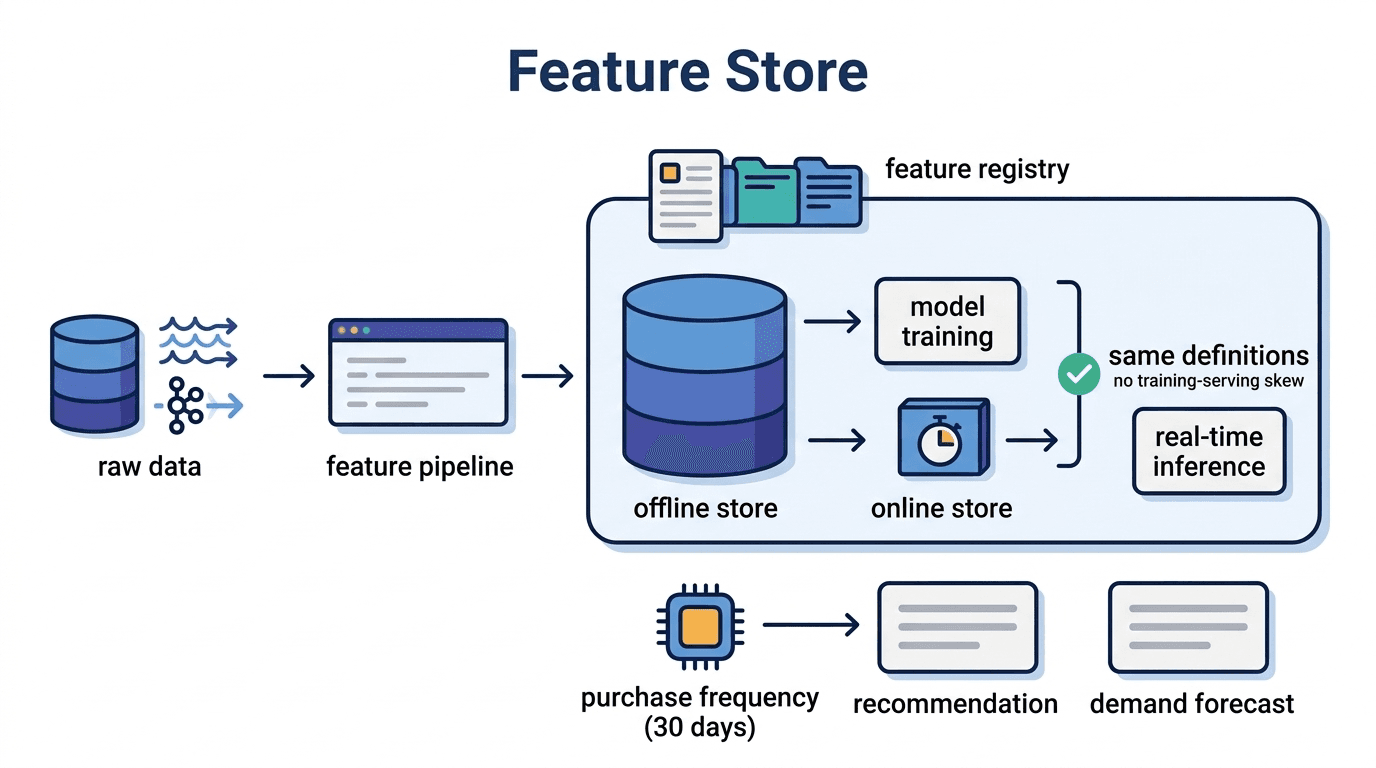
Feature Store
A feature store is a data infrastructure for centrally managing and reusing features used in machine
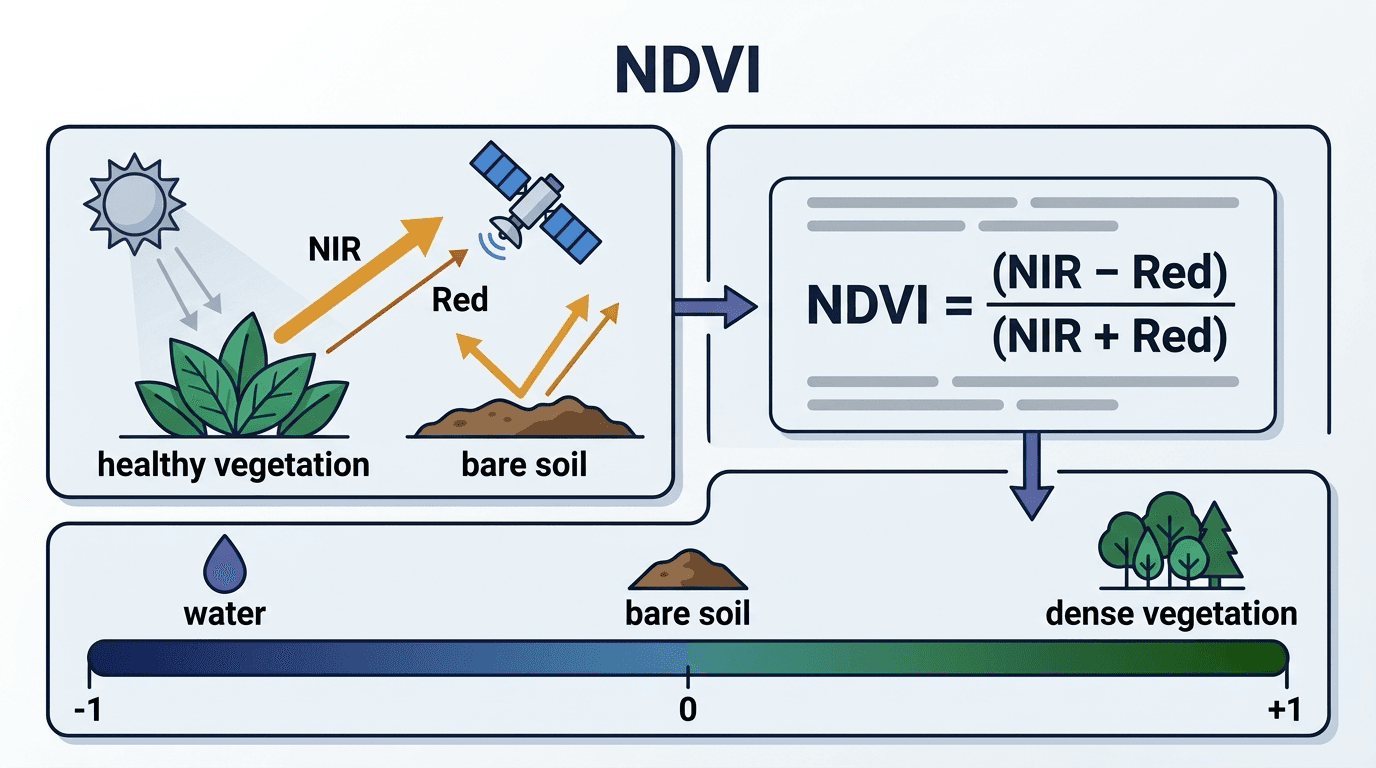
NDVI
NDVI (Normalized Difference Vegetation Index) is an index derived by normalizing the reflectance dif
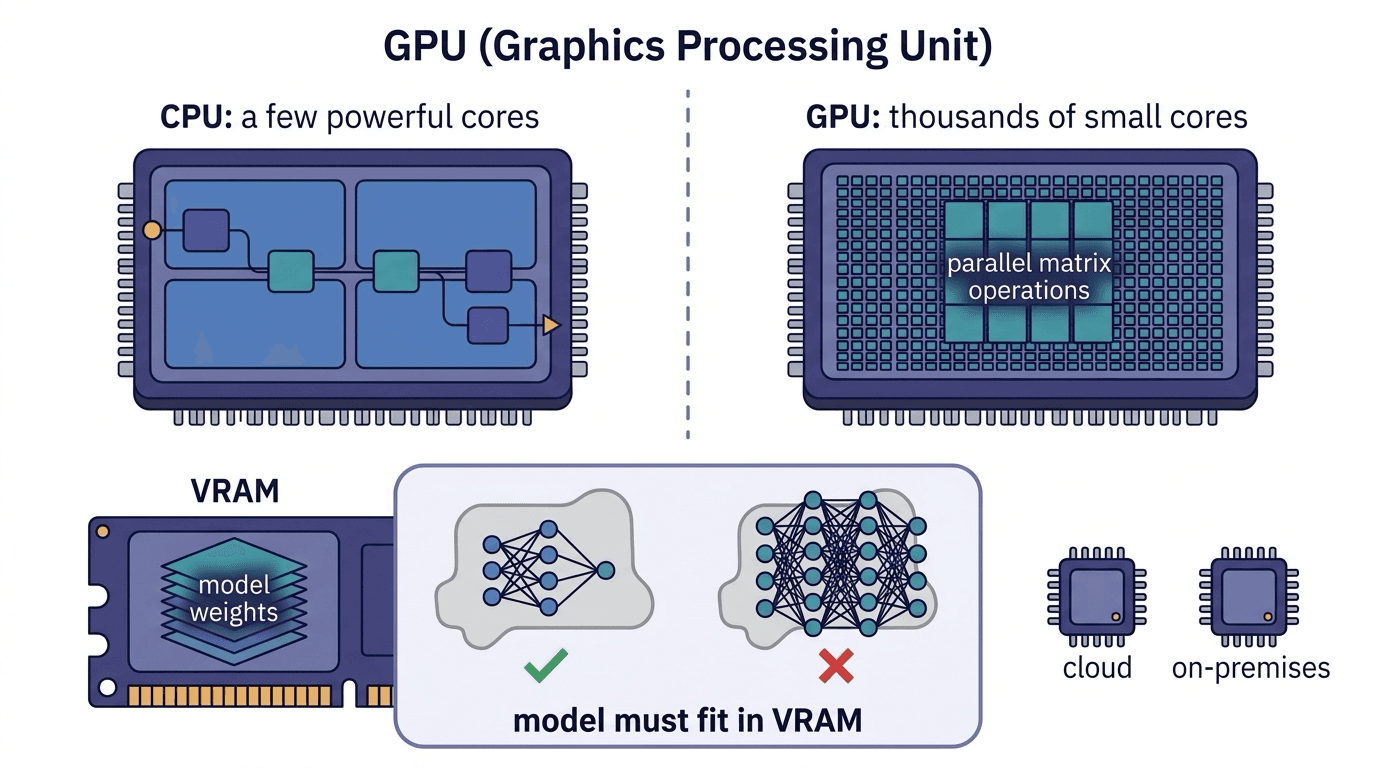
GPU (Graphics Processing Unit)
A GPU (Graphics Processing Unit) is a semiconductor chip that processes large volumes of parallel co

Firecracker
Firecracker is an open-source virtual machine monitor (VMM) developed by AWS that boots lightweight