Project Glasswing
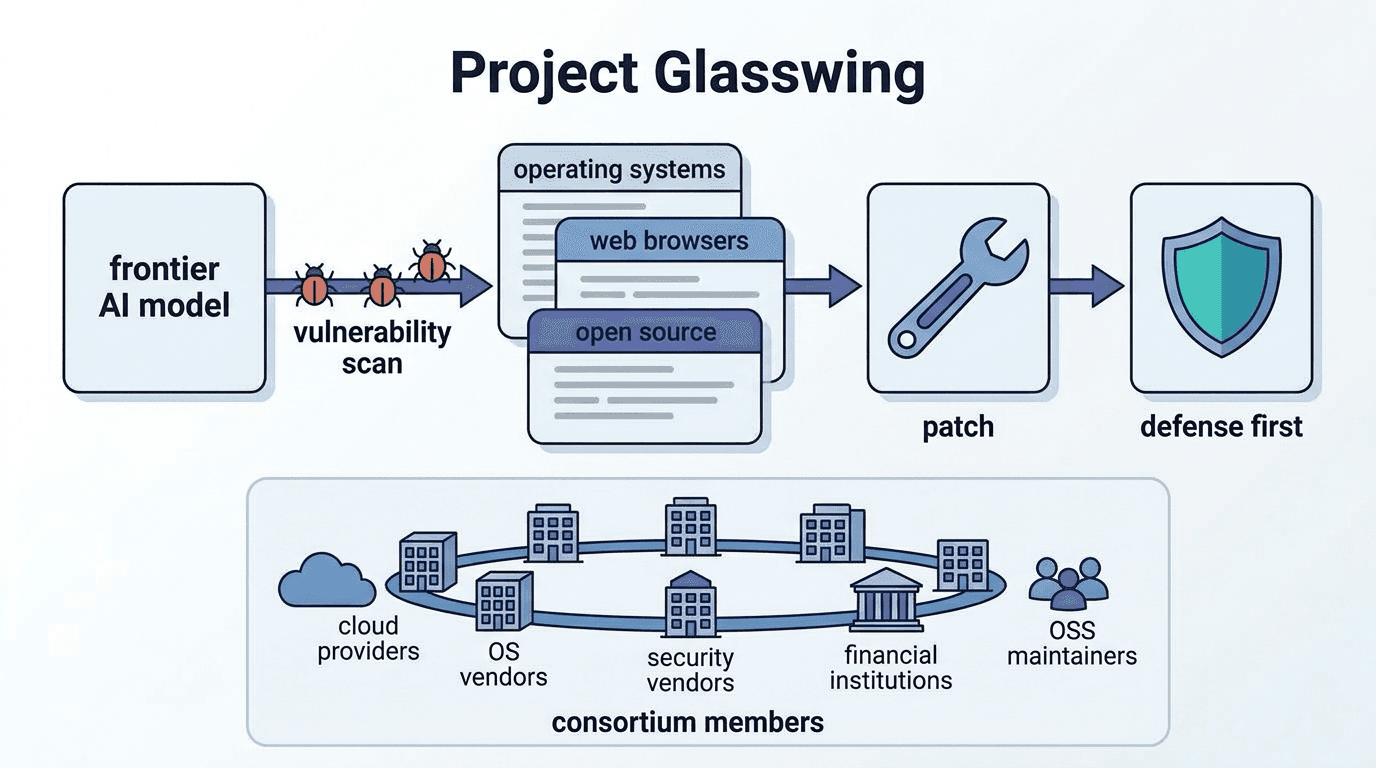
Project Glasswing is a cybersecurity consortium led by Anthropic, with participation from major tech companies including AWS, Apple, Google, Microsoft, and NVIDIA, dedicated to defensively scanning and remediating critical global software using frontier AI models.
Background ― Why a Consortium Is Needed
As AI has dramatically enhanced the ability to discover software vulnerabilities, it is becoming a security concern whether offensive or defensive actors will be the first to leverage that capability. Claude Mythos Preview, developed by Anthropic, has discovered thousands of zero-day vulnerabilities spanning major operating systems and web browsers, including a remote crash bug that had lurked in OpenBSD for 27 years and a 16-year-old bug in FFmpeg that evaded 5 million automated tests.
Rather than a single company monopolizing this capability, Project Glasswing was launched as a framework for the entire industry to use it defensively.
Participating Organizations and Scale
The consortium includes AWS, Apple, Broadcom, Cisco, CrowdStrike, Google, JPMorgan Chase, the Linux Foundation, Microsoft, NVIDIA, and Palo Alto Networks. Defensive access to Claude Mythos is also being extended to more than 40 OSS maintenance organizations.
Anthropic's financial commitment is substantial. In addition to up to $100 million in model usage credits, the company has announced $4 million in direct grants to OSS security organizations. Many OSS projects operate on a volunteer basis and lack sufficient resources to dedicate to security audits. How effective this funding will prove in practice depends on future operations, but it appears to be the largest AI security investment in the OSS ecosystem to date.
Technical Approach
The core of Glasswing is "defensive scanning," but its methodology is fundamentally different from conventional static analysis tools or fuzzing. Claude Mythos can read large codebases with full context, and is capable not only of discovering vulnerabilities, but also of generating exploit code that actually abuses them, and of producing remediation patches — all in an end-to-end workflow.
While the shift-left principle in DevSecOps aims to "eliminate vulnerabilities early in development," Glasswing takes a complementary approach: "retroactively and comprehensively identifying vulnerabilities in already-deployed code." If AI red-teaming is an attack simulation conducted by a human team, Glasswing can be understood as an attempt by defenders to get ahead of the curve through continuous, large-scale AI-driven attack simulation.
On the CyberGym benchmark, Mythos scores 83.1% (compared to 66.6% for Opus 4.6), and also achieves top-tier results on SWE-bench Prop and Terminal-Bench 2.0, suggesting it can address not only known categories as classified by OWASP, but also unclassified attack surfaces.
Connection to Supply Chain Defense
Discovered vulnerabilities are handled in accordance with Responsible Disclosure principles: details are made public only after the relevant projects have been notified and patches have been confirmed. Unpatched vulnerabilities are disclosed only by hash. By using AI to accelerate this "discovery → reporting → remediation → disclosure" cycle, there is potential to shorten the window of exposure for supply chain attacks.
Anthropic positions Glasswing as a "starting point," stating that as frontier AI capabilities continue to advance, ongoing coordination among AI developers, security vendors, OSS maintainers, and governments will be essential.
Articles covering this term
- Claude Mythos and Project Glasswing — How Companies Should Prepare for the Era When AI Uncovers Long-Dormant BugsAnthropic's Claude Mythos Preview & Project Glasswing redefine AI-driven vulnerability discovery. From OpenBSD's 27-yr bug to FreeBSD CVE-2026-4747—5 DevSecOps actions you can take now.
- How Japan's Government and Financial Institutions Responded to Claude Mythos — FSA and Megabank Reactions and Corporate PreparednessHow Japan's government, FSA & 3 mega-banks responded to Anthropic's restricted AI "Claude Mythos." Covers Minister Katayama's meetings, access rights, regional banks & G7 talks.
- What Is GLM-5.3? Defending Enterprises in the Age of Automated Attacks by Freely Available AIGLM-5.3 is the AI NIST rated as the most cyber-capable open-weight model yet. Based on Anthropic's findings and real attacks, learn what changed and defenses to review first.
- [2026] Vibe Coding (AI-Driven Development) Failures & Security Incidents: Causes and Countermeasures from Domestic and International Case Studies and Latest DataExamining vibe coding (AI-driven development) failures and security incidents using 2026 primary sources: Moltbook's ~4.75M record exposure, Lovable's exposed public projects, a 380K-app survey, 74 AI-related vulnerabilities.


![[2026] Vibe Coding (AI-Driven Development) Failures & Security Incidents: Causes and Countermeasures from Domestic and International Case Studies and Latest Data](/_next/image?url=https%3A%2F%2Fxlawjotwdonvcisfgnkc.supabase.co%2Fstorage%2Fv1%2Fobject%2Fpublic%2Farticle-images%2Farticles%2F317%2Fcover-en.png%3Ft%3D1787890746142&w=3840&q=75)
Related Terms

Deepfake
Deepfake is a technology that uses deep learning to realistically manipulate and synthesize a person

Mesh VPN (Mesh VPN)
Mesh VPN is a VPN architecture in which each node communicates directly with encrypted connections w

Shadow AI
Shadow AI refers to the collective term for AI tools and services used by employees in their work wi

Zero Trust Network Access (ZTNA)
Zero Trust Network Access is a security model that continuously verifies users and devices, controll