Fuzzing
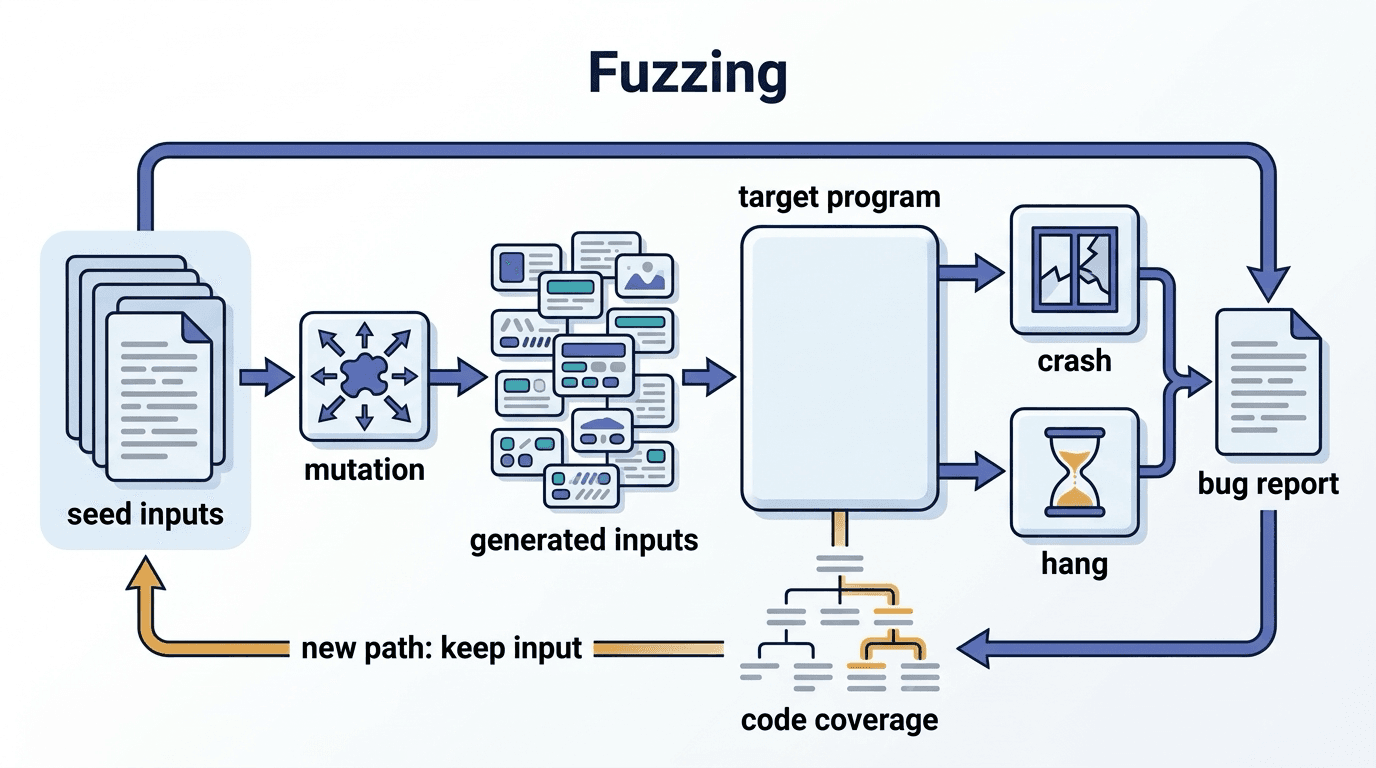
Fuzzing is a testing technique that automatically feeds large amounts of random or semi-structured input data to a target program, detecting software vulnerabilities and bugs by triggering crashes or unexpected behavior.
Basic Mechanisms of Fuzzing
Fuzzing (fuzz testing) is a technique that automatically generates large volumes of abnormal inputs, feeds them into a target program one after another, and observes how it "breaks." Inputs include random byte sequences, extremely long strings, values near boundary conditions, and malformed files. If a program crashes or hangs, there is a high likelihood that a potential vulnerability lurks there.
There are two broad categories of approaches. Mutation-based fuzzing takes valid inputs and modifies them incrementally to produce abnormal inputs. While easy to set up, it struggles to reach deep processing paths because it does not understand the structure of the input. Generation-based fuzzing defines the grammar or protocol specification of the input and generates data that is syntactically correct but semantically invalid. For structured inputs such as HTTP requests or image files, the latter approach is more efficient.
The Rise of Coverage-Guided Fuzzing
The dominant approach in modern fuzzing tools is coverage-guided fuzzing. AFL (American Fuzzy Lop), released by Google for OSS, significantly advanced this field. The program is instrumented to track which code paths a given input traverses. Inputs that discover new code paths are deemed "interesting" and are mutated further before being fed back in. This evolutionary feedback loop enables efficient discovery of bugs in deep processing logic that random inputs alone could never reach.
Google's OSS-Fuzz project continuously runs coverage-guided fuzzing against more than 1,000 OSS projects and has discovered over 10,000 vulnerabilities to date. There is also a growing movement to integrate fuzzing into DevSecOps CI pipelines.
The Relationship with AI — Limitations of Fuzzing and Complementarity
Fuzzing is powerful, but not a silver bullet. The case in which Claude Mythos discovered a 16-year-old bug in FFmpeg that had slipped past 5 million automated tests illustrates the existence of areas where fuzzing is structurally ill-suited. Fuzzing is a technique that probes the "input→output" boundary, making it difficult to detect logic vulnerabilities that span multiple components or bugs that only manifest in specific combinations of state transitions.
AI-driven code analysis, such as Project Glasswing, reads source code with full context and finds vulnerabilities at a different level of abstraction than fuzzing. The two are not competing approaches but complementary ones. In shift-left practice, integrating fuzzing into CI while periodically conducting deep AI-driven analysis is becoming the realistic approach of choice.
Articles covering this term
- Claude Mythos and Project Glasswing — How Companies Should Prepare for the Era When AI Uncovers Long-Dormant BugsAnthropic's Claude Mythos Preview & Project Glasswing redefine AI-driven vulnerability discovery. From OpenBSD's 27-yr bug to FreeBSD CVE-2026-4747—5 DevSecOps actions you can take now.
- [2026] Vibe Coding (AI-Driven Development) Failures & Security Incidents: Causes and Countermeasures from Domestic and International Case Studies and Latest DataExamining vibe coding (AI-driven development) failures and security incidents using 2026 primary sources: Moltbook's ~4.75M record exposure, Lovable's exposed public projects, a 380K-app survey, 74 AI-related vulnerabilities.
- Automating AI Red Teaming: Test Case Generation and Scalable Vulnerability ValidationLearn how to automate AI red teaming: test case generation tools, scalable vulnerability verification flows, and steps to implement continuous security testing.
- What is AI Red Teaming? A Practical Guide to Finding LLM VulnerabilitiesLearn about AI red teaming: methods, tools & techniques to systematically uncover LLM vulnerabilities like prompt injection & jailbreaking for safer AI operations.

![[2026] Vibe Coding (AI-Driven Development) Failures & Security Incidents: Causes and Countermeasures from Domestic and International Case Studies and Latest Data](/_next/image?url=https%3A%2F%2Fxlawjotwdonvcisfgnkc.supabase.co%2Fstorage%2Fv1%2Fobject%2Fpublic%2Farticle-images%2Farticles%2F317%2Fcover-en.png%3Ft%3D1787890746142&w=3840&q=75)


Related Terms

Deepfake
Deepfake is a technology that uses deep learning to realistically manipulate and synthesize a person

Mesh VPN (Mesh VPN)
Mesh VPN is a VPN architecture in which each node communicates directly with encrypted connections w

Shadow AI
Shadow AI refers to the collective term for AI tools and services used by employees in their work wi

Zero Trust Network Access (ZTNA)
Zero Trust Network Access is a security model that continuously verifies users and devices, controll