Bug Bounty
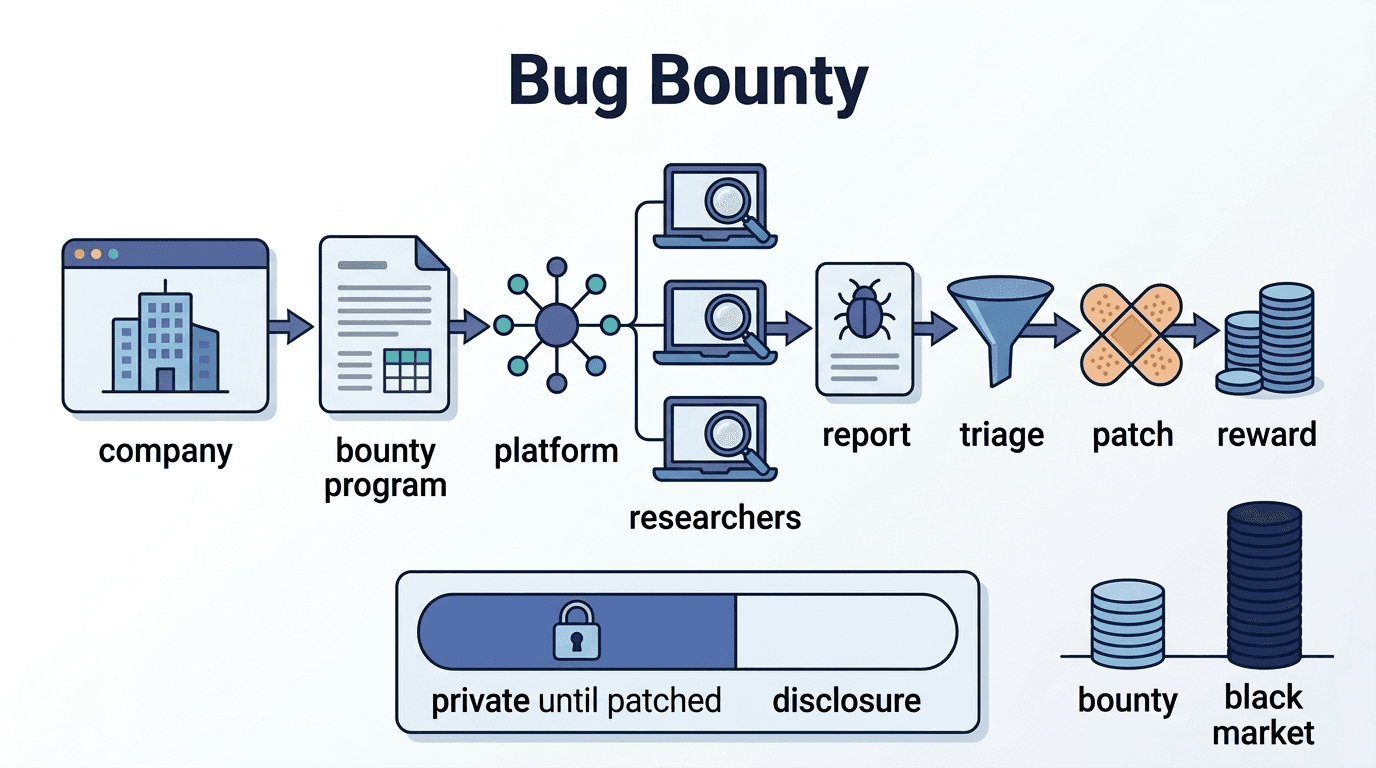
Bug bounty is a program that pays rewards to external security researchers who discover and report vulnerabilities in products or services, providing a mechanism to broadly collect vulnerabilities that cannot be found through an organization's internal testing alone.
The Concept of "Rewards for Finding Vulnerabilities"
A bug bounty is a program that invites external security researchers (white-hat hackers) to search for vulnerabilities in a company's products and services, offering monetary rewards for valid reports. It is based on the idea of supplementing attack surfaces that cannot be fully covered by internal security teams or penetration testing alone, using the "eyes" of researchers around the world with diverse skill sets.
Major tech companies such as Google, Microsoft, and Apple have set reward amounts in the hundreds of thousands of dollars, with some cases of critical zero-day vulnerabilities receiving payouts exceeding $200,000 per finding. Platforms such as HackerOne and Bugcrowd serve as intermediaries, streamlining the matching of companies and researchers, report triage, and reward payments.
A Tug-of-War with the Black Market
There is a structural dilemma in bug bounty reward design. In the black market for zero-day vulnerabilities (exploit brokers), nation-state actors and cybercriminal groups may offer hundreds of thousands to millions of dollars. If bug bounty rewards fall below this, purely from an economic rationality standpoint, researchers face an incentive to turn to the black market instead.
Of course, many researchers choose bug bounties for ethical motivations or to build their reputation. Nevertheless, the asymmetry of "defender-side rewards < attacker-side rewards" is recognized as a challenge across the entire industry.
Relationship with Responsible Disclosure
Bug bounties can also be seen as an institutionalization of Responsible Disclosure. Researchers first report a vulnerability to the vendor before making it public, keeping the details confidential until a fix patch is released. The same principle applies in Project Glasswing, where vulnerabilities discovered by Claude Mythos are only disclosed in detail after being reported to each project and patches have been applied.
If bug bounties represent "decentralized security testing by human researchers," then Glasswing is closer to "centralized, continuous security scanning by AI." The two are complementary, and a practical division of labor is emerging in which AI handles scalable initial scanning while human researchers dive deeper into complex business logic vulnerabilities and social engineering aspects.
Integration into DevSecOps
In mature organizations, bug bounty reports are integrated into existing DevSecOps pipelines through the process of CVE registration → SBOM cross-referencing → patch distribution. In cases where a reported vulnerability affects not only the organization itself but also other organizations in the supply chain, immediate identification of the scope of impact using an SBOM becomes essential. Bug bounties are no longer a standalone program; they now function as the entry point for the entire vulnerability management ecosystem.
Articles covering this term

Related Terms

Deepfake
Deepfake is a technology that uses deep learning to realistically manipulate and synthesize a person

Mesh VPN (Mesh VPN)
Mesh VPN is a VPN architecture in which each node communicates directly with encrypted connections w

Shadow AI
Shadow AI refers to the collective term for AI tools and services used by employees in their work wi

Zero Trust Network Access (ZTNA)
Zero Trust Network Access is a security model that continuously verifies users and devices, controll