**Offshore Development Team AI Skill Acquisition: Bridging Learning Gaps When Adopting the Latest Models and Frameworks**

Introduction
We frequently receive consultations along the lines of: "As soon as we entrusted our offshore development team with the latest LLMs and inference scaling techniques, communication with headquarters stopped aligning." In most cases, the root cause is not technical capability itself but a gap in the "speed of knowledge updates." While the headquarters team keeps up with the latest trends through daily research and internal study sessions, offshore sites often push new technology catch-up to the back burner amid their regular workload, and before anyone notices, a gap of several months has accumulated.
This article is aimed at engineering leaders, CTOs, and technical department managers who leverage offshore development, and explains a practical design process for closing this gap. Specifically, it covers an approach combining a three-stage learning program—foundational learning, implementation exercises, and synchronization meetings with headquarters—with monthly technology trend sharing, aiming to synchronize technical levels within six months. By the time you finish reading, you should be able to sketch out the framework of a training plan suited to your own offshore team.
You may have encountered situations where, no matter how you try to introduce new AI models or frameworks to your offshore development team, they somehow fail to take root on the ground. Behind this lies a skill gap arising along two axes: technology acquisition speed and implementation experience. A "difference in acquisition speed"—where knowledge updates on the latest models can't keep pace—intertwines with a "difference in implementation experience"—where opportunities for hands-on practice are scarce—creating an invisible gap within the team. In the next H3, we'll look concretely at how these two axes manifest in the field.
Differences in Technology Trend Adoption Speed Compared to Headquarters Teams
When the headquarters team is in an environment where they routinely follow technical conferences and official blogs, information about new models is shared within days. However, when the offshore development team operates under language and information access constraints, the same information tends to arrive several weeks later. This gap isn't merely a matter of information transmission speed—it also shows up in the time required to understand the design philosophy underlying technology trends.
Concepts like test-time compute (inference-time scaling) are difficult to grasp fully just by reading official documentation. This is an area that requires the hands-on experience of actually running models and verifying the trade-off between inference time and cost. While the headquarters team naturally encounters such opportunities in the course of daily work, the offshore team often struggles to gain this kind of practical intuition unless deliberate exercise opportunities are set up.
The same holds true when new architectures such as LLMs or MoE emerge: the headquarters side can absorb information casually through internal Slack channels or lunchtime chatter, while the offshore side often lacks such informal learning channels. As a result, the presence or absence of formal training opportunities tends to directly determine the speed of skill acquisition. If this speed gap is left unaddressed, it tends to surface as rework during the implementation phase or as discrepancies in design decisions.
Learning Gaps Revealed When Introducing LLMs and Inference Scaling
Between foundational knowledge of LLMs and Transformers and the implementation skills needed to leverage test-time compute (inference-time scaling), there exists a divide separate from a simple difference in the amount of knowledge. The question "Why does the design judgment on production deployment clash with the headquarters team, even though we're supposed to understand how the model works?" is an issue that repeatedly surfaces in offshore development settings.
Much of the cause lies in the separation between conceptual understanding and operational experience. Even if one can explain the difference between MoE (Mixture of Experts) and Dense Models, without the experience of actually verifying how inference cost and latency change in practice, it becomes difficult to participate in discussions on framework selection. The same applies to fine-tuning with PEFT, LoRA, and QLoRA: even after learning the procedures from training materials, the judgment of which method to choose under GPU (Graphics Processing Unit) resource constraints tends to be hard to acquire without hands-on trial and error on actual hardware. QLoRA in particular involves a balance between memory reduction through quantization and accuracy degradation that varies by method, and discerning this balance is an area where accuracy improves in proportion to the amount of implementation experience.
Designs using Reasoning Models or CoT (Chain of Thought) require a sense for judging the trade-off between accuracy and cost. This sense is difficult to develop through classroom learning alone and requires repeated implementation in a practice environment.
Challenges Offshore Teams Face in Acquiring AI Skills

Why does a learning gap arise between the offshore team and the headquarters team, even though their technical understanding should be similar? The cause is not simply a difference in the amount of knowledge. The speed at which one reads and comprehends English technical documentation, the degree of understanding of the abbreviations and tacit knowledge that fly around on internal Slack, and the time-difference structure in which answers to questions posted by the headquarters team at night are stalled until the following morning—these factors accumulate, causing differences in learning speed even when the same training is provided. In the next section, we'll delve into how these two barriers—language and time difference—concretely slow down learning.
Language and Cultural Barriers and Disparities in Access to Technical Documentation
The language and quality of technical documentation vary greatly depending on who reads it and at what stage.
Information on the latest LLMs and inference-time scaling tends to be published first in English primary sources such as official blogs, papers, and GitHub READMEs. Since a certain lag occurs before Japanese translations or explanatory articles appear, there is a structural tendency for offshore members who are unfamiliar with reading technical documents in English to receive information later than the head office team.
Furthermore, during the process of translation or paraphrasing, the meaning of technical terms can subtly shift. For example, whether the word "" refers to "inference (runtime prediction processing)" or "reasoning (inference through chains of thought)" depends on context, and misreading it can render the entire learning content off-target.
An effective countermeasure is to separate the role of reading primary sources from the role of adapting them into plain language. By having bridge engineers or technical leads read primary sources in advance and prepare glossaries and summary notes for the offshore team, the access gap can be narrowed at a practical level. Systematizing knowledge transfer, as introduced in How to Streamline In-House Training and Knowledge Transfer with AI, is also one of the means to support this bridging.
Difficulties in Synchronous Learning Due to Time Zone Differences
When the head office and offshore locations are in similar time zones, real-time Q&A tends to work well; conversely, when they are far apart, reliance on asynchronous document sharing increases. In fast-moving areas like AI technology trends, this difference directly translates into a gap in learning speed.
The time-zone issue is often assumed to be solved simply by securing even one hour of overlap per day, but in practice, rather than increasing the frequency of synchronous meetings, improving the quality of asynchronous learning materials is often more effective. Cramming explanations of the latest models into a short overlapping window tends to result in discussions held while both sides are exhausted, which does not help solidify understanding.
A realistic approach is to divide roles: use the overlapping time window to resolve questions and conduct implementation reviews, while handling explanations of new concepts and sharing of foundational knowledge asynchronously through recorded videos or documents. If a system is in place to accumulate questions and answers in text form, even members who could not attend a meeting due to time differences can follow the discussion later. Since the time difference itself cannot be eliminated, the key question becomes how to optimize the use of synchronous time.
Designing a Phased Learning Program for AI Skill Acquisition

One point often overlooked when trying to close technical gaps is jumping straight into implementation exercises. Even if offshore engineers are at a stage where they can "make things run," if their terminology and prerequisite knowledge diverge from the head office side, this misalignment surfaces during code review, causing rework. Since this rework occurs after implementation, it tends to be more costly than aligning vocabulary and prerequisites at the initial design stage.
An effective approach here is a design that proceeds through three stages in order: unification of foundational knowledge, implementation exercises, and synchronization with the head office. In the unification of foundational knowledge stage, term definitions for models and frameworks are aligned with the head office side, and the background of why a particular technology is being adopted is also shared. The more carefully this stage is carried out, the higher the quality of questions that arise in the subsequent implementation exercises, enabling more focused discussions. The implementation exercises stage is where knowledge gained through classroom-style learning is verified with hands-on code; by repeating small tasks and receiving review from the head office side, members grasp practical know-how. The final stage, synchronization with the head office, is a finishing step to confirm whether any misalignment remains between teams—by this point, most questions that arose during the implementation exercises should already be resolved.
Phase 1: Unifying Foundational Knowledge (How LLMs and Transformers Work)
Why do discussions go off track between the offshore team and the head office team even when both use the same term "LLM"? Much of the cause lies in moving into the implementation phase while a gap still exists in the understanding of foundational concepts such as the internal structure of transformers and the attention mechanism. Even with a single request like "we want to reduce the number of tokens," the quality of the response varies greatly depending on whether one understands the splitting rules of the BPE tokenizer.
In the first stage, teams learn the mechanics of LLMs (Large Language Models), token splitting via the BPE tokenizer (Byte-Pair Encoding Tokenizer), and the basic principles of inference-time scaling (Test-time Compute) using shared materials with the head office team. The learning course published by Hugging Face, which includes explanations of fine-tuning and the Trainer API, is a useful resource as a foundation for building a common language. Cutting corners here tends to result in a situation where, during code review in later stages, explanations of "why this implementation was chosen" fail to reach the head office side, causing man-hours to balloon due to repeated back-and-forth corrections.
The focus of learning should be adjusted according to the role each team plays. It is effective to have teams that will handle RAG (Retrieval-Augmented Generation) prioritize understanding vector databases and embeddings, while teams responsible for fine-tuning focus on the differences between PEFT (Parameter-Efficient Fine-Tuning), LoRA, and QLoRA. Rather than feeding the same curriculum equally to everyone, adjusting the allocation according to each team's area of responsibility leads to faster retention. In addition, preparing a glossary in advance and unifying Japanese-English term correspondences is essential. Neglecting this can lead to small discrepancies—such as saying "fine-tuning" while referring to different things—accumulating during subsequent implementation exercises and synchronization meetings with the head office, and by the time they are noticed, they have already become a source of rework. For a detailed foundational explanation, What Is PEFT (Parameter-Efficient Fine-Tuning)? A Technology That Cuts AI Model Customization Costs by 90% is also a useful reference.
Phase 2: Acquiring Implementation Skills (Operating Frameworks and Libraries)
The success or failure of the second stage hinges on whether conceptual understanding can be translated into implementation. Even after foundational knowledge has been established as a common language, there are not a few teams whose hands stop moving when it comes time to actually write code. In offshore development settings, it is common to encounter situations where members can explain terminology but stall because they don't know how to combine framework APIs into working code.
In the second stage, the focus shifts to actual library operations in order to overcome this barrier. Specifically, this includes implementing distributed training with PyTorch's DistributedDataParallel (DDP), fine-tuning exercises using Hugging Face's Trainer API, and hands-on practice with lightweight adjustment methods such as PEFT (Parameter-Efficient Fine-Tuning), LoRA, and QLoRA. An effective format for exercises is to share notebooks or sample code previously used by the head office team and check whether the same results can be reproduced using the same dataset. Rather than simply following the steps, pushing further to be able to explain why a particular hyperparameter was chosen or why only a certain layer is being updated makes a significant difference in how well implementation skills take hold.
Since environment setup is a common stumbling block, it is also effective to incorporate conditional branching into the exercises. Designing the training so that members physically work through decision criteria—such as using QLoRA with quantization when GPU (Graphics Processing Unit) memory is constrained, or using a server platform like NVIDIA Triton Inference Server when verifying inference load—enables them to make context-appropriate choices rather than merely memorizing operations. There is no need to dig deeply into the internal mechanics of PEFT; a realistic goal for the second stage is simply reaching a state where one can judge "which method to choose in which situation."
Phase 3: Technical Synchronization with Headquarters (Hands-on Practice for New Model Adoption)
In the initial stage of introducing a new model, it is efficient to proceed with technical verification led by headquarters, and once stable operation is in sight, entrust practical exercises to the offshore team. Even if the team accumulates foundational knowledge and implementation skills in Stage 1 and Stage 2, simply handing over the latest models used by the headquarters team or inference scaling methods as-is causes the context of why that design was chosen to be lost.
In Stage 3, the offshore team is gradually shifted from observer to co-worker, participating in the PoC (Proof of Concept) that headquarters conducts when verifying new LLMs or frameworks. In practice, an approach that works well is to spend the first week having the offshore team read through headquarters' implementation and compile questions, then from the following week onward, assign them minor modification tasks.
For example, when adopting test-time compute (inference-time scaling), an exercise in which headquarters shares the selection rationale and evaluation metrics while the offshore side performs reproduction verification on a separate dataset is an effective way to confirm the effects of technical synchronization. If the evaluation axes diverge, this can be caught early; if they align, it serves as evidence that there is no gap in understanding.
If you are unsure how to proceed, adjusting the frequency according to the project's pace of change—for example, monthly synchronization exercises for projects with frequent model replacement, and quarterly exercises for projects using relatively mature technology—allows this to be sustained without strain.
Learning Roadmap for Adopting the Latest Frameworks

When introducing a new framework, proceeding step by step from requirements definition to environment setup allows the offshore team to enter implementation with the same level of understanding as headquarters. Here, we divide the process into two stages—requirements definition and learning goal setting, and environment setup and implementation exercises—and look at the preparations that should be arranged before introduction.
Defining Technical Requirements and Setting Learning Goals Before Adoption
Before introducing a new framework, what does the offshore team need to learn in order to withstand implementation?
Technical requirements definition plays the same role as blueprints in construction. Without drawings, the site cannot determine materials or processes, and both learning and implementation become guesswork.
Specifically, the technical lead on the headquarters side and the leader of the offshore team should jointly document the model formats supported by the framework being introduced (Dense Model or MoE), the anticipated inference infrastructure (GPU configuration, or whether to use SageMaker's large model inference feature), and compatibility with existing PyTorch or Hugging Face libraries.
Learning goals should be translated not into abstract expressions such as "being able to use the framework's API," but into verifiable behavioral objectives, such as "being able to independently modify sample code for distributed training using DistributedDataParallel."
As an exception, when incorporating the framework into an existing RAG infrastructure, the connection specifications with the vector database and the design policy for chunk size must also be agreed upon at the requirements definition stage. Omitting this process tends to cause rework during the later environment setup stage.
Phased Environment Setup and Implementation Exercises
Decision axis: Whether environment setup and implementation exercises are integrated or separated changes the learning speed.
Proceeding by first completing environment setup and then moving on to exercises is a clear-cut approach in terms of procedure, but it tends to postpone understanding the causes of errors that occurred during setup. In practice, a back-and-forth approach that intersperses operational checks and simple exercises after each small setup step may lead to faster retention, since the causes of trouble can be isolated on the spot.
Specifically, first perform fine-tuning on a small dataset using Hugging Face's Trainer API in a single-GPU environment to confirm the operating principles. Next, transition to a multi-GPU configuration using PyTorch's DistributedDataParallel (DDP), allowing trainees to experience firsthand the behavior of gradient synchronization and changes in training speed due to batch size adjustments. Furthermore, when handling large-scale models, conduct exercises in building inference serving using Amazon SageMaker's large model inference feature or NVIDIA Triton Inference Server, helping trainees understand that training and inference require different foundational knowledge.
As for conditional branching, if the framework adopts MoE (Mixture of Experts), add verification of expert routing behavior to the exercises; if it is a Dense Model, focus on the relationship between memory efficiency and batch size. Evaluating the completion criteria for each step not only through operational checks but also including how to read logs makes discussions in the later synchronization meetings easier to align.
Implementation Example: Addressing Learning Gaps When Introducing LLMs

When assuming full-scale operation after completing the construction phase, the design of the training schedule becomes the key point, and if the selection of teaching materials is fixed first, the granularity of progress management tends to become inconsistent. Here, as a hypothetical example, we present a concrete operational procedure for building both simultaneously. Considering progress management and teaching material selection in parallel determines the implementation precision of measures against learning gaps.
Concrete Examples of Training Schedules, Material Selection, and Progress Management
As a hypothetical example, consider designing a 12-week training program divided into three phases. Weeks 1–4 are dedicated to unifying foundational knowledge, using the Hugging Face Course's Fine-tuning materials and the Transformers Trainer API tutorial as shared learning materials. Weeks 5–8 constitute the implementation exercise phase, incorporating hands-on assignments using PyTorch's DistributedDataParallel (DDP) and Amazon SageMaker's large-model inference documentation. Weeks 9–12 serve as the synchronization phase with headquarters, running weekly hands-on exercises in parallel with monthly technology trend sharing sessions.
When selecting training materials, it's tempting to think that distributing comprehensive materials all at once would be efficient. In practice, however, breaking materials into smaller portions and delivering only what's needed for each phase tends to improve retention more effectively. This is because increasing the volume of information at a stage when understanding is still shallow tends to cause participants to get stuck during implementation exercises.
Progress management is conducted through weekly checklists, recording three minimum-unit items: "completion of reading materials," "execution results of exercise code," and "responses to feedback from headquarters reviews." At this level of granularity, even teams working across time zones can identify delays early through asynchronous reviews.
FAQ on AI Skill Acquisition for Offshore Teams

We've organized the questions commonly raised after designing a training program. The answers below focus on points that are often difficult to judge in practice, centering on the recommended learning duration, synchronization methods across time zones, and how to prioritize technologies with limited resources.
How Long Does It Take for Offshore Teams to Catch Up with AI Technology Trends
Decision criteria: The duration varies depending on the team's prior knowledge and the precision of the learning system design.
For teams that already have foundational knowledge, the first stage—aligning understanding of LLMs and transformer mechanisms—typically takes 1–2 months, the second stage including implementation exercises takes 2–3 months, and the third stage including synchronization exercises with headquarters takes 1–2 months, adding up to roughly 6 months as one benchmark. On the other hand, teams that need to build up from the basics may require additional time at each stage.
This sense of duration is consistent with the differences in basic digital skill possession rates by country shown in the World Bank's Digital Progress and Trends Report 2025 (under 5% in low-income countries, around 38% in upper-middle-income countries). In other words, it's a natural outcome that the same training program would reach completion at different speeds depending on the starting skill level.
Rather than seeking results in a short period, it's more effective for early detection of delays to first take stock of the current skill level, set achievement criteria for each stage, and then check progress monthly. Six months is only a benchmark, and it's practically important to maintain the premise that the duration can be adjusted at progress-check points.
How to Learn at the Same Pace as the Headquarters Team Despite Time Zone Differences (Comparison Table)
When the time difference stays within a few hours, the basic policy is to design around real-time synchronization; when it exceeds half a day, the basic policy is to design around asynchronous learning. The barrier of time zone differences cannot be completely eliminated, so it's practical to think of it like a relay race baton pass—absorbing the speed gap by "aligning the information format between the sender and the receiver."
| Method | Evaluation Axis | Decision Points |
|---|---|---|
| Real-time synchronous meetings | Interactivity, immediate feedback | Suitable for time differences within 3–4 hours, exercises involving important decision-making |
| Asynchronous recorded review | Information retention, repeated learning | Suitable for time differences of 5+ hours, stage of unifying foundational knowledge |
| Document sharing + asynchronous comments | Record-keeping, searchability | Suitable for progress management of implementation exercises and aligning technical requirements |
| Monthly summary meetings | Comprehensiveness of trend sharing | Suitable for synchronizing on the latest model trends, but low in immediacy |
As a point of caution, leaning too heavily on asynchronous methods tends to delay the resolution of questions, causing learning gaps to become fixed. Conversely, leaning too heavily on real-time methods increases the burden on the headquarters side and undermines continuity, so combining methods by stage is the practically realistic design approach. For systematizing knowledge sharing, How to Streamline Internal Training and Knowledge Transfer with AI may also be a useful reference.
Which AI Technologies Should Be Prioritized Given Limited Learning Resources
Under limited learning resources, the basic policy is to prioritize technologies that are frequently used in daily work and that are likely to serve as a common language with the headquarters team. When there isn't enough time to cover everything comprehensively, clarifying priorities enhances the effectiveness of learning.
The highest priority is the fundamental mechanisms of LLMs and prompt engineering. These can be directly applied to daily coding tasks and specification confirmation, offering a high practical return relative to the learning cost. Next comes a basic understanding of RAG and fine-tuning (PEFT, LoRA, etc.), which enables accurate comprehension of technical proposals from headquarters.
On the other hand, it's more realistic to postpone advanced implementations such as inference-time scaling and multi-agent systems until the foundational understanding has taken root. When teams attempt advanced technologies before the basics are sufficiently established, the intent of the exercises often fails to come across, resulting in wasted time.
As decision criteria, narrowing things down using two questions—"Is there a plan to use this in a project within the next 3 months?" and "Is this a term the headquarters team uses regularly in conversation?"—helps prevent priorities from drifting even with limited training time. For building a foundation in AI literacy, How to Streamline Internal Training and Knowledge Transfer with AI may also be a useful reference.
Author & Supervisor

Yusuke Ishihara
Started programming at age 13 with MSX. After graduating from Musashi University, worked on large-scale system development including airline core systems and Japan's first Windows server hosting/VPS infrastructure. Co-founded Site Engine Inc. in 2008. Founded Unimon Inc. in 2010 and Enison Inc. in 2025, leading development of business systems, NLP, and platform solutions. Currently focuses on product development and AI/DX initiatives leveraging generative AI and large language models (LLMs).
Recommended Articles


Terms related to this article
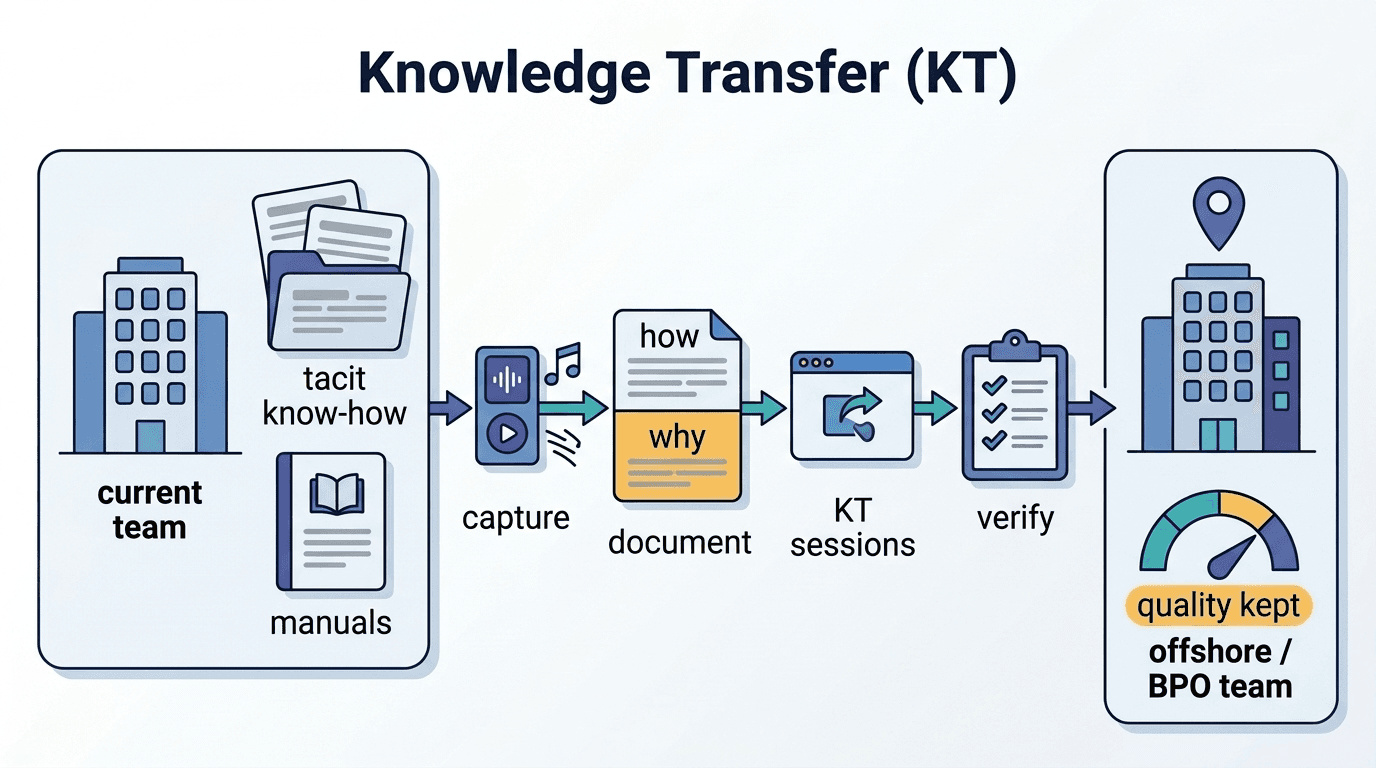
Knowledge Transfer
Knowledge transfer refers to the process of systematically transferring business knowledge, know-how
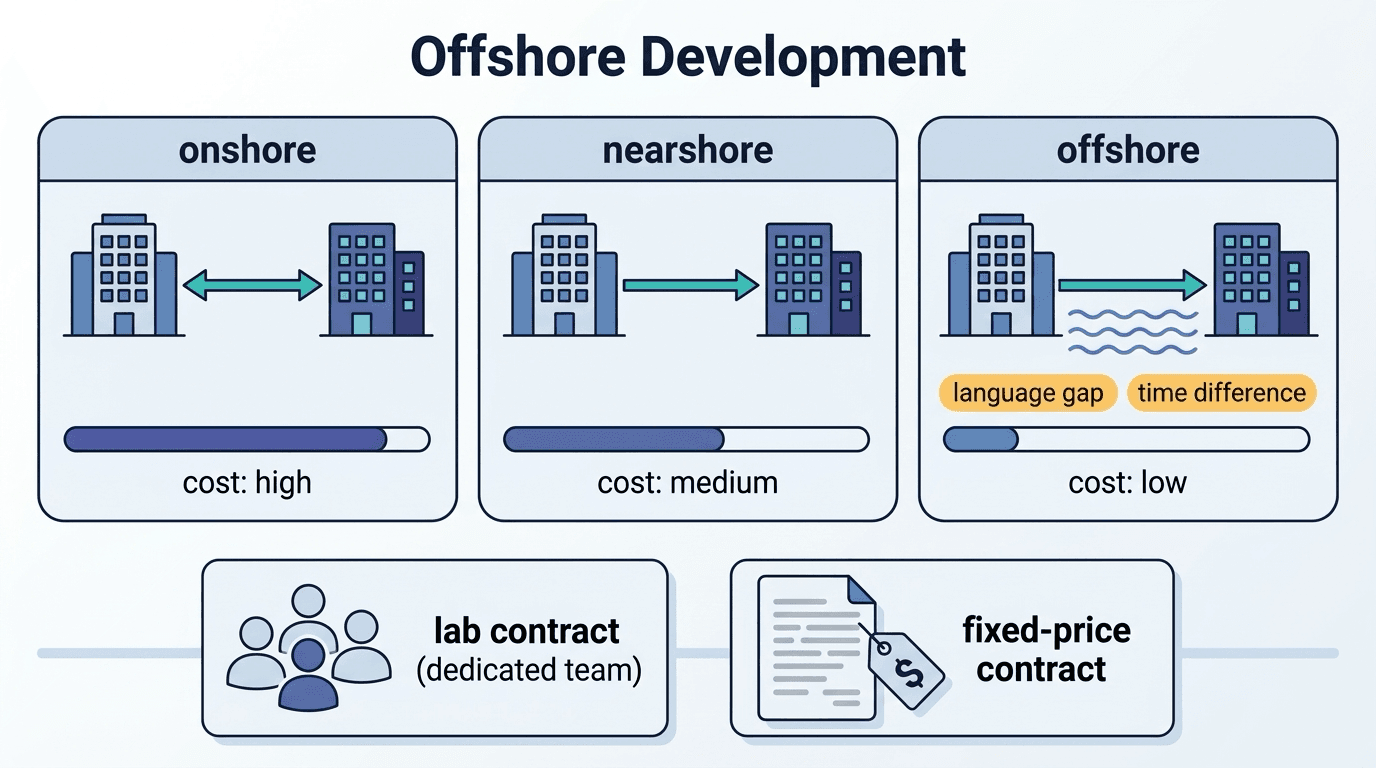
Offshore Development
Offshore development is the practice of contracting software and system development to companies or
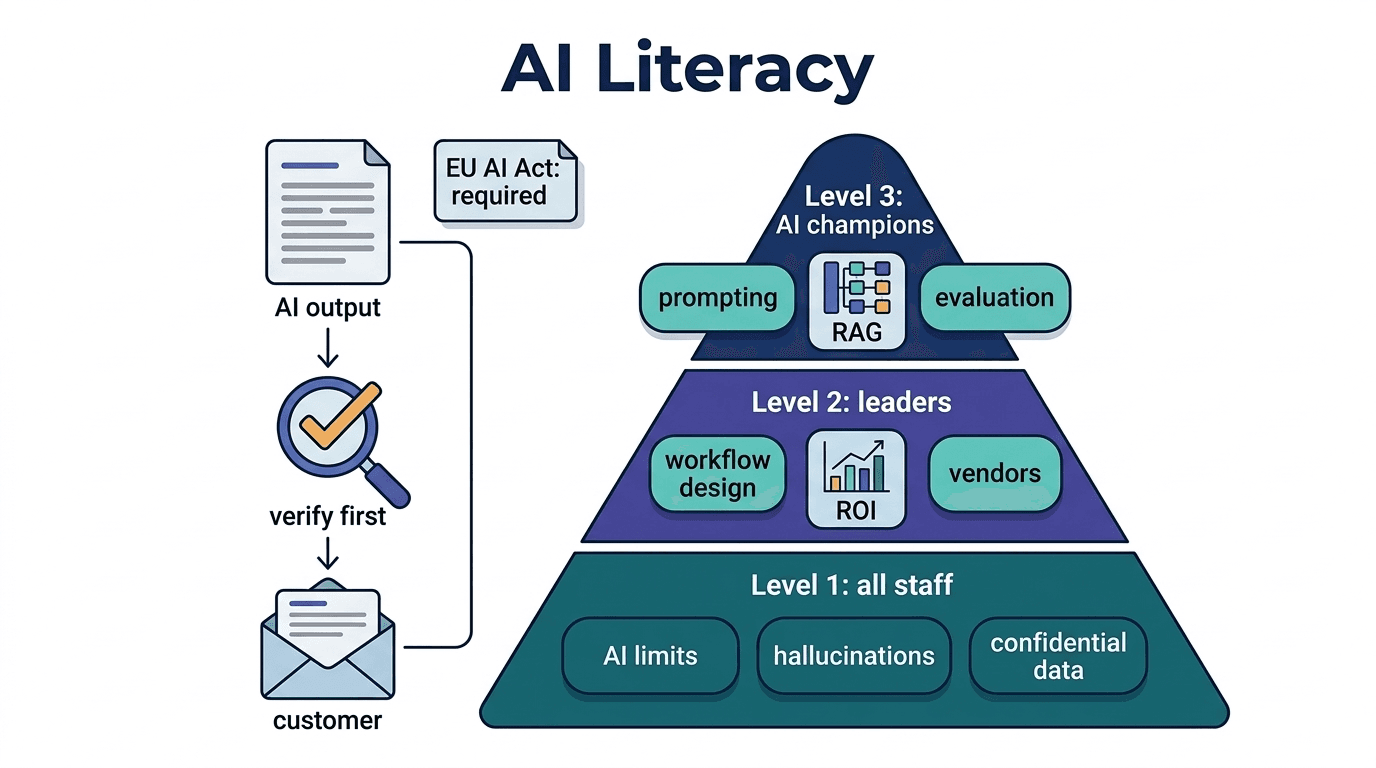
AI Literacy (AI Literacy)
Knowledge and skills to understand the basic concepts, limitations, and risks of AI, and to appropri