Preventing Knowledge Leakage and Establishing a Phased Skill Transfer Process in Offshore Development

Introduction
In offshore development settings, it is not uncommon for talented engineers to suddenly resign, or for entire teams to be restructured overnight. Each time this happens, the tacit knowledge behind design decisions and the rationale for business logic disappears, and successors end up repeating the same mistakes. This "knowledge loss" is a real and pressing concern faced by many client organizations.
This article is aimed at PMs, technical leads, and HR managers who run offshore development projects, and explains implementable strategies that combine talent development from the hiring stage, multilingual documentation, gradual delegation of authority, and regular knowledge audits. By the end, you should have a clear grasp of the concrete mechanisms and division of responsibilities needed to maintain quality and delivery deadlines even in environments with high staff turnover.
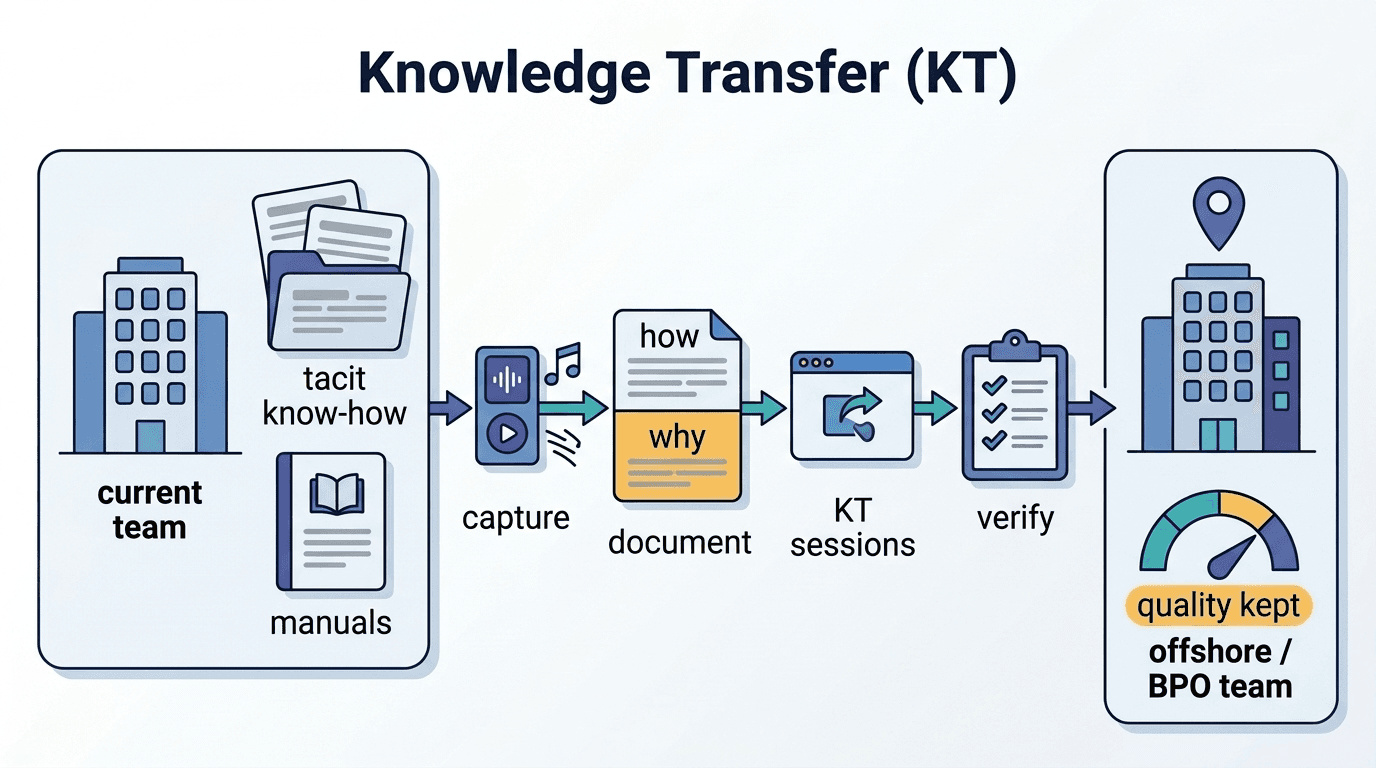
Knowledge loss occurs not so much because of turnover itself, but because tacit knowledge has never been converted into explicit knowledge. The moment a responsible team member leaves, situations arise where "no one can explain why that specification exists"—precisely because the knowledge existed only inside that individual's head. In offshore development, this problem is compounded by language, cultural, and time-zone barriers, which reduce the opportunities for tacit knowledge to be shared compared to domestic development. As a result, quality degradation and schedule delays often surface weeks after the actual departure. The next section organizes the three underlying factors that give rise to this problem.
Why Knowledge Loss Occurs: Staff Turnover and Loss of Tacit Knowledge
When resignations are concentrated in a short period, there is a high risk that entire bodies of business knowledge are lost along with the departing staff; when resignations are spread out gradually, it becomes easier to secure opportunities for handover. In offshore development teams, personnel changes often occur in line with contract renewal timing or project completion, and when the owner of tacit knowledge suddenly leaves, the background behind design decisions and the history of past incident responses vanish without ever being documented.
ISO 30401:2018 calls for knowledge management to be operated as an organizational system, positioning knowledge retention that depends on individual memory as a risk. What remains in code comments and design documents tends to be limited to explicit knowledge about "what was built," while the rationale behind "why that particular implementation was chosen" tends to rely on verbal transmission. This gap may seem subtle, but it runs deep. Even when a document review confirms the comprehensiveness of explicit knowledge, the absence of decision rationale is easy for the reviewer themselves to overlook, allowing it to slip through the check.
Under offshore-specific contract arrangements, teams are often organized on a per-project basis, and there are cases where knowledge that has become siloed in individuals is lost the moment the project ends. To compensate for this structural weakness, organizations need both a mechanism for detecting early signs of resignation and an operational practice of recording decision rationale as part of daily work. The talent development philosophy set out in ISO 10015:2019 can also be referenced as a framework for continuous skill transfer, rather than one-off handovers.
Challenges Unique to Offshore Development: Language, Culture, and Time Zone Barriers
Language, cultural, and time-zone barriers, apart from the loss of tacit knowledge due to turnover, act as factors that hinder day-to-day information transmission itself. When the client and the offshore development team use different languages, it becomes difficult to accurately convey design intent or the background of specification changes verbally, and information is gradually lost each time it passes through translation. As the number of transmission steps increases, the original volume of information becomes harder to preserve—and background information explaining "why a particular specification was chosen" tends to be the first thing cut, compared to conclusions or procedures.
Cultural differences are also not to be overlooked. When a culture that seeks confirmation for ambiguous instructions coexists with a culture that executes instructions literally, discrepancies in specification understanding can carry through to the implementation stage. If engineers tend to refrain from asking questions even when they have doubts, misunderstandings tend to surface only after delivery, inflating correction costs. This issue runs deeper than the language barrier and cannot be solved simply by improving translation accuracy. It is necessary to build into the process a relationship where questions are easy to ask, along with appropriate timing for confirmation.
As for the time-zone barrier, it is a simple problem: because working hours do not overlap, question-and-answer exchanges get pushed to the following day or later, and implementation proceeds while open questions remain unresolved. The fact that JISA's "UML Application Guidelines for Offshore Development" recommends sharing specifications through diagrams is also intended, in part, to compensate for these language and time-zone gaps.
Impact of Knowledge Loss on Organizations: Quality Decline and Delivery Delays
If left unaddressed, how does knowledge loss ultimately manifest itself in the numbers on the ground in development?
The most obvious impact is quality degradation. When the person who understands the background of a specification or the history of past incident responses leaves, the successor has no choice but to implement based solely on the surface-level specification document. As a result, bugs that were once resolved in the past tend to recur, and modifications that misjudge the scope of impact on existing features are more likely to slip in.
Schedule delays are also a significant impact, though they tend to progress in a less visible way than quality degradation. When the rationale behind design decisions has not been preserved as explicit knowledge, successors must repeat the same investigations from scratch, and confirmation work that should normally take just a few hours can balloon into a matter of days. In cases where the person who left was responsible for system integrations or complex business logic in particular, there are examples where the replacement staff member consumes the majority of the schedule simply trying to decipher the intent behind existing code. Even though things may appear on schedule on the surface, the investigation phase is in fact expanding beneath the surface, and it is not uncommon for the delay to only come to light in the later stages of the process.
These impacts rarely end with a single occurrence: rework caused by quality degradation damages trust with the client, and the resulting increase in additional confirmation steps triggers a chain of delays into the next schedule as well. Knowledge loss must be understood not merely as a loss occurring at the moment it happens, but as a structural risk that affects the entire subsequent process.
Designing a Phased Skill Transfer Process

When knowledge loss occurs in offshore development, the cause is often attributed to a one-time shortage in handover training, but in reality, the root problem lies in the failure to design a continuous flow from recruitment through authority delegation to successor development. By dividing the process into three stages—building a knowledge foundation during onboarding, gradually delegating authority through hands-on work, and developing leadership—it becomes clear who is responsible for what at each phase, and where skill transfer is stalling.
Phase 1: Building a Knowledge Foundation During Onboarding
For sites with many existing members, a one-on-one approach linking a single mentor to each new hire is effective, while for launching a new site where multiple people join simultaneously, a group-based approach using a common curriculum is more efficient. What needs to be established at the early stage of onboarding is not business knowledge itself, but the knowledge foundation. This includes documentation covering development environment setup procedures, coding standards, past incident response records, and the background behind key decisions. If this is neglected, understanding will vary among members at the later stages of authority delegation and task handover, ultimately forcing mentors into a cycle of individual firefighting.
Following the requirements for knowledge management systems outlined in ISO 30401:2018, this information should be centrally managed as an organizational asset rather than as personal notes. In practice, it works well to set aside the first one to two weeks after joining for reading through existing documentation, then assign simple tasks afterward to check comprehension. However, at some sites, existing documentation itself may be insufficiently developed. In such cases, the reading period can instead be repurposed as a documentation-building period, with new hires writing the documentation themselves—allowing foundation-building and onboarding to proceed simultaneously.
It's also worth noting that combining this with a mechanism allowing new hires to add their questions directly into the documentation keeps the knowledge foundation continuously updated. In fact, questions from new hires can serve as a valuable tool for surfacing areas that existing members had treated as tacit knowledge and neglected to document. Positioning onboarding not merely as a training period but as a process for building a foundation capable of withstanding the next stage of authority delegation directly contributes to preventing knowledge loss later on. Skimping on investment at this stage will cause the foundation to crumble, no matter how well the transfer process is structured in subsequent stages.
Phase 2: Gradual Delegation of Authority Through Practical Work
Rather than delegating authority all at once, a practical design involves progressing through stages based on task difficulty and scope of impact. As a general guideline, it works well to first assign tasks with limited scope of impact—such as modifying existing code or writing tests—and then, once a track record of passing reviews has accumulated, move on to tasks involving new feature design or integration with other modules.
To avoid relying on ad hoc, individual judgment for this transition, criteria for expanding authority must be defined in advance. Setting standards such as "rework in recent pull requests below a certain number of instances" or "able to independently complete initial response to an incident," and raising authority levels only once the mentor and PM agree, functions as a reliable pattern. If authority is expanded based purely on gut feeling in the field without clear standards, evaluations will shift the moment mentors change, and the speed of delegation will vary inconsistently across teams. This is the single biggest factor undermining staged delegation as a countermeasure against knowledge loss.
Recording the delegation of authority itself is also part of knowledge loss prevention. Keeping records of who acquired which authority at which stage clarifies the scope of responsibilities that must be handed over to a successor upon departure. Without such records, the successor must spend additional time reaching the same level of authority, doubling the development cost.
Phase 3: Leadership Development and Securing Successors
Should personnel who have progressed through authority delegation simply be left as leadership candidates without further action?
Unless leadership development runs in parallel once authority expansion reaches a certain point, decision-making responsibilities become concentrated in specific individuals, creating a risk that organizational capability is entirely lost the moment that person leaves. The focus of development must extend beyond technical skill to include the ability to guide junior members and to be entrusted with decision-making within the team. It is effective to assign lead engineer candidates the responsibility of onboarding new members and to review their mentoring records. Making the quality of mentorship visible allows an organization to distinguish between individuals who have strong technical skills but struggle to explain things, and those who are well-suited to developing others.
Securing successors requires a system that does not depend on a single candidate. Placing a first and second candidate for each major module and giving both equal opportunities for design decisions shortens the handover gap even if one of them leaves. In line with the knowledge management philosophy set out in ISO 30401, such succession planning should be established as an organizational mechanism rather than left to individual goodwill. Having HR and the PM hold a session once every six months to check on the progress of successor candidates is also a practical measure to prevent development from stalling.
Documentation and Knowledge Visualization in Multilingual Environments

The language barrier cannot be solved by simply increasing the volume of translation. It is, rather, a problem that can be overcome by redesigning how things are written.
No matter how far authority delegation and leadership development progress, as long as knowledge remains locked inside an individual's head, all of it is lost the moment that person leaves. How should documentation be formatted so that it is properly conveyed to readers in a multilingual environment, and how can a mechanism be built to convert tacit knowledge into explicit knowledge? Let's look at this in concrete terms from here.
Principles and Formats for Effective Documentation
If the personnel reading the reference language are not native speakers of Japanese or English, it is practical to prioritize structured short sentences and diagrams, and to add supplementary annotations when a glossary in the reader's native language can be used together. JISA's "UML Application Guidelines for Offshore Development V3.0" recommends creating documentation using diagrammatic notations such as UML as a means of reducing the ambiguity of natural language in such multilingual projects.
Specific principles include thoroughly adhering to one sentence, one meaning, keeping the distance between subject and predicate short, clearly stating conditions and results in the active voice, and defining technical terms before using them upon their first appearance. In terms of format, specifications should be organized primarily around bullet points and diagrams, avoiding lengthy prose-style explanations. For procedure manuals, numbering each step and separately describing expected inputs, outputs, and exception handling reduces discrepancies in interpretation during translation.
As an exception, context-dependent content such as background explanations and design intent is difficult to convey through diagrams alone, so it is necessary to add concise explanatory text focused on the key points. Thoroughly implementing version control and retaining a history of updates so that successors can trace which point in time the knowledge was handed over from is what determines the practical effectiveness of documentation.
Mechanisms for Converting Tacit Knowledge into Explicit Knowledge
Tacit knowledge is experience-based reasoning about "why a particular judgment was made," and by its nature it is difficult to convey through procedure manuals alone. An effective mechanism for converting this into explicit knowledge is to record decision-making separately from deliverables. For example, when making design changes or handling defects, leaving a brief note not only on what was changed but also on "why that choice was made" and "what other options were considered and why they were not adopted" makes it easier for successors to reproduce the same decision-making criteria.
As a concrete mechanism, it is practical to establish a rule for leaving the rationale behind decisions in the comment sections of code reviews or ticket management systems, and to operate a process where, at regular intervals, only the key points from this accumulation are extracted and transcribed into a knowledge base. The knowledge management system requirements set out in ISO 30401:2018 call for the identification, acquisition, and retention of such knowledge to be sustained as an organizational mechanism, providing grounds for building a system that does not rely on individual goodwill.
Additionally, rather than having veteran personnel individually document "answers to frequently asked questions," recording and summarizing actual consultation sessions and converting them into text tends to be less burdensome and improves the accuracy of tacit knowledge extraction. The methods introduced in How to Streamline In-House Training and Knowledge Transfer with AI serve as a useful reference for systematizing this kind of dialogue-based knowledge extraction.
Knowledge-Sharing Framework Within Offshore Teams

How can we create a mechanism to circulate knowledge that has become person-dependent throughout the entire team, rather than leaving it confined to an individual's head? Documentation alone cannot fully share insights gained face-to-face or implicit know-how. By combining two practical settings—meeting structures and pair work—the circulation and retention of knowledge can be systematized.
Running Regular Knowledge-Sharing Meetings
Decision Criteria: How the frequency and agenda design of meetings are fixed determines the continuity of knowledge sharing.
Securing a 30–45 minute slot weekly or biweekly, and fixing the agenda to three items—"technical issues resolved recently," "newly identified specification constraints," and "background on tasks to be handed over next week"—reduces the burden of preparation and makes it easier for the meetings to become a regular practice. In offshore development, time differences between locations often make it impossible for everyone to participate simultaneously, so it is important to attach recordings and chat logs to the meeting minutes, keeping them in a format that can be followed asynchronously.
When there is a language barrier, using presentation materials in simplified English or a bilingual format combining the local language and Japanese, and limiting verbal explanations to the key points, helps reduce variation in understanding. As a hypothetical example, if the on-site lead documents the agenda in advance and the client side prepares a list of questions before entering the meeting, the density of Q&A can be increased even within limited time.
The purpose of the meeting is not information sharing itself, but leaving a record that anyone can reference the next time the same issue arises. Reflecting the minutes into the knowledge base on the same day, and establishing operational rules to ensure the meeting is not treated as a one-off event, will sustain its effectiveness.
Leveraging Pair Programming and Mentoring
Combining pair programming for the training phase of new members with mentoring for expanding the technical horizons of existing members increases the efficiency of tacit knowledge transfer. Pair programming has the strength of allowing the reasons behind judgments and quirks in design—which are difficult to write down in documentation—to be shared on the spot, since both parties work on implementation while looking at the same screen. In particular, the business knowledge underlying specifications and the lessons learned from past incident responses are often difficult to convey even when documented in writing, and tend to be understood more readily through hands-on explanation.
Mentoring, on the other hand, differs from pair programming in that it involves setting aside regular one-on-one reflection time and addresses not only technical aspects but also career development and the expansion of roles. By placing a candidate for the next leadership position in the mentor role and giving them experience teaching others, one can also expect an increase in that person's own motivation to stay with the organization.
As a general guideline for progression, it tends to work well in practice to increase the proportion of pair programming during the first few months after joining, and to increase the proportion of mentoring once business understanding has progressed. Linking the confirmation of progress to the agenda of the regular meetings discussed in the previous section, and creating a flow in which issues identified during pair work are shared at the meeting, prevents individual skill development and organization-wide knowledge sharing from becoming disconnected. Between locations with time differences, it is realistic to limit the timing of pair work to overlapping hours and to combine asynchronous chat with online interviews for mentoring.
Organizational Structure and Responsibility Allocation for Preventing Knowledge Loss (RACI Chart)

To prevent knowledge loss, the key is to clarify via RACI who is responsible for "execution," "approval," "consultation," and "reporting" regarding knowledge, and to build a system in which the ownership does not become vacant even when a departure occurs. In particular, when the responsibilities of the offshore site and the client side remain ambiguous, it often happens that the scope of handover is only discussed for the first time once notice of departure is received.
| Comparison Target | Evaluation Axis | Decision Points |
|---|---|---|
| Documentation Preparation | Who executes and who approves | The offshore PM/technical lead is Responsible, and the client-side manager is Accountable. The Japan side holds approval authority over quality standards |
| Technical Knowledge Approval (Code Review) | Decision-maker for authority delegation | Senior engineers are Accountable, and the reviewer performing the review is Responsible. Junior members remain at Consulted and are not given authority |
| Handover Plan at Time of Departure | Person responsible for initiation and oversight | HR is Informed, the technical lead is Responsible, and the PM manages deadlines as Accountable |
| Knowledge Audit (Periodic Inventory) | Frequency of implementation and reporting destination | The quality control person in charge is Responsible, and management is Informed. Inventory records are kept in line with the requirements of ISO 30401 |
The RACI chart is not something to create once and leave as-is; it is premised on being updated whenever a departure or role change occurs. In particular, distributing the Accountable role among multiple people tends to result in a situation where no one takes action in an emergency, so the principle should be one Accountable person per knowledge area.
FAQ|Frequently Asked Questions on Skill Transfer in Offshore Development

This section answers frequently occurring questions in the field, such as the handover period, the feasibility of documentation, and metrics for measuring the degree of skill succession. Based on the premise of the role division defined in the RACI chart, we have concisely organized situations where practitioners tend to hesitate when making decisions.
How Long Is Needed to Transfer Knowledge When Staff Leave
Decision Axis: The handover period varies depending on the complexity of the assigned work and the notice period given for departure, and cannot be determined by a uniform number of days.
If the period between the notice of resignation and the last day of work is short, the focus will be on verbal interviews and supplementing existing documentation, making it difficult to transfer deep tacit knowledge. On the other hand, if a successor has already been decided and gradual delegation of authority has been proceeding in advance, the handover at the time of departure is completed with only final confirmation work. In other words, the substantive length of the handover period is determined not by "the several weeks after the departure becomes known" but by how much skill transfer has been advanced ahead of time during day-to-day operations.
As a general guideline, for simple routine tasks, there are cases where document review and hands-on training over several days to about a week can suffice. On the other hand, for personnel involved in system architecture decisions or client-specific business knowledge, it is desirable to advance gradual delegation of authority to successor candidates over a period of several months; attempting to secure sufficient time in a rush after receiving notice of departure tends to be inadequate. The concept behind the knowledge management system required by ISO 30401 also presumes routine recording and sharing of knowledge, rather than a response made only at the time of departure. Therefore, before asking about the handover period, checking the state of routine documentation preparation and the progress of authority delegation becomes the practical decision axis.
Is Documentation Feasible Despite Language Barriers
When strict unification of terminology definitions and description granularity is required, the approach of retaining the original language alongside the Japanese translation is effective. However, when the focus is on sharing relatively abstract design philosophies and decision-making criteria, using Japanese summaries together with diagrams tends to be more effective. The language barrier cannot be completely eliminated, but it is important to identify what is feasible.
What determines the feasibility of documentation is the nature of the knowledge in question. Structured technical information, such as API specifications and coding standards, is relatively easy to make multilingual if templates and glossaries are prepared. On the other hand, highly context-dependent knowledge, such as business decision-making criteria and implicit rules, is difficult to convey through translation alone, and requires supplementary diagrams, flowcharts, and concrete examples.
In practice, there is a known insight that fixing the glossary before starting to write tends to be effective. This is because if term translations are inconsistent, the same concept appears under multiple names, causing confusion for the reader. The "UML Application Guidelines for Offshore Development" published by JISA also emphasizes forming a shared understanding through diagrams, and the idea of prioritizing diagram sharing over language is a useful reference.
Ultimately, what makes documentation "feasible" is not translation accuracy itself, but the degree of thoroughness in structuring and unifying terminology.
What Metrics Measure Skill Transfer in Offshore Teams
The progress of skill succession must be confirmed not through a single metric but by combining multiple perspectives.
Representative metrics include document coverage (the proportion of target tasks that have been documented), the stage of authority delegation (how far delegation has progressed—design, review, or decision-making), and the results of reproduction tests in knowledge audits. A reproduction test is a method for confirming whether a successor can complete a specific task without the presence of existing members, and this is consistent with the competence management concept presented in ISO 10015:2019.
The decision branch point is whether the personnel in question pose a high departure risk. For personnel responsible for core design decisions, priority is given to tracking the stage of authority delegation and the results of reproduction tests. For personnel primarily engaged in routine implementation work, document coverage trends serve as the main indicator, and operations can proceed with a lower audit frequency.
When managing metrics numerically, it is effective to continuously record a ratio such as "number of documented tasks ÷ total number of target tasks" for each project, and to check whether this ratio declines when a departure occurs. Metrics should not be evaluated in isolation; when assessed together with records from regular knowledge-sharing meetings, it becomes easier to grasp actual comprehension rather than mere formal documentation.
Author & Supervisor

Yusuke Ishihara
Started programming at age 13 with MSX. After graduating from Musashi University, worked on large-scale system development including airline core systems and Japan's first Windows server hosting/VPS infrastructure. Co-founded Site Engine Inc. in 2008. Founded Unimon Inc. in 2010 and Enison Inc. in 2025, leading development of business systems, NLP, and platform solutions. Currently focuses on product development and AI/DX initiatives leveraging generative AI and large language models (LLMs).
Recommended Articles