What Are the Roles of AI and Humans? 3 Key Criteria for Deciding What to "Delegate, Collaborate On, or Keep Human"

The division of roles between AI and humans refers to the practice of categorizing the individual tasks that make up a business operation into three types—"delegate to AI," "human-AI collaboration," and "handled by humans"—and redesigning the overall workflow from the perspectives of accuracy, risk, and accountability.
This article is intended for DX managers, IT departments, and corporate planning professionals at companies considering or advancing AI adoption. It explains three decision-making criteria for determining role allocation, a four-quadrant framework for sorting tasks, and five steps for moving forward with implementation. The goal is that, by the end of this article, readers will be able to look at their own organization's list of operations and draw clear, well-reasoned lines: "this goes to AI, this is collaborative, and this stays with humans."
What Is the Division of Roles Between AI and Humans?

Designing a division of roles is not about "listing what AI can do"—it is a decision-making process of selecting the appropriate type of delegation for each individual task. We begin by organizing the overall picture into three types.
Three Models: Delegate, Collaborate, and Human-Led
The division of responsibilities between AI and humans is not a binary choice of "automate or don't automate." In practice, the following three types provide a useful framework.
| Type | Human Involvement | Typical Task Examples |
|---|---|---|
| Delegate to AI (Automation) | Post-hoc sampling checks only | Meeting minute summaries, data formatting and transcription, routine internal inquiry responses |
| Collaborate with AI (HITL) | AI processes, with humans making judgments or approvals at key points | Initial screening for estimates and credit assessments, application screening, contract review |
| Handled by Humans | AI limited to research assistance or drafting support | Major decision-making, customer apologies and negotiations, relationship building |
The key point is that these types are determined at the task level, not the business process level. Take billing operations as an example: data extraction can be delegated to AI, handling exceptional cases can be done collaboratively, and negotiations with customers who have delayed payments are handled by humans. It is entirely normal for all three types to coexist within a single business process. Specific implementation patterns for the collaborative type are covered in detail in the Human-in-the-Loop (HITL) explainer article.
Why You Shouldn't Decide Based on "What's Technically Possible"
As AI capabilities improve, "whether it can be done" becomes less useful as a criterion for determining role allocation—because technically, most tasks can be done by AI. Even so, there remain cases where delegation is inadvisable. There are three main reasons.
First, what AI can do and what is acceptable when it goes wrong are two different questions. Generative AI must be designed with the assumption that it will make errors at some rate, and tasks where the impact of errors is significant cannot easily be automated on the basis of high accuracy alone. Second, there is the question of accountability. If damage occurs as a result of AI output, saying "the AI did it" is not an acceptable explanation to customers or regulators. Third, there is the emotional dimension for the recipient. The IMF has coined the term "nostalgic jobs" to describe work that AI could technically replace, but that society prefers to keep in human hands—fields such as caregiving, education, and ceremonial roles, where the very act of a human performing the work carries intrinsic value. This concept is introduced in detail in the Nostalgic Jobs explainer article.
This topic is often discussed in public discourse through the lens of "jobs AI won't replace" or "things only humans can do." However, the right question for business process design is not "can AI replace this?" but rather "do we want to delegate this, and should we?"—and the answer differs from task to task. In other words, the division of roles between AI and humans is not a technical assessment, but a management decision concerning risk, value, and accountability.
Why Designing Role Division Matters Now

Now that the practical deployment of AI agents has dramatically expanded the scope of what can be delegated, the skill with which boundaries are drawn will determine the outcomes of AI adoption. We examine the background from two perspectives.
AI Agents Going Practical Has Rapidly Expanded What Can Be Delegated
Traditional generative AI usage centered on a model where "humans give instructions and AI responds once." Today, AI agents that formulate plans, operate tools, and execute multiple steps in sequence are beginning to enter real-world operations. In other words, the option of delegating not just "drafting text" but an entire "segment of a business process" has become a practical reality.
The scope of impact is not small. IMF analysis suggests that approximately 40% of global employment will be affected by AI (IMF, "Gen-AI: Artificial Intelligence and the Future of Work," 2024). As the range of delegable tasks expands, the question of "how much to delegate and where humans take back control" directly becomes a design problem for operational quality and risk management. Leaving these decisions entirely to individual teams without any established guidelines tends to result in AI being used according to inconsistent standards across departments, and a paradoxical situation where higher-risk tasks are automated without awareness.
Furthermore, the division of roles is not only a matter of operational efficiency but also one of job design. As more tasks are delegated to AI, the center of gravity in human roles shifts toward verification, exception handling, and building customer relationships. A role-allocation framework serves both as a tool for operational improvement and as a foundation for planning employee skill transitions (reskilling).
Most Failures Stem from Role Design, Not Technology
When AI adoption fails, the cause is more often found in the design of role allocation than in model accuracy. Failures tend to appear at two extremes.
One extreme is "over-delegation." Even when human review is nominally in place, automation bias—the tendency to uncritically accept AI output—causes the review process to become a formality, effectively allowing content to pass through unchecked. This phenomenon and its countermeasures are covered in detail in the article on automation bias. The other extreme is "under-delegation," where requiring multiple layers of human approval for every output results in slower processing than before automation, causing teams to stop using AI altogether.
Neither is a failure of technology—both are failures of design judgment regarding "how much human involvement is appropriate for this task." This is precisely why organizations need to establish and share a common set of criteria for making such judgments in advance.
Three Decision Criteria for Dividing Roles

The three decision axes are "cost of error," "the value of human involvement," and "accountability." Applying them in this order allows most tasks to be sorted naturally.
Criterion 1: Cost of Errors and Reversibility
The first question to ask is: "What happens if AI gets this task wrong?" There are two factors to examine: the magnitude of the impact and its reversibility.
For tasks like drafting emails or summarizing meeting minutes, a mistake can simply be corrected by a human, and the impact remains internal. Tasks with low error costs and high reversibility are prime candidates for automation. On the other hand, tasks such as executing a funds transfer, issuing an official response to a customer, or applying changes to a production system—where the consequences are difficult to undo the moment they are carried out—should have a human or a safety mechanism placed "before execution," regardless of how high the accuracy may be. Impact magnitude is easier to assess when categorized into three levels: "contained within the organization," "reaches the customer," and "touches society or regulation." The further outward the level, the lower the tolerance for the same error rate.
When delegating execution to an AI agent, the "cost of error" itself can be reduced by limiting permissions to the minimum necessary and incorporating a mechanism that automatically halts operation in the event of an anomaly. Expanding the scope of delegation and establishing safety mechanisms should always be pursued together (see: Circuit Breaker Design for AI Agents).
Criterion 2: Is There Value in Humans Doing It Themselves?
The second question is: "Is there inherent value in having a human perform this task?"
Even when a task is technically replaceable, there are jobs where customers or society expect human involvement. The nostalgic jobs described by the IMF referenced at the outset are a prime example, with caregiving, education, and religious ceremonies among those cited. Bringing this closer to a B2B context, tasks such as in-person apology visits during a crisis, milestone meetings with key clients, and final-round job interviews derive their value not from the quality of execution alone, but from the very fact that "a human showed up" or "a human made the decision"—and that fact itself serves as a guarantee of trust.
One important caveat with this axis is that the party determining the value is not your own organization, but the other party. Even if something appears "sufficient with AI" internally, automating a touchpoint where the recipient expects human involvement risks sacrificing relational capital in exchange for efficiency gains. When allocating customer-facing tasks, it is recommended to explicitly incorporate "the value of human involvement" into the cost calculation.
Criterion 3: Accountability, Regulation, and Governance
The third question is: "Who explains the results to whom, and how?"
Decisions that directly affect individual rights and interests—such as hiring, credit assessment, and performance evaluation—tend to require human involvement from an accountability standpoint, separate from the cost of errors. For example, the EU AI Act, which is being applied in phases, requires human oversight for AI applications classified as high-risk. Domestically as well, business processes that cannot explain the rationale behind their decisions become untenable in audits and customer-facing situations.
In practice, it is advisable to have three elements in place as a set to avoid treating "the AI decided" as a final answer: preserving decision logs, clarifying who is responsible, and establishing a pathway for human re-evaluation when a decision is contested. The method for formalizing these elements as organizational rules is explained in detail in Governance Frameworks for the Agentic Era.
A Framework for Sorting Tasks into Four Quadrants

Taking two of the three decision axes—"cost of errors" and "the value of being human"—tasks can be organized into four quadrants. The accountability axis is then layered on as an operational rule after the initial sorting.
Sorting Matrix: Cost of Errors × Value of Human Involvement
Conclusion: Assign tasks with low error costs and low human value to AI; move tasks with high error costs to collaboration; and keep tasks with high human value human-led.
| Quadrant | Cost of Errors | Value of Being Human | Recommended Approach | Task Examples |
|---|---|---|---|---|
| A | Low | Low | Delegate to AI | Meeting minute summaries, data entry, internal FAQs, first-draft translations |
| B | High | Low | Collaborate with AI (HITL) | Initial credit assessments, quote creation, applying changes to production environments |
| C | Low | High | Human-led + AI assistance | Day-to-day customer communication, internal training, team management |
| D | High | High | Human-handled | Apologies and negotiations for serious incidents, management decisions, final hiring decisions |
Quadrant C is the one most often overlooked. Because the cost of errors is low, it may appear to be a candidate for automation at first glance; however, interactions such as everyday check-ins and training are touchpoints where the act of a human being present builds trust. Automating these areas degrades relationship quality in ways that do not show up in efficiency metrics. It is appropriate to keep AI in a supporting role—limited to drafting and reminder assistance.
The key to operationalizing this framework is not to treat the sorting results as fixed labels. Even the same task—"quote creation"—can shift quadrants depending on the deal size or the importance of the customer. Drawing conditional lines, such as "standard quotes below a certain amount are handled as Quadrant B collaboration; above that threshold, they are handled as Quadrant D by a human," makes the framework easier to apply on the ground.
Design Considerations for Tasks Delegated to AI
When delegating Quadrant A tasks to AI, "delegating" does not mean "leaving unattended." What must be designed is the execution environment and a verification mechanism.
First, the execution environment. To enable AI to work reliably, prepare in advance: the data it will reference, the tools and permissions it is allowed to use, and the retry and stop conditions in the event of failure. The article on harness engineering is a useful reference for this concept of "preparing an environment in which AI can work."
Next, verification. It is not necessary for humans to review every output, but sampling inspections and quality metric monitoring should remain in place. Rather than fixing the sampling rate, it is better to operate dynamically—lowering it as quality stabilizes, and temporarily raising it immediately after a model or workflow change. After automation, the human role shifts from "executing the work" to "verifying outputs and handling exceptions." This qualitative change in the nature of work is discussed in detail in the article on the shift to the verifier role. The broader the scope of what is delegated, the more verification design becomes the primary responsibility on the human side.
Design Considerations for Collaborative Tasks
In Quadrant B collaborative workflows, the most critical design decision is determining at which point to involve a human. There are broadly three options:
- Pre-approval model: A human approves the AI's proposal before it is executed (suited for irreversible operations)
- Post-review model: The AI executes, and a human reviews and corrects afterward (suited for reversible operations)
- Exception escalation model: The AI handles tasks by default, and only low-confidence cases are routed to a human
Which model to choose maps directly onto the reversibility criterion from decision axis 1. The basic approach is: pre-approval for irreversible operations, post-review for reversible ones, and exception escalation when volume is high and accuracy has been confirmed through operational track record.
Getting the insertion point wrong will tip the process in one of two directions: too many approvals causing throughput to stall, or too few causing reviews to become a rubber stamp. To prevent rubber-stamping, effective measures include displaying the AI's reasoning and areas of uncertainty on the approval screen, requiring approvers to log their reasons for rejection, and periodically injecting dummy errors to measure detection rates. For an overview of collaborative workflow design, please refer to the HITL explainer article.
Common Failures and How to Avoid Them

Failures in role allocation come down to two patterns: binary thinking and the hollowing out of approvals. Both are avoidable if you know about them in advance.
Failure 1: Thinking in Binary Terms — All AI or All Human
When discussions about AI adoption start with the question "Should we automate this process with AI?", they tend to stall. Thinking in binary terms at the process level makes it easy to either abandon full automation of an entire process because a few high-risk tasks are involved, or conversely, to automate an entire process indiscriminately on the basis of a few routine tasks.
The workaround is simple: shift the unit of judgment from processes down to tasks. Take "inquiry handling," for example — it can be broken down into roughly six tasks: reception, classification, drafting a response, sending, escalating complaints, and updating the knowledge base. The moment you decide that classification and response drafting go to AI, sending is a human-AI collaboration with conditions (e.g., amounts or emotional language triggering human review), and complaint handling stays with humans, the discussion moves forward.
By breaking a workflow into around ten tasks and sorting each into a four-quadrant matrix, you can draw a realistic picture: "We can hand off 70% of the tasks in this process to AI, but keep these two judgment calls with humans." A useful rule of thumb for the level of granularity is "a unit that can be handed off even when the person responsible changes."
Failure 2: Human Approval Workflows Become a Rubber Stamp
The most common failure in collaborative design is the hollowing out of approvals — a state where having a human check in place creates a false sense of security, and AI output is essentially waved through unchallenged. Underlying this is an cognitive tendency known as automation bias, where people place excessive trust in AI output (see the explainer article on automation bias for details).
The signs show up in the data. An approval rate that stays consistently high, approval times that remain constant regardless of content complexity, and rejection reason fields left blank — these are all signs that the review process is not functioning.
The fix is to design in a way that reduces the approver's burden while maintaining their attention. Practical options include moving away from approving every item and focusing on high-risk cases only, having the AI output a self-reported confidence score and scrutinizing only low-confidence items, and conducting periodic sampling re-checks.
Five Steps for Designing Role Division

The following outlines the steps for applying the decision criteria and frameworks covered so far to an actual project.
- Break the process down into tasks — Divide the target process into around ten tasks and document the inputs, outputs, and stakeholders for each.
- Evaluate using the three decision criteria — For each task, rate "cost of error," "value of human involvement," and "accountability" as high or low. Prioritize aligning stakeholders on a shared understanding over achieving a perfect evaluation.
- Place tasks in the four quadrants and make a provisional allocation — For tasks where you are unsure, start by placing them on the safer side (greater human involvement).
- Run a small pilot and observe — Begin operations with one or two tasks, and measure not only accuracy but also the effectiveness of approvals (approval rate, rejection reasons) and changes in workload. The AI Agent ROI Measurement Guide is a useful reference for designing impact measurement.
- Redraw the lines regularly — Model performance, regulations, and organizational maturity continue to change. Revisit the quadrant placements at least once a quarter to check whether any tasks can be shifted further toward AI, or conversely, whether any should be returned to humans.
Role allocation is not a static rule set once and forgotten — it is an operational process built on a foundation of ongoing observation and review.
FAQ

Below is a compilation of questions frequently asked during the planning stage regarding the allocation of roles between AI and humans.
Q1: How Should You Decide How to Divide Roles Between AI and Humans?
The basic approach is to break work down into tasks and evaluate them along three axes: "cost of error," "human value," and "accountability." If the cost of error is low and human value is also low, delegate to AI; if the cost of error is high, adopt a collaborative model that incorporates human approval; if human value is high, keep humans in the lead. When in doubt, it is safer to start with greater human involvement and gradually expand what is delegated as you build a track record. If there are many tasks where the right call is unclear, try sorting just one business process first — this will help you quickly develop a sense of your organization's own criteria.
Q2: How Does HITL (Human-in-the-Loop) Differ from Role Division?
If role allocation is the higher-level design of "which tasks to handle under which category," then HITL is the concrete methodology for implementing the collaborative category within that framework. In other words, the two concepts are not in opposition but exist in a hierarchical relationship — HITL design involves deciding, for tasks designated as "collaborative" during role allocation, whether to involve humans in the form of pre-approval, post-review, or exception escalation. For details, please refer to the HITL explainer article.
Q3: Do Small and Medium-Sized Businesses Also Need to Design Role Division?
It is necessary. In fact, smaller organizations are more prone to unconscious "over-delegation," precisely because individuals often handle multiple tasks with differing costs of error. That said, an elaborate framework is not required — simply listing your core business processes and placing them in a four-quadrant matrix is enough to build shared understanding of what can be automated versus what should remain with humans. In organizations with heavy role overlap, even just deciding in advance "who performs the final check" can make a meaningful difference. We recommend starting with an audit of one business process over one week.
Conclusion

The division of roles between AI and humans is a management decision made not on the basis of "what AI can do," but on "cost of error, human value, and accountability." Breaking work down into tasks, sorting them into four quadrants, running small experiments, and continuously redrawing the lines — this operational cycle itself becomes the core of business design in the age of AI.
Related topics can be explored in the following articles:
- What Are Nostalgic Jobs? — The nature of work that remains with humans
- Automation Bias Mitigation Guide — The mechanism behind rubber-stamp approvals
- Human-in-the-Loop (HITL) — Implementing the collaborative model
- Harness Engineering — How to build an environment for delegating to AI
If you need support sorting your organization's business processes or designing an AI agent implementation, please feel free to contact us.
Author & Supervisor

Yusuke Ishihara
Started programming at age 13 with MSX. After graduating from Musashi University, worked on large-scale system development including airline core systems and Japan's first Windows server hosting/VPS infrastructure. Co-founded Site Engine Inc. in 2008. Founded Unimon Inc. in 2010 and Enison Inc. in 2025, leading development of business systems, NLP, and platform solutions. Currently focuses on product development and AI/DX initiatives leveraging generative AI and large language models (LLMs).
Recommended Articles


Terms related to this article
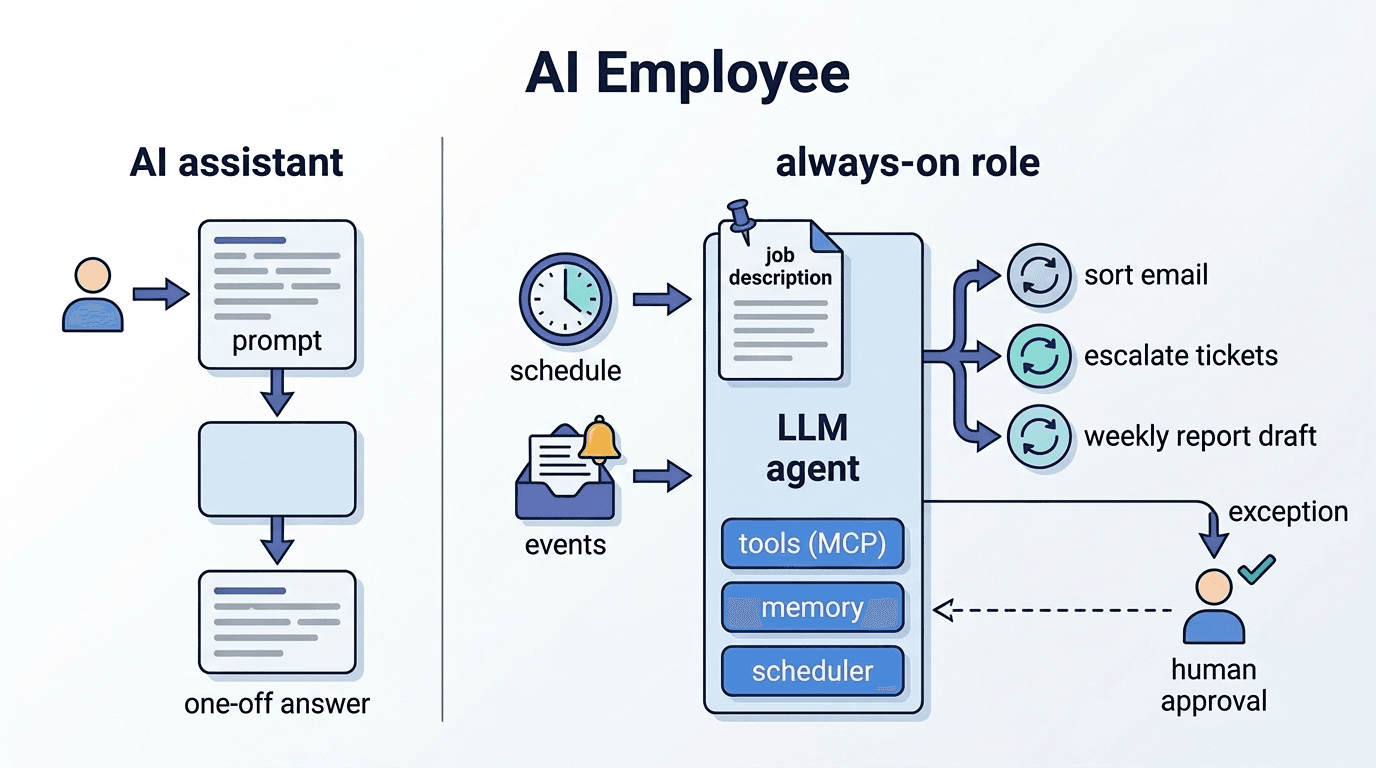
AI Employee (AI Employee)
An autonomous AI agent that takes on a specific business role and continuously performs tasks in the

Shadow AI
Shadow AI refers to the collective term for AI tools and services used by employees in their work wi
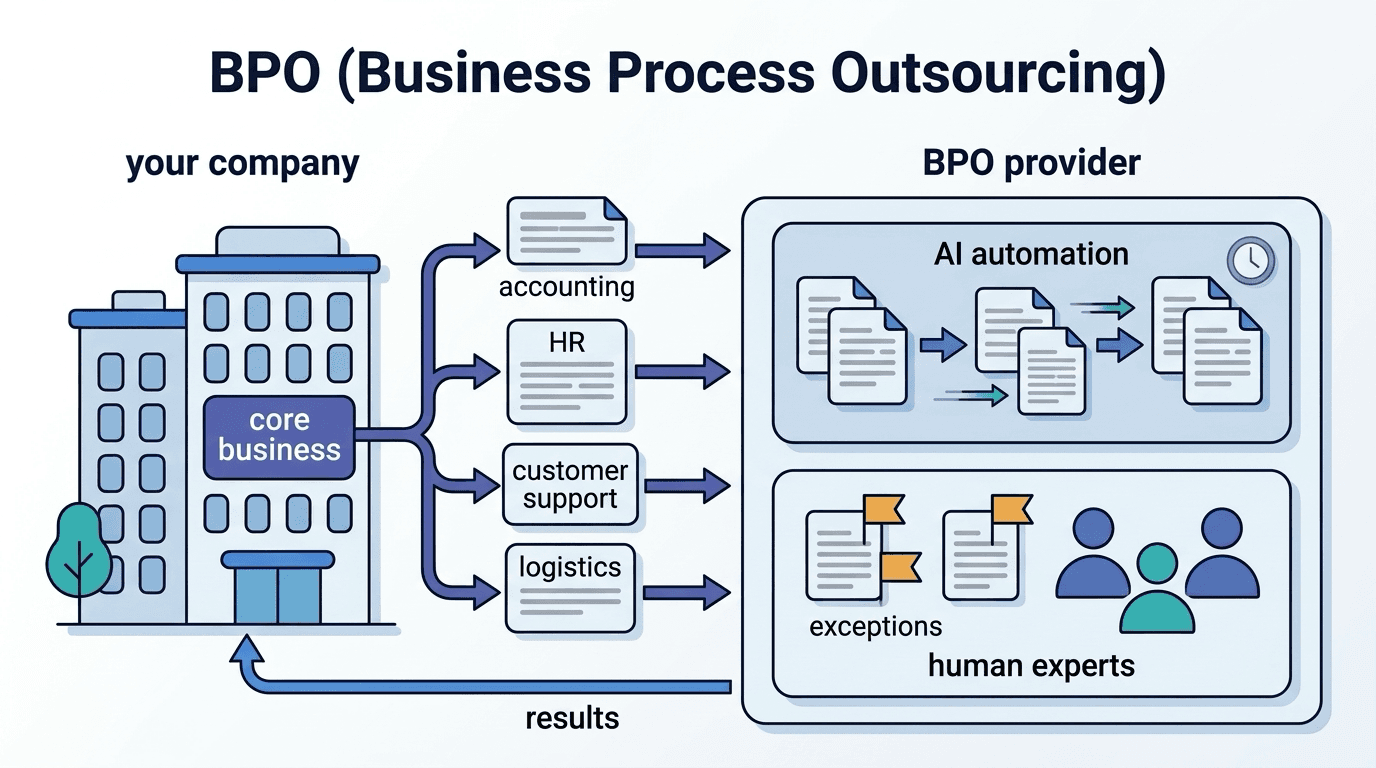
BPO (Business Process Outsourcing)
BPO refers to a form of outsourcing in which a company delegates specific business processes to an e