AI Automation Bias: Causes and 3-Layer Countermeasures

Lead
AI automation bias refers to a cognitive bias in which people place excessive trust in the output of AI systems, skipping the verification and critical scrutiny that humans should otherwise perform. It is the phenomenon of approving important decisions on the assumption that "if the AI says so, it must be correct," and tends to surface once business AI or agents are deployed in production environments.
This article clarifies why AI automation bias is a problem in B2B AI adoption, examines typical failure scenarios, outlines countermeasures across three layers—organizational, design, and operational—and explains implementation patterns for presenting confidence levels in a way that actually communicates to users through UX. The intended audience is operations managers, PMs, and IT administrators who have already introduced AI but have a nagging sense that "people on the ground are taking AI output at face value."
Automation bias is a cognitive bias in which humans defer their judgment to a machine on the assumption that "an answer produced by a machine must be correct." It has been identified since the 1990s in research on aircraft autopilot systems and clinical decision support systems. As generative AI spreads into business use, this classic problem is once again drawing attention as a design challenge for B2B systems.
This section first establishes the definition and psychological mechanisms, then clarifies the distinctions between automation bias and two commonly confused concepts: automation complacency and confirmation bias.
Defining Automation Bias and the Psychology of "Overtrust"
Automation bias is a term conceptualized by Mosier and colleagues in papers from the 1990s. It refers to the tendency of humans to overlook the judgments of automated systems in two directions: "commission errors" (accepting an incorrect recommendation) and "omission errors" (failing to notice a problem the system has missed).
The three main factors that give rise to overreliance are as follows:
- Conservation of cognitive resources: Humans tend to skip conscious verification in order to speed up decision-making. AI easily becomes the starting point for that shortcut, functioning as an "automated authority."
- Diffusion of responsibility: When people feel they can shift the responsibility for a decision to the AI—"the system recommended it"—their own verification becomes lax.
- Interface design: A UI that displays no confidence level, or one that always appears high, strips away any sense that outputs vary in their degree of certainty.
In other words, automation bias should be understood not as "a problem with AI accuracy" but as a problem with the interface between humans and AI (cf. CSET: AI Safety and Automation Bias).
Differences from Related Biases (Automation Complacency / Confirmation Bias)
Because these terms are easily confused with similar ones, it is worth sorting them out here.
| Term | Primary Target | Characteristics |
|---|---|---|
| Automation bias | Output of AI / automated systems | Accepting output as "probably correct" without verification |
| Automation complacency | Monitoring and surveillance | Relaxing attention in situations that require continued monitoring, with a "it'll probably be fine" attitude |
| Confirmation bias | One's own hypotheses | Selectively gathering only information that supports a hypothesis |
| Anchoring | The first figure presented | Judgment being pulled toward the AI's initial proposal |
In practice, multiple biases occur simultaneously. A common pattern is a chain of misjudgments that accumulates as follows: anchoring on the AI chat's first response, reading only subsequent outputs that support it (confirmation bias), and skipping verification altogether (automation bias).
Lumping all of these together as "overconfidence in general" leads to unfocused countermeasures. When designing systems, it is therefore necessary to clearly identify which stage of bias you are targeting.
Why Is This a Problem in B2B AI Adoption Now?

When AI chat and RAG were merely "assistive tools," it was taken for granted that a human would make the final call. But the moment AI agents begin operating business processes autonomously, the question of who inserts a verification step—and where—becomes a design problem. Deploying to production without resolving this ambiguity means automation bias will become an issue on two fronts simultaneously: compliance and audit.
Decision-Making Risks in Production AI Agent Deployments
AI agents call multiple tools and complete tasks through a chain of decisions. Because humans do not review each individual decision along the way, operations tend to default to "approve based on the final output alone."
This gives rise to the following patterns:
- Concealment of compound errors: Even if the search results in step 1 are incorrect, the final output gets approved because it appears "plausible."
- Automatic expansion of permissions: The moment an agent asks "This operation requires approval," the user approves without reading the context.
- Invisibility of failures: When an agent reports its own failures in a user-friendly, smoothed-over way, humans perceive the task as having "succeeded."
When deploying an agent to production, what matters is designing the system to make the "chain of intermediate decisions" visible—not just the "final output"—and to enforce human verification at the necessary points. For more details, see How to Deploy AI Agents to Production: Practical Steps from Pilot to Scale.
Intersection with AI Governance and Audit Requirements
AI governance regulations such as the EU AI Act and ISO/IEC 42001 consistently require "meaningful human oversight." An operation in which a human merely clicks an approval button in a perfunctory manner may not be considered to satisfy this requirement for "meaningful oversight."
In other words, we have entered an era where leaving automation bias unaddressed is not simply an operational mistake, but a governance risk that can be scrutinized externally as well.
If you are working to establish internal AI governance, it is helpful to first confirm the overall picture in What Is AI Governance? A Practical Guide from EU AI Act Compliance to Internal Rule-Setting, and then map the countermeasures discussed in this article onto that framework.
Typical Scenarios Where AI Automation Bias Occurs

Automation bias does not disappear simply by issuing an internal notice telling people to "be careful." That is because it is induced by the system itself. Here we examine three scenarios frequently observed in the field and explain concretely why this is a structural problem.
Cases Where High-Confidence Incorrect Outputs Are Accepted As-Is
LLMs excel at producing plausible-sounding language. The more confident the tone of an output, the more humans tend to perceive it as "correct." This stems from a structural problem: the tonal confidence inherent in LLM outputs and the actual factual accuracy of those outputs are essentially uncorrelated.
Typical examples:
- In a search of operational manuals, the AI confidently cites a non-existent article number. The person in charge, reassured by the presence of a number, does not verify the content.
- In a competitive analysis, the AI asserts fabricated market share figures. The numerical claim feels persuasive, and the figures are transcribed directly into an executive report.
- In code review assistance, the AI proposes a non-existent API. The review is passed before anyone tries running it.
Given that tonal confidence and factual correctness are decoupled, it is necessary to surface both the output's grounding and its confidence level in the UI.
Cases Where HITL Review Becomes a Formality
HITL (Human-in-the-Loop) is often described as the ideal model for human-AI collaborative design. However, many of the failures observed in practice follow a pattern where HITL has been put in place but rendered hollow.
Signs of hollowing out:
- The approval button uses neutral language such as "Next," which does not prompt any verification.
- Review time per item is under five seconds, resulting in an operation where reviewers click without actually looking.
- The rejection rate has consistently fallen below 1%, and reviewers have entered a mode of "just passing things through."
What matters in HITL is not the mere fact that "a human was involved," but the fact that "the human was given room to refute." The design of the review screen and the mechanism for rejection feedback are covered in detail in What Is Human-in-the-Loop (HITL)? The Fundamentals of Human-Participatory Design for Embedding AI-Driven Workflow Automation.
Cases Where Alert Fatigue Leads to Unverified Approvals
In security operations and business monitoring, when AI generates a large volume of alerts including false positives, reviewers tend to stop verifying them around the several-hundredth item. In this state, known as alert fatigue, automation bias becomes rationalized as a "labor-saving measure."
Directing countermeasures toward "please review more carefully" is ineffective here. Instead, a structural approach like the following is needed:
- Filter alerts by confidence and impact level to deliberately narrow the queue that humans review.
- For high-severity alerts only, require a "confirmation checkbox + mandatory brief comment."
- Periodically review alert patterns and retire rules that have become a breeding ground for false positives.
For a combination of alert tuning and AI monitoring, What is AI Observability? A Guide to Monitoring LLMs in Production is also a useful reference.
Overview of Countermeasures (Three Layers: Organization, Design, and Operations)

Countermeasures against automation bias cannot be completed at a single layer. They only become effective when the three layers of organizational governance, UI design, and operational monitoring are properly interlocked. Addressing only one layer leaves the other two as gaps, allowing bias to pass through regardless.
Governance-Layer Countermeasures
At the governance layer, document who may delegate which decisions to AI, and to what extent.
Minimum items to define:
- Decision-level classification: Write an operational policy with four tiers — decisions that can be fully automated, decisions requiring AI recommendation + human approval, decisions requiring AI assistance + human judgment, and decisions where AI must not be used.
- Designation of oversight responsibility: Assign the role bearing final accountability for AI output on a per-business-unit basis. A state of "leaving it to AI" creates a vacuum of accountability.
- Failure feedback channels: Define who people who notice AI errors should report to, and how, and operate accordingly. Without a reporting path, learning is impossible.
To prevent this from being written down and left in a drawer, it must be tied to the operational layer and UI described below.
Communicating Confidence at the UX Layer
At the UX layer, make the areas where AI output lacks confidence visible. What is needed is a middle ground between "trust everything" and "doubt everything," yet most products fall to one extreme or the other.
It is helpful to organize the confidence displayed in the UI into the following two types:
- Model confidence: A self-assessment based on the model's own output probabilities or log-likelihoods.
- Validation confidence: An assessment by a downstream validation pipeline, such as whether the output is corroborated by primary sources or retrieved via vector search.
In practice, combining both into a three-tier label (high / medium / low) and changing the interaction for low-labeled outputs to "cannot proceed without human confirmation" is the most realistic approach.
When combining this with guardrail-side implementation, please also refer to AI Guardrails Implementation Guide — How to Design Safety Fences for LLM Applications.
Detection Through Monitoring and Auditing
At the operational layer, put in place a mechanism to retroactively detect whether automation bias is occurring. Without detection, bias is left unaddressed as a mere "feeling."
Items to have in place from an implementation perspective:
- Distribution of approval times: Measure review time per item and visualize users and queues with extremely short times.
- Time-series of rejection rates: Track whether the rejection rate of the same reviewer is declining over time. A downward trend is a sign of alert fatigue.
- Divergence log between AI output and final decisions: Always log cases where AI recommended "reject" but a human approved, or vice versa.
These are difficult to surface with standard BI tools, so building a dedicated AI dashboard from the outset reduces operational overhead. For LLM output monitoring in general, refer to What is AI Observability? A Guide to Monitoring LLMs in Production.
Implementation Patterns — How to Communicate Confidence Levels Correctly

Even if you display the confidence value as-is—such as "78%"—users cannot interpret what that number actually means. What matters is that the UI instructs users on "what to use for decision-making." Here we introduce two implementation patterns that have proven effective in practice.
Displaying Uncertainty in Three Levels
Continuous confidence values are intuitively difficult for humans to work with. Consolidating them into a 3-tier label system reduces inconsistency in decision-making.
Recommended 3-tier structure:
| Label | Meaning | UI Treatment |
|---|---|---|
| Confirmed | Backed by primary sources, or the model has high confidence | Standard display. Additional human verification is optional |
| Needs Verification | The model is confident but backing is weak, or vice versa | Display a banner saying "Please verify the source." A primary source link is required |
| Uncertain | The model has low confidence, or the output is contradictory | Treat the output as a "draft" and enforce an explicit editing step |
The standard approach for building the classification rules used to reduce values to 3 tiers is to combine them with downstream evaluators (LLM-as-a-Judge or rule-based validation). Details on the classification logic are covered in What is LLM-as-a-Judge? A Method for Evaluating AI Output with AI and Implementing Hallucination Detection.
The key point of this label design is not to "show a number," but to "change how the human acts next."
Always Including Grounding with AI Output
Just as important as how confidence is displayed is showing the output's grounding alongside it. AI output with visible grounding gives users a sense that they can "verify it themselves," which has the effect of mitigating automation bias.
Concrete implementation examples:
- RAG citation blocks: Place the original retrieved text in a collapsible section directly below the AI response. Showing the source title, page number, and last updated date increases perceived credibility.
- Intermediate steps in calculations: For AI features that handle numerical data, make it possible to expand not just the final result but the intermediate calculations (which values were used).
- Structured reasoning for decisions: For classification tasks such as "approve / reject," include a bulleted list explaining "why it was classified that way."
Showing grounding alongside output tends to make the UI heavier, but the burden can be reduced by defaulting to a collapsed view and automatically expanding it for low-confidence outputs.
The operational design that combines "making grounding visible" with "human review" is a natural extension of the HITL discussion. Reading What is Human-in-the-Loop (HITL)? The Basics of "Human-Participatory" Design for Establishing AI-Driven Business Automation alongside this will help clarify the picture.
Industry-Specific Automation Bias: Risks and Countermeasures
Automation bias plays out very differently across industries—what you over-trust, and what breaks as a result, varies by sector. Below we outline typical risks and practical countermeasures for healthcare, manufacturing, and finance. The cross-cutting design principles above still apply, but sector-specific regulations and operational constraints change the priority order. See also What Is Human-in-the-Loop (HITL)?.
Healthcare — Overtrust in Diagnostic-Support AI
When imaging or triage-support AI reports high confidence, clinicians tend to prioritize the AI's judgment over their own findings. The busier the setting, the more verification is skipped, raising the risk of missing rare conditions or image artifacts the model handles poorly. The countermeasure is to position AI output as a "second opinion" rather than the final decision, always show the confidence level and its grounding (relevant region or reference data), and require human re-confirmation (HITL) for any judgment above a set risk threshold. Record the AI's reasoning and the final decision-maker in an audit log so errors can be traced.
Manufacturing — Automated Decisions in Predictive Maintenance and Quality Inspection
When AI judgments are auto-accepted in predictive maintenance or visual inspection, false negatives and false positives feed straight into shipping decisions or line stoppages. A textbook case of automation bias is when the model mislabels a novel defect mode—or a distribution shifted by lot or seasonal variation—as "normal," and the floor no longer questions it. The countermeasure is to route low-confidence items to human inspection (confidence-based triage), regularly reconcile against physical measurements, and monitor for drift in the judgment distribution. Design AI as a "first-pass filter," not a replacement for inspectors.
Finance — Blindly Accepting Credit and Fraud-Detection Scores
When AI scores are adopted mechanically in credit assessment or fraud detection, model bias and overfitting become baked into decisions, and accountability erodes. The higher the score, the less reviewers check the rationale—so wrongful rejections and missed cases increase. The countermeasure is to always present the score's rationale (contributing factors) for material decisions, require human review near thresholds and for high-risk cases, and keep a decision-history audit log for regulatory response and after-the-fact explanation. Regular fairness and accuracy monitoring of the model is essential.
Frequently Asked Questions (FAQ)

Here we have compiled frequently asked questions from practitioners as they work through countermeasures against AI automation bias.
Q1: If we add AI confidence indicators, won't users end up trusting AI less?
That reaction may occur in the short term. However, communicating that "uncertain things are uncertain" tends to build user trust over the long term. In fact, a UI that presents everything as "100% confident" is more likely to cause a sudden and complete loss of trust the moment an error is discovered. A UI like the 3-tier label system—where it is clear "when to question the AI"—preserves users' psychological safety while suppressing overconfidence.
Q2: How should automation bias be measured?
No perfect metric exists, but there are several proxy indicators that can serve as approximations: the median approval time, the time-series trend of rejection rates, the divergence rate between AI recommendations and human judgments, and the lead time until errors are discovered after the fact. Displaying these on a dashboard enables data-driven discussion rather than relying on intuition.
Q3: Are countermeasures necessary even for small AI features?
The right way to think about it is not by the size of the feature, but by the "scope of impact of the decision." For something like an internal search assistant where mistakes cause little harm, lightweight confidence display and citation references are often sufficient. On the other hand, for high-impact use cases such as credit assessments or medical document summarization, the 3-layer countermeasures are necessary even if the feature itself is small.
Q4: Is it realistic to add confidence display to an existing system after the fact?
It is possible, but the further back the design decision is pushed, the higher the cost. The easiest place to start is adding the 3-tier label at the UI layer. Even if confidence is not being calculated in the backend, you can create a simple score from factors such as output length, presence of citations, and response patterns to use for interim labeling—enough to reach a provisional state of governance compliance.
Q5: Isn't it sufficient to leave it to the AI vendor?
What a vendor can provide is confidence at the model level; they cannot know "what to trust" within the context of your specific use case. The responsibility for final decision-making lies with the implementing organization, and governance and operational design cannot be delegated to a vendor. When selecting an AI implementation partner such as our company, one key criterion is whether they provide hands-on support that extends to addressing automation bias.
Conclusion — Building a Team That Does Not Blindly Trust AI

The starting point for AI automation bias is to treat it not as a problem of AI accuracy, but as a problem of the interface between humans and AI. Since the tone of the output and the factual reliability are separate, "being careful" is not a solution—it must be structurally contained across three layers: organizational, design, and operational.
Here is a summary of the minimum steps for moving into implementation:
- At the governance layer, document the classification of decision levels and the responsible supervisors.
- At the UI layer, add the 3-tier confidence labels and grounding references.
- At the operational layer, monitor approval time, rejection rates, and the divergence between AI and human judgments.
The further a team has progressed into production deployment of AI, the more likely it is that delays in establishing these three layers will surface as governance risks. The practical approach is to advance this work in conjunction with HITL design, guardrail implementation, and AI governance development.
If you need hands-on support for AI implementation, please feel free to reach out to us.
Author & Supervisor

Yusuke Ishihara
Started programming at age 13 with MSX. After graduating from Musashi University, worked on large-scale system development including airline core systems and Japan's first Windows server hosting/VPS infrastructure. Co-founded Site Engine Inc. in 2008. Founded Unimon Inc. in 2010 and Enison Inc. in 2025, leading development of business systems, NLP, and platform solutions. Currently focuses on product development and AI/DX initiatives leveraging generative AI and large language models (LLMs).
Recommended Articles


Terms related to this article

Shadow AI
Shadow AI refers to the collective term for AI tools and services used by employees in their work wi
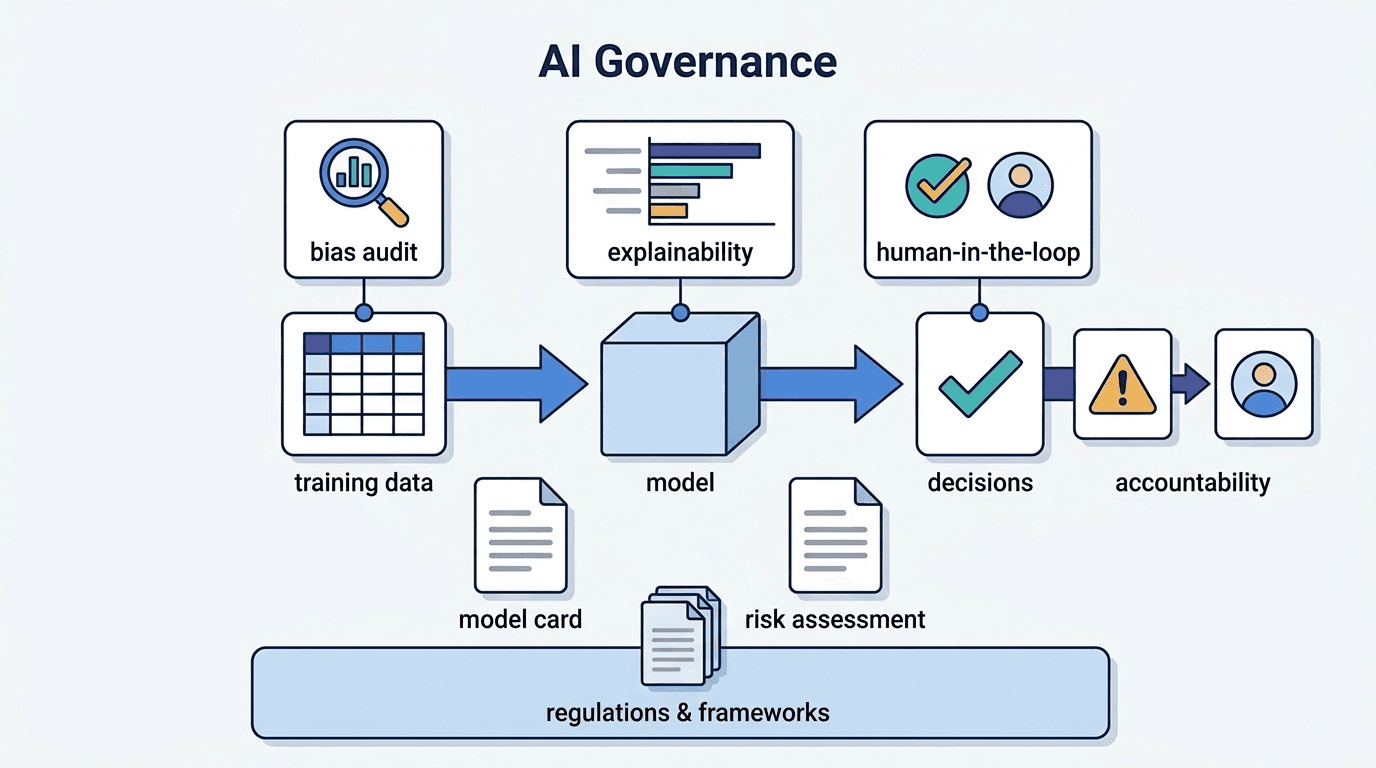
AI Governance
AI governance refers to the organizational policies, processes, and oversight mechanisms that ensure
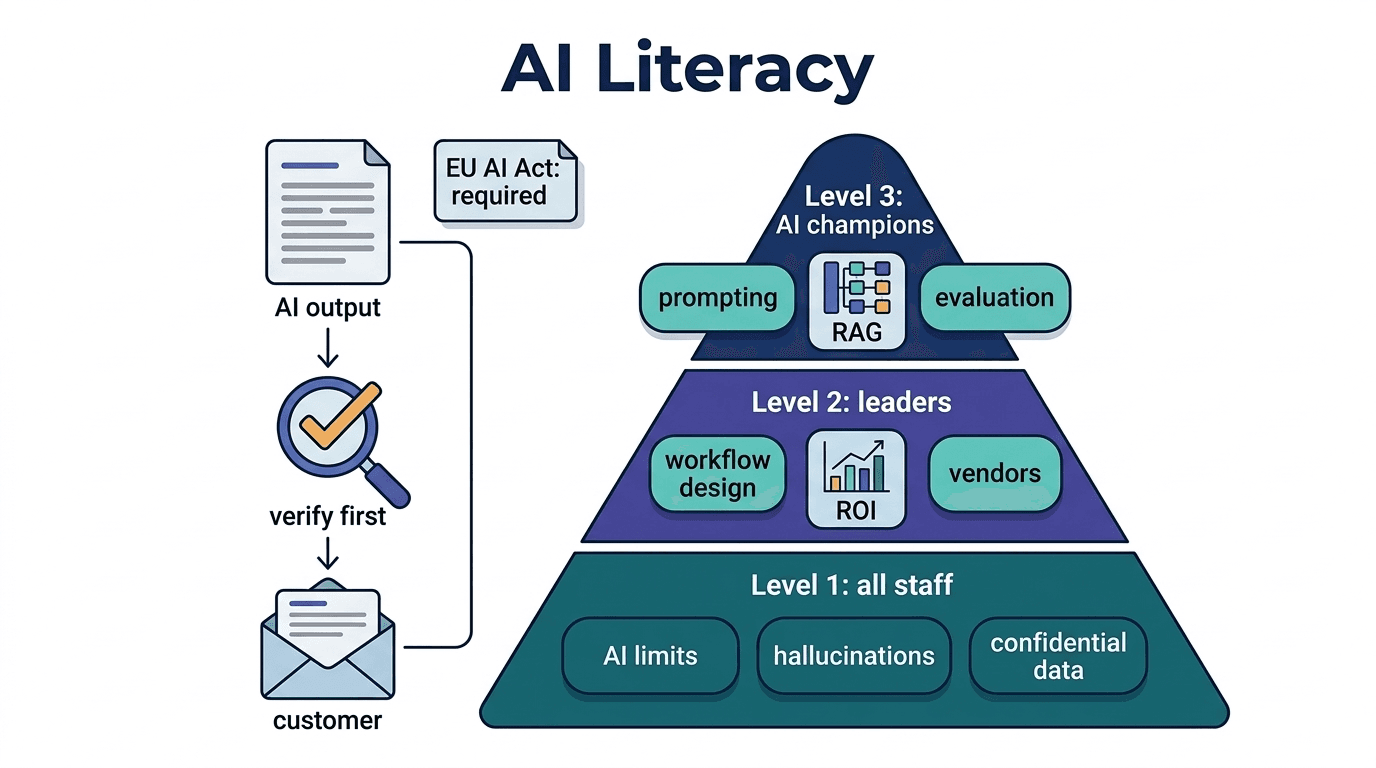
AI Literacy (AI Literacy)
Knowledge and skills to understand the basic concepts, limitations, and risks of AI, and to appropri