NVIDIA OpenShell
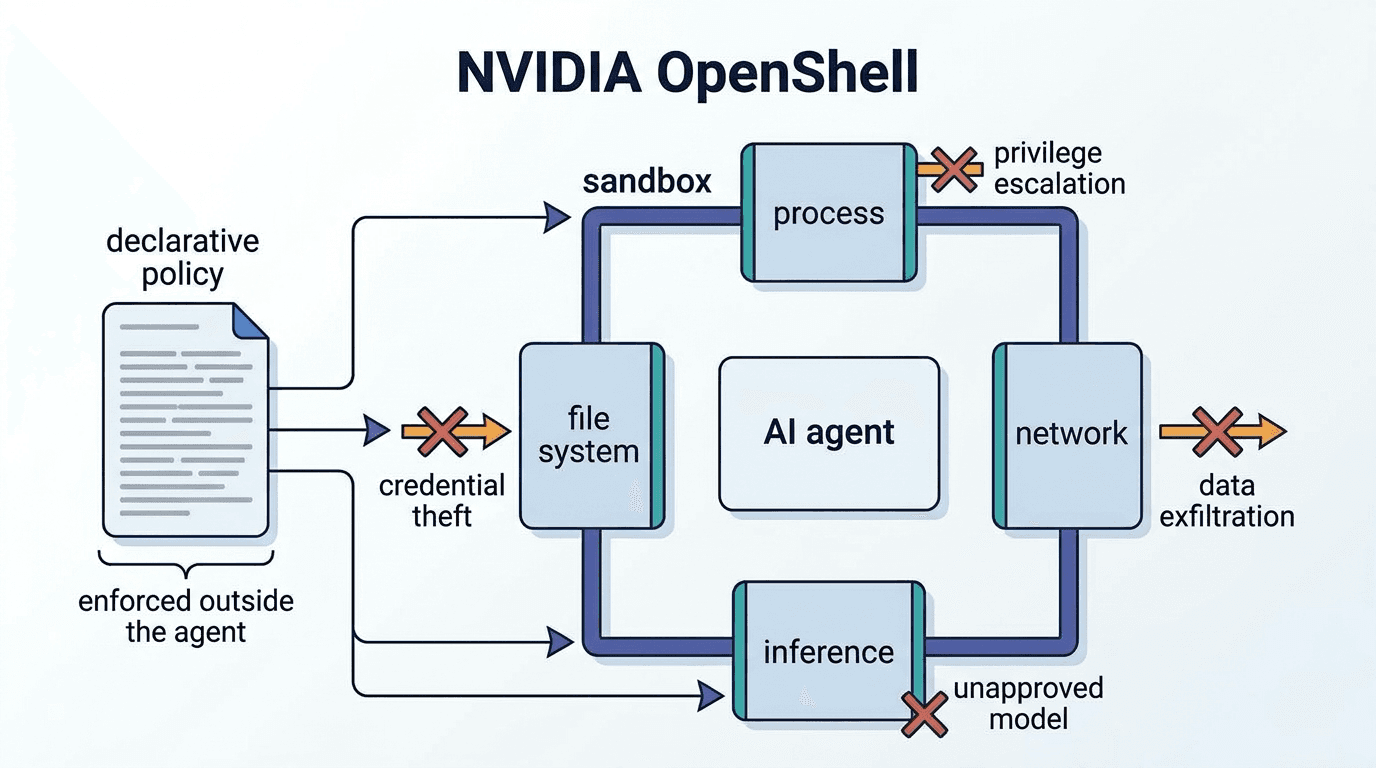
NVIDIA OpenShell is an open-source runtime environment that isolates AI agents within a sandbox and controls file, network, process, and inference operations through declarative policies.
Why a Dedicated Execution Environment for Agents Is Needed
AI agents write code, install packages, and rewrite configuration files—continuously modifying their own working environment. While ordinary Docker containers are primarily designed to isolate applications, OpenShell specializes in safely running these "agents that keep changing their environment." Its defining characteristic is "out-of-process" enforcement: rather than constraining agents through prompts (behavioral instructions), it imposes restrictions on the environment itself in which the agent operates. Because the constraints take effect outside the agent, they cannot be overridden by the agent itself—even if the agent is compromised. NVIDIA has released it as open source under the Apache 2.0 license, and the source code is available at github.com/NVIDIA/OpenShell.
Four Protection Domains and Kernel-Level Isolation
OpenShell implements a multi-layered defense across four domains—filesystem, network, process, and inference—to prevent credential theft, data exfiltration, privilege escalation, and unauthorized transmission to unapproved models, respectively. Filesystem isolation uses the Linux kernel's Landlock LSM, while process restriction relies on seccomp. The inference domain functions as a privacy router, keeping sensitive context local with open models and forwarding to frontier models only when policy permits. Policies are written in declarative YAML; filesystem and process rules are fixed at creation time, while network and inference rules support hot-reloading during runtime. The principle of least privilege—"deny by default, explicitly allow only what is necessary"—aligns with the concept of privacy by isolation, which protects data through physical segregation.
Supported Agents and Use Cases
The CLI automatically detects credentials for recognized agents (Claude Code, Codex, OpenCode, etc.) from the shell environment, meaning most agents can be run inside the sandbox without any code modifications. Container backends support Docker and Podman, as well as MicroVMs such as the lightweight virtual machine Firecracker. The more autonomy an agent is granted, the more critical the design of guardrails and containment becomes. Our standard approach is to first verify behavior in a small sandbox, then gradually expand the policy. Detailed setup instructions are provided in the related article: "What Is NVIDIA OpenShell? A Quick-Start Guide to a Sandbox for Running AI Agents Safely."
Articles covering this term
- What is NVIDIA OpenShell? A Quick Start Guide to the Sandbox for Running AI Agents SafelyNVIDIA OpenShell is an open-source runtime for safely running AI agents in sandboxes. Learn how to install it, create your first sandbox, and control network access with policies.
- What is Computer Use? How AI Automates Tasks by Controlling Your ScreenAI agents see screens, click, and type like humans to automate tasks without APIs—Computer Use explained. Learn how it works, RPA differences, and B2B implementation steps.
- AI Agent Supply Chain Attack Defense Guide — Protective Implementation for MCP/Skill Distribution ChannelsAI agents create new attack surfaces via MCP / Skills. An enterprise implementation guide covering MCP by-design vulnerabilities, malicious skill delivery, and SSRF mitigation.
- AI Development Supply Chain Attacks 2026 — A Defense Guide Against Model Poisoning, Dependency Packages, and SaaS BreachesBased on 2026 cases like Hugging Face model poisoning and SaaS breaches, this implementation guide covers AI BOM, least-privilege OAuth, and sensitive secret management for AI developers.


Related Terms

Deepfake
Deepfake is a technology that uses deep learning to realistically manipulate and synthesize a person

Mesh VPN (Mesh VPN)
Mesh VPN is a VPN architecture in which each node communicates directly with encrypted connections w

Shadow AI
Shadow AI refers to the collective term for AI tools and services used by employees in their work wi

Zero Trust Network Access (ZTNA)
Zero Trust Network Access is a security model that continuously verifies users and devices, controll