How Thailand's Tourism Industry Is Automating Foreign Traveler Support with AI Chatbots

Lead
AI chatbots are software that leverage natural language processing (NLP) to automate conversations with humans. In Thailand's tourism industry, they are increasingly being adopted as a means of providing 24/7, unmanned multilingual support to travelers.
The number of foreign tourists visiting Thailand grows year by year, generating daily inquiries across a wide range of languages, including English, Chinese, Japanese, Korean, and Russian. However, securing staff capable of handling multiple languages is difficult, and delayed or incorrect responses have become a contributing factor to lower customer satisfaction.
This article explains the specific steps for automating multilingual support through AI chatbot implementation in Thailand's tourism industry, covering a 3-step process from FAQ organization to reservation integration. It also introduces common failure patterns during implementation and practical approaches for enhancing the traveler experience.
Thailand's tourism industry faces the dual challenges of multilingual support and labor shortages, and AI chatbots are a means of simultaneously addressing both.
Thailand is one of Southeast Asia's largest tourism-dependent nations, yet its service infrastructure has failed to keep pace with the growth in inbound travelers. Here, we examine two key challenges in depth.
Challenges of Multilingual Support for Inbound Travelers
Travelers visiting Thailand come from a wide variety of countries—China, Malaysia, India, South Korea, Japan, Russia, and nations across Europe and the Americas—meaning inquiries arrive in at least five to eight different languages. At hotel front desks and tour counters, English is often the only language staff can manage. When a detailed question comes in Chinese or Japanese—such as "Do you offer allergy-friendly meals?" or "What times of day is the airport transfer route most congested?"—it is not uncommon to see staff scrambling to respond with a translation app in hand.
If this is the situation even at major hotel chains in Bangkok, then at small and mid-sized resorts and tour operators in regional areas, languages other than English are effectively "unsupported." Sending an inquiry and receiving no reply, or receiving a reply that makes no sense—these experiences feed directly into OTA (online travel agency) review scores.
Making matters worse is the issue of translation accuracy. Mistranslations involving religious dietary restrictions or allergies can lead not only to complaints, but to safety incidents as well. Accidents like a dish containing nuts being served to a guest who clearly communicated "nut-free" arise precisely from this kind of ambiguity in translation.
Labor Shortages and the Need for 24-Hour Support
Thailand's tourism industry faces a chronic labor shortage. During the high season (November–February) in particular, inquiries to hotels and tour companies swell to several times their normal volume. Since travelers contact businesses from countries in different time zones, they often send questions outside Thai business hours—late at night or in the early morning. When straightforward questions such as "I'd like to confirm tomorrow's tour meeting point" or "Can I arrange an early check-in?" go unanswered until the next business day, it leads to booking cancellations.
The longer a response to an inquiry is delayed, the greater the risk that the traveler will turn to a competing establishment. On OTA reviews, "slow response to inquiries" is a classic reason for low ratings. Around-the-clock availability is no longer a nice-to-have feature—it has become an essential function for protecting revenue.
Attempting to provide 24-hour coverage with human staff means combining the labor costs of night shifts with the recruitment costs of multilingual personnel, making it impractical for small and medium-sized operators in particular. This is where AI chatbots offer their greatest value. While there is an initial implementation cost, once built, they can respond to inquiries 24 hours a day in multiple languages with no additional labor costs.
Steps for Implementing AI Chatbots in the Tourism Industry

Chatbot implementation proceeds in 3 steps: FAQ organization → build → reservation integration. By expanding incrementally, you can scale while confirming results while keeping initial investment low.
Below, we explain the specific approach for each step.
Step 1: Organizing the Scope of Support and FAQ
The first thing to tackle when introducing a chatbot is defining the scope of "what it should answer." Attempting to automate all operations at once will reduce response accuracy and undermine traveler trust.
Concrete steps:
- Categorize past inquiries — Collect 3–6 months of inquiry history from email, LINE, and phone calls, and sort them by category. In most cases, the majority of inquiries will concentrate in the following categories:
- Check-in / check-out times
- Airport transfers and transportation access
- Facilities and amenities
- Nearby tourist attractions and restaurants
- Cancellation policies and pricing
-
Create response templates — For each category, prepare accurate and concise answers. At this stage, build in a mechanism to dynamically update information that changes with the season or events (e.g., pool operating hours, service arrangements during Songkran).
-
Define rules for out-of-scope inquiries — Clearly list the types of inquiries that require human handling, such as complaints, refund processing, and medical consultations, then design an escalation flow so that when the chatbot detects these, it hands off to a staff member.
A practical approach is to start by focusing on the "top 20 questions." Even with a narrow coverage range, a chatbot that answers common questions accurately will receive higher ratings from travelers than one with broad but inaccurate coverage.
Step 2: Building a Multilingual Chatbot
Once the FAQ has been organized, build a multilingual chatbot. There are broadly two options to choose from here.
Conclusion: A rule-based approach is suitable when the number of FAQs is 50 or fewer and responses fit a fixed format; an LLM-based approach is suitable when natural conversation across multiple languages is required.
| Item | Rule-Based | LLM-Based (GPT / Claude, etc.) |
|---|---|---|
| Initial cost | Low | Medium to high |
| Multilingual support | Rules must be created per language | Multiple languages supported via prompt configuration |
| Response flexibility | Fixed responses only | Natural contextual understanding and responses |
| Unexpected questions | Cannot handle | Can handle to a certain extent |
| Hallucination risk | None | Present (generation of responses that differ from facts) |
| Operational cost | Low | Varies depending on API usage |
Key points for building an LLM-based solution:
- Embed facility information in the system prompt — Include information needed for responses in the prompt, such as the hotel name, address, list of amenities, and rate sheet. If the volume of information is large, using RAG (Retrieval-Augmented Generation) allows large numbers of documents to be referenced efficiently.
- Automatic language detection — Configure the system to automatically detect the language entered by the traveler and respond in the same language. An experience where "a question asked in Chinese gets answered in English" significantly lowers satisfaction.
- Tone configuration — In the tourism industry, a friendly yet polite tone is important. Stiff responses resembling business documents create a sense of unease for travelers. Chatbots that open with a welcoming introduction such as "Sawasdee kha, welcome to ○○ Hotel!" demonstrably achieve higher traveler engagement.
Step 3: Integration with Reservation System and Payment
If a chatbot only answers FAQs, travelers still need to complete their booking in a separate screen. If the entire process—from reservation to payment—can be completed within the conversation flow, drop-offs can be prevented and conversion rates can be significantly improved.
Systems to integrate:
- PMS (Property Management System) — For hotels, this enables real-time availability checks and bookings. When a traveler asks, "Is a twin room available from next Friday for two nights?", the ideal experience is to instantly return availability and allow them to confirm the booking right then and there.
- OTA (Online Travel Agent) integration — Sync reservation data from OTAs such as Agoda and Booking.com to prevent double bookings.
- Payment gateway — In Thailand, PromptPay (QR code payments) is widely used. There is a growing pattern of generating QR codes within the chatbot to complete payments. Supporting credit card payments as well increases coverage for international travelers.
A phased integration approach is the practical way forward. Start with FAQ responses only in the initial stage, then move on to booking integration once results are confirmed, followed by payment integration. Attempting to develop all features at once drives up costs and delays the release. The approach that minimizes the risk of failure is to first establish a solid foundation where the chatbot accurately answers questions, and then expand from there.
AI Utilization Patterns for Enhancing Traveler Experience

AI chatbots are not just tools for FAQ responses — they are weapons for elevating the traveler experience itself through personalized suggestions and real-time translation.
Once FAQ handling is stable, the next step is to turn attention toward enhancing the traveler experience.
Personalized Tourism Plan Proposals
LLM-based chatbots can read preferences and constraints from conversations with travelers and suggest personalized sightseeing plans.
For example, in response to a question like "I want to find somewhere fun for half a day with my kids. I don't do well in the heat," the chatbot can propose a plan centered on indoor facilities — this kind of personalization was impossible with traditional rule-based chatbots.
Implementation key points:
- Retain traveler context — Maintain conversation history with the same traveler to handle follow-up requests such as "I'd like to eat somewhere near the restaurant you recommended yesterday." Without properly designed session management, every conversation starts from scratch, leading to frustration like "I already told you this."
- Reflect local information in real time — Retrieve weather, traffic, and event information via API and incorporate it into suggestions. This prevents mismatches like recommending a trekking trip on a rainy day.
- Connect to bookings — When a traveler says "I want to join this tour," complete the booking process within the conversation itself. It is essential that the flow from suggestion to booking remains uninterrupted.
For a traveler hoping to visit temples in Bangkok, the chatbot can suggest an early morning route that avoids peak crowds and provide end-to-end guidance including transportation options (arranging a tuk-tuk or navigating BTS transfers) — this level of attentive service creates an experience on par with a human concierge. And unlike a concierge, it can handle hundreds of travelers simultaneously.
Real-Time Translation and Voice Support
In addition to text chat, supporting real-time voice translation significantly expands the range of chatbot applications.
Advanced Text Translation:
LLMs are capable of translation that goes beyond simple word-for-word rendering, capturing cultural nuances. For example, the Thai phrase "ไม่เป็นไร" (Mai Pen Rai) translates literally as "no problem," but depending on the context, it may need to convey the nuance of "It's alright, please don't worry about it." LLM-based translation can generate natural responses that take such cultural context into account.
Voice Support Options:
- Speech-to-Text → LLM → Text-to-Speech — Converts a traveler's spoken words to text, generates a response via LLM, and reads it aloud. This can be implemented to support voice messages on LINE or WhatsApp.
- Automated Phone Support — Introduces AI voice response to a hotel's main phone line, enabling automatic multilingual handling of inquiries outside business hours.
A scene where a street vendor at a night market in Chiang Mai speaks into a tablet and a menu description plays in the traveler's native language is already technically achievable. Experiences like this at tourist destinations tend to spread through word of mouth and social media, with the effect of enhancing the brand value of individual establishments and entire areas.
Common Mistakes and Solutions When Getting Started

The most common failures in AI chatbot implementation are "set it and forget it" neglect after launch, and the failure to design handoff points to human agents.
What determines success or failure is not the technical build, but the operational design after deployment.
Operational Framework for Maintaining AI Response Accuracy
Chatbot response accuracy will degrade over time if left unattended. Even when new services are added (e.g., a newly opened spa, seasonal tours), if the chatbot's knowledge base is not updated, it will return outdated information or produce more "I don't know" responses.
Operational flow to prevent accuracy degradation:
- Weekly response log review — Review on a weekly basis the questions the chatbot was unable to answer and the responses travelers rated as "unhelpful." Questions that went unanswered are candidates for addition to the FAQ.
- Regular FAQ updates — Update the FAQ and knowledge base in line with seasons, events, and pricing changes. Clearly define who is responsible for updates and establish an update schedule (e.g., monthly plus at seasonal transitions). During Songkran and Loy Krathong, it will be necessary to add information about holiday operating hours and special plans.
- Regular monitoring of accuracy metrics — Track two key metrics: "response rate" (the percentage of questions for which a response was returned) and "resolution rate" (the percentage of travelers who were satisfied without asking follow-up questions).
If early signs of a declining response rate are ignored, travelers will conclude that "this chat is useless" and begin ignoring the chatbot altogether. Recovering usage rates for a chatbot that has already earned a reputation as "useless" is harder than launching a new one from scratch.
Appropriate Escalation Design to Humans
A design philosophy of "leaving everything to AI" will inevitably fail. Escalation design—identifying inquiries that the chatbot should not handle and handing them off to human staff at the appropriate moment—is essential.
Cases That Should Be Escalated to a Human:
| Category | Examples |
|---|---|
| Complaints and dissatisfaction | "The room was dirty." / "The room was different from what I booked." |
| Safety and health | "My child has a fever. Is there a nearby hospital?" |
| Complex changes | "I want to extend my 3-night reservation to 5 nights and also change the room type." |
| Emotionally charged interactions | The traveler is angry or feeling anxious. |
| Payment issues | "I've been charged twice." / "I'd like a refund." |
Key Points for Escalation Design:
- Seamless handoff — When switching from the chatbot to a staff member, ensure that the conversation history up to that point is passed on to the staff member. It is critical not to make the traveler repeat themselves.
- Explicit notification — Clearly communicate: "I will connect you with a staff member. Please wait a moment." If AI continues responding while pretending to be human, trust will be irreparably damaged once discovered.
- Handling outside business hours — If an escalation occurs when no staff are available, respond with: "A representative will contact you during the morning of the next business day," and log the inquiry as a ticket. Saying "we'll take care of it" and then doing nothing is the single greatest source of distrust toward chatbots.
Escalation design is not "exception handling"—it is a core component of chatbot design. Neglecting this invites the worst-case scenario: the AI returning tone-deaf responses during a complaint, causing the situation to deteriorate even further.
Frequently Asked Questions (FAQ)

Q1: How much does it cost to implement an AI chatbot? Can small hotels adopt it too?
Implementation costs vary significantly depending on the approach. A simple rule-based chatbot (using LINE Official Account's auto-reply feature) can start at a few thousand baht per month. Custom LLM-based builds incur initial development costs plus API usage fees (which depend on monthly conversation volume). Even for small hotels, a practical path is to start with LINE's auto-reply, confirm its effectiveness, and then migrate to an LLM-based solution.
Q2: How many languages beyond Thai can it support? Does accuracy vary by language?
An LLM-based chatbot can technically support dozens of languages. However, response accuracy varies by language. High accuracy can be expected for English, Chinese, Japanese, and Korean, while languages such as Burmese and Khmer may see reduced accuracy. It is most efficient to analyze the nationality breakdown of your property's guests and prioritize support for the top three to five languages first.
Q3: Can it be integrated with an existing LINE Official Account?
Yes. Since LINE holds an overwhelming market share in Thailand, the most natural approach is to operate the chatbot by integrating it with the LINE Official Account's Messaging API. Parallel operation with WhatsApp and Facebook Messenger is also technically feasible, and supporting multiple channels based on guests' countries of origin can improve reach.
Q4: Does it conflict with the PDPA (Thailand's Personal Data Protection Act)?
If the chatbot handles guests' personal information—such as names, passport numbers, and contact details—compliance with the PDPA is required. This entails clearly stating the purpose of data collection and obtaining consent, limiting data retention periods, and responding to deletion requests from guests. It is particularly important to establish in advance a policy governing the retention period of conversation logs and the handling of personal information contained within them.
Summary

Here are the key points for Thailand's tourism industry to automate multilingual support with AI chatbots.
- Start by organizing your FAQs — Analyze your inquiry history and begin with the top 20 questions. Travelers rate a narrow but accurate chatbot more highly than a broad but imprecise one.
- Scale incrementally — Expand from FAQ responses → booking integration → payment integration, confirming results at each stage. Don't try to build every feature at once.
- Design your operational framework first — Decide before launch how you will monitor response accuracy, regularly update FAQs, and handle escalation to human agents. "Build it and forget it" is the single biggest failure pattern.
- Aim to enhance the traveler experience — Once FAQ handling is stable, build a competitive advantage through personalized sightseeing recommendations and real-time translation.
AI chatbots are both a "cost-reduction tool" and a means of improving the experience that makes travelers think, "I'm glad I chose this hotel." For Thailand's tourism industry, the most suitable approach is to start small and grow the system while observing how travelers respond.
For a comprehensive overview of the steps involved in implementing AI-driven business automation, see "How Thai Businesses Can Adopt AI in Their Operations."
Author & Supervisor

Yusuke Ishihara
Started programming at age 13 with MSX. After graduating from Musashi University, worked on large-scale system development including airline core systems and Japan's first Windows server hosting/VPS infrastructure. Co-founded Site Engine Inc. in 2008. Founded Unimon Inc. in 2010 and Enison Inc. in 2025, leading development of business systems, NLP, and platform solutions. Currently focuses on product development and AI/DX initiatives leveraging generative AI and large language models (LLMs).
Recommended Articles


Terms related to this article
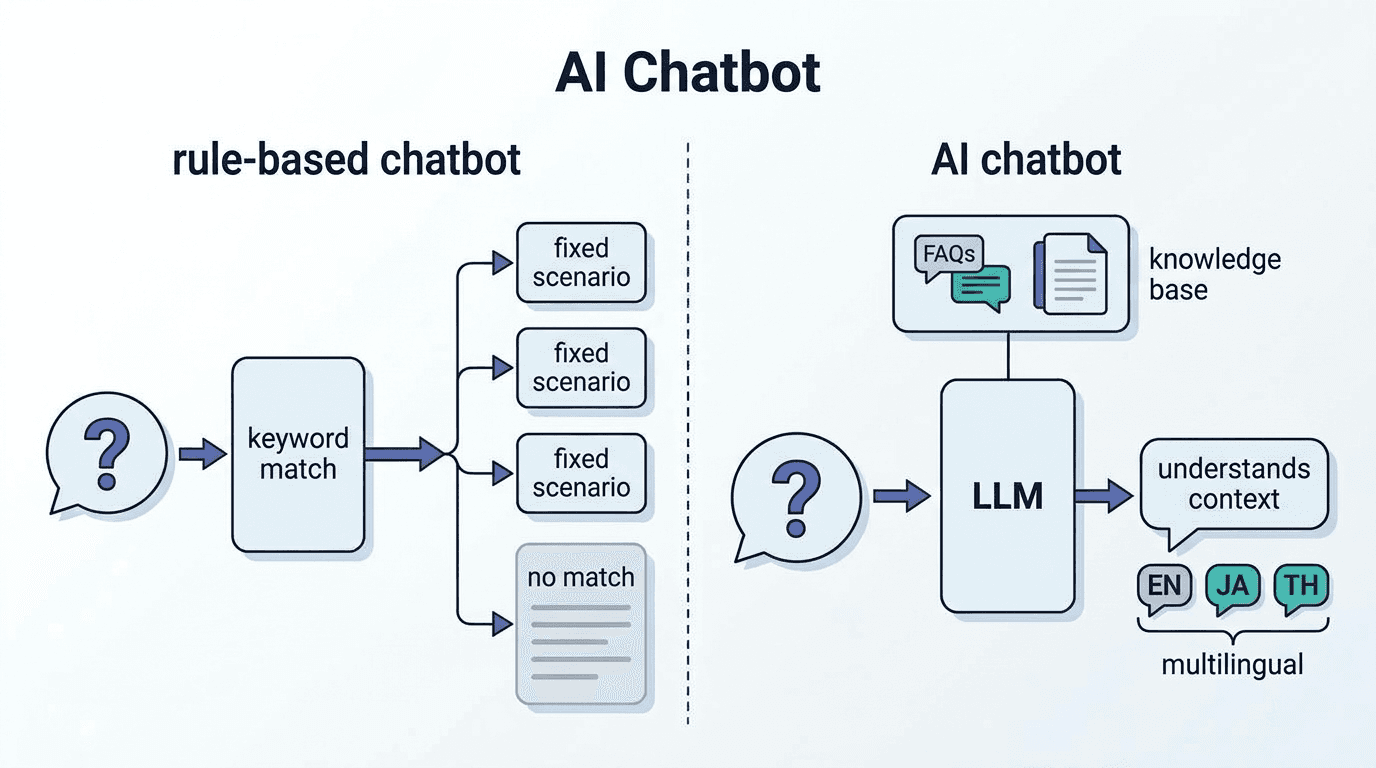
AI Chatbot
An AI chatbot is software that leverages natural language processing (NLP) and LLMs to automatically
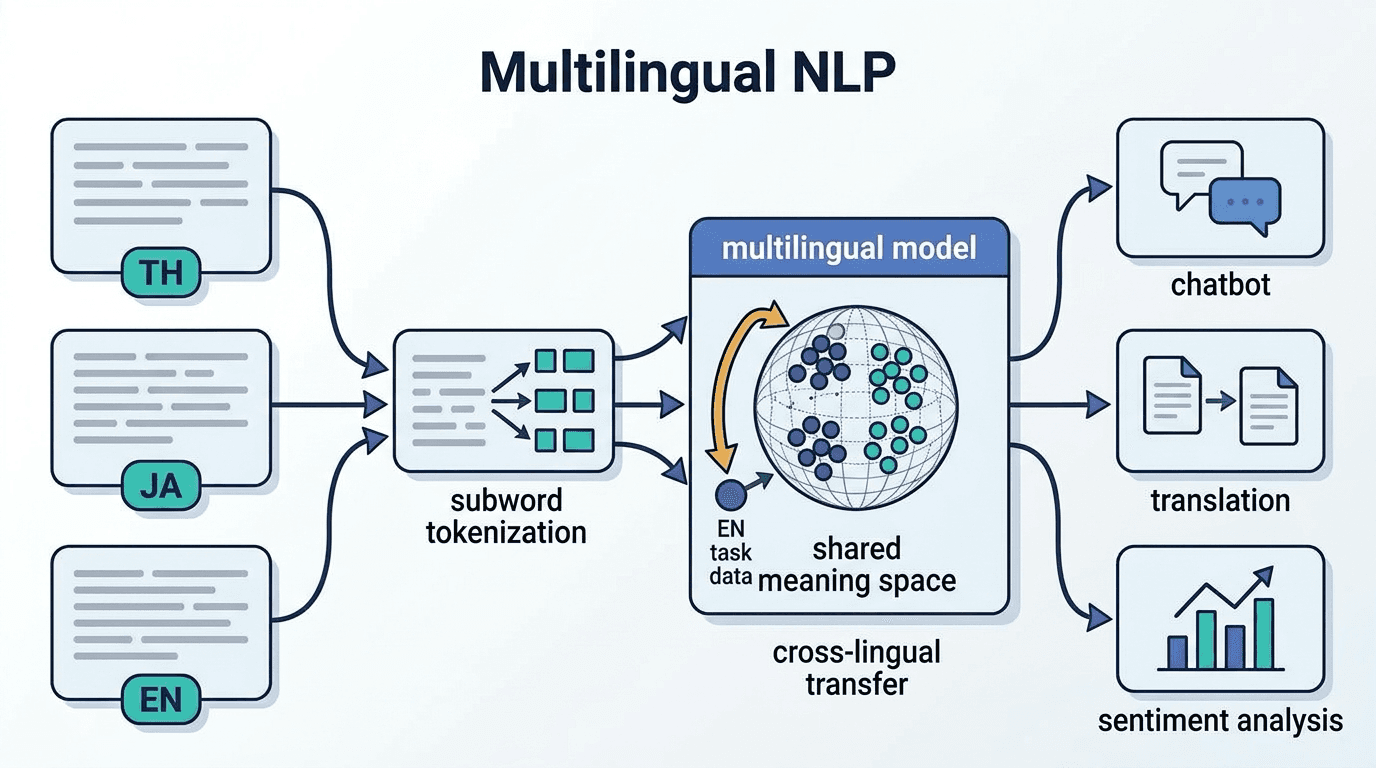
Multilingual NLP (Multilingual Natural Language Processing)
Multilingual NLP is a natural language processing technology capable of analyzing and generating tex
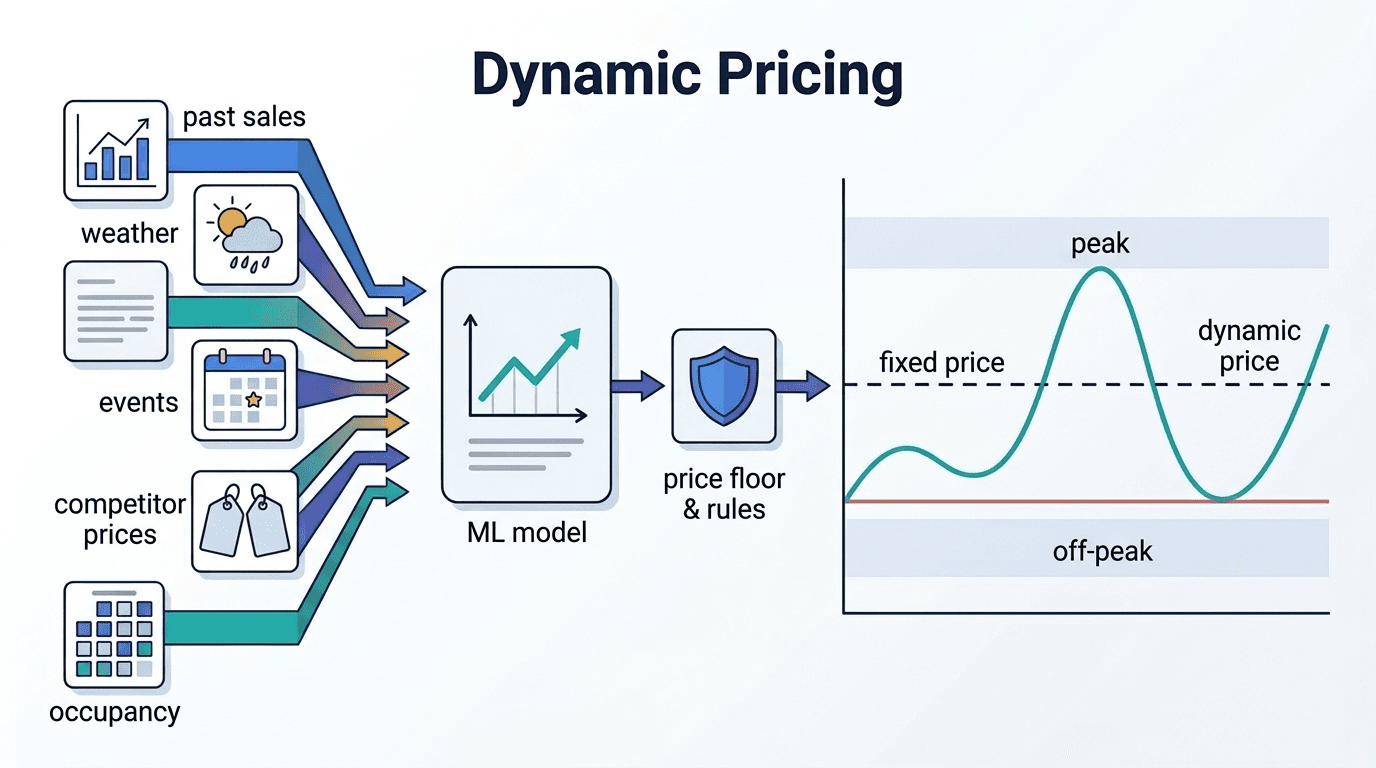
Dynamic Pricing
Dynamic pricing is a pricing strategy that adjusts the prices of goods and services in real time bas