How Thailand's Real Estate Industry Can Automate Property Inquiries from Foreign Buyers with AI Chatbots

Lead
A real estate chatbot is a system that leverages AI to automate property inquiry responses, requirements gathering, and viewing reservations. In Thailand's real estate market, it is attracting attention as a means of handling LINE inquiries from foreign buyers around the clock.
Bangkok's condominium market sees a significant proportion of foreign buyers from China, Japan, Russia, and Western countries. However, there are limits to how much sales staff can individually handle multilingual property information delivery and inquiries from overseas across different time zones. Since prospective buyers simultaneously contact multiple real estate agencies, the speed of the initial response is a decisive factor in closing deals.
This article explains, in three steps, the specific procedures for Thai real estate businesses to introduce AI chatbots and automate property inquiries from foreign buyers—from requirements gathering through to guidance on contract procedures.
Thailand's real estate industry needs to move away from the inefficient model in which sales staff individually handle a high volume of LINE inquiries from foreign buyers, and AI chatbots represent a promising solution to achieve this.
The high proportion of foreign buyers in the condominium market, combined with heavy reliance on LINE, creates unique challenges not found in other industries.
Explosive Increase in LINE Inquiries from Foreign Buyers
In Thailand's real estate market, particularly Bangkok's condominium market, LINE is effectively the dominant communication channel. Foreign buyers frequently use LINE rather than email to inquire about properties. Prospective buyers who visit developer showrooms exchange LINE contacts, after which a large volume of messages flows back and forth throughout the consideration process.
"What is the view like from this unit?" "How much are the maintenance fees?" "Where are the nearby international schools?" "Are pets allowed?"—it is not uncommon for a single prospective buyer to send dozens of questions. Sales representatives handle tens of prospective clients simultaneously, making delayed responses a chronic issue.
In the sales teams of developers along Sukhumvit, there are cases where a single representative processes over one hundred LINE messages on a weekday. Compounding this, communication channels are also fragmented: Chinese investors use WeChat, Japanese expatriates use LINE, and Russians use Telegram.
Challenges of Multilingual Property Information and After-Hours Support
Foreign buyers come from diverse countries, requiring property information to be provided in English, Chinese, Japanese, and Russian. However, sales staff who can accurately communicate property details—floor plans, amenities, legal restrictions, and cost breakdowns—in multiple languages are limited.
There is also the issue of time differences. When investors from China or Japan are researching properties in Thailand, they do so at night in their home countries—after Thai business hours. If a message sent with the expectation of a reply "by tomorrow" goes unanswered until the next business day, prospective buyers will turn to competing developers.
Purchasing real estate is not an impulsive decision, but there are moments when people want information right now. Immediately after watching a property walkthrough video, immediately after reviewing a price list—to avoid missing these "hot moments," a system capable of responding instantly, 24 hours a day and in multiple languages, is essential.
Steps for Implementing an AI Chatbot for Real Estate

Introducing a real estate chatbot proceeds in 3 steps: organizing property FAQs → building → integrating with reservations and procedures. The key is to incorporate the real estate-specific flow of "requirements gathering → property matching" into the design.
The following explains how to approach each step.
Step 1: Organizing Property FAQ & Condition Hearing Items
Real estate inquiries fall into two categories: questions about the property itself, and questions about the purchasing process.
Organizing Property FAQs:
- Property specifications (floor plan, area, floor number, view, interior finishes)
- Pricing and payment terms (lump sum / installment, deposit, transfer costs)
- Breakdown of management fees and maintenance reserve funds
- Shared amenities (pool, gym, parking, co-working space)
- Surrounding environment (distance from BTS/MRT stations, supermarkets, hospitals, schools)
- Pet policy and foreign ownership restrictions
Designing Needs Assessment Questions:
The greatest value of a chatbot lies in its ability to efficiently gather prospect requirements and match them to suitable properties. The following information is collected through conversational dialogue:
- Purpose (owner-occupancy / investment / rental operation)
- Budget range
- Preferred area
- Floor plan and size
- Desired move-in date
- Priority amenities and conditions
By handing this information over to sales representatives in a structured format, they can begin consultations already fully informed of the client's needs. Being able to skip the traditional first meeting — which typically starts with "What is your budget and what are you looking for?" — represents a significant improvement in sales efficiency.
Step 2: Building a Chatbot Integrated with the Property Database
After condition hearings, the next step is building a chatbot that integrates with a property database to perform automatic matching.
Key Points for Development:
- API Integration with Property Database — Reference inventory status (for sale / reserved / sold) in real time. Recommending "sold out" properties will damage trust. Integrate with CRM systems (Salesforce, HubSpot, etc.) or proprietary property management systems.
- Sending Images and Videos — Set up a system that enables smooth delivery of floor plans, property tour videos, and 360-degree panoramic photos within LINE chats. Text descriptions alone cannot convey the appeal of a property.
- Comparison Feature — When prospects are considering multiple properties, respond to requests such as "I want to compare properties A and B" by generating and presenting a comparison table.
Conclusion: Since property information is constantly changing, database integration is essential rather than static FAQs.
| Item | Static FAQ | Database Integration |
|---|---|---|
| Inventory Status | Manual updates (risk of delays) | Real-time reflection |
| Price Changes | Manual updates required | Automatically reflected |
| New Property Additions | Requires FAQ updates | Automatically included in search |
| Personalization | Not possible | Automatically recommends properties matching conditions |
Step 3: Automating Property Viewing Reservations and Contract Procedure Guidance
For prospects who have shown strong interest in a property, guide them smoothly toward the next action (viewing appointment / online viewing / contract procedures).
- Automated viewing appointments — Sync with sales representatives' calendars to display available slots and confirm bookings. Instantly handle requests such as "I'd like to visit the showroom next Saturday."
- Online viewing arrangements — For prospective buyers located overseas, arrange property tours via video call. Automatically calculate time zones and suggest mutually convenient times for both parties.
- Contract procedure guidance — Foreign buyers are often unfamiliar with real estate purchase procedures in Thailand. Provide language-specific checklists of required documents (passport copy, proof of bank transfer, FET form) to help them understand the overall process.
However, completing the contract itself within the chatbot is not practical. Real estate transactions require legal verification, and the chatbot's role should be limited to "providing information and guiding procedures up to the point of contract." The final contract should be executed through a sales representative and a lawyer.
AI Utilization Patterns for Improving Conversion Rates

AI chatbots not only handle inquiries but also boost conversion rates through intelligent property recommendations based on prospect criteria and by alleviating anxiety throughout the purchasing process.
Once FAQ responses and reservation integration are stable, move on to the next level of utilization.
Property Recommendations Matching Buyer Criteria
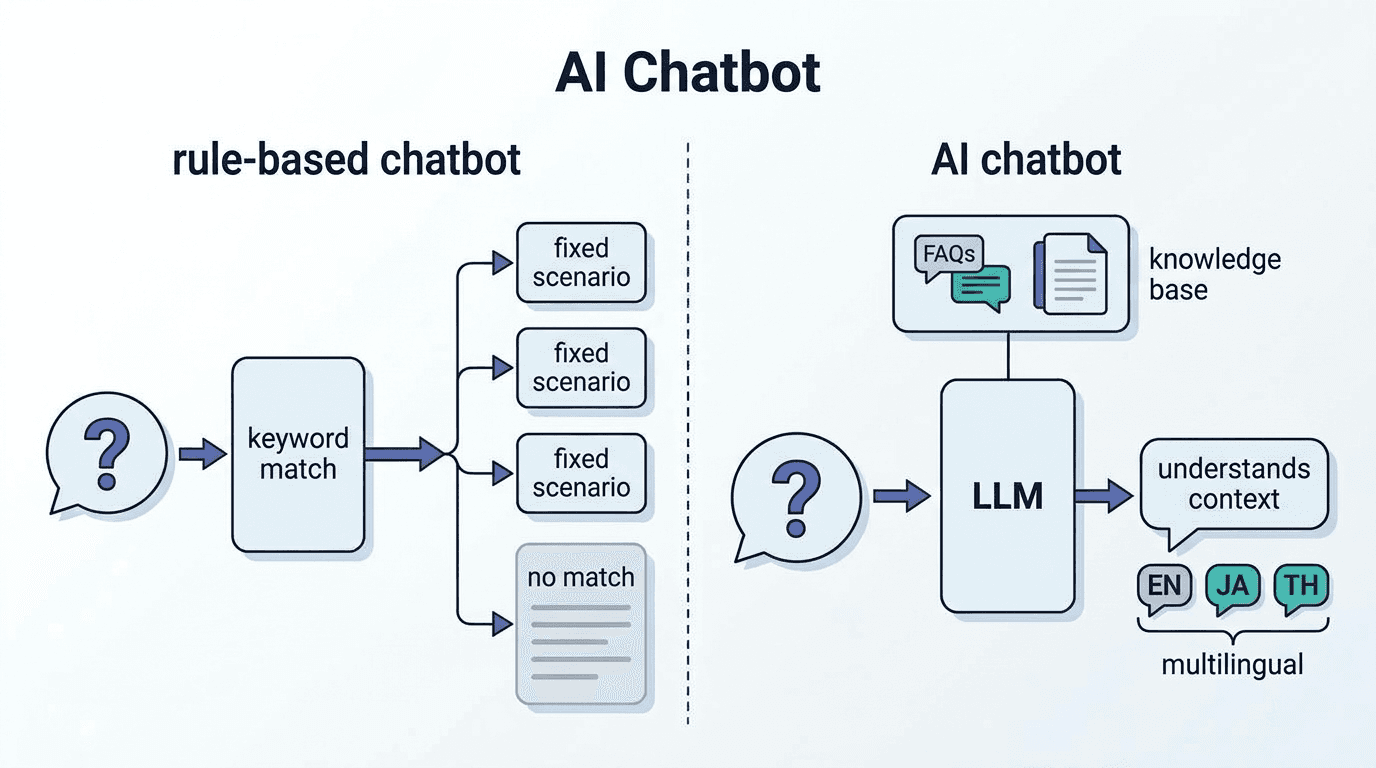
LLM-based chatbots can read "unspoken needs" from conversations with prospects and deliver more accurate property recommendations.
From a remark such as "my child attends an international school," the system prioritizes properties within the school's commuting zone. From "I want to play golf on weekends," it recommends areas with convenient access to golf courses——this kind of contextual understanding cannot be achieved through simple condition filters.
Implementation highlights:
- Accumulation and analysis of conversation history — References past conversations with the same prospect to handle follow-ups such as "I'd like a room larger than the one I saw last time."
- Automatic recommendation of similar properties — When a prospect says "I like this property but it's over my budget," the system automatically suggests properties in the same area and size range that fall within budget.
- Reference information on investment returns — For buyers with investment purposes, the system provides publicly available information on rental yield trends in the area and future transportation infrastructure plans (such as the opening of new BTS stations). However, it does not offer investment advice such as "prices are guaranteed to rise."
Automated Information Guide for Visas, Loans, and Foreign Ownership
When foreigners purchase real estate in Thailand, concerns about legal restrictions and processes are a major factor that causes hesitation. By proactively addressing these questions through a chatbot, the quality of sales consultations can be significantly improved.
Key topics to cover with automated guidance:
- Restrictions on foreign ownership — Condominiums can be purchased in a foreigner's name, but the foreign ownership ratio per building is capped at 49%. In principle, detached houses with land cannot be owned under a foreigner's name.
- The relationship between visas and property purchases — Purchasing real estate alone does not qualify one for a visa. Guide users on combining their purchase with long-term stay visas such as the Thailand Elite Visa.
- Remittance and the FET (Foreign Exchange Transaction) form — The purchase price must be remitted from outside Thailand, and a FET form must be obtained from a bank. This form is required when reselling the property or transferring funds abroad.
- Taxes and associated costs — Provide estimates in multiple languages for transfer registration fees, withholding tax, stamp duty, and Special Business Tax.
While this information is factual and based on applicable laws, a disclaimer should be added stating: "Please consult a lawyer for specific legal advice." A real estate chatbot serves as "an informational source that conveys a general overview of the law," not "a tool that provides legal advice."
Common Mistakes and Solutions When Getting Started

The biggest risks of real estate chatbots are recommending already-sold properties and providing inappropriate automated responses in high-value transactions.
Prevent real estate-specific failure patterns through proactive design.
Property Listing Freshness Management and Inventory Synchronization
In the real estate market, property inventory status fluctuates on a daily basis. When a chatbot tells a prospect "this property is available," only for it to have already sold the day before — such information inconsistencies instantly destroy a prospective buyer's trust.
Inventory Synchronization Design:
- Real-time synchronization — Reference inventory status from the property management system (CRM) in real time via API. A once-daily batch sync is insufficient to keep information fresh.
- "Checking" buffer — While API integration is not yet in place, include a buffer in inventory-related responses such as "Staff will confirm the latest availability and get back to you."
- Immediate reflection of price changes — If promotional pricing or price reductions are left outdated, prospects will feel misled and lose trust. Establish an operational workflow that immediately reflects price changes in the chatbot's knowledge base.
Escalation Design for High-Value Transactions
Real estate involves high-value transactions where emotional factors play a significant role for prospective buyers. If a chatbot continues to respond mechanically, it can lead to frustration — "I'm making a purchase worth tens of millions of baht, and I'm being handled by a robot?"
Key Points for Escalation Design:
| Situation | Response |
|---|---|
| Specific price negotiation | Immediately transfer to a sales representative |
| Legal questions (ownership, tax details) | Direct to legal counsel |
| Loan/financing inquiries | Introduce affiliated financial institutions |
| Complaints/dissatisfaction | Transfer to a senior manager |
| Prospects close to closing | Sales representative handles directly |
The critical judgment is knowing "when to switch to a human at the right moment." Once it is detected that a prospect's questions have shifted from the "information-gathering phase" to the "purchase consideration phase," notify a sales representative and hand off the conversation. In high-value transactions, the ultimate relationship of trust is built through human-to-human interaction. A chatbot is a tool designed to "allow sales representatives to focus their time on the business negotiations that truly matter."
Frequently Asked Questions (FAQ)

Q1: What are the costs of implementing a real estate chatbot?
A simplified version utilizing LINE's auto-reply feature can start from a few thousand baht per month. Custom LLM-based development integrated with a property database incurs initial development costs plus monthly API usage fees. A practical approach is to start with FAQ responses, confirm the ROI, and then scale up.
Q2: Which nationalities of foreign buyers should be supported?
Analyze your own past transaction data and prioritize the top 3–5 languages by country. In Bangkok's condo market, there tends to be demand in the following order: Chinese, English, Japanese, and Russian.
Q3: Can the chatbot also send property images and videos?
Using the LINE Messaging API, it is possible to send images, videos, and PDFs (floor plans). By leveraging Flex Messages, property information can also be displayed in a rich card format.
Q4: What are the key points of differentiation from competitors?
The speed of the initial response is the greatest differentiating factor. A chatbot that can respond instantly 24/7 in multiple languages provides a significant advantage over competitors where customers must "send an email and wait until the next day for a reply." In addition, the automation of requirements gathering—allowing sales representatives to enter the first meeting already informed of a prospect's needs—also serves as a competitive advantage.
Summary

Key points for Thai real estate businesses looking to automate property inquiries from foreign buyers using AI chatbots.
- Automate requirements gathering — Collect budget, area, floor plan preferences, and purpose through conversational dialogue, then hand off structured information to sales representatives. This allows agents to begin consultations already informed about the client's needs.
- Integrate with the property database in real time — Keep inventory status and pricing continuously up to date. Recommending a sold-out property instantly destroys trust.
- Keep legal information at a summary level — Provide factual guidance on foreign ownership, visas, and taxes, but always include a disclaimer that "specific legal advice should be sought from a lawyer."
- Hand off high-value transactions to a human — The chatbot's role is to provide information and clarify requirements. Once a buyer enters the purchase consideration phase, hand off seamlessly to a sales representative.
For a broader overview of AI-driven business automation, see "How Thai Businesses Can Adopt AI in Their Operations."
Author & Supervisor

Yusuke Ishihara
Started programming at age 13 with MSX. After graduating from Musashi University, worked on large-scale system development including airline core systems and Japan's first Windows server hosting/VPS infrastructure. Co-founded Site Engine Inc. in 2008. Founded Unimon Inc. in 2010 and Enison Inc. in 2025, leading development of business systems, NLP, and platform solutions. Currently focuses on product development and AI/DX initiatives leveraging generative AI and large language models (LLMs).