What Is Thailand-Laos Hybrid Offshore Development? | Balancing Quality and Cost Revealed Through a 4-Country Comparison [2026 Edition]
![What Is Thailand-Laos Hybrid Offshore Development? | Balancing Quality and Cost Revealed Through a 4-Country Comparison [2026 Edition]](/_next/image?url=https%3A%2F%2Fxlawjotwdonvcisfgnkc.supabase.co%2Fstorage%2Fv1%2Fobject%2Fpublic%2Farticle-images%2Farticles%2F19%2Fcover-en.png%3Ft%3D1774676523788&w=3840&q=75)
"Is there an offshore destination beyond Vietnam and the Philippines that maintains quality while keeping costs down?" — This article is for CTOs and IT department heads grappling with exactly that challenge. One answer is "hybrid development" combining Thailand and Laos.
Senior engineers in Bangkok, Thailand handle design, review, and project management, while an implementation team in Vientiane, Laos carries out coding and testing. This three-tier structure simultaneously delivers "Thai quality × Laos cost" — a model we have spent 15 years refining.
This article compares the strengths of offshore development in Thailand against four major competing countries, then provides a concrete breakdown of the cost structure behind hybrid development and why it achieves both quality and affordability. From a partner selection checklist and the rationale behind pricing starting at ¥157,000/month, to real-world case studies — everything is covered, so by the time you finish reading, your next move in offshore development should be clear. If you first want the basics—what offshore development is, the contract models, and how to get started—see What is offshore development?
What is Thailand × Laos Hybrid Offshore Development?
Thailand-only offshore development offers high quality, but engineer rates tend to be somewhat higher compared to Vietnam or the Philippines. On the other hand, if you prioritize cost alone and choose a country with lower rates, additional costs arise from quality control and communication issues, often resulting in a "cheap but poor quality" outcome.
The "Thailand × Laos Hybrid Development" model proposed by Unimo structurally resolves this dilemma. By combining Thailand's design and management capabilities with Laos's implementation strengths, the model divides the roles of quality gatekeeper and cost optimization within a single team.
Overview of the Three-Layer Structure
Hybrid development involves three locations — Japan, Thailand, and Laos — each playing the following roles.
Japan Location — Client Interface & Requirements Definition
This location handles interviews conducted in Japanese, creation of requirements definition documents, and contract and billing operations. Since direct communication with client companies is conducted entirely in Japanese, there is no need to separately arrange a bridge SE.
Thailand Location (Bangkok) — Design, Review & PM
Senior engineers and project managers are stationed here, handling architecture design, code reviews, and sprint management. The Thailand side retains merge authority over pull requests, ensuring that code failing to meet quality standards never reaches production.
Laos Location (Vientiane) — Implementation & Testing
Middle- to junior-level engineers carry out coding and testing based on specifications designed by the Thailand side. By having the Laos side handle high-volume implementation work, overall personnel costs for the team are significantly reduced.
The key to this three-tier structure is the geographical separation of the processes that determine quality (design and review) from the processes that drive the highest costs (implementation and testing). Quality is guaranteed by senior engineers in Thailand, while costs are optimized through the talent pool in Laos. Because roles are clearly defined, neither aspect requires compromise.
Why Laos? — A Neighboring Country Just One Hour from Bangkok, with No Time Difference
"Why Laos?" — to answer that question directly: it comes down to the overwhelming advantages in proximity, language, and cultural affinity with Thailand.
- Distance: Bangkok to Vientiane is approximately a one-hour flight — close enough for Thailand-based senior engineers to visit in person once a month for face-to-face code reviews and technical mentoring.
- No time difference: Both Thailand and Laos are UTC+7. There are no timezone barriers for daily scrums or pair programming sessions.
- Linguistic proximity: Lao and Thai belong to the same Tai-Kadai language family and share a high degree of mutual intelligibility. Senior engineers on the Thai side and engineers on the Lao side can communicate directly in their native languages, eliminating the need for double translation through English or Japanese.
- Labor cost differential: Engineer rates in Laos are approximately 40–60% of those in Thailand. The number of IT professionals educated at institutions such as the National University of Laos and the Laos-Japan Center in Vientiane is growing, and the level of technical skill relative to cost continues to improve year by year.
This geographical advantage — being so close yet so different in cost — is what underpins the economic rationale of the hybrid model.
Why Quality Doesn't Degrade — Review Gates and Merge Permissions
"Won't quality suffer if we outsource implementation to a cheaper country?" This is a legitimate concern. The hybrid model ensures quality through the following mechanisms.
1. Pull Requests Required — Thai-Side Review Approval is Mandatory
All code written by Laotian engineers must pass review by a Thai senior engineer via pull request before it can be merged. Laotian engineers are not granted permission to commit directly to the main branch.
2. Design and Specification Documents are Created by the Thai Side
Technical specifications, DB design, and API design are prepared by senior engineers at the Thai office before implementation begins. Since Laotian engineers start implementation with a clearly defined picture of "what to build and how," rework is kept to a minimum.
3. Automated Testing + CI/CD
A pipeline of unit tests and E2E tests is in place, running automatically on every pull request. Code that fails the tests cannot be merged. This removes reliance on individual judgment for quality assessment.
4. Monthly In-Person Reviews
Thai senior engineers visit Vientiane to conduct in-person checks on the overall health of the codebase, inventory technical debt, and provide hands-on technical guidance to engineers. This creates a regular cycle for surfacing issues that tend to be overlooked in remote-only settings.
Five Strengths of Thailand as an Offshore Development Destination

Here is why the "Thai side" of the hybrid model functions as a quality gatekeeper. The foundation lies in the structural strengths that Thailand itself possesses as an offshore development destination. We will explore this from the following five perspectives.
Only 2 Hours Time Difference from Japan
The time difference between Thailand (UTC+7) and Japan (UTC+9) is 2 hours. Morning meetings and daily scrums can be held in real time, allowing questions about specifications to be resolved within the same day. Compared to India (3.5-hour difference) or Ukraine (6–7-hour difference), communication loss is significantly reduced, making it a well-suited environment for agile development.
On a practical level, when the Japanese side arrives at the office at 9:00, it is 7:00 in Thailand. Because the overlapping working hours in the morning are long, responses via chat and video calls are fast, greatly reducing the offshore-specific stress of "sending a question and waiting until the next day for an answer."
Affinity Between Pro-Japanese Culture and Business Etiquette
Thailand is home to approximately 5,800 Japanese-affiliated companies (JETRO 2025 survey), making it one of the countries with a deep understanding of Japanese business etiquette. The culture of horenso (reporting, informing, and consulting) is relatively well-established there, and compared to other Southeast Asian countries, there tends to be less friction with the characteristically Japanese expectation of having things understood without being explicitly stated.
In addition, Thai engineers come from a cultural background that values hierarchical relationships, and their high level of compliance with project manager instructions is an operational advantage for team management. Based on our 15 years of experience operating a development base in Bangkok, this cultural affinity has contributed greatly to the stable execution of projects.
Engineers' English Proficiency and Technical Standards
Thai engineers frequently receive university education conducted in English, resulting in an abundance of talent capable of handling technical documentation and GitHub communications in English without difficulty. Thailand scores higher than Vietnam on the EF EPI (English Proficiency Index), and it is not uncommon to communicate directly without going through a bridge SE.
On the technical side, a fintech, e-commerce, and SaaS startup ecosystem is growing, centered around Bangkok, with an increasing number of engineers well-versed in modern tech stacks such as React / Next.js / TypeScript / Python / AWS.
Bangkok's IT Infrastructure and Talent Pool
Bangkok is home to multiple tech hubs where IT companies are concentrated, including True Digital Park and AIS Startup Campus. High-speed internet infrastructure is stable in urban areas, with few infrastructure-related concerns that would hinder remote development.
From a talent pool perspective, leading engineering universities such as Chulalongkorn University, Kasetsart University, and King Mongkut's Institute of Technology produce a large number of IT professionals every year. The Bangkok metropolitan area alone is said to have an active software engineering workforce of around 100,000, making it an environment where recruitment is unlikely to become a bottleneck during scale-up.
Long-Term Stable Country Risk
Thailand is one of the most politically and economically stable countries in Southeast Asia. While foreign ownership restrictions (the Foreign Business Act) do exist, establishing and operating an IT company is relatively straightforward if you take advantage of the BOI (Board of Investment) incentives.
The currency (Baht) also tends to be more stable compared to the Vietnamese Dong or Philippine Peso, meaning exchange rate risk is less likely to significantly disrupt cost estimates for long-term contracts. Regarding natural disaster risk, the central Bangkok area functions as a hub for data center concentration and is highly regarded from a BCP (Business Continuity Plan) perspective as well.
Country Comparison Table — Thailand vs Vietnam vs Philippines vs India

To determine "which country is ultimately the best fit," we will compare four major countries across three axes: cost, quality, and risk. Each comparison table also includes the effective values when a hybrid model is applied, so please check the differences compared to Thailand alone.
Cost Comparison (Monthly Unit Price / Rate)
| Item | Thailand (standalone) | Vietnam | Philippines | India | Thailand × Laos (Hybrid) |
|---|---|---|---|---|---|
| PG / Junior SE monthly rate | ¥270,000–370,000 | ¥350,000–400,000 | ¥300,000–370,000 | ¥300,000–380,000 | — (absorbed by Laos side) |
| Mid-level SE monthly rate | ¥370,000–500,000 | ¥400,000–500,000 | ¥370,000–480,000 | ¥380,000–450,000 | — (absorbed by Laos side) |
| Senior SE monthly rate | ¥450,000–600,000 | ¥450,000–550,000 | ¥400,000–500,000 | ¥400,000–500,000 | ¥450,000–600,000 (Thailand side) |
| PM / TL monthly rate | ¥550,000–750,000 | ¥600,000–720,000 | ¥550,000–640,000 | ¥550,000–680,000 | ¥550,000–750,000 (Thailand side) |
| Bridge SE | Additional ¥500,000–700,000 | Additional ¥500,000–600,000 | Additional ¥500,000–600,000 | Additional ¥500,000–600,000 | Included |
| Exchange rate stability | ◎ | ○ | ○ | △ | ◎ |
| Laboshare team unit price | — | — | — | — | From ¥157,000/person-month |
※ General market rates as of March 2026 (Sources: offshore-kaihatsu.com 2026 edition, etc.). Subject to variation based on company size, skill set, and contract type.
Of particular note is the fact that Vietnam's rates have surged sharply in recent years. PG-level rates have reached approximately ¥400,000 per month, nearly closing the gap with Thailand. The conventional wisdom from just a few years ago that "Vietnam is cheap" no longer holds true.
In the hybrid model, implementation and testing are handled by the Laos side, which significantly lowers the average unit cost across the entire team. Furthermore, since Bridge SE costs are included in the pricing, the additional ¥500,000–700,000/month that typically arises with offshore teams in other countries is eliminated. When comparing effective costs inclusive of Bridge SE, the advantage of the hybrid model is clear.
Laboshare's monthly rate starting from ¥157,000 is made possible by a team structure in which senior Thai engineers handle design and review, while Laos-based engineers carry out implementation. This is not a matter of cutting quality to reduce costs — it is cost optimization through structural design that assigns each process to the most suitable location.
Quality & Communication Comparison
| Item | Thailand | Vietnam | Philippines | India |
|---|---|---|---|---|
| Time difference with Japan | 2 hours | 2 hours | 1 hour | 3.5 hours |
| English proficiency (EF EPI) | High | Mid | High | High |
| Japanese-speaking talent | Low–Mid | High | Low | Very Low |
| Hou-Ren-Sou culture | ◎ | ○ | ○ | △ |
| Code review quality | ○ | ○ | ○ | ◎ |
| Agile adaptability | ◎ | ○ | ○ | ◎ |
The Philippines has the smallest time difference at just 1 hour, but the limited availability of Japanese-speaking talent remains a challenge. Vietnam offers an abundance of Japanese-speaking talent and relatively low costs, though it has seen a sharp rise in unit rates in recent years. Thailand strikes a good balance between affinity with Hou-Ren-Sou culture and English proficiency, and is often able to operate without a bridge SE.
In the hybrid model, day-to-day communication with Laos-side engineers is relayed through Thailand-side seniors, meaning Japanese clients rarely interact directly with Laos. From the Japanese client's perspective, communication quality is on par with a Thailand-only arrangement.
Comparison of Risk Factors
| Risk Item | Thailand | Vietnam | Philippines | India |
|---|---|---|---|---|
| Political Risk | Medium | Low | Medium | Low–Medium |
| Currency Risk | Low | Low | Medium | Medium–High |
| Talent Turnover Risk | Medium | High | Medium | High |
| Infrastructure Risk | Low | Low–Medium | Medium | Low |
| Regulatory Risk | Medium | Medium | Low | Low |
| Natural Disaster Risk | Low | Medium | High | Low–Medium |
Vietnam and India carry high talent turnover risk, where engineer retention rates are directly tied to project stability. In the Philippines, typhoon risk can be a concern from a BCP perspective. Thailand's risks are well-distributed overall, and the fact that it has "few critical risk factors" serves as a reassuring element in long-term partnerships.
In a hybrid model, having operations spread across two countries is itself a BCP advantage. Even if an issue arises on the Thailand side, the implementation team on the Laos side can continue operating independently, and vice versa. This structure, which avoids dependence on a single location, enhances overall risk resilience.
Typical Costs of Offshore Development in Thailand [2026 Edition]
![Typical Costs of Offshore Development in Thailand [2026 Edition]](/_next/image?url=https%3A%2F%2Fxlawjotwdonvcisfgnkc.supabase.co%2Fstorage%2Fv1%2Fobject%2Fpublic%2Farticle-images%2Farticles%2F19%2F630%2Fai-generated.jpg%3Ft%3D1772685809567&w=3840&q=75)
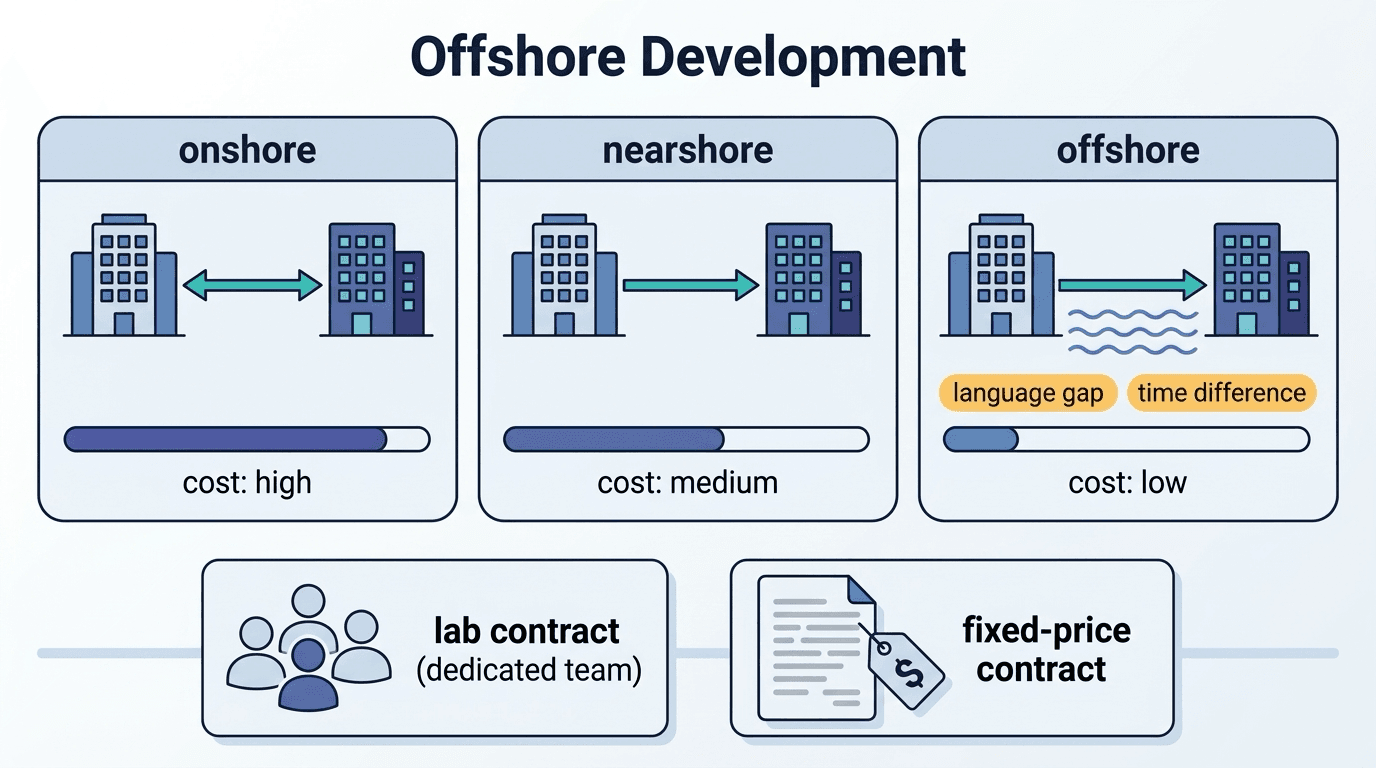
When considering offshore development in Thailand, understanding the full picture of costs is unavoidable. We will explain not only the monthly unit price, but also the differences depending on the contract type and hidden costs that are easy to overlook.
Monthly Rate Range for Engineers
| Position | Years of Experience | Monthly Rate (Estimate) |
|---|---|---|
| Junior SE | 1–3 years | ¥270,000–¥370,000 |
| Middle SE | 3–5 years | ¥370,000–¥500,000 |
| Senior SE | 5–10 years | ¥450,000–¥600,000 |
| Tech Lead | 8+ years | ¥550,000–¥750,000 |
| PM | 5+ years | ¥550,000–¥750,000 |
| UI/UX Designer | 3+ years | ¥300,000–¥450,000 |
| QA Engineer | 2+ years | ¥250,000–¥350,000 |
※ Market rates in Thailand (Bangkok) as of March 2026. Sources: offshore-kaihatsu.com, Glassdoor, PayScale, etc.
Compared to hiring engineers with equivalent skills domestically in Japan, cost reductions of 30–50% can often be expected. However, rates tend to spike in specialized fields such as AI/ML and blockchain, making it important to obtain estimates tailored to the technical requirements of each project.
It should also be noted that as programmer rates in Vietnam have risen to around ¥400,000 per month, the rate gap between Thailand and Vietnam has largely closed. The perception that "Thailand is expensive" is becoming a thing of the past.
Thailand-Only vs. Hybrid Effective Cost Comparison
Looking at the monthly unit price alone, offshore development in Thailand may appear more expensive than Vietnam or the Philippines. However, the actual project cost is determined by the sum of "engineer unit price + bridge SE + management man-hours + rework costs."
Below is a comparison of effective costs based on a team of 3 mid-level SEs on a 6-month contract.
| Item | Thailand Only | Vietnam (Typical) | Hybrid (Laboshare) |
|---|---|---|---|
| 3 Engineers (Mid-level SE) | ¥1.2M–1.5M/month | ¥1.2M–1.5M/month | — |
| Bridge SE | +¥500K–700K/month | +¥500K–600K/month | Included |
| Japan-side Management Man-hours | 40h/month | 40h/month | 8h/month |
| Rework Rate (Based on Experience) | Low | Medium | Low |
| Total Monthly Team Cost | Approx. ¥1.7M–2.2M | Approx. ¥1.7M–2.1M | From approx. ¥470K |
※ Note that due to rising rates in Vietnam, a team of 3 mid-level SEs now costs roughly the same as Thailand-only engagement.
In the hybrid model, having the Laos side handle implementation lowers the engineer unit price, while the Thailand-side PM also serves as the bridge function, eliminating the need for additional bridge SE costs. Furthermore, Japan-side management man-hours are reduced to just 8 hours per month, making this the most cost-competitive option when factoring in hidden costs as well.
Lab-Based vs. Contract-Based Cost Models
| Item | Lab-type (Dedicated Team) | Contract-type (Per Project) |
|---|---|---|
| Cost Structure | Monthly fixed rate × headcount | Lump-sum total or milestone-based payments |
| Cost Predictability | ◎ (Clear on a monthly basis) | △ (Subject to change with additional requirements) |
| Team Exclusivity | ◎ (Dedicated to your company) | △ (May be shared with other projects) |
| Flexibility for Spec Changes | ◎ (Changes accommodated at any time) | × (Change management required) |
| Minimum Contract Period | Typically 3–6 months | Until project completion |
| Best Suited For | Mid-to-long-term development, ongoing improvement | Short-term development, finalized requirements |
When nurturing a product over the mid-to-long term, the lab-type model holds a decisive advantage. Unlike the contract-type model, where additional estimates are generated with every specification change, the lab-type allows for flexible scope adjustments at a fixed monthly rate.
Beware of Hidden Costs
Comparing only monthly unit rates can lead to misjudging the actual project cost. Please confirm the following items in advance.
- Bridge SE costs: If a separate interpreter/coordinator for Japanese↔English is required, an additional 500,000–700,000 JPY per month will be added
- Infrastructure and tool costs: License fees for cloud environments, CI/CD tools, and project management tools
- Travel and business trip costs: Airfare and accommodation for kickoffs and regular visits (Bangkok is approximately 6 hours from Tokyo)
- Management man-hours: The time cost borne by the Japanese-side project manager
- Cancellation and migration costs: If documentation is insufficient, significant migration costs can arise when changing partners
With the hybrid model, many of these hidden costs are structurally reduced. The Bridge SE function is integrated into the Thailand-based PM role, so no separate fees are incurred. Regarding travel, a system is already in place for Thailand-side seniors to make monthly visits to Laos, eliminating the need for frequent business trips from the Japanese side. Japanese-side management man-hours can be reduced to participating in a weekly sprint review (approximately 8 hours per month).
How to Choose a Thai Development Partner Without Failing

It's no exaggeration to say that 80% of the success or failure of offshore development depends on partner selection. Here, we explain the selection criteria based on Thailand-specific circumstances.
5 Points to Check
- Presence of a local entity and years of operation: Does the vendor have a legal entity in Thailand with at least five years of operating history? If a hybrid model is claimed, verify whether the Laos-side base is also company-operated or subcontracted to a third party. A company-operated base ensures consistency in quality control, whereas subcontracting makes control more difficult.
- Actual Japanese language capability: Beyond the sales representative being able to speak Japanese, are there bridge SEs or engineers with Japanese proficiency within the development team? Confirm specifically what "Japanese support available" actually means.
- Engineer retention rate: Can the vendor disclose its turnover rate for the past two years? Since job-hopping is common in Thailand's IT industry, a low retention rate increases project handover costs. In a hybrid model, the retention rate of senior Thai-side engineers is particularly critical, as turnover in this role directly impacts quality control on the Laos side.
- Development process transparency: Are mechanisms in place to visualize progress, such as GitHub/GitLab repository access, daily standups, and sprint reviews? In a hybrid setup, it is also worth confirming whether the workflow requiring code to pass through a Thai-side review before merging is actually being followed in practice.
- Security posture: Review ISO 27001 certification, VPN environment, device management policies, and NDA terms. When operations span multiple locations, verify that the data communication channels between sites and the security policies at each location are consistent and unified.
How to Identify Bad Partners
The following cases require careful consideration:
- Extremely low estimates: If the quoted price is less than half the market rate, there is a possibility of a junior-only team composition or subcontracting to third parties
- Unable to provide specific past achievements: If they cannot share even a project overview citing NDA reasons, their actual track record may be limited
- Unable to explain the rationale for technology stack selection: If they cannot logically answer questions such as "Why do you recommend Vue over React?", concerns about their technical capabilities remain
- No trial period offered: If they refuse a 1–2 month trial period, they may lack confidence in their quality
- Contracts available in English or Thai only: If they cannot accommodate Japanese governing law selection or Japanese-language contracts, the risk in the event of a dispute is high
Our Laboshare Service — Thailand × Laos from ¥157,000/month

The "Thailand × Laos hybrid development" approach explained so far has been brought to life as Laboshare, built on our 15 years of experience. Here, we introduce the rationale behind the pricing starting from ¥157,000/month, as well as the specific framework that supports quality.
Laboshare Service Model
Laboshare is the lab-style offshore development service we provide. Built on a Thailand × Laos hybrid structure, it allows you to secure a development team with Bangkok-level quality management starting from ¥157,000 per month.
The Basis for the ¥157,000/Month Price
The reason this price point is achievable lies not in undervaluing engineers, but in optimal allocation across each phase of the process.
| Phase | Responsible Location | Cost Structure |
|---|---|---|
| Requirements Definition & Client Interface | Japan | Direct client communication |
| Design, Review & PM | Thailand (Bangkok) | Senior SEs ensure quality |
| Implementation & Testing | Laos (Vientiane) | 40–60% of Thailand labor costs |
| Bridge SE | Handled by Thailand PM | No additional cost |
The "Implementation & Testing" phase, which accounts for the majority of costs, is handled by the Laos office, while "Design & Review," which determines quality, is managed by senior staff at the Thailand office. This division of labor makes low pricing possible without sacrificing quality.
Choosing Between the Share Model and Full-Time Dedicated
Laboshare also offers a "share model," where a single engineer's time is shared across multiple projects on an hourly basis. This enables flexible operations tailored to project progress — for example, keeping man-hours low during phases with smaller development volumes, then switching to a full-time dedicated arrangement once the project scales up.
- From ¥157,000/month: Cost optimization through a hybrid structure
- Bridge SE fees included: Thailand-based PM communicates directly in Japanese
- Starting from as little as 1 month: No long-term contract lock-in
- Tech stack: Supports React / Next.js / TypeScript / Python / AWS
See the Laboshare service page for plans and team structure.
Quality and Cost Compatibility Created by a Three-Base Structure
We were founded in Bangkok in 2010 and currently operate across three locations in Japan, Thailand, and Laos. Each location has a clearly defined role, and this division of responsibilities is the engine that enables Laboshare to deliver both quality and cost-effectiveness.
Japan Office — Zero Distance from Clients
Native Japanese-speaking staff handle everything from requirements definition and meeting facilitation to contract and billing support. This front-facing function ensures that clients never feel the distance of working with an overseas partner.
Thailand Office (Bangkok) — The Final Gatekeeper of Quality
Senior engineers with five or more years of hands-on experience, along with Japanese-speaking PMs, are stationed here full-time. They oversee architecture design, code reviews, and sprint management, and hold merge authority over pull requests. Quality assurance for Laboshare is guaranteed by this Thailand office.
Laos Office (Vientiane) — The Source of Implementation Capacity
Coding and testing are carried out here based on technical specifications prepared by the senior staff in Thailand. Thanks to the high degree of mutual intelligibility between Lao and Thai, there is virtually no language barrier in day-to-day communication with the Thailand team. Senior staff from Thailand visit Vientiane on a monthly basis to provide in-person technical guidance and conduct health checks on the codebase.
A track record of over 1,850 client engagements attests to the effectiveness of this hybrid model.
Implementation Case Study (Administrative Hours Reduced from 40h to 8h)
A Japanese manufacturing client company introduced Laboshare into an in-house core system renovation project.
Before (Prior to Introduction):
- Outsourced to a domestic SIer, with a monthly cost of approximately 4 million yen
- Additional estimates required for every specification change, with approval taking 1–2 weeks
- Japanese-side PM management hours: 40 hours per month
After (Following Laboshare Introduction):
- A hybrid team of 1 Thailand-based PM + 2 Laos-based engineers, with a monthly cost of approximately 1.2 million yen (70% reduction)
- Specification changes handled flexibly within sprints
- Japanese-side PM management hours: 8 hours per month (80% reduction)
The primary factor behind the reduction in management hours from 40 to 8 hours was that the Japan-language-capable PM at the Thailand office took sole responsibility for translating specifications, coordinating adjustments, and managing progress. Since the Thailand-based PM communicates instructions to the Laos-based engineers in their native languages (Thai/Lao), a structure was established in which the Japanese side could stay informed of project progress simply by participating in a weekly sprint review.
FAQ

Here are answers to our frequently asked questions.
Q1: Is Japanese language support possible with offshore development in Thailand?
Yes, it is possible. Japanese-speaking Bridge SEs are assigned to all of our projects, providing Japanese-language support for everything from specification document translation to daily progress reports. While technical communication with engineers is primarily conducted in English, meeting summaries and key decisions are shared in Japanese.
Q2: Are the technical skills of Laotian engineers adequate?
While the IT talent market in Laos is smaller in scale compared to Thailand and Vietnam, a steady pipeline of talent has been developing in recent years, centered around the National University of Laos and the Laos-Japan Human Resource Development Institute (operated by JICA). At Laboshare, we handle the recruitment and development of Laos-based engineers in-house, with the following quality management framework in place:
- Implementation is based on technical specifications created by senior engineers on the Thailand side (no ground-up design is required)
- All code passes review by the Thailand side via pull requests
- In-person technical guidance sessions are held monthly
- Automated testing via CI/CD pipeline
Due to a role structure focused on implementation and testing, the goal is not to find "self-directed senior full-stack engineers," but rather to create an environment where mid-level to junior engineers who can write code faithfully to specifications can thrive.
Q3: Are there any restrictions on minimum contract period or number of people?
Laboshare contracts are available starting from as little as one month, with the option to begin with just one person. We recommend an approach of starting small during the PoC (Proof of Concept) phase, confirming results, and then scaling up the team. When scaling up, it is also possible to quickly expand the team by drawing from the talent pool in Bangkok.
Q4: What security measures are in place?
As standard, we develop within VPN environments, apply device management policies, and sign NDAs. For projects with high security requirements, such as those in the financial or medical sectors, we can also provide a dedicated security enhancement plan. As we handle each case individually based on specific requirements, please feel free to consult us when making an inquiry.
Summary — First Steps in Thailand × Laos Hybrid Offshore Development

Thailand is a strong candidate for quality-focused offshore development, thanks to its advantages of a 2-hour time difference with Japan, a pro-Japan culture, and engineers with solid English proficiency. However, Thailand alone can sometimes fall short of Vietnam and the Philippines in terms of unit cost.
The "Thailand × Laos Hybrid Model" that we have built over 15 years is a three-tier structure in which Thai senior engineers ensure quality through design, review, and project management, while Laos-based engineers optimize costs through implementation and testing. This model achieves both quality gatekeeping and cost reduction within the same team, realizing a price starting from ¥157,000 per month, inclusive of a bridge SE.
When selecting a partner, in addition to evaluating their track record in operating a local entity, engineer retention rates, and development process transparency, be sure to closely examine—in the case of a hybrid structure—whether the Laos office is company-owned and whether the review workflow is actually functioning in practice.
If you'd like to "start small and test the waters," Laboshare allows you to get started in as little as one month with just one engineer. Experience the balance of quality and cost through a hybrid structure backed by 15 years of Bangkok-based operations and a track record of over 1,850 client companies.
Author & Supervisor

Yusuke Ishihara
Started programming at age 13 with MSX. After graduating from Musashi University, worked on large-scale system development including airline core systems and Japan's first Windows server hosting/VPS infrastructure. Co-founded Site Engine Inc. in 2008. Founded Unimon Inc. in 2010 and Enison Inc. in 2025, leading development of business systems, NLP, and platform solutions. Currently focuses on product development and AI/DX initiatives leveraging generative AI and large language models (LLMs).
Recommended Articles