What is Loop Engineering? The New Standard in AI Agent Design Coming After Prompt Engineering

Lead
Loop Engineering is a practical methodology in which, instead of a person entering a prompt to an AI agent each time, the agent itself is designed with a "loop (a repeating mechanism)" that allows it to continue operating autonomously toward a goal. It spread rapidly in 2026, sparked by communications from prominent developers and leaders of AI coding tools.
This article is intended for planning and development leaders and DX promotion personnel at business companies advancing AI adoption. It provides a clear overview of Loop Engineering's meaning, its evolution from prompt engineering, the components of a loop, its business impact, and key considerations for implementation. For those who want to understand "what comes after prompts," it offers a comprehensive picture and a first step forward.
Loop Engineering is the practice of designing a system that, rather than eliciting a single response from an AI, drives it to run autonomously through "action → observation of results → next decision → repeat" until a goal is achieved. What a person designs is not individual instructions, but the repeating mechanism (loop) itself. Below, we examine the differences from conventional chat and the four elements that a loop cycles through.
The Difference Between a Single Round-Trip Response and a Loop
Conventional chat was completed in a single exchange: "ask a question → receive an answer." What prompt engineering refined was the technique of making that single-exchange input (the prompt) as precise as possible. However, for tasks spanning multiple steps, a person had to review the results, enter the next instruction, review again, and so on — repeating this back-and-forth many times. As AI grew more capable, this bottleneck of "a person continuously making the next move" became increasingly apparent.
With a loop, this back-and-forth is enclosed on the AI's side. The person provides only the goal (the desired end state) and the constraints that must not be crossed. The AI then judges what to do next on its own, executes it, checks the results, and if not yet finished, proceeds to the next step. Human involvement is limited to the initial design and key checkpoints for review and approval.
For example, given the goal "get all tests passing," the AI will examine failing tests, fix the code, run the tests again, and repeat until they pass — all without the person touching the keyboard. If a single-exchange chat is "one question, one answer," then a loop is closer to a relationship of "hand over the goal and leave it to the agent." The difference lies not in intelligence, but in whether the person or the mechanism holds the initiative over repetition.
How "Goal · Execute · Verify · Remember" Circulates
The contents of a loop are easiest to understand as a cycle of roughly four movements.
- Goal: Define what constitutes completion.
- Execution: Take concrete action — running code, manipulating files, calling external tools, and so on.
- Verification: Confirm whether the result of execution has moved closer to the goal.
- Memory: Record what has been completed and what remains, and carry that forward into the next iteration.
Once these four steps complete one cycle, the loop re-enters by comparing the goal against the current state. What matters is that each iteration proceeds on the basis of the "previous result." This is not a loop that merely repeats the same process; it reads the current state each time and adjusts the next decision accordingly — and this is precisely where the room for "engineering" lies.
Conversely, if any of these four elements is weak, the loop breaks down. If the goal is vague, the loop cannot terminate; if verification is lax, an incorrect outcome may be mistaken for success; if there is no memory, the same work will be repeated over and over. Loop Engineering can be described as the practice of explicitly designing each of these elements so that the cycle runs stably.
Why "Loops" Are Gaining Attention Now — Evolution from Prompts

Loop Engineering did not appear out of nowhere; it is a continuation of a trend in which AI utilization skills have progressively raised their level of abstraction: "prompt → context → harness → loop." The backdrop is that the unit of work a person handles has gradually grown larger and more abstract.
The Stages: Prompt → Context → Harness → Loop
The approach to leveraging AI has broadly evolved through the following stages:
- Prompt Engineering: How to make a single instruction (input text) as precise as possible.
- Context Engineering: How to structure the information environment passed to the model (reference materials, instructions, tool definitions, etc.). This is covered in detail in What is Context Engineering?.
- Harness Engineering: Designing the environment itself in which agents operate (documents, tools, constraints) to structurally prevent mistakes. See What is Harness Engineering? for more.
- Loop Engineering: Rather than giving instructions directly, designing the "loop itself" that issues instructions to AI.
What is worth noting is that these stages are not mutually exclusive replacements but rather cumulative layers. A good loop contains good context and good harness design within it. Loop Engineering sits at the top rung of this ladder, bundling all of these together into a "self-sustaining mechanism."
The 2026 Remarks That Sparked the Movement
This concept is said to have gained widespread attention following a series of public statements in 2026. A developer working on an open-source coding agent posted on social media arguing, in essence, that "you should no longer be prompting coding agents yourself," and the message quickly generated significant response.
Around the same time, the head of an AI coding tool was reported to have said in talks and presentations something to the effect of: "I no longer prompt AI myself. I run a loop where AI prompts AI and decides what to do next. My job is to write the loop."
These are, in both cases, claims grounded in individual experience and perspective, and they do not necessarily apply directly to every context. Nevertheless, they have been received as emblematic of a broader shift in sentiment—from a model in which "humans give instructions one step at a time" to one in which "the work is delegated to a system." The term itself has yet to fully take hold, but practical interest is growing rapidly.
Components That Drive a Loop: What Are We Designing?

What does it actually mean to "design a loop," and what does it produce? At its core are the elements of verifiable goals, task discovery, execution, verification, and memory—with parallelization and sub-agents added in real-world deployments. Let's walk through each in turn.
Verifiable Goals and Exit Conditions
The first thing to determine in loop design is: "What constitutes completion?" This is both the most important and the most error-prone decision. The key is to define completion in terms of conditions that can be verified mechanically, rather than relying on the AI's self-reported assessment.
For example, "improve the code" does not qualify as a goal. There is no defined endpoint, and the AI will either keep running indefinitely or declare "done" at some arbitrary point. Instead, frame it as something like "all specified tests pass," "output matches the specified format," or "error log is zero"—conditions where pass or fail can be determined automatically.
Termination conditions should cover not only "success" but also "failure." For instance: "if no improvement is made after a certain number of iterations, stop and report to a human," or "stop when the estimated cost ceiling is reached." A loop with only a success condition risks running indefinitely when the goal cannot be reached. Designing both an exit for success and an exit for giving up—this is the prerequisite for a stable loop.
Task Discovery, Execution, and Memory
Once the goal is defined, three types of motion need to be built to keep the loop running.
Task discovery is the part where the AI identifies what needs to be done at any given moment. It selects the next action from a list of remaining tasks, failed tests, unresolved items, and so on. If this is vague, the AI will spend time on work that doesn't matter.
Execution is where the actual work happens. Editing code, running commands, calling external services—the key design decision here is how many "tools" to give the AI. Too few, and the work stalls; too many, and the risk of unintended operations increases.
Memory is the mechanism for recording what has been completed and what remains, and carrying that forward into the next iteration. The longer the loop runs, the more information accumulates—so rather than holding everything in context each time, a design that writes key points to external storage and reads them back only when needed tends to work better. A loop with weak memory will repeat the same work or lose track of decisions made in previous iterations and go astray. Memory design for agents is itself a deep topic, covered in detail in Long-Term Memory Design for AI Agents.
Parallel Execution, Skills, and Sub-Agents
Once you are comfortable with small loops, real-world deployments scale them up by combining the following building blocks.
- Parallel execution: Run independent tasks simultaneously to reduce wait times. The standard practice is to isolate workspaces so tasks do not interfere with one another.
- Skills (runbooks): Consolidate frequently used procedures so they can be called from within a loop. This is faster than having the AI reason from scratch each time, and produces more consistent quality.
- Tool integrations: Provide connectors to internal systems and external services so the loop can interact with real business data.
- Sub-agents: Distribute work across multiple AIs with distinct roles, overseen by a coordinator. A typical pattern separates the planner, executor, and verifier.
Combining these elements evolves a loop from a simple repetition into something closer to "a small team advancing multiple tasks in parallel." Key design principles for coordinating multiple agents and preventing infinite recursion are covered in detail in A Practical Guide to Multi-Agent Orchestration Design. There is no need to incorporate everything from the start — the practical approach is to stabilize your goal and verification first, then add one element at a time.
Differences from Prompting and Orchestration

To state the conclusion upfront: the difference among the three comes down to "who issues the next instruction." With prompt engineering, a human does so every time; with orchestration, a human-defined procedure does; with a loop, the mechanism issues instructions automatically toward a verifiable goal.
| Dimension | Prompt Engineering | Agent Orchestration | Loop Engineering |
|---|---|---|---|
| Who gives instructions | A human, each time | A human defines the framework | The loop, automatically |
| Termination condition | Human judgment | Completion of the procedure | Achievement of a verifiable goal |
| Human involvement | Every single step | At step-design time | At design time + approval at key points |
| Best suited for | One-off generation or research | Fixed multi-step tasks | Long-running, repetitive, self-directed tasks |
The distinction most easily confused is that between orchestration and loops. Orchestration has a strong character of "executing a predetermined sequence of steps in order" — it is an extension of automation. A loop, by contrast, has judgment built in: at each iteration the AI evaluates whether it has moved closer to the goal and independently decides its next action.
That said, the three are not in opposition. In practice, well-crafted prompts are used at key points within a loop, and multi-agent orchestration operates as a component inside it. Loop Engineering is best understood as a higher-level design that brings these elements together into "a self-directed flow aimed at a goal."
What Changes Will This Bring to Business?

The primary reason Loop Engineering is attracting attention is that AI can keep working even when no human is watching. As a result, the human role shifts from "giving detailed instructions" to "defining goals and verifying outcomes."
Work That Progresses Even When No One Is Watching
If goals and guardrails are designed in advance, loops can advance routine tasks overnight or on weekends, with results ready by the next morning — this kind of operation is becoming a realistic prospect. Because AI no longer sits idle waiting for human instructions, active hours are no longer constrained by human working hours.
The tasks where this pays off most are those that are "clearly defined but labor-intensive." Examples include updating dependency libraries, fixing tests, high-volume repetitive modifications, and data formatting and inspection. These tasks have goals that are easy to evaluate mechanically (the update is complete / the tests pass), making them a natural fit for loops.
On the other hand, tasks with ambiguous goal definitions, or judgments with no single correct answer — such as setting strategic direction, assessing design quality, or negotiating with customers — are not well suited to being looped. Identifying "what to delegate and what to keep in human hands" is what determines whether adoption delivers results. Rather than trying to automate everything, the practical mindset is to carve out the tasks that can run autonomously.
The Human Role Shifts from "Giving Instructions" to "Setting Goals and Verifying"
The broader the scope delegated to a loop, the more the center of gravity in human work shifts from "input (instructions)" to "verifying output" and "designing goals." No matter how much the AI does, determining whether the results are truly correct and aligned with intent remains a human responsibility — and one that only grows in importance.
This is not a story about humans becoming unnecessary. The value of people who can define goals precisely, judge the quality of a design, and verify results is expected to be higher than ever. The wider the scope delegated to AI, the more consequential human judgment becomes in deciding "what to delegate and how to confirm it."
This shift toward "verification work" is already being discussed in development circles. The question of how the object of verification moves from "is the implementation correct?" to "is the right work being done in the first place?" is explored in depth in Verification: From "Correct Implementation" to "Correct Work". It is worth reading alongside this article when thinking about the role humans will play in the age of loops.
Precautions and a Small-Start Approach for Implementation

A loop is not "magic that works on its own if you leave it alone." Poor design leads to failures such as runaway costs and goal derailment. That is precisely why guardrails must be in place and starting small is essential.
Risks of Cost Overruns, Derailment, and Context Bloat
Failure patterns unique to loops can generally be organized into the following four categories.
- Runaway costs: Because loops operate autonomously, AI usage fees (token costs) tend to balloon. Autonomous loops consume more tokens than ordinary chat, and it has been reported that multi-agent configurations consume even more. A loop without an upper limit can lead to open-ended expenditure.
- Goal derailment: When objectives are vague, the loop keeps running in the wrong direction.
- Context bloat: The longer a loop runs, the more information the AI must handle, and the accuracy of its judgments degrades.
- Silent failure: The loop continues performing incorrect work indefinitely, with no visibility into progress.
These failures occur not because "the AI lacks capability" but because "the design is insufficient." In fact, the more capable the AI, the greater the impact when it goes off the rails. The idea of placing cost at the center of design is covered in detail in AI Agent Economic Models and Operational Cost Architecture, and the mechanisms for detecting and halting runaway behavior are covered in AI Agent Emergency Stop Design (Circuit Breakers).
Setting Guardrails and Starting Small
The key to preventing failures is the guardrail. At a minimum, the following four elements should be built into any design.
- Iteration limit: Stop the loop after it exceeds a set number of iterations.
- Cost limit: Halt execution when the expected budget is reached.
- Progress monitoring: Detect when the loop is no longer advancing and stop it.
- Human approval checkpoints: Always require human approval before irreversible operations (deploying to production, deleting data, sending to external parties, etc.).
The golden rule for verification is to determine outcomes mechanically through tests and automated checks—not by having the AI grade itself. A design that asks the AI "Did you do well?" tends to overlook incorrect results.
As a practical approach, rather than attempting to automate an entire workflow all at once, it is more realistic to start with small loops on low-risk, routine tasks. For example, begin with tasks such as dependency updates or test fixes—work where the impact of failure is limited and success or failure can be determined automatically. Gradually expand the scope as you confirm the loop is functioning correctly, while keeping final verification and decision-making in human hands. Following this sequence is the most reliable path to a safe rollout.
Frequently Asked Questions (FAQ)

Q. Will prompt engineering become unnecessary? It will not disappear. Instructions passed to the AI remain important even within a loop, and prompt design will continue to live on as a component of loop design. It is more accurate to think of the center of gravity shifting from "one-off prompts" to "self-running systems."
Q. Does adoption require advanced expertise? Full in-house implementation does require technical capability, but you can start by testing small loops on low-risk, routine tasks. The prerequisite is having guardrails in place—such as iteration limits, cost limits, and human approval checkpoints.
Q. Can small and medium-sized businesses make use of this? Yes. In fact, organizations with limited staff stand to gain the most from automating routine tasks. However, design measures to prevent runaway behavior—such as setting cost limits—are indispensable. It is recommended to start small, verify the results, and then expand gradually.
Q. How does this differ from harness engineering? Harness engineering is the philosophy of "designing the environment so that agents do not make mistakes," while Loop Engineering is the philosophy of "designing the loop that allows agents to run autonomously." The two are complementary—a good loop contains a good harness within it.
Conclusion: Human Work Shifts from "Instructions" to "Design"

Loop Engineering is an emerging paradigm that shifts the focus of AI utilization from "writing good prompts" to "designing systems in which AI runs autonomously." It sits at the top rung of the abstraction ladder built up through prompts, context, and harnesses.
The key points can be distilled into three. First, the core of a loop is designing a "verifiable goal" along with "exit paths for both success and failure." Second, guardrails—cost limits, iteration limits, and human approval checkpoints—must always be in place. Third, start small with low-risk routine tasks, and keep verification and decision-making in human hands throughout.
This is not a story about replacing human work; it is a shift that elevates human work from "giving instructions" to "designing and verifying systems." How to design the "loop" that lies beyond the prompt is becoming an unavoidable topic for anyone thinking about AI utilization going forward. Our company is engaged in business process design and implementation support that reflects these latest trends in AI adoption. If you would like to explore which of your operations could be the starting point for loop automation, please do not hesitate to contact us.
Author & Supervisor

Yusuke Ishihara
Started programming at age 13 with MSX. After graduating from Musashi University, worked on large-scale system development including airline core systems and Japan's first Windows server hosting/VPS infrastructure. Co-founded Site Engine Inc. in 2008. Founded Unimon Inc. in 2010 and Enison Inc. in 2025, leading development of business systems, NLP, and platform solutions. Currently focuses on product development and AI/DX initiatives leveraging generative AI and large language models (LLMs).
Recommended Articles


Terms related to this article
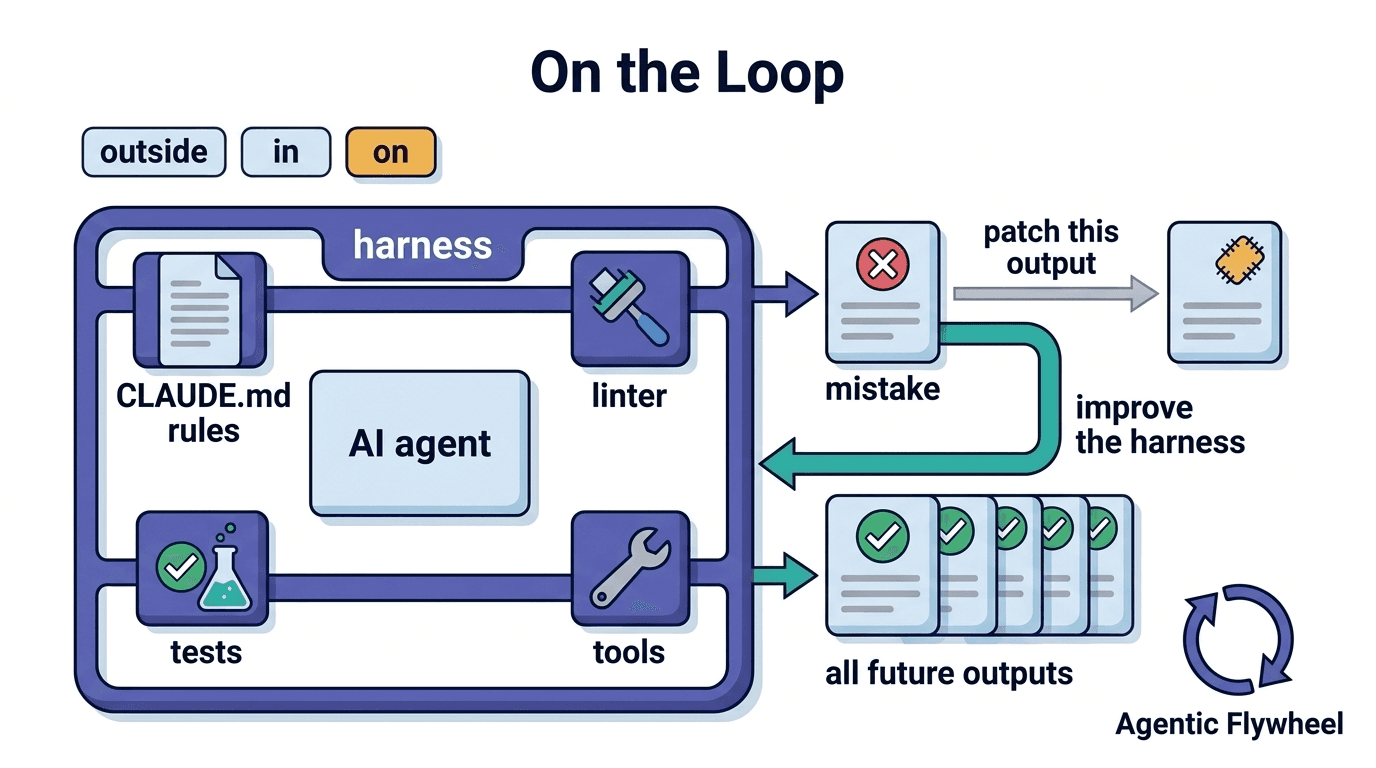
On the Loop
"On the Loop" is a collaboration mode that focuses on improving the harness (operating environment,
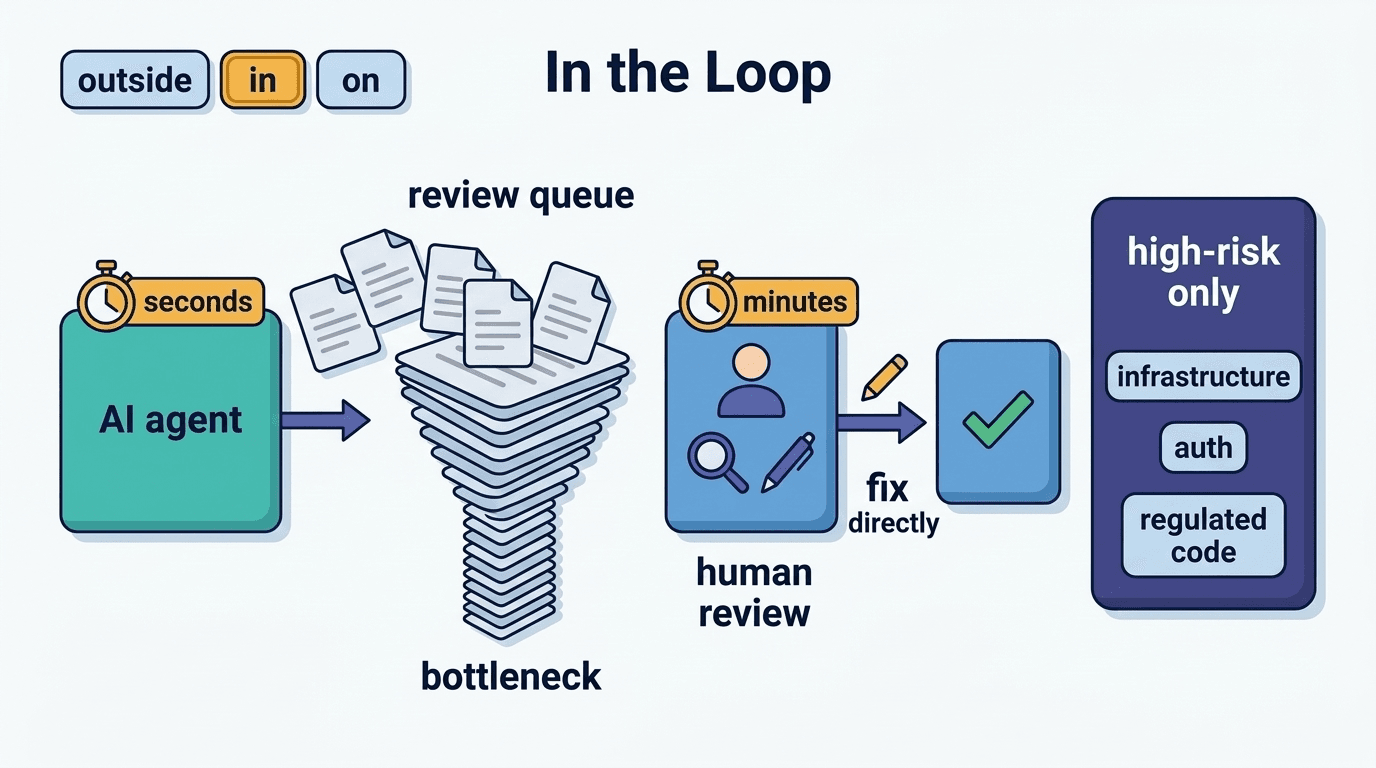
In the Loop
"In the Loop" is a collaborative mode in which humans review and correct AI agent outputs one by one
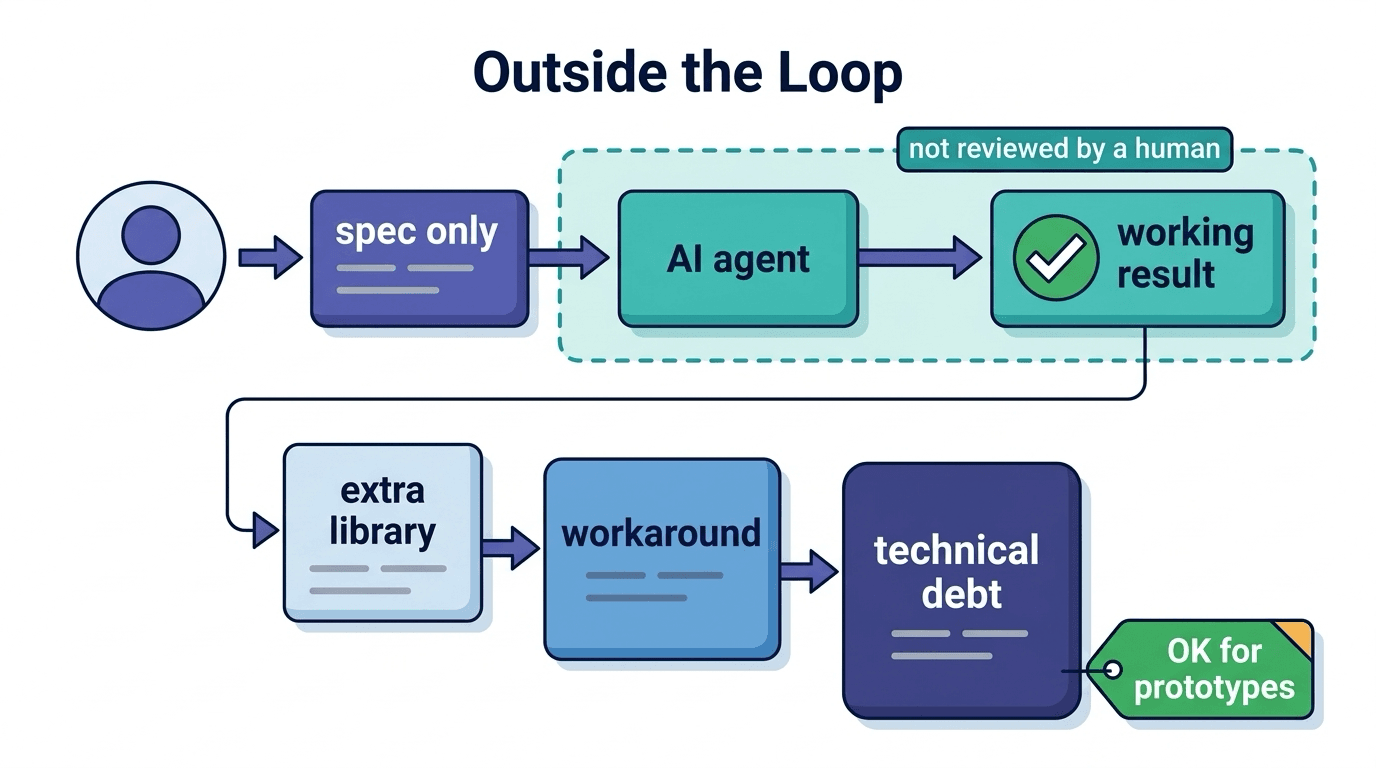
Outside the Loop
"Outside the Loop" is a collaboration mode in which humans specify only the outcome requirements and