What is Adaptive RAG? How to Balance Cost and Accuracy with Query-Driven Dynamic Retrieval

Lead
Adaptive RAG is an extended approach to RAG (Retrieval-Augmented Generation) that dynamically switches retrieval strategies based on query complexity. While conventional RAG applies the same retrieval pipeline to all queries, Adaptive RAG processes simple queries with an LLM alone and performs multi-step retrieval only for complex queries, simultaneously optimizing both cost and accuracy. This article provides a systematic explanation for developers and ML engineers responsible for improving RAG operations, covering how Adaptive RAG works and how it differs from conventional approaches, preparation and implementation steps, concrete measures for cost reduction and accuracy assurance, and how to avoid common pitfalls.
The essence of Adaptive RAG lies in abandoning "the same retrieval process for every question" and instead selecting the optimal retrieval strategy for each query. We first organize the structural challenges of conventional static RAG, then examine the mechanism of dynamic routing and clarify the positioning of the related concept of active retrieval.
The Cost-Accuracy Tradeoff in Static Retrieval Pipelines
Conventional RAG always executes a fixed pipeline of "retrieval → context injection → generation" upon receiving user input. While this design is simple to implement, it disregards the nature of each query, producing inefficiencies in both directions.
Consider an internal FAQ bot. Even greetings like "Hello" or casual questions like "What can you do?" trigger searches against the vector database, and the irretrievably unrelated chunks retrieved consume tokens. The same applies to general knowledge questions that an LLM alone could answer sufficiently. Conversely, questions that require cross-referencing multiple sources—such as "Explain the differences in warranty conditions between Product A and Product B, taking into account the history of policy revisions"—cannot gather the necessary documents in a single retrieval pass, resulting in degraded answer accuracy.
In other words, a static pipeline structurally embeds a cost-accuracy tradeoff: it incurs excessive retrieval costs for simple queries while providing insufficient retrieval for complex ones. The wider the distribution of query difficulty, the greater this inefficiency becomes.
How Dynamic Routing Works Based on Query Complexity
The core of Adaptive RAG is a "query complexity classifier" that assesses complexity at the moment a query is received and routes it to one of three retrieval strategies. The research that proposed this framework (Jeong et al., NAACL 2024, arXiv:2403.14403) trains a lightweight language model as the classifier to route queries to the following three strategies:
| Strategy | Target Queries | Processing |
|---|---|---|
| No retrieval | Greetings, general knowledge | Answer with LLM alone |
| Single-step retrieval | Simple fact-checking | Retrieve context in one pass and generate |
| Multi-step retrieval | Multi-hop reasoning | Iteratively retrieve and reason to construct an answer |
A key implementation point is that the training data for the classifier is not labeled by hand; instead, it is automatically generated by actually testing which strategy yields the correct answer for existing QA datasets. The same research reports that this adaptive routing improves the balance between accuracy and efficiency compared to fixing a single strategy.
Importantly, the classifier itself only needs to be a small, inexpensive model. Because the routing overhead can be minimized, the overall cost-reduction benefit is not negated.
Relationship and Positioning Relative to Active Retrieval
A concept often discussed alongside Adaptive RAG is the approach known as active retrieval. Both share the philosophy of "retrieve only when necessary," but differ in the timing of that decision.
FLARE (arXiv:2305.06983), a representative example of active retrieval, triggers retrieval at the point during answer generation when the model determines it lacks confidence in the next sentence. Self-RAG (arXiv:2310.11511) has the model itself evaluate—using special tokens—whether retrieval is needed and how useful the retrieved results are, as generation proceeds. Both are forms of "in-flight optimization" that dynamically interleave retrieval during the generation process.
Adaptive RAG, by contrast, is positioned as "upfront optimization," deciding on a strategy at the entry point when the query is received. The two approaches are not mutually exclusive: for example, a query that Adaptive RAG classifies as requiring multi-step retrieval at the entry point can then have its retrieval timing controlled by active retrieval during execution. Agentic RAG, in which an agent autonomously plans retrieval, is best understood as an advanced development along this same continuum.
What to Prepare Before Implementation: Prerequisites and Environment Setup

Adaptive RAG is structured by layering a "classifier" and "multiple retrieval paths" on top of an existing RAG foundation, making the quality of that foundation critical to success. This section organizes the components to verify before implementation and the criteria for selecting them.
Required Components: Vector Database, LLM, and Query Classifier
Adaptive RAG consists of three main components.
- Vector database: Stores document embeddings and handles similarity search. An existing vector database already in use can be reused as-is.
- Generative LLM: The core component that generates responses. Multiple models may be prepared when used selectively by strategy (tiered processing, described later).
- Query classifier: A newly added element specific to Adaptive RAG.
Classifier implementation approaches fall into three broad categories: a pre-trained small classifier (fast and low-cost, but requires training data); zero-shot classification via LLM prompting (no training required and easy to introduce, but incurs inference cost for classification on every query); and rule-based classification using query length or keywords (fastest, but vulnerable to variations in phrasing).
A practical approach for initial deployment is to verify behavior using zero-shot classification first, then replace it with a small classifier once operational logs have accumulated. There is no need to aim for a perfect classifier from the outset.
Selection Criteria for Hybrid Search and Embeddings
The quality of the retrieval layer forms the foundation of response quality regardless of which strategy a query is routed to. Two aspects in particular warrant close attention: the retrieval method and the embedding model.
For the retrieval method, hybrid search combining keyword matching (such as BM25) with semantic search is recommended. Keyword search excels at exact matches for model numbers and proper nouns, while vector search handles paraphrasing and conceptual questions more effectively. This also aligns with the intent of Adaptive RAG to handle diverse queries.
The criteria for selecting an embedding model are the following three:
- Supported languages: Verify retrieval accuracy for the languages actually in use—such as Japanese or Thai—not only against public benchmarks but also against your own documents.
- Dimensionality and cost: Higher dimensionality increases expressiveness, but also raises storage and retrieval costs.
- Domain fit: In domains with extensive specialized terminology, similarity judgments from general-purpose models may diverge from intuition.
It is also worth assessing at this stage whether there is room to introduce reranking to reorder the top retrieval results.
Assessing Compatibility with Existing RAG Pipelines
Adaptive RAG is not something built from scratch; it is an extension that inserts a routing layer in front of an existing pipeline. How easily it can be integrated depends on the degree of separation in the existing implementation.
There are three aspects to verify. First, whether the retrieval process is separated from the generation process as a function or API. In implementations where retrieval and generation are tightly coupled, reuse as a single-step retrieval path becomes difficult. Second, whether there is a single unified entry point for queries. If retrieval is called from multiple disparate entry points, those entry points must first be consolidated. Third, whether logs of queries and response quality are being captured. These logs are the very training data for the classifier described later; proceeding with Adaptive RAG adoption without a logging infrastructure in place will prevent the classifier improvement cycle from functioning.
Of the three, establishing logging is worth prioritizing regardless of whether Adaptive RAG is adopted.
How to Implement: Steps for Building Adaptive RAG

Construction proceeds in three steps: "classifier → strategy-specific pipelines → routing integration." Because each step can be validated independently, risk can be managed by releasing incrementally.
Step 1: Design and Train a Query Complexity Classifier
The first thing to tackle is designing the query complexity classifier. The labels are based on the three categories mentioned earlier (no retrieval / single-step / multi-step).
For creating training data, the automatic labeling approach proposed in the Adaptive RAG research paper (arXiv:2403.14403) can be used. The method involves running all three strategies against your QA pairs and labeling each query with "the lightest strategy that produced a correct answer." Since no manual annotation is required, training data grows naturally as operational logs accumulate.
So what do you do during the initial launch phase when no training data exists yet? Many teams get stuck trying to build a perfect classifier from the start, but the answer is simple: substitute with a zero-shot classification prompt to an LLM. Simply asking "Does the following query fall under A: no retrieval needed / B: answerable with a single retrieval / C: requires combining multiple sources?" already produces more rational routing than a fixed pipeline.
What to watch in evaluation is not classification accuracy per se, but the asymmetry in the cost of misclassification. Misrouting a simple query to multi-step retrieval is merely a "waste of cost," but misrouting a complex query to no retrieval directly leads to "wrong answers." Design your evaluation to penalize the latter heavily, and set a threshold that defaults toward the retrieval side when in doubt.
Step 2: Build Parallel Pipelines for Each Retrieval Strategy
Next, build each of the three destination pipelines independently.
- No-retrieval path: The LLM answers on its own. The key point is to explicitly state in the system prompt that "company-specific information is delegated to the retrieval path," constraining the model from guessing at things it doesn't know.
- Single-step retrieval path: An existing RAG pipeline can be reused almost as-is. The standard configuration is retrieval → injection of top chunks → generation.
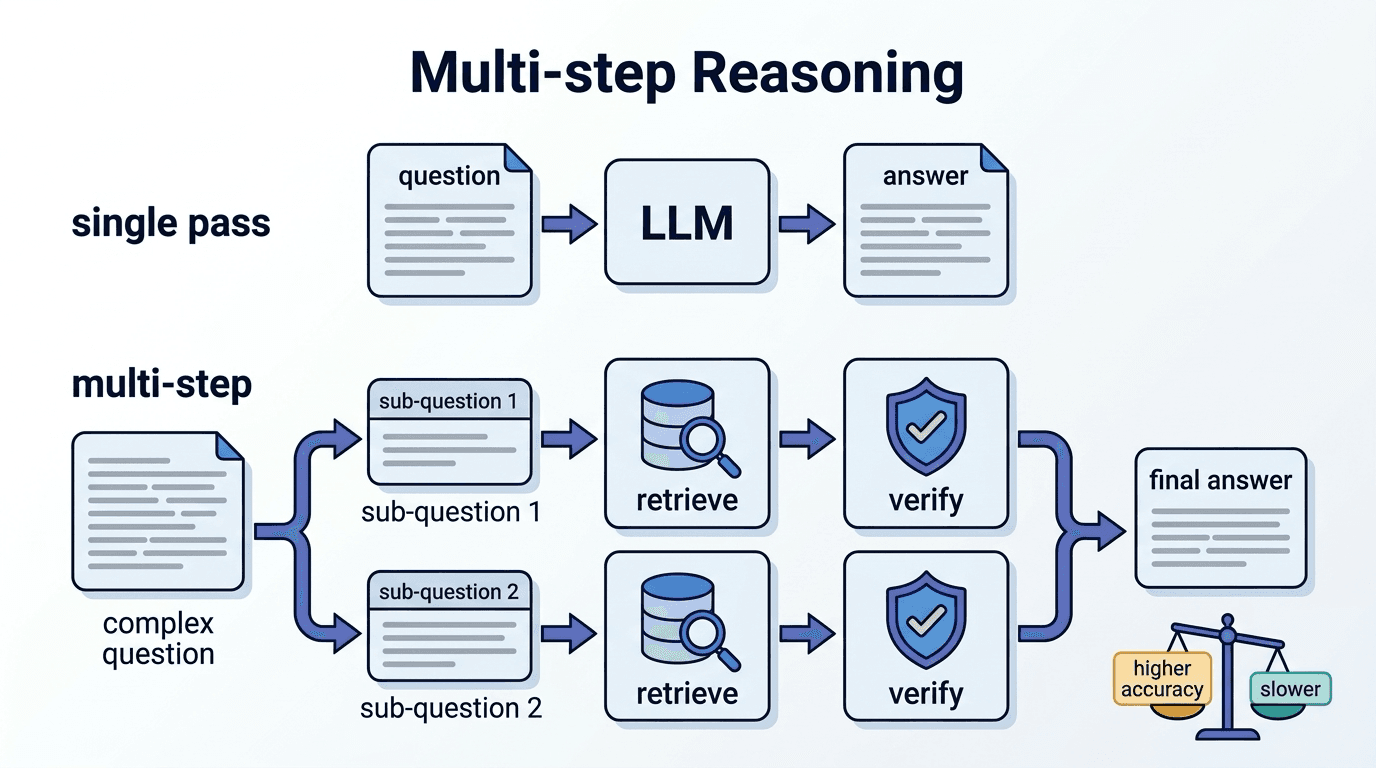
- Multi-step retrieval path: Decomposes the query into sub-questions and alternates between retrieval and reasoning to build up an answer. Because it involves loop control (maximum iteration count and termination conditions), this is the most complex of the three to implement.
The key point is to keep each path in a state where it can be tested independently. Preparing an evaluation query set for each path makes it possible, when problems arise during downstream routing integration, to determine whether the issue stems from a classifier error or degradation within the path itself.
Step 3: Integrate Dynamic Routing Logic and Connect End-to-End
Finally, connect the classifier and the three paths to run end-to-end. The implementation itself is nothing more than "branching based on the classification result," but the following three points determine operational quality.
- Fallback design: Set a default that routes queries with low classifier confidence to the single-step retrieval path. Also prepare an exit that switches to "answer within known scope + explicit acknowledgment of gaps" when the multi-step retrieval path reaches its maximum iteration count without gathering sufficient evidence.
- Per-strategy monitoring: Record the routing distribution (what percentage of traffic flows to each strategy), along with latency, token consumption, and answer quality broken down by strategy. Without this breakdown, it is impossible to determine whether the classifier or a specific path needs improvement.
- Staged rollout: Rather than switching all traffic at once, first run in shadow mode—logging routing decisions only while running in parallel with the existing RAG—to confirm the distribution, then switch over starting with a portion of traffic.
After integration, compare cost and accuracy against the conventional fixed pipeline using the same query set, and quantify the impact before completing a full migration.
How to Reduce Costs: Token Consumption Optimization Strategies

The cost reduction effect of Adaptive RAG is determined not only by routing, but by token design within each pipeline. This section explains three optimization levers that can be tuned per strategy.
Saving Tokens by Tuning Chunk Size and Context Window
Input token volume is largely determined by "chunk size × number of retrieved results (top-k)." Being able to vary this per strategy is one of the cost advantages of Adaptive RAG.
With a fixed pipeline, it is common to apply larger chunks and higher k values across all queries to accommodate complex ones, meaning the same token cost is paid even for simple queries. With Adaptive RAG, you can differentiate: use a smaller k for the single-step retrieval path, and retrieve a small number of results per iteration for the multi-step retrieval path.
Tuning chunk size itself follows the same principles as conventional RAG—too small and context gets fragmented, degrading retrieval accuracy; too large and irrelevant content crowds the context window. Use document logical structure such as headings and paragraphs as the basis for splitting, and tune based on retrieval evaluation on your own documents.
Note that the brute-force approach of feeding entire documents into a model with a large context window amplifies the very "wasteful token consumption" that Adaptive RAG aims to solve, and tends to be counterproductive.
Tiered Processing Architecture Using SLMs and LLMs Selectively
It is not necessary to use a top-tier LLM for every stage of processing. By dividing models into "tiers" based on their role, you can reduce costs while maintaining quality.
The basic approach is to assign lightweight tasks such as classification to SLMs, and to assign generation involving multi-document synthesis or reasoning to LLMs.
| Process | Recommended Tier | Reason |
|---|---|---|
| Query complexity classification | SLM / small classifier | Runs on every query, so low latency and low cost are essential |
| Response on the no-retrieval path | Mid-tier model | Casual conversation and general knowledge do not require top-tier model capabilities |
| Generation for single-step retrieval | Mid- to high-tier model | Reading comprehension quality of context directly affects answer quality |
| Reasoning and synthesis for multi-step retrieval | High-tier model | Query decomposition and information integration require the highest reasoning capability |
Depending on data sovereignty requirements and query volume, running the classifier and lightweight path on a local LLM is also an option. In that case, verify the impact of quantization on accuracy for your own tasks before adopting it.
Reducing API Costs with Throttling and Caching
The third lever is simply reducing the number of LLM calls in the first place.
- Semantic cache: Detects queries that are semantically identical—such as "How do I apply for paid leave?" and "How do I request time off?"—using embedding similarity, and reuses past responses. This is highly effective for FAQ-heavy workloads.
- Embedding cache: Avoids recomputing embeddings for identical text. Can be combined with incremental embedding on document updates.
- Prompt cache: Uses the prompt caching feature provided by major LLM APIs to reduce the cost of reprocessing system prompts and boilerplate context.
- Throttling: Per-user and per-tenant rate control to prevent sudden cost spikes caused by runaway clients or malicious repeated requests.
One caveat is cache freshness management. If you update documents in your knowledge base without also designing a mechanism to invalidate related cache entries, the system will continue returning stale responses.
How to Ensure Accuracy: Grounding and Hallucination Mitigation

Cutting costs means nothing if the system returns incorrect answers. The key to accuracy in Adaptive RAG lies in grounding checks—mechanically evaluating the quality of retrieved results—and in multi-step handling of complex queries.
How to Insert Grounding Checks After Retrieval
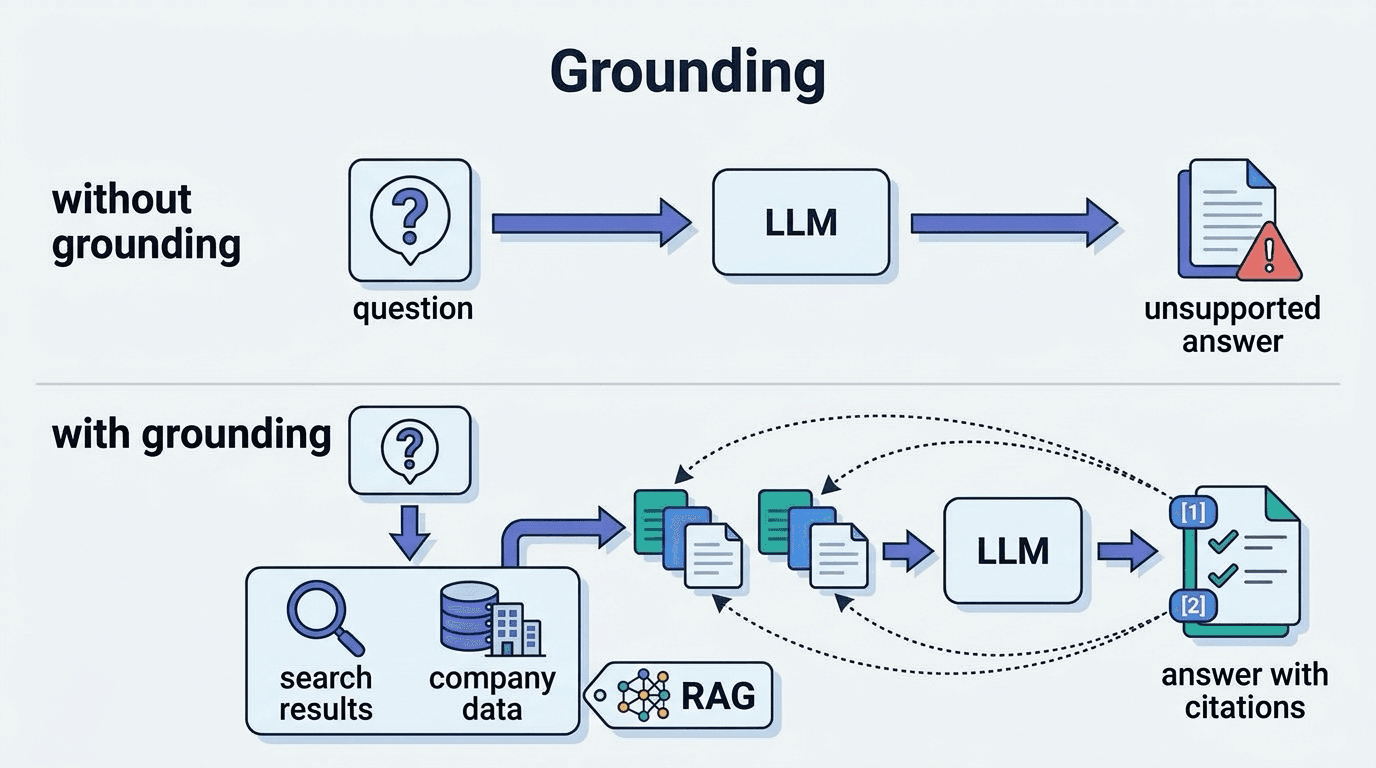
Grounding means anchoring the LLM's responses to the source documents obtained through retrieval. In Adaptive RAG, checkpoints can be inserted at two points: after retrieval and after generation.
A useful reference for post-retrieval checking is the retrieval evaluator proposed by CRAG (Corrective RAG, arXiv:2401.15884). It uses a lightweight evaluator to determine whether retrieved documents are truly relevant to the query, and if quality is low, it does not proceed directly to generation—instead taking corrective actions such as rewriting the query and re-retrieving, or switching to a different source. The underlying idea is to intervene upstream of the causal chain: "generating from poor retrieval results leads to hallucination."
Post-generation checks verify which part of the source documents each claim in the response corresponds to, and detect any unsupported statements. Designing the response to include citations—specifying which document and which section—allows users to verify the information themselves, which also limits the real-world harm if an incorrect answer slips through.
How rigorously this is applied depends on the use case, but at a minimum, simply "withholding a response and explicitly stating so when the relevance score of retrieval results falls below a threshold" can significantly reduce confidently delivered incorrect answers.
Handling Patterns for Queries Requiring Multi-Step Reasoning
Questions such as "Are there any contradictions between the contract terms with Company X and the current internal regulations?" require retrieving and cross-referencing multiple documents, and cannot be answered with a single retrieval. There are three design patterns for multi-step retrieval paths.
- Query decomposition: Decompose the original question into sub-questions, retrieve for each, then synthesize. Sub-questions can be executed in parallel, making it easier to keep latency low.
- Iterative retrieval: Identify "the next piece of information needed" as reasoning progresses, and repeat retrieval accordingly. This is sequential because each retrieval result determines the next query, but it handles reasoning with dependencies well.
- Generation with self-evaluation: As in Self-RAG (arXiv:2310.11511), have the model itself evaluate during generation whether retrieval is needed and how useful the retrieved results are.
In all of these patterns, always set a maximum number of iterations and a termination condition. If iterations continue without sufficient evidence being gathered, costs will balloon—so a safe design is to respond at the limit by separating "what has been established" from "what information is still missing."
Note that if questions frequently involve traversing relationships between entities (such as org charts or dependency graphs), combining with GraphRAG, which uses a knowledge graph, is well suited.
Common Pitfalls and How to Avoid Them

Failures in Adaptive RAG often manifest not as dramatic errors, but as "silent quality degradation." It is worth understanding two representative failure patterns and how to avoid them.
Routing Malfunctions Caused by Insufficient Classifier Accuracy
The most typical failure is when a complex query is mistakenly routed to the "no retrieval" path. In this case, the system does not throw an error. The LLM simply returns a plausible but incorrect answer using only its internal knowledge, delivered in a confident tone. The issue only comes to light through user reports of "shallow answers" or "factual inaccuracies," and it is rarely obvious that the root cause lies in the routing.
There are four mitigation strategies.
- Asymmetric thresholds: When classification confidence is low, default to the retrieval path. The wasted cost of retrieving unnecessarily is cheaper than the cost of a wrong answer caused by skipping retrieval.
- Shadow mode operation: Before switching to production, log only the routing decisions and compare them against responses from the existing RAG system to identify misclassification tendencies.
- Per-strategy quality monitoring: Track quality metrics separately by path—such as the low-rating rate for responses on the no-retrieval path. Aggregate averages can mask degradation in specific paths.
- Periodic retraining: Collect misclassification cases from operational logs and continuously update the classifier. Query patterns shift as the system is used.
Ultimately, the most effective mitigation is to design your monitoring with the premise that "the classifier is also an operational component subject to degradation."
Addressing Retrieval Quality Degradation and RAG Poisoning Risks
Another failure mode is degradation of the retrieval layer itself. There are two root causes.
The first is age-related decay of the knowledge base. As document duplication and outdated versions accumulate, the top retrieval results become dominated by stale information, causing answer quality to decline regardless of which strategy is used for routing. This can be prevented by storing document update dates and version numbers as metadata and designing retrieval to prioritize newer versions, along with routinely scheduled deduplication.
The second is an externally induced risk known as RAG poisoning. If malicious text is mixed into the sources ingested into the knowledge base—such as shared drives, web pages, or externally received documents—it can function as indirect prompt injection to the LLM when surfaced by retrieval, potentially leading to manipulated responses or information leakage.
Countermeasures include classifying ingestion sources by trust level and managing access permissions accordingly, inspecting content for instruction-like patterns at ingestion time, and always displaying source citations in responses to preserve a human-verifiable audit trail. The broader the retrieval scope, the greater this risk becomes—so an "ingest everything" approach should be avoided.
Frequently Asked Questions About Adaptive RAG

Q. Should I choose Adaptive RAG or standard RAG? Base the decision on query diversity. If user questions are formulaic and uniform in difficulty, a standard RAG with a fixed pipeline is sufficient. The greater the range of difficulty—from casual small talk to multi-hop reasoning—and the higher the query volume, the more Adaptive RAG delivers in terms of cost reduction and accuracy improvement.
Q. What is the difference between Adaptive RAG and Agentic RAG? The difference lies in the locus and scope of decision-making. Adaptive RAG is a mechanism that makes a single upfront determination of which retrieval strategy to use. Agentic RAG, on the other hand, refers to a broader framework in which an agent autonomously repeats cycles of retrieval, tool execution, and replanning. When agent-style control is applied to the multi-step retrieval path in Adaptive RAG, the two naturally converge.
Q. What kind of model should I use for the query classifier? A phased approach is practical. Start with a zero-shot classification prompt to an LLM during the initial rollout, then train and replace it with an SLM or lightweight classifier once operational logs have accumulated. Since this process runs on every query, the standard practice is to ultimately move toward a low-latency, low-cost model.
Q. How much can costs be reduced by adopting Adaptive RAG? It depends on the query distribution, so no single answer applies. Workloads with a higher proportion of simple queries that require no retrieval will see greater savings. Before adoption, sampling existing logs to estimate "the proportion of queries that can be answered without retrieval" allows you to project the expected impact for your own use case. The original research (arXiv:2403.14403) also reports the benefit as an improvement in the balance between accuracy and efficiency, with the absolute reduction rate varying by workload.
Conclusion: Optimizing RAG Operations with Query-Adaptive Retrieval Strategies

Adaptive RAG is an extension of RAG that classifies query complexity at the entry point and dynamically selects among three strategies—no retrieval, single-step retrieval, and multi-step retrieval. Its greatest value lies in simultaneously resolving two problems inherent in conventional fixed-pipeline configurations: excessive cost for simple queries and insufficient accuracy for complex ones.
A practical adoption path is to start small with a zero-shot classification-based router, refine the classifier using operational logs, and protect quality through grounding checks and monitoring. There is no need to have a fully trained classifier from day one; the approach allows you to build on and extend your existing RAG pipeline.
We provide support for AI adoption, including the design and operational improvement of RAG pipelines. When considering the introduction of Adaptive RAG tailored to your own query distribution, we recommend starting with an analysis of your operational logs.
Author & Supervisor

Yusuke Ishihara
Started programming at age 13 with MSX. After graduating from Musashi University, worked on large-scale system development including airline core systems and Japan's first Windows server hosting/VPS infrastructure. Co-founded Site Engine Inc. in 2008. Founded Unimon Inc. in 2010 and Enison Inc. in 2025, leading development of business systems, NLP, and platform solutions. Currently focuses on product development and AI/DX initiatives leveraging generative AI and large language models (LLMs).
Recommended Articles


Terms related to this article

GraphRAG
A next-generation RAG architecture that combines knowledge graphs and vector search, leveraging rela
Multi-step reasoning
Multi-step reasoning is a reasoning approach in which an LLM arrives at a final answer not through a
Grounding
A technique that cross-references LLM outputs with external data sources and search results to gener