What Is a Token Trap? Practical Token Consumption Management to Prevent Hidden Cost Explosions in AI Agents

Token traps are a pitfall where AI agents over-consume tokens, causing pay-as-you-go costs to spiral out of control. This article targets developers and operators of LLM-based systems, explaining the mechanics of cost explosions and how to achieve stable operations through practical consumption management.
The token trap refers to a situation where AI agents over-consume tokens, causing LLM pay-per-use costs to spiral out of control. Cloud LLM rate limits (such as the number of tokens that can be processed per minute) are often set very high, and the larger the limit, the harder it becomes to notice unintended mass consumption. Cases have been reported where billing amounts reach tens of times the expected level simply due to vague termination conditions in agent loops or unnecessary information being stacked in the context window.
This article is primarily intended for developers and operators of systems that leverage LLMs. Once you understand the mechanisms behind cost explosions, it walks through practical consumption management steps, including setting budget limits, throttling, and redesigning loop logic.
LLM (Large Language Model) APIs are billed based on the number of tokens consumed. While this may appear to be a simple mechanism at first glance, there are pitfalls where costs can balloon unpredictably depending on how an AI agent is designed. This is the structural risk known as the "token trap."
Agents do not operate through single-shot inference; they work by repeating multiple steps. In the process, they carry over past interactions as context and repeatedly embed tool call results into prompts. A single blind spot in the design can cause one task execution to consume several times more tokens than expected. The following sections walk through this mechanism step by step.
Basic Structure of Tokens and Pay-As-You-Go Pricing
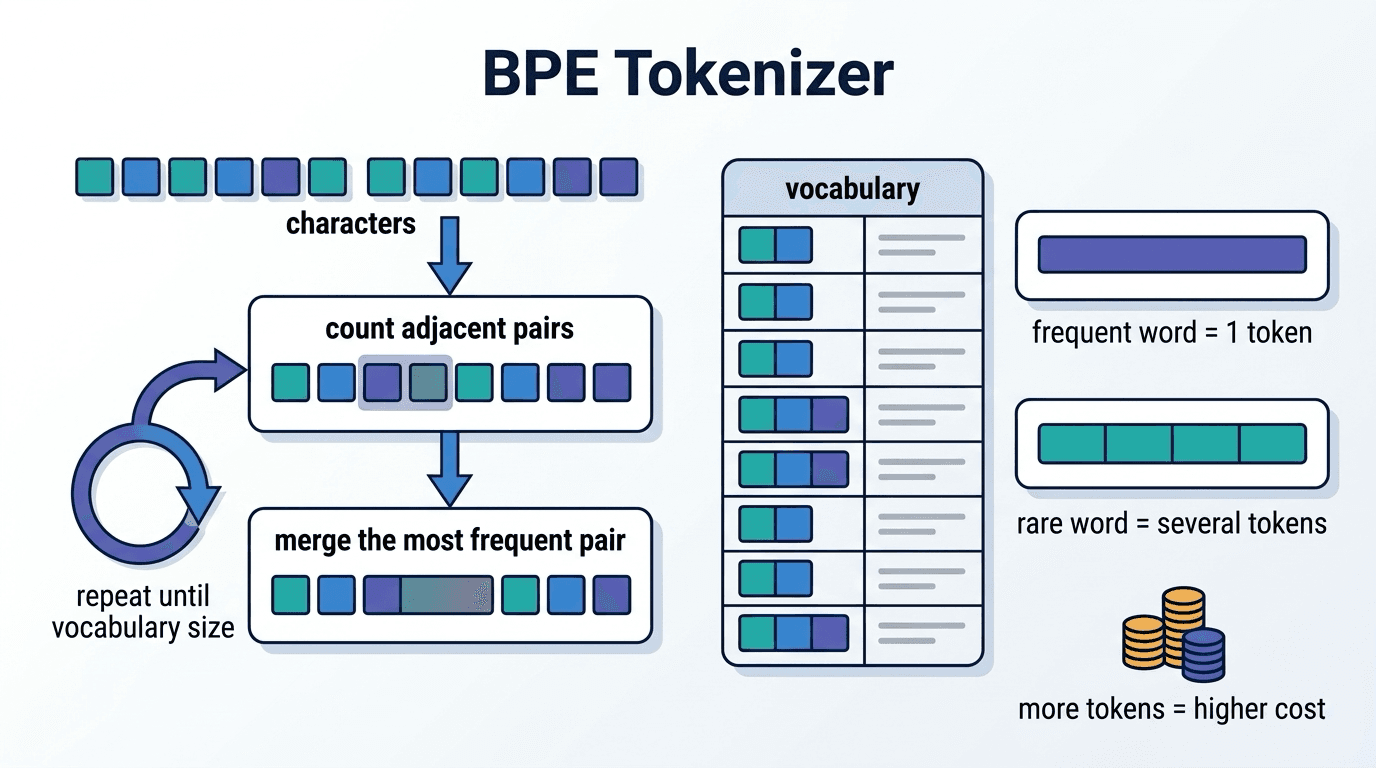
LLM API usage fees are calculated on a "pay-per-token" basis. A token is the smallest unit into which text is split by a BPE tokenizer (Byte-Pair Encoding Tokenizer); in English, one token corresponds to roughly 4 characters or 0.75 words, while in Japanese, one character tends to correspond to approximately one to two tokens.
The basic billing structure consists of the following three elements:
- Input tokens: The total of the prompt, system prompt, and conversation history
- Output tokens: The length of the text generated by the model
- Rate limits: Limits set across multiple axes such as RPM, TPM, and TPD; exceeding them returns a 429 error
It is easy to assume at first that "short output means low cost," but in practice, the accumulation of input tokens is often the primary driver of cost explosions. When conversation history and search results are packed directly into the context, a single call can reach thousands to tens of thousands of tokens, and costs multiply as the number of calls increases.
Pricing levels vary by model and provider, but for many models, the unit price of output tokens is set at several times that of input tokens. As a result, output-side costs cannot be ignored for agents that repeatedly generate long-form text. Always check the latest pricing in the official rate table of the model you are using.
The Cascade Effect of Context Window Bloat
As the number of conversation turns increases, the context window expands without bound. In many API implementations, the entire history of past messages is concatenated directly into the next request, resulting in a structure where the token count per turn accumulates with each successive turn.
The mechanism behind cascading bloat
- Turn 1: System prompt + user input = a few hundred tokens
- Turn 5: The above + full text of the past 4 exchanges = a few thousand tokens
- Turn 20: Tool call results and intermediate outputs also accumulate, potentially reaching tens of thousands of tokens
Many models have a default maximum output token limit, so passing an entire long conversation history rapidly compresses the available output space. The output limit can sometimes be adjusted via parameters, but on the input side, rate limits (such as TPM) are often set very high—and the larger the limit, the more easily unintended mass consumption occurs, a point that warrants caution.
As the context approaches its limit, the risk of hallucination also increases—where the model "loses track" of important prerequisite information.
The direct impact on costs
Both input tokens and output tokens are subject to billing. In a design that carries the full conversation history, the cost of answering the same question increases with each additional turn.
Amplification Risks Unique to Multi-Agent Systems
"Combining multiple agents should make the system smarter than any single one"—yet it is not uncommon for a multi-agent system designed with this expectation to generate unexpectedly large bills.
In a multi-agent system, token consumption does not simply equal "number of agents × per-agent consumption." Because conversation history accumulates in each agent's context window every time messages are exchanged between agents, consumption tends to grow multiplicatively.
The main pathways through which amplification occurs are as follows:
- Instruction forwarding from orchestrator to sub-agents: When a parent agent passes its entire context directly to a sub-agent, the same information piles up redundantly in the prompts of multiple agents.
- Sharing of intermediate results via A2A (Agent-to-Agent Protocol): When agents form a loop in which they mutually reference each other's intermediate outputs, the number of API calls required to complete a single task increases sharply.
- Duplicate context during parallel execution: Because multiple agents each independently hold the same system prompt and RAG search results, duplicate tokens quietly accumulate.
Platform-side limit settings also warrant caution. In cloud LLMs, rate limits are managed in units of TPM (Tokens Per Minute), and because those limits are often set very high, the increase in consumption caused by duplicate context tends to be overlooked.
Why Do AI Agents Over-Consume Tokens?

Conclusion: Excessive token consumption by AI agents stems from structural problems in their design. Three compounding factors—loops without termination conditions, the internal reasoning expansion of inference models, and context bloat caused by RAG—lead to unintended cost overruns. Each mechanism is examined in turn below.
Unbounded Consumption: Loops Without Termination Conditions
It is tempting to think, "If I let the agent handle tasks autonomously, I can just leave it alone," but in practice, failing to specify termination conditions allows loops to run indefinitely, with the risk that your bill balloons to tens of times the expected amount.
This is known as Unbounded Consumption. An AI agent autonomously repeats tool calls and LLM queries until it achieves its goal. When termination conditions are left vague at the design stage, the following chain of events occurs:
- The agent determines that it "doesn't yet have enough information" and repeatedly performs additional searches and summaries
- The output of each step accumulates as input for the next step, causing the context window to grow bloated
- As the token count increases, the cost per API call rises, and that cost multiplies with each loop iteration
A classic failure example is instructing a web research agent to "look up all competitors and produce a report." Because the termination criterion depends on the vague word "all," the agent may continue searching without end. Cloud LLM rate limits are often set very high, and the larger the limit, the harder it becomes to notice the mass consumption caused by a runaway loop, a point that warrants caution.
The three key countermeasures are as follows:
Hidden Costs of Chain-of-Thought and Reasoning Models
Chain-of-Thought (CoT) and reasoning models improve answer accuracy, but they carry an often-overlooked cost structure: the thinking process itself is billed as tokens.
In a standard prompt call, the number of input and output tokens is the basic unit of billing. In reasoning models, however, the "intermediate steps used for thinking" generate a large volume of output tokens. When asked to perform complex mathematical reasoning or multi-step planning, thinking tokens have been reported to reach several times the number of tokens in the final answer.
The appropriate model choice varies significantly depending on the nature of the task:
- For simple classification or summarization tasks: Standard models tend to be more cost-efficient than reasoning models.
- For tasks requiring complex, multi-step reasoning: The improved accuracy of reasoning models can reduce the number of retries, which may ultimately lower costs.
Particular caution is warranted when calling a reasoning model inside an agent loop. If the loop runs just 10 times, the thinking tokens per iteration are amplified and feed directly into the bill.
Token Accumulation from RAG and Embeddings
It is not uncommon for teams to notice, the moment they introduce RAG (Retrieval-Augmented Generation), that token consumption is somehow more than double what they expected.
The token cost of RAG arises from the structure of stuffing search results directly into the context window. The typical flow is as follows:
- The user's question is converted into an embedding and used to search a vector database
- The top-K chunks are concatenated into the system prompt
- The entire concatenated prompt is sent to the LLM (Large Language Model)
The problem lies in the top-K setting. With K=5 and a chunk size of 512 tokens, the search results alone consume 2,560 tokens per request. When the original system prompt and conversation history are added on top of that, the token count per request easily exceeds 5,000–8,000 tokens.
The cost of embedding generation is also easy to overlook. Running real-time embedding generation per query without restriction produces token consumption that accumulates separately from the core inference cost.
The three key points for reduction are as follows:
Prerequisites and Measurement Environment Setup Before Implementation

Before taking measures to reduce tokens, it is essential to accurately grasp "how much you are consuming right now." Cloud LLM rate limits are often set very high, and because the limits are so large, over-consumption tends to be hard to see—so establishing a measurement environment is the starting point.
Selecting and Deploying AI Observability Tools
It's easy to think "we can just review the logs later," but in practice, setting up real-time token consumption visualization tools in advance is more effective for early detection of cost explosions.
AI Observability tools automatically aggregate the number of tokens consumed, latency, and cost for each request to an LLM, and provide a mechanism for monitoring these metrics via a dashboard. The key selection criteria are as follows:
- Multi-model support: Can it measure across multiple providers?
- Agent loop tracking: Can it link multi-step reasoning and the chained calls of multi-agent systems using trace IDs?
- Alert integration: Can it send notifications to Slack or similar when token consumption exceeds a threshold?
- Automated cost conversion: Can it automatically convert token counts to monetary amounts based on pricing rates, and visualize daily and monthly cost trends?
Note that cloud LLM rate limits are often set very high, and the larger the limit, the more easily unintended mass consumption occurs—making continuous monitoring via an observability tool indispensable.
For implementation, start by integrating a tracing library into the SDK or middleware layer and attaching spans to each API call.
How to Measure Baseline Token Consumption
Baseline measurement begins with quantifying how many tokens are consumed in an "idle state" — that is, without any optimizations applied. Without this reference value, it is impossible to properly configure the alert and throttling thresholds described later.
The measurement procedure is as follows:
- Select 3 to 5 representative use cases: Target flows that occur frequently in production, such as chat responses, RAG searches, and tool calls.
- Record input tokens, output tokens, and total tokens separately: The ratio of input to output is an important metric for determining the direction of optimization.
- Calculate the average, maximum, and P95 values per request: Evaluate using percentile values to avoid being skewed by outliers.
- Graph cumulative consumption on a daily and weekly basis: The goal is to understand variation over time, not just from one-off measurements.
There is a conditional branch in the choice of measurement tools. If you are using a single-model cloud API, the shortest path is to directly log the usage field (prompt_tokens, completion_tokens) included in the API response. On the other hand, for multi-agent systems that span multiple models, routing through an AI Observability tool for centralized aggregation reduces management overhead.
If you are using a cloud LLM, it is also helpful to check the configured values of rate limits such as TPM (Tokens Per Minute) at the same time, which clarifies the premises of your measurement.
Configuring Cost Cap Alerts and Throttling
"I thought I had set up alerts, but by the time I noticed, most of the monthly budget had already been consumed" — this is a common experience in agent development. Once your measurement environment is in place, it's time to implement mechanisms that actually put the brakes on costs.
Cost cap alerts and throttling are the first line of defense against token traps. There are three main categories of settings to configure.
Concrete Steps to Reduce Token Consumption

Conclusion: Reducing token consumption is most effectively approached in a systematic three-step process: prompt compression, context optimization, and model separation.
Address the bottlenecks identified through measurement by tackling the input side, the retrieval side, and model selection — in that order. Since each step can be applied independently, you can start with the highest-priority areas first.
Step 1: Input Compression Through Prompt Engineering
The tendency to lengthen prompts under the assumption that "more detail leads to better accuracy" is common, but in practice, concise prompts with unnecessary information stripped away have frequently been reported to deliver superior results in terms of both cost and quality.
Reducing input tokens is the most immediately effective cost-saving measure. Review your prompts from the following perspectives:
- Eliminate redundant preambles: Boilerplate phrases such as "You are an excellent assistant" consume tokens without contributing to task execution. Trim system prompts down to role definitions and constraints only.
- Minimize few-shot examples: While examples are effective for improving quality, the token cost per example is easy to overlook. Avoid adding examples to tasks that can be handled zero-shot.
- Replace verbose expressions with structured formats: Passing information as JSON or bullet points is more token-efficient than lengthy prose descriptions.
- Design prompts so that only dynamic variables are swapped out: Keep the fixed portions of templated prompts short, and only vary the variables injected at runtime.
The model selection perspective is also important. Cloud LLM rate limits are often set very high, and the higher a model's limits, the more thoroughly you must compress prompts to avoid unintended mass consumption.
Step 2: Optimizing Chunk Size and Context Engineering
In a RAG pipeline, chunk size configuration directly affects token consumption. Chunks that are too large pass unnecessary context to the LLM, while chunks that are too small fragment meaning and degrade retrieval accuracy — resolving this trade-off is at the heart of context engineering.
The criteria for determining chunk size vary depending on the nature of the task. Small chunks are suitable for fact-lookup queries (FAQ, specification document search, etc.), allowing only the necessary portions to be extracted and limiting what flows into the context window. Large chunks, on the other hand, are better suited for tasks requiring document summarization or long-form reasoning, but balance is maintained by limiting the number of retrieved results accordingly.
From a context engineering perspective, it is important to apply relevance score thresholding rather than simply concatenating and passing retrieved chunks as-is. There are reported cases where filtering out chunks whose similarity scores fall below a threshold significantly reduces input tokens per request.
If the design of retrieved chunks is sloppy, it directly inflates the input token volume. Because cloud LLMs often have very high rate limits, you must control input volume on the chunk strategy side rather than relying on those limits.
System prompt bloat is also an often-overlooked cost factor.
Step 3: Fine-Tuning and Task Offloading to SLMs
"Does this task really need to be sent to a large LLM every time?" — the moment you feel that in practice is exactly the signal to reconsider your task separation.
General-purpose LLMs can answer any question, but they also consume large context windows even for simple routing or classification tasks. An effective approach here is to offload specific tasks to fine-tuned SLMs (Small Language Models).
The criterion for separation is the "degree of task standardization."
- Highly standardized tasks (sentiment classification, category assignment, short-text extraction) → Delegate to an SLM or fine-tuned model
- Moderately complex reasoning tasks (summarization, translation, structured extraction) → Often handleable by a lightweight model
- Complex reasoning and creative tasks (multi-step planning, code generation) → Retain a large-scale LLM
When selecting a model, you should pay attention not only to the per-token price but also to the maximum output token setting. Many models have a default maximum output token limit, so within an agent loop it is important to understand each model's limit and set explicit constraints.
Structurally Preventing Traps with AI Guardrails and Architecture Design

Conclusion: Individual configuration changes alone have their limits — a design that constrains token consumption at the architecture level is essential.
By combining AI guardrails with orchestration design, token traps can be structurally contained. This section explains concrete implementation approaches across three layers: budget management, injection countermeasures, and HITL (Human-in-the-Loop).
Token Budget Management at the Agent Orchestration Layer
The agent orchestration layer is the sole control point capable of centrally managing token consumption across an entire system in which multiple sub-agents collaborate.
It is tempting to assume that "each sub-agent can autonomously adjust its own costs," but in practice it is more effective to manage budgets centrally at the orchestrator level. Because sub-agents cannot get a bird's-eye view of their own consumption, distributed management tends to make it difficult to prevent limit overruns.
The key measures to implement at the orchestration layer are as follows:
- Pre-allocation of token budgets: Set token limits for each node in the task graph before execution. If the remaining budget falls below a threshold, cut off the subtask or switch to an SLM (Small Language Model).
- Real-time tracking of cumulative consumption: Aggregate the usage fields included in API responses so that the orchestrator continuously maintains consumption figures per session and per agent.
- Throttling and priority control: Allocate budget preferentially to high-priority tasks, and handle low-priority tasks via queuing or thinning.
Cloud LLM rate limits are often set very high, so control that relies on those limits tends not to work well. It is effective to embed fallback logic within the orchestrator that automatically switches to a lightweight model once a certain token consumption rate is reached.
The Relationship Between Prompt Injection Countermeasures and Token Consumption
Prompt Injection is not only a security risk — it is also a hidden factor that can cause token consumption to spike sharply.
When an attacker embeds malicious instructions in external data, the agent attempts to process those instructions as legitimate tasks. This results in additional reasoning, tool calls, and re-confirmation loops that would not otherwise be necessary, causing token consumption to balloon. The higher the rate limits in an environment, the harder it becomes to notice the unintended mass consumption caused by injection attacks, a point that warrants caution.
The choice of countermeasure depends on the situation. When handling external data sources (web retrieval, user input, databases), prioritize a Prompt Firewall and input sanitization; in closed environments that handle only internal data, structuring the System Prompt and narrowing the permission scope are effective approaches.
Specific countermeasures that are effective include the following:
Placing Humans in the Loop to Suppress Excessive Agency
"I left it to the agent, and before I knew it, it had called unintended APIs dozens of times" — this is a classic example of Excessive Agency. Unless you constrain the scope within which an agent can make autonomous decisions, token consumption will expand without limit.
HITL (Human-in-the-Loop) is a design approach that establishes checkpoints where humans can review and approve agent actions. In the context of token traps, it functions as a "gate" that prevents the agent from proceeding to the next step without approval.
Key gate points to implement
- Before high-cost actions: Immediately before processes that consume large numbers of tokens in a single operation, such as external API calls, bulk data retrieval, or long-form generation
- Loop continuation decisions: Requiring human approval before an agent autonomously decides to "retry" or "investigate further"
- Upon reaching budget thresholds: Pausing when a session's token consumption reaches 80% of the configured limit, and confirming whether to continue
It is practical to design approval flows asynchronously. By combining notifications to Slack or Teams with approval buttons, you can maintain gates while minimizing human wait time.
Common Failure Patterns and How to Address Them

The typical cases of falling into token traps can be broadly grouped into two categories: "cannot observe" and "cannot stop." Cloud LLM rate limits are often set very high, and because the limits are so large, unintended mass consumption tends to occur easily—a point that also warrants caution. Let's take a look at each failure pattern and the countermeasures available.
Cases Where Cost Spikes Go Unnoticed Due to Lack of Logging
It's easy to think "checking the bill monthly is sufficient," but in reality, without real-time token consumption logs, anomaly detection ends up delayed by weeks. By the time you first notice the problem when reviewing the invoice at the end of the month, the damage has already been done.
The typical failure patterns caused by the absence of logs can be organized into three:
- No aggregation by model or endpoint: It becomes impossible to identify which agent is consuming tokens, causing root cause analysis to take extra time.
- Input and output tokens not distinguished: Many models charge more per token for output than input, so failing to notice an increase in output volume can lead to growing losses.
- Missing retry logs on errors: When automatic retries are triggered by timeouts or API errors, token consumption for the same task can double without anyone noticing.
In addition, while many models have a default maximum output token limit, the input side often has very high rate limits (such as TPM), and the larger the limit, the more easily unintended mass consumption occurs. Without real-time logs, you cannot notice such anomalies.
What these cases have in common is a design decision that treated log collection as a "feature to add later" and deprioritized it.
Cases Where Recursive Call Loops Multiplied Billing Costs Tenfold
When recursive calls are implemented with vague termination conditions, there are reported cases where billing amounts balloon to tens of times the original within a short period.
The typical pattern is as follows:
- Every time an agent determines a "task is incomplete," it calls itself again
- Each call carries over the entire output of the previous turn as context
- As the context window accumulates, the number of tokens per call increases sharply
Cloud LLM rate limits are often set very high, and the larger the limit, the more easily unintended mass consumption occurs. When error handling is insufficient, a classic example is an agent that misinterprets an external API timeout as a "task failure" and keeps sending the same request repeatedly. With just 10 loop iterations, token consumption can reach tens of times the initial amount due to context accumulation.
The appropriate response depends on the situation. When the number of loop iterations is predictable, hardcoding a maximum iteration count (max_iterations) is the most reliable approach. On the other hand, for dynamic tasks where the number of iterations is indeterminate, the appropriate design is to force termination when the cumulative token count exceeds a threshold and hand off to HITL (Human-in-the-Loop).
The following summarizes effective measures for preventing recurrence.
Author & Supervisor

Yusuke Ishihara
Started programming at age 13 with MSX. After graduating from Musashi University, worked on large-scale system development including airline core systems and Japan's first Windows server hosting/VPS infrastructure. Co-founded Site Engine Inc. in 2008. Founded Unimon Inc. in 2010 and Enison Inc. in 2025, leading development of business systems, NLP, and platform solutions. Currently focuses on product development and AI/DX initiatives leveraging generative AI and large language models (LLMs).
Recommended Articles