What is Inference-Time Scaling? How to Optimize the Trade-off Between AI Inference Cost and Accuracy

Lead
Test-Time Compute (inference-time scaling) is a collective term for techniques that deliberately increase computation during the phase when an LLM generates its response, thereby improving reasoning accuracy. In contrast to the conventional scaling laws that invest large amounts of data and computation at training time, the idea of extending performance through additional computation at inference time has spread rapidly alongside the emergence of reasoning models.
This article is aimed at developers, PdMs, and executives who leverage LLMs in B2B contexts. It systematically covers the foundational concepts of inference-time scaling, key techniques, how to incorporate them into enterprise AI, cost-accuracy tradeoff design, and common pitfalls. By the end, readers will have a solid basis for deciding whether—and to what extent—to apply inference-time scaling to their own use cases.
Inference-time scaling is an approach that "increases thinking time" rather than "increases training." Specifically, it refers to a set of techniques that improve answer quality by increasing inference computation through step-by-step reasoning, multiple sampling passes, and exploratory comparison of candidate solutions.
This section organizes the definition, the differences from training-time scaling, and the background behind the emergence of reasoning models. Understanding the distinction between the two makes it clear why this way of thinking is necessary for designing enterprise AI.
Definition and Differences from Training-Time Scaling
Inference-time scaling is a collective term for techniques that improve model performance by increasing the amount of computation at the inference stage—namely, the number of tokens generated, the number of sampling passes, and the search depth. Techniques such as Chain-of-Thought (CoT), Self-consistency, Best-of-N, Tree-of-Thoughts, and Reflection fall within this framework.
Pre-training Scaling, which was the mainstream approach in conventional LLM development, is based on the Scaling Law: increasing the number of parameters, the volume of training data, and the training compute leads to better performance. However, large-scale training is prone to constraints in cost, data, and power consumption, and a flattening of the performance curve has been noted.
| Dimension | Training-Time Scaling | Inference-Time Scaling |
|---|---|---|
| When costs are incurred | Concentrated at training time | Incurred per inference |
| Bottleneck | Data and compute resources | Latency and inference cost |
| What is improved | Foundational model capabilities | Output quality at the task level |
| Flexibility of application | Requires retraining | Can be applied to existing models |
The two are not opposing concepts but complementary ones. Even when using the same base model, practical accuracy can vary significantly depending on how much computation is invested at inference time.
→ Related: LLM Cost Optimization Guide, How to Choose Between Fine-Tuning and RAG
Background Behind the Emergence of Reasoning Models
Inference-time scaling began attracting serious attention when OpenAI's line of reasoning models, DeepSeek's reasoning-enhanced models, Google's reasoning models, and others adopted architectures that consume a large number of tokens for their internal thought processes. These models internally generate a long sequence of tokens for "thinking" before producing a final answer.
The impact on the industry has been significant, and debate has emerged in two directions.
The first is a shift in inference cost structure. Against a cost design that previously assumed "calling lightweight models many times," reasoning models involve an order-of-magnitude greater amount of computation per request. Cost estimates now need to be redesigned to include not just the per-token price for input and output, but also the pricing for internal reasoning tokens—which many providers charge at a separate rate.
The second is a shift in evaluation criteria. Beyond "is it fast / is it cheap," the ability to correctly handle difficult problems has become a differentiating factor for enterprise AI, and applications are expanding into areas that were previously difficult for LLMs alone—such as competitive analysis, contract review, and handling complex inquiries.
What I have been sensing firsthand in recent B2B engagements is that the expectation that "using reasoning models will solve everything" and the anxiety that "inference costs are unpredictable and we can't ship to production" are both intensifying simultaneously. The tradeoff design covered in the latter half of this article is a framework for settling on an implementation policy between these two poles.
Why Does Inference-Time Scaling Matter Now?

While the Scaling Law on the training side is said to be approaching its ceiling, the inference side still has significant room to grow. Furthermore, as enterprise AI use cases expand from "templated responses" to "processing that involves judgment," accuracy requirements have risen by a notch. These two factors have elevated inference-time scaling into a practical topic.
This section organizes the limitations of training-time scaling, the trend toward inference cost optimization, and the typical scenarios in enterprise AI where accuracy requirements rise to the next level.
Limits of Training Scaling and the Shift Toward Inference Cost Optimization
LLM development around 2020 proceeded under the simple premise that "more parameters and more training data means smarter models." However, as the development costs of frontier models reached the hundreds of billions of yen scale, multiple studies have reported diminishing returns on performance relative to additional investment.
The approach attracting attention as an alternative is shifting computation to the inference side. Specifically, this includes techniques such as:
- Solving the same problem multiple times via different paths and selecting the answer by majority vote
- Having a separate LLM call critique and revise a previously generated answer
- Using search algorithms to compare multiple reasoning branches
These methods require no additional training and can be applied to existing models. As gains on the training side slow down, the room for differentiation in enterprise AI has shifted toward how inference is engineered.
In parallel, providers are developing pricing structures tailored to reasoning models, and billing that counts "internal thinking tokens" in addition to input/output tokens is becoming more widespread. It is fair to say that the main battleground for cost optimization has moved from training investment to inference workflow design.
→ Related: Context Engineering, Hybrid LLM × SLM Routing
Scenarios Where Accuracy Demands Are Rising in Enterprise AI
Inference-time scaling is especially effective for problems where "a single pass is not enough to determine the answer." Some concrete examples:
- Legal and contract review: Checking consistency between clauses, extracting risk provisions. Single-pass generation tends to miss things.
- Code review and vulnerability detection: Multiple perspectives (security / readability / performance) must be examined in parallel and conclusions compared.
- Decision support for data analysis: Requires a loop of hypothesis formulation → refutation → re-verification.
- Multi-step research: Investigating through multiple paths while varying assumptions, then integrating conclusions.
- Agent planning: Selecting the optimal path from among multiple tool-call sequences.
At a B2B product development site I supported, when a single LLM pass was used for preliminary review of contracts, the detection rate for risk provisions hit a ceiling. Switching to a configuration that enabled internal reasoning on the same model and additionally sampled multiple outputs in parallel for cross-comparison resulted in a noticeable reduction in missed detections. On the other hand, latency increased several-fold and per-document costs rose, so the use of this approach was narrowed to "critical contracts only."
When the need arises to improve accuracy in enterprise AI, the instinct to first increase training data is natural—but it is worth keeping in mind that there is often significant room to solve the problem through inference-side engineering.
Key Techniques in Inference-Time Scaling

Inference-time scaling broadly falls into three categories: internal scaling, parallel scaling, and search-based scaling. Because the way computational costs grow and the tasks each method suits differ, selecting the right approach for your use case is essential.
Below, we organize the three representative categories by mechanism, suitable tasks, and cost profile.
Internal Scaling (CoT & Reflection)
Internal scaling is an approach that lets the model think longer within a single request. Representative examples are as follows:
- Chain-of-Thought (CoT): Prompting the model to "think step by step," generating the reasoning process before producing a conclusion.
- Reflection / Self-correction: Having the model review a previously generated answer and check for errors, then revise it.
- Internal reasoning in reasoning models: Major providers' reasoning models think deeply using internal tokens invisible to the user before delivering a response.
An intuitive way to picture the mechanism is "having the model write a draft before writing the final version." It has long been known that simply adding CoT significantly improves accuracy on arithmetic and logical reasoning tasks; reasoning models can be seen as having this built into their architecture.
| Item | Characteristics of Internal Scaling |
|---|---|
| Suitable tasks | Arithmetic, logic, coding, step-by-step judgment |
| Cost driver | Increase in output token count (including thinking tokens) |
| Implementation difficulty | Low (addressable via prompt or model selection) |
| Latency impact | Medium to high (proportional to output length) |
For simple question-answering, the effect is limited and can result in wasted cost. The basic principle is to restrict its use to tasks that require logical steps.
Parallel Scaling (Self-Consistency & Best-of-N)
Parallel scaling is an approach where the model is asked to answer the same problem multiple times independently, and the results are then aggregated.
- Self-consistency: Generating diverse answers by raising the temperature parameter, then adopting the most frequently occurring conclusion as the final answer.
- Best-of-N: Generating N answers and selecting the best one using an evaluator model or scoring function.
- Majority voting: Deciding the conclusion by majority vote. Particularly effective for arithmetic and classification tasks.
| Item | Characteristics of Parallel Scaling |
|---|---|
| Suitable tasks | Arithmetic, classification, extraction, coding |
| Cost driver | Proportional to the number of calls N |
| Implementation difficulty | Medium (requires parallel execution and aggregation logic) |
| Latency impact | Equivalent to a single call when executed in parallel |
In practice, 3–5 parallel samples often yield sufficient improvement, and accuracy gains saturate as the degree of parallelism continues to increase. As a prerequisite for parallel execution, it is also necessary to verify the model API's concurrent execution limits (Rate Limit / Concurrency Limit).
→ Related: AI Output Evaluation with LLM-as-a-Judge
Search Scaling (Tree-of-Thoughts & MCTS)
Search scaling is an approach that expands answer candidates in a tree structure and drills down into promising branches while evaluating them.
- Tree-of-Thoughts (ToT): Expands the reasoning process in a tree structure, evaluating each node and selecting promising branches
- MCTS (Monte Carlo Tree Search): Applies the search algorithm used in game AI to reasoning as well. Repeats simulation and evaluation
- Beam Search Extension: Retains the top-k candidates at each step and selects the best path at the end
| Item | Characteristics of Search Scaling |
|---|---|
| Suitable Tasks | Planning, puzzles, complex decision-making |
| Cost Incurrence | Proportional to number of search nodes (beware of exponential growth) |
| Implementation Difficulty | High (requires building a search framework) |
| Latency Impact | High |
Because implementation costs are high and operations tend to become complex, everyday use in enterprise AI is still uncommon. The practical approach is to limit adoption to only those difficult problems that other methods cannot solve.
→ Related: Multi-Agent AI
How to Apply Inference-Time Scaling in Enterprise AI and Trade-off Design

Inference-time scaling is not something that simply improves results whenever applied—it requires design decisions that account for task difficulty, acceptable latency, and cost constraints. Aligning evaluation metrics and an operational vision before adoption is the key to moving a PoC into production.
This section organizes method selection by task difficulty, trade-off design, and how to define PoC evaluation metrics.
Technique Selection by Task Difficulty
Dividing task difficulty into three levels makes it easier to identify the appropriate method.
| Task Difficulty | Examples | Recommended Approach |
|---|---|---|
| Low | FAQ responses, classification, summarization | No scaling / lightweight CoT |
| Mid | Extraction, initial contract review, code generation | CoT + Best-of-N (3–5) |
| High | Planning, complex analysis, research tasks | Reasoning model + parallel + verification loop |
Applying high-cost methods to low-difficulty tasks is wasteful and also degrades latency. Conversely, using minimal single-pass generation for high-difficulty tasks turns incorrect answers into operational risk.
As a rule of thumb, ask: "Could a human expert answer this in one minute?" If yes, inference-time scaling is unnecessary; if five or more minutes of deliberation would be needed, a reasoning model or parallel scaling is likely to help.
Within agentic workflows, a common design pattern is to classify task types upfront and route them to different reasoning paths based on difficulty.
→ Related: AI Agent ROI Measurement Guide
Trade-offs Among Cost, Latency, and Accuracy
Inference-time scaling is a design that trades cost and latency for accuracy. The balance across three axes must be determined deliberately.
| Axis | Factors That Increase It | Mitigation Strategies |
|---|---|---|
| Cost | Thinking tokens, number of parallel calls | Narrowing applicable tasks, switching to lighter models |
| Latency | Output length, degree of parallelism, search depth | Parallel execution, streaming, asynchronization |
| Accuracy | Insufficient scaling | Combining methods, downstream verification with an evaluation model |
A common real-world pitfall is: "Accuracy improved, but latency exceeded acceptable limits and UX broke down." In scenarios like call center responses where waiting more than a few seconds is unacceptable, internal reasoning in a reasoning model or high-parallelism sampling is not practical.
As alternatives, design patterns such as processing only critical requests asynchronously and returning results via email or dashboard, or having a lightweight model assess request difficulty upfront and routing only high-difficulty requests to the reasoning model, are effective. In our own B2B engagements, we have seen cases where switching from a design that routes all requests through a reasoning model to one where "only requests flagged as necessary by a classifier go to the reasoning model" significantly reduced monthly costs while maintaining high accuracy in the areas that mattered.
→ Related: LLM Cost Optimization Guide
How to Define PoC Evaluation Metrics
To bring a PoC to a state where a production decision can be made, it is important to design evaluations that let inference-time scaling be discussed in concrete numbers. At a minimum, align on the following four axes.
- Task Accuracy: A success rate that is meaningful from a business perspective (e.g., F1 for extraction tasks, answer correctness rate, miss rate for review findings)
- Cost per Request: Measure the actual inference cost per request (input/output + thinking tokens + parallel overhead)
- P50 / P95 Latency: Percentiles, not averages. Determine how well the system holds up against the operational SLA
- Failure Mode Distribution: What types of failures remain (mis-extraction, hallucination, overconfidence). Determine whether downstream guardrails can address them
The baseline is single-pass generation without inference-time scaling. Design the evaluation so that the delta—"X% accuracy improvement / Y× cost increase"—can be compared directly.
Prepare a minimum of 100 evaluation samples, ideally 500 or more. It is advisable to use stratified sampling from existing operational logs to avoid skew in difficulty, category, and edge-case patterns.
→ Related: AI Observability, LLM-as-a-Judge Evaluation Guide
Common Misconceptions and Implementation Pitfalls

"More compute always means better accuracy." "Bolt it onto an existing LLM app and it will raise the floor." — The excitement around inference-time scaling is mixed with misconceptions that tend to cause real pain in production deployments.
Here we examine two misconceptions commonly encountered in the field and outline how to avoid them.
"More Computation Means Higher Accuracy" Is Conditional
With inference-time scaling, the accuracy gains vary significantly depending on the combination of task and technique. The intuition that "the relationship between compute and accuracy is roughly monotonically increasing" only holds under limited conditions.
The following trends have emerged from research reports and community evaluations:
- Math, coding, and formal logic: Show marked improvement with scaling
- Open-ended dialogue and creative tasks: Accuracy can plateau or even degrade
- Fact-based question answering: Information the model doesn't know cannot be conjured by adding more compute (and hallucinations may actually increase)
In the context of hallucination mitigation in particular, relying on inference-time scaling alone is a risky approach. Without combining it with RAG to supply prerequisite knowledge and guardrails that require cited answers, the tendency to "be confidently wrong" can intensify.
If investment decisions proceed on the assumption that "more compute means better accuracy," the cost of retreating when you hit a ceiling after implementation becomes substantial. Empirically measuring the saturation point during the PoC stage is the most reliable way to avoid over-investment.
→ Related: RAG Implementation Failure Patterns
Naively Adding to Existing LLM Apps Can Backfire
Retrofitting inference-time scaling into an already-live LLM application tends to produce unexpected side effects. Here are some of the most common pitfalls:
- Latency SLA violations: In chat UIs, the addition of thinking tokens can delay responses by several seconds, increasing user drop-off
- Cost structure collapse: Monthly cost projections go off the rails — it's not uncommon to only notice when the invoice arrives
- Prompt compatibility breakage: Existing prompts are not optimized for reasoning models, causing output formatting to break down
- Test asset degradation: Automated tests built around single-pass generation start failing
In a project I was involved in, we retrofitted a reasoning model into a code review assistance tool, which caused CI times to balloon significantly and drew complaints from the development team. We ultimately settled on a configuration that limited reasoning model usage to "security-related changes only," leaving everything else on the original model.
When rolling out, the golden rule is to validate in a small segment first — specific users or specific task types — before expanding to all requests. Put feature flags or a routing layer in place so you can roll back instantly.
→ Related: AI Guardrails Implementation Guide
Key Points for Monitoring and Continuous Improvement in Production

Once inference-time scaling is in production, you need to continuously observe cost, latency, and accuracy across all three axes and run a cycle of tuning your operational knobs. It's not a one-time design exercise.
Here are the key points to keep in mind for production operations.
1. Minimum Observability Requirements
- Log input/output tokens, thinking tokens, and parallelism per request
- Monitor P50 / P95 / P99 latency as a time series and visualize the conditions under which outliers occur
- Continuously measure accuracy metrics by task category — combine sampled human review with LLM-as-a-Judge
2. Alert Design
- Detect immediately when costs exceed the expected unit price by 1.5–2×
- Monitor reasoning model failures and latency degradation (provider-side) on a separate channel
- Detect sudden spikes in output format violation rates (JSON failures, structural breakdowns)
3. Operational Knob Design
At the design stage, preserve parameters that can be tuned during operation without writing code. Specifically:
- Parallel sampling count (
N) - Reasoning model usage rate (routing that can be toggled A/B-test style)
- Task difficulty classification threshold
- Fallback model for when the reasoning model is degraded
Making these adjustable via configuration files or an admin interface allows you to respond quickly during incidents or cost overruns.
4. Improvement Cycle
On a monthly or quarterly basis, revisit the following while refreshing your evaluation data:
- Scaling strategy review (increase parallelism or switch models?)
- Addition or removal of applicable tasks
- Base model update handling (replacement decisions when new models appear)
Reasoning models and parallel techniques are an area where the technology landscape moves fast. Building an operational rhythm of reviewing the latest developments every three months makes it harder for competitors to leave you behind.
→ Related: AI Observability, AI Agent ROI Measurement Guide
Summary: Using Inference-Time Scaling Techniques Appropriately

Inference-time scaling is a family of techniques for recovering on the inference side the performance gains that have stalled on the training side. The key is not "use it and things will always improve," but rather a design judgment — made per use case — that keeps an eye on the triangle of task difficulty, cost, and latency.
The key takeaways from this article are as follows:
- Inference-time scaling falls into three families: internal, parallel, and search. Choose based on the task and acceptable latency
- The slowdown of training-side Scaling Laws and the emergence of reasoning models have shifted value toward investment in the inference side
- In PoC, it is essential to design for quantitative comparison of accuracy, cost, and latency as deltas against a baseline
- "More compute means better accuracy" is conditional — identify the saturation point and the tasks it actually fits
- Retrofitting into existing LLM apps is prone to side effects — validate in a small segment first
- In production, build observation, alerting, operational knobs, and an improvement cycle into the design itself
Inference-time scaling is a powerful tool that can serve as the catalyst for rethinking the cost and accuracy design of enterprise AI. Through our B2B AI development support, we have accumulated expertise designing optimal inference workflows for individual use cases, and we accompany clients from PoC design through to production operations. If you need help with adoption decisions or design reviews, please also refer to our AI consulting services.
Author & Supervisor

Yusuke Ishihara
Started programming at age 13 with MSX. After graduating from Musashi University, worked on large-scale system development including airline core systems and Japan's first Windows server hosting/VPS infrastructure. Co-founded Site Engine Inc. in 2008. Founded Unimon Inc. in 2010 and Enison Inc. in 2025, leading development of business systems, NLP, and platform solutions. Currently focuses on product development and AI/DX initiatives leveraging generative AI and large language models (LLMs).
Recommended Articles


Terms related to this article

Inference-time Scaling (Test-time Compute)
Inference-time scaling is a technique that dynamically increases or decreases the amount of computat
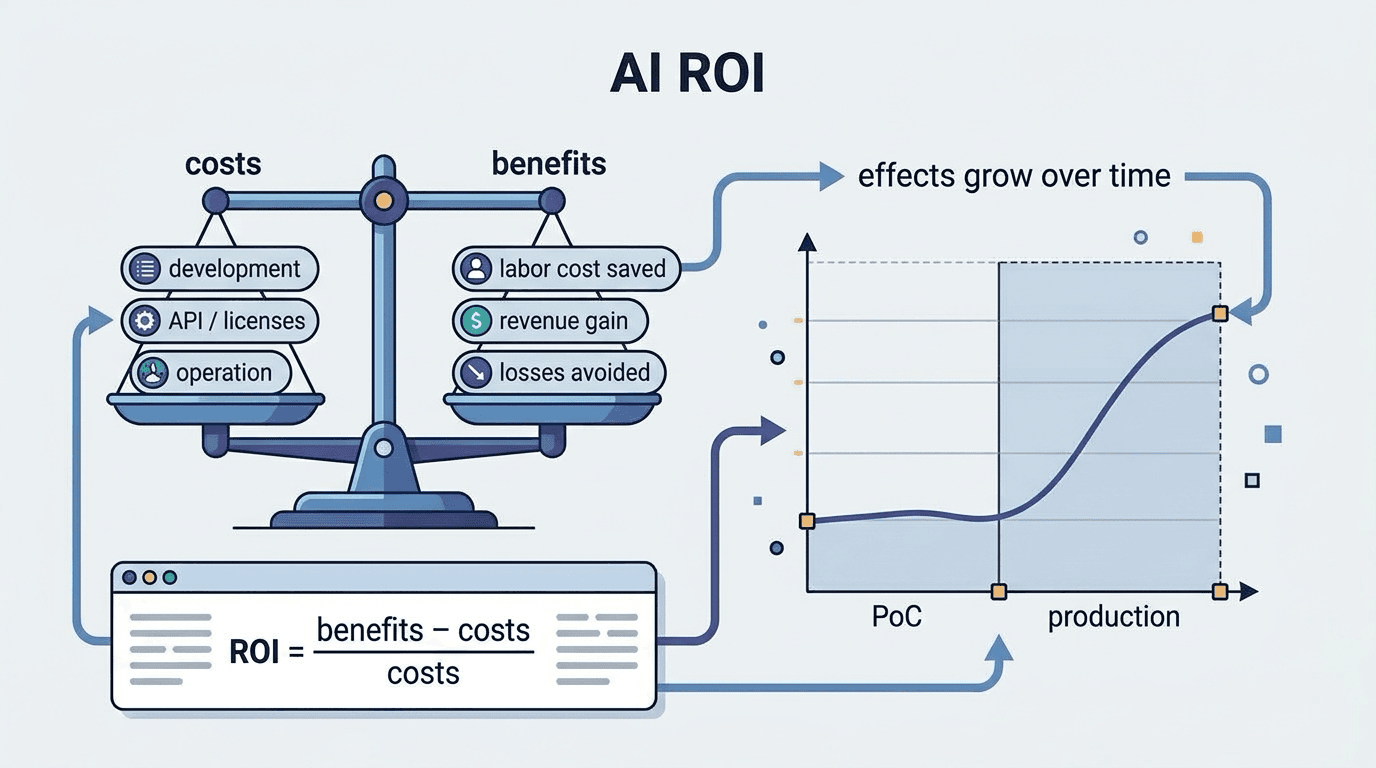
AI ROI (Return on Investment in AI)
AI ROI is a metric that quantitatively measures the effects obtained — such as operational efficienc
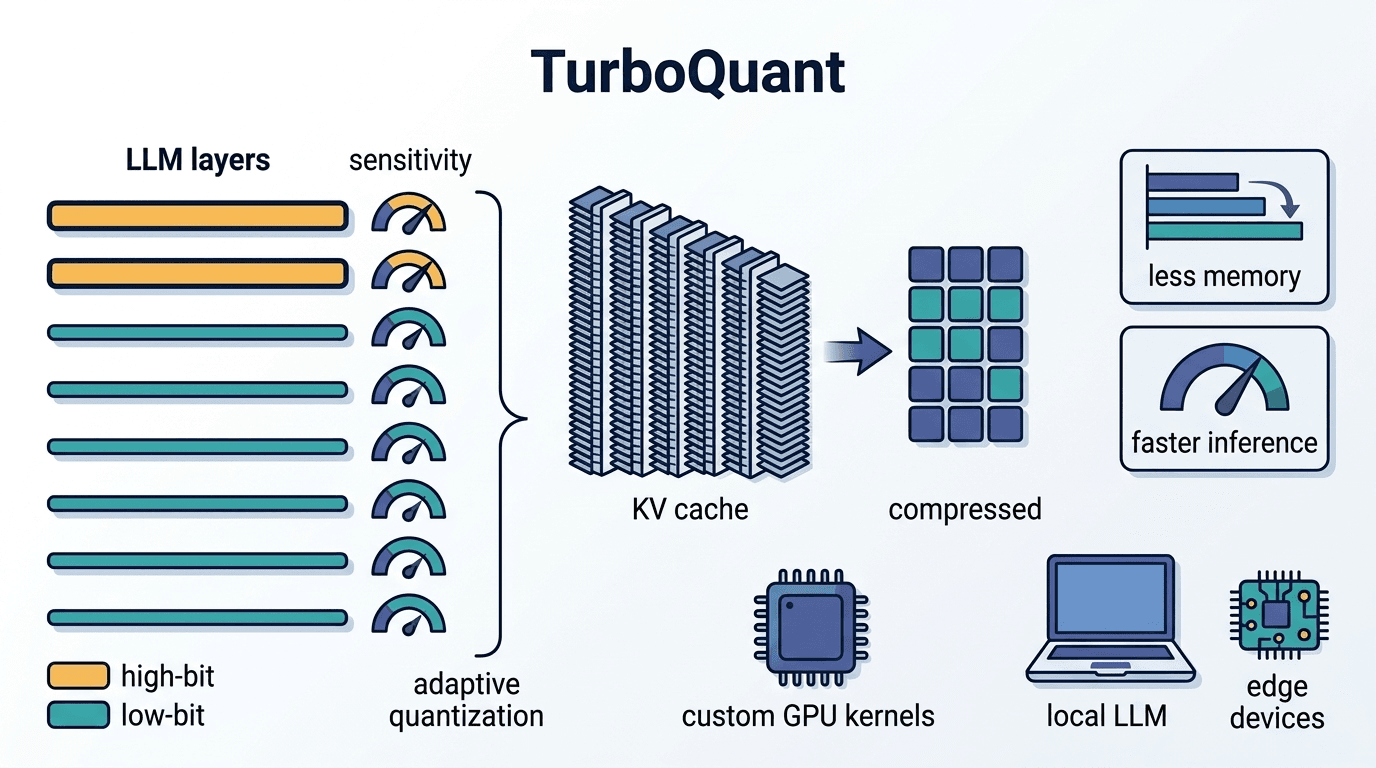
TurboQuant
A memory compression technology for LLMs developed by Google. It reduces memory consumption by up to