How Thailand's Hotel and Travel Industry Can Start Dynamic Pricing with AI

Lead
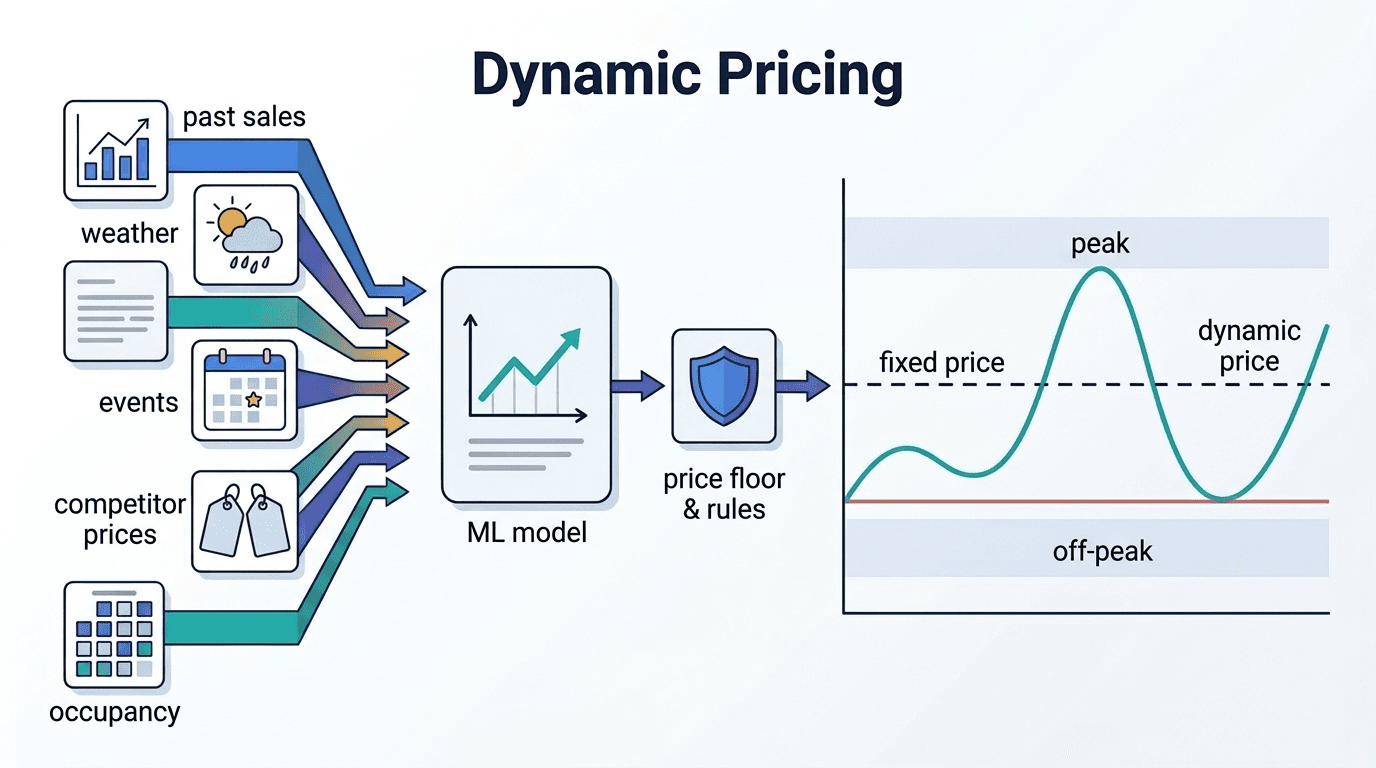
Dynamic pricing is a mechanism that automatically adjusts prices in real time based on demand, competition, and market conditions. While it has long been used in the airline, hotel, and travel industries, the spread of AI is making it increasingly accessible to small and mid-sized operators as well.
Thailand's tourism industry is characterized by three distinct climate seasons—cool season, hot season, and rainy season—as indicated by the Tourism Authority of Thailand (TAT), with November through February generally considered the peak demand period. However, peaks can shift depending on region, customer segment, and destination; for example, demand at southern beach resorts and for MICE events in urban areas tends to remain strong through March and April. Fixed pricing makes it difficult to respond to these demand fluctuations, leading to missed revenue opportunities. Additionally, commission fees charged by major OTAs are generally around 15–30% (a reference figure at the time of writing; please check each OTA's official page for the latest contract terms), and the burden these fees place on profits is a common challenge across the industry.
This article is intended for hotel and travel industry staff and managers, and provides a step-by-step guide to implementing AI—from data collection and demand forecasting model development to the automation of pricing rules. By the end, readers should have a clear picture of the first steps best suited to their organization's size and budget.
Thailand's tourism market has a structure in which demand fluctuates significantly due to seasons, holidays, and international events, making it easy to miss revenue opportunities when prices remain fixed. While November through February is generally considered the peak demand period, discrepancies arise depending on region, customer segment, and destination, meaning uniform pricing tends to lead to missed opportunities. OTA commissions are generally around 15–30%, and the higher the dependency, the more likely profits are to be squeezed. Against this backdrop, interest in AI-powered dynamic pricing and revenue management is growing.
Magnitude of Demand Fluctuations Due to Seasons and Events
Tourism demand in Thailand tends to fluctuate significantly depending on the season, public holidays, and international events. The Tourism Authority of Thailand (TAT) categorizes the country's climate into three zones—the rainy season, cool season, and hot season—and this climate cycle forms the backbone of travel demand.
The main factors that tend to drive higher demand are as follows:
- Cool Season (roughly November–February): Long-stay visitors from Western countries tend to concentrate in Bangkok, Phuket, and Chiang Mai. However, demand for southern beach resorts and urban events tends to remain strong through March and April, meaning peak periods vary by region and traveler segment.
- Songkran (public holiday, April 13–15): Domestic travelers move all at once, and bookings often fill up within a short period. There are also cases where the government increases airline seat capacity in anticipation of the demand surge.
- MICE (international conferences and exhibitions): In Bangkok, which TCEB promotes as a key MICE destination, hotel demand can shift sharply around the dates of convention events.
On the other hand, demand tends to weaken during the rainy season (roughly May–October), and depending on the region, significant seasonal gaps can emerge in both occupancy rates and ADR (Average Daily Rate). According to tourism statistics published by the Bank of Thailand, the national average hotel occupancy rate fluctuates by as much as several tens of percentage points from month to month, with a difference of more than 20 percentage points observed between September and December even in Chiang Mai in the north.
The greater this seasonal disparity, the more likely a fixed pricing strategy will result in either a price collapse during the off-season or missed revenue opportunities during peak periods. AI-driven dynamic pricing is attracting attention as an approach that reads these waves of demand in real time and adjusts prices at the right moment.
Breaking Free from OTA Dependence and Improving RevPAR
Dependence on OTAs is widely recognized as a profitability issue in hotel management. Commission rates charged by major OTAs are generally around 15–30% (see industry sources such as Cloudbeds), varying further depending on the hotel's size and contract terms. When this burden coincides with low room rates during off-peak periods, the margin for revenue improvement tends to narrow considerably.
One of the goals of implementing AI-powered revenue management is to strengthen direct booking channels and gradually reduce dependence on OTAs. However, the relationship between "strengthening direct sales and reducing commissions" is not straightforward—it presupposes a combination of traffic acquisition strategies for the hotel's own website and a loyalty program.
RevPAR (Revenue Per Available Room) is a metric that multiplies both occupancy rate and average room rate together, making it difficult to improve by focusing on either factor alone. The main reasons why AI price optimization is said to contribute to RevPAR improvement are as follows:
- Demand-driven pricing: Present appropriate rates during high-demand periods to minimize opportunity loss
- Occupancy-first approach during low-demand periods: Use data to determine the timing and extent of price reductions, preventing rate erosion
- Automated competitor benchmarking: Monitor nearby hotels' rates in real time to avoid excessive price competition
It should be noted that OTA contracts may include rate parity clauses, and diverging prices between a hotel's own website and OTAs could potentially violate contract terms. It is essential to review the contract details with each OTA before implementation.
The essence of improving RevPAR is not simply raising prices. It lies in a continuous process of optimizing "when, at what price, and through which channel" by combining demand, competitive, and inventory conditions.
Steps to Implement Dynamic Pricing with AI

By following the three steps of data collection, demand forecasting, and automatic adjustment in sequence, AI-driven dynamic pricing becomes easier to implement incrementally. Rather than trying to build everything at once, an approach that starts small and gradually improves accuracy is often considered effective from the perspective of embedding the system into day-to-day operations. The following sections explain how to proceed with each step in concrete terms.
Step 1: Collecting Historical Reservation Data and External Data
The accuracy of dynamic pricing is directly linked to the quality of input data. Organizing both internal and external data serves as the starting point.
Internal Data to Collect
- Reservation history from the past 2–3 years (check-in date, length of stay, room type, selling rate)
- Trends in cancellation rates and no-show rates
- Reservation share and lead time by channel (OTA, direct website, phone)
External Data to Collect
- Thailand's public holiday and long weekend calendar (Songkran, Loy Krathong, etc.)
- Regional large-scale events and MICE event schedules
- Publicly listed rates of competing hotels (via rate shopping tools)
- Weather data and information on new and increased airline routes
Among external data, Thailand's holiday and event information is particularly important. Songkran (a public holiday from April 13–15) is a period when domestic and international travel demand concentrates intensely, with demand reportedly rising to the point that the government encourages airlines to increase seat capacity. By incorporating these demand peaks into the model in advance, forecast accuracy tends to improve.
When data is scattered across sources, simply exporting it from a PMS (Property Management System) in CSV format and consolidating it in a spreadsheet can often be sufficient to serve as training data for a demand forecasting model. It is not uncommon to be able to start from this stage even without a sophisticated data infrastructure.
Before proceeding to the next step, the following data quality checks should also be performed.
- Checking for missing values: Exclude or impute records with blank reservation dates or selling rates
- Handling outliers: Flag records with special rates, such as group contracts, separately
- Period homogeneity: It is often recommended to exclude periods with abnormal demand patterns—such as during a pandemic—from the training data, or to reduce their weighting
Note that reservation data may contain guests' names and contact information. From the perspective of Thailand's PDPA (Personal Data Protection Act), it is required to clearly state the purpose of use and to establish an appropriate legal basis (such as consent, contract performance, or legitimate interest). When using data for analytical purposes, consider anonymizing or aggregating it into a form that does not allow identification of individuals.
Step 2: Building a Demand Forecasting Model
This is the stage where AI builds a model to forecast demand based on the collected data. Since forecast accuracy forms the foundation for the pricing rule configuration in Step 3, it is important to approach this process carefully.
Key Forecasting Targets
- Occupancy Rate (OCC): Daily and weekly booking fill rates
- Average Daily Rate (ADR): Appropriate price ranges based on demand levels
- Lead Time Distribution: How many days in advance bookings tend to concentrate
In addition to historical booking data, model inputs often incorporate holiday calendars, local event information, and publicly available competitor hotel rates. In the case of Thailand, calendar-driven factors carry significant weight—such as sharp demand surges around Songkran and mid-week demand spikes in MICE host cities—making the integration of external data particularly effective.
Approach to Model Selection
- Gradient Boosting Models (XGBoost, LightGBM, etc.): Offer high flexibility in feature engineering, allowing event flags, day-of-week indicators, and holiday flags to be incorporated with ease
- Time Series-Specific Models (Prophet, SARIMA, etc.): Well-suited for automatically accounting for seasonality and cyclical patterns
- Hybrid Approach: Methods that combine both to correct residuals are also sometimes adopted
Since the optimal model varies depending on data volume and operational setup, it is generally recommended to test and compare multiple options.
Approach to Accuracy Validation
A common approach is to reserve the most recent 3–6 months of data as a holdout set and verify whether the forecast error (MAPE) falls within an acceptable range. If accuracy proves insufficient, it is often recommended to revisit the data quality from Step 1—checking whether periods with many missing values or anomalous data from exceptional circumstances, such as the COVID-19 pandemic, have been inadvertently included.
One important point to keep in mind is that a "high-accuracy model" does not necessarily mean a "model that works in practice." By visualizing forecast results in a form that staff can interpret and establishing a process for cross-referencing them against on-the-ground intuition, the model tends to gain greater credibility among those who use it.
Step 3: Setting Price Rules and Starting Automatic Adjustments
Once the demand forecasting model is up and running, the next step is configuring pricing rules. It is generally recommended to keep the rules simple at first, limiting them to 3–5 patterns. Expanding them incrementally tends to be more effective from the perspective of adoption on the operational floor.
Key Rule Examples to Configure
- Floor and ceiling prices: Fix a lower and upper limit to prevent extreme price swings. Setting a floor price helps curb excessive rate erosion even in the Thai market, where the gap between peak and off-peak periods can be significant.
- Occupancy triggers: Automatically raise prices when the number of remaining rooms falls below a certain threshold. Pairing this with a rule that gradually lowers prices when vacancy is high makes the system more effective.
- Lead time linkage: Adjust prices incrementally based on the number of days until check-in. Whether to set a premium or offer a discount for last-minute bookings should be determined according to the hotel's guest segment strategy.
- Competitor monitoring: Retrieve competitor prices from OTAs and automatically adjust rates to maintain a set price differential. Note that if OTA contracts include a rate parity clause, certain pricing practices may conflict with the contract terms, so it is essential to review the contract details.
Operational Points After Enabling Automatic Adjustments
Even after automation is launched, it is advisable to review the price change logs daily for the first 2–4 weeks. Adopting a HITL (Human-in-the-Loop) approach to detect abnormal price movements early and fine-tune the rules tends to be the most direct path to stable operation.
For example, it is easy for a situation to arise where, due to a missed entry in the holiday calendar, the floor price is mistakenly left applied throughout the Songkran period. Such configuration errors can be caught early if log review is established as a routine habit.
Once the rules have stabilized, it is advisable to transition to weekly reviews and establish an ongoing evaluation cycle using RevPAR (revenue per available room) and ADR (average daily rate) as key metrics.
Advanced Revenue Management

Once the foundation of dynamic pricing is in place, the next step is to advance into the sophistication phase of revenue maximization. Pricing automation alone has its limits when it comes to RevPAR growth potential.
By combining channel-specific pricing strategies, a review of OTA contract terms, and the automation of upselling and cross-selling, it becomes easier to build revenue from both occupancy rate and average spend per guest. The following H3 sections provide detailed explanations of the practical steps and key considerations for each approach.
Channel-Specific Pricing Strategy and Parity Management
Optimizing prices by channel—OTA, direct website, corporate contracts, and others—tends to reshape the overall revenue structure. Because commission rates and customer profiles vary by channel, a uniform pricing approach often leads to missed opportunities.
Key management points are as follows:
- Prioritizing direct sales: Set your own website at the same price or slightly more favorable terms to reduce costs from OTA bookings. OTA commissions are generally around 15–30% (a reference figure at the time of writing; check each OTA's official page for the latest contract terms), so increasing the direct booking ratio tends to improve profit margins.
- Handling rate parity: Listing the same room at a lower price than other channels may violate OTA contract terms, so it is important to review your agreements carefully. In practice, a common approach is to offer added value—such as breakfast inclusion, complimentary early check-in, or a welcome drink—exclusively through the direct website, maintaining nominal room rate parity while achieving meaningful differentiation in practice.
- Fixed rates for corporate and extended-stay guests: Securing these as a stable revenue source less susceptible to demand fluctuations helps raise the baseline RevPAR.
Using AI tools allows you to sync pricing across multiple OTAs in real time while continuously comparing conversion rates and profit margins by channel. An increasing number of tools also feature alerts that flag potential parity violations, making it easier to reduce operational costs compared to manual management.
However, even when a tool automatically syncs prices, OTA contract terms vary on a case-by-case basis. Before implementing AI-driven automatic adjustments, it is advisable to revisit the contract with each channel and confirm the extent to which flexible pricing is permitted. Channel strategy is not a "set it and forget it" exercise—it functions properly only when paired with regular reviews and ongoing verification of contract terms.
Upsell and Cross-sell Automation
Additional upselling to guests after a confirmed booking is another area that can be automated with AI. Delivering the right offer at the right time tends to be key to increasing revenue per guest.
The main initiatives that can be automated are as follows:
- Pre-check-in email: Propose room upgrades three to five days before arrival. Systems that reference real-time availability and allow AI to dynamically set discount rates are becoming increasingly common.
- Activity suggestions: Personalize recommendations for spa treatments and sightseeing tours based on length of stay, past purchase history, and seasonal events. Interest in local experiential content tends to rise during Songkran and public holiday periods, which can lead to higher response rates.
- Dining and transfer packages: The system assists front desk staff with upsell suggestions at check-in, supporting staff decision-making. Even smaller hotels where understaffing is a common challenge can find this assistive feature relatively easy to adopt.
The design of suggestion timing and frequency is particularly important. Excessive notifications tend to detract from the guest experience, so it is often recommended to set a cap on the number of touchpoints per stay.
Ensuring price transparency is equally critical. Upsell offers that fail to communicate "why this price" can easily breed distrust. Message copy that includes supporting context — such as "only X rooms remaining" or "X% off the standard rate" — helps guests feel confident in the offer and directly ties into maintaining customer trust, which is addressed in the next section.
Note that when personalizing offers using guest preferences and behavioral history, the PDPA (Thailand's Personal Data Protection Act) requires that the purpose of data use be clearly stated and that an appropriate legal basis — such as consent, contract performance, or legitimate interest — be established. When selecting automation tools, it is advisable to verify their compliance with data handling policies in advance.
Precautions and Common Failure Patterns During Implementation

AI-driven dynamic pricing tends to generate unexpected issues after implementation. Failure patterns span multiple dimensions, including customer reactions to price fluctuations, alignment with OTA contract terms, and tool selection mismatches. Gaining a prior understanding of risks from both a customer service and system design perspective is often the most direct path to stable operations.
Maintaining Customer Trust in the Face of Price Fluctuations
When prices fluctuate frequently, guests who feel they "paid more than before" are likely to express their dissatisfaction directly in reviews. To maximize the benefits of dynamic pricing, a framework for maintaining customer trust must go hand in hand with price optimization.
Key Practices for Maintaining Trust
- Clearly communicate the reasons for price changes: Briefly display the rationale behind price fluctuations on your website—such as "peak season rates" or "early booking discounts." When guests can see the reason, they tend to be less likely to feel they are being charged unfairly.
- Offer a best price guarantee: Guaranteeing the lowest rate for bookings made through the official website helps drive traffic toward direct reservations. However, if your OTA agreements include rate parity clauses, this approach may conflict with those terms, so it is essential to review your contracts in advance.
- Manage sharp price increases gradually: Significant price hikes over a short period tend to erode guest trust. Establishing upper and lower limits on price fluctuations and building gradual adjustments into your automation framework helps maintain stability.
- Design flexible cancellation policies: The greater the price variability during a given period, the more guests tend to prioritize ease of modifying their reservations. Transparent terms and conditions also contribute to repeat guest acquisition.
From a data utilization perspective, compliance with the PDPA (Thailand's Personal Data Protection Act) is also essential. The PDPA came into full effect in June 2022, and when collecting and using customer data, businesses are required to clearly state the purpose of use and establish an appropriate legal basis—such as consent, contract performance, or legitimate interests. Obtaining consent is not always necessary, but organizing and documenting which legal basis applies to each instance of data processing helps reduce the risk of violations. Since violations can result in administrative or criminal penalties, compliance verification is recommended regardless of hotel size.
Balancing price transparency with legal compliance forms the foundation for long-term brand trust.
Tool Selection That Even Small Hotels Can Start With
Even small hotels and travel agencies with limited room inventory can now access dynamic pricing through cloud-based revenue management tools at relatively low upfront costs. However, "easy to start" and "delivers results" are two different things, and it is important to establish clear evaluation criteria from the tool selection stage onward.
Key Points to Verify During Selection
- Upfront cost structure: Prioritize subscription-based tools with monthly fees only. The higher the initial implementation cost, the greater the exit cost if you need to withdraw at the PoC (proof of concept) stage.
- Ease of PMS integration: Verify in advance through official documentation whether the tool can integrate with your existing property management system via API. Tools that rely on manual processes for integration tend to create high operational burdens.
- Dashboard intuitiveness: For small properties that cannot dedicate a full-time revenue manager, a UI that allows intuitive configuration changes and price checks is a decisive factor in whether the tool becomes embedded in day-to-day operations.
- PDPA (Thailand's Personal Data Protection Act) compliance: Confirm that data storage locations, access control management, and the stated purposes of data use are appropriately designed. Since PDPA does not always rely solely on "consent" as a lawful basis—contract performance and legitimate interests also qualify—it is important to clarify which legal basis the tool vendor uses to process data.
Why a Phased Implementation Approach Is Often Recommended
A common approach for managing risk is to begin with a PoC period of approximately one to two months, testing automated price adjustments on only specific room types or rate plans. Applying changes across all rooms at once is discouraged because it widens the potential impact if unexpected price fluctuations occur.
During the PoC period, track weekly trends in occupancy rate, ADR, and RevPAR to evaluate whether the pricing rules are appropriately calibrated. Running this verification cycle allows you to simultaneously assess both the tool's accuracy and its fit with your operational workflows.
Please note that any pricing information for tools mentioned in this article reflects details available at the time of writing; it is recommended to check the latest pricing pages for current information.
Frequently Asked Questions (FAQ)

Q1. Can AI dynamic pricing be implemented even at small-scale hotels?
Even properties with a small number of rooms have increasing options to get started at low cost by leveraging cloud-based SaaS tools. More products are available on a monthly subscription model that keeps initial costs down, and it is often considered practical to begin with a PoC (proof of concept) trial of one to two months. For properties that cannot dedicate a full-time revenue manager, it is advisable to prioritize products with an intuitive, easy-to-navigate dashboard.
Q2. What level of demand forecasting accuracy can be expected?
Accuracy depends heavily on the volume and quality of data, so no definitive answer can be given. Combining historical reservation data with external data such as public holidays, events, and weather information tends to improve accuracy. It should be noted that Thailand has significant regional variation—MICE demand in Bangkok differs considerably from the seasonality of beach resorts in the south. Data design tailored to the specific region and guest segment is therefore widely recommended.
Q3. Is compliance with the PDPA (Thailand's Personal Data Protection Act) required?
When handling customer reservation histories and behavioral data, there is a possibility that the PDPA will apply. The PDPA requires that the purpose of data use be clearly stated and that an appropriate legal basis—such as consent, contractual performance, or legitimate interest—be established; it is not simply a matter of obtaining consent alone. It is recommended to clarify the purpose and legal basis for data collection and, where necessary, to consult a legal professional.
Q4. How should price parity with OTAs be managed?
Price discrepancies between a hotel's own website and OTAs may conflict with the terms of OTA contracts, so reviewing those contract terms is the necessary first step. Building a mechanism that synchronizes price changes in real time through integration with a channel manager can reduce the risk of such discrepancies. While major OTA commissions are generally said to be around 15–30% (a general reference figure at the time of writing, which varies depending on individual contracts, regions, and specific arrangements), combining this with efforts to strengthen direct booking channels through the hotel's own sales channels has the potential to improve the overall revenue structure.
Summary

AI dynamic pricing in Thailand's hotel and travel industry is an initiative that can holistically optimize demand forecasting, automated price adjustment, and channel management. As we look back on the key points covered in this article, let us also outline a clear path toward practical implementation.
The essentials for implementation can be summarized in five points:
- Data collection: Centralize booking history, OTA data, and public holiday information
- Demand forecasting: Use machine learning to anticipate seasonal fluctuations and event-driven demand, improving both occupancy rate and ADR
- Pricing rules: Set upper and lower price limits to clearly define the scope of automated adjustments
- Channel management: Verify OTA contract terms, maintain rate parity, and increase the share of direct bookings
- Customer trust: Maintain transparency around price fluctuations to protect long-term loyalty
Tourism demand in Thailand tends to vary by region, guest segment, and destination. While November through February is generally considered the high-demand season, demand in southern beach destinations and urban MICE markets often remains strong through March and April. Data design that accounts for these regional differences is what determines the accuracy of demand forecasting.
Even small hotels can get started incrementally by using SaaS-based tools that integrate with their PMS. A commonly recommended approach is to begin with a PoC (proof of concept) by running a pilot on select room types, confirming results, and then rolling out the system more broadly.
On the legal compliance front, adherence to the PDPA (Thailand Personal Data Protection Act) is essential. When handling customers' booking histories and behavioral data, it is required to clearly state the purpose of use and to establish an appropriate legal basis—such as consent, contract performance, or legitimate interests. It is also worth understanding in advance that obtaining consent is not the only available compliance approach.
AI dynamic pricing is not a one-time implementation; it is a system that improves in accuracy through repeated cycles of data accumulation and model refinement. The surest path to success toward the goal of improving RevPAR is to start small and maintain a continuous cycle of improvement.
Author & Supervisor

Yusuke Ishihara
Started programming at age 13 with MSX. After graduating from Musashi University, worked on large-scale system development including airline core systems and Japan's first Windows server hosting/VPS infrastructure. Co-founded Site Engine Inc. in 2008. Founded Unimon Inc. in 2010 and Enison Inc. in 2025, leading development of business systems, NLP, and platform solutions. Currently focuses on product development and AI/DX initiatives leveraging generative AI and large language models (LLMs).
Recommended Articles


Terms related to this article
Dynamic Pricing
Dynamic pricing is a pricing strategy that adjusts the prices of goods and services in real time bas

Demand Forecasting AI
Demand forecasting AI refers to a system that analyzes historical sales data and external factors us

AI Chatbot
An AI chatbot is software that leverages natural language processing (NLP) and LLMs to automatically