Winning with a Lean Team Through AI Leverage: Maximizing Output, Not Just Saving Time

When bringing AI into a lean, high-performing team, the first decision to make is: what will you use it for? Is it to cut down on working hours, or to redirect the time freed up toward work that directly drives results? This article takes the latter position. The ability to work faster will eventually be within anyone's reach, and the real differentiator will shift toward how that time is spent.
The kind of lean team referred to here is a small unit that handles everything from planning to implementation, sales, and improvement—and is judged by results. This applies equally to startups and to elite divisions within large organizations, and even includes cases where a single person runs the whole operation. In the sections that follow, we'll look at how AI is changing the shape of competition, what to delegate and what to keep, and how to turn short-term effort into sustainable systems—drawing on data from productivity research. Readers in a hurry can follow the key points by reading just the bold text at the start of each section.
Why "Fast Workers" Will Lose Their Edge in the Age of AI

AI first raises the floor on routine tasks, leveling the playing field. As a result, the locus of competitive advantage shifts away from execution speed and toward judgment, integration, and intuition—areas where AI still struggles. For small teams, this is actually a tailwind.
AI Levels Up Newcomers and Equalizes Skills
When it comes to AI-driven productivity gains, the first to benefit are those who handle routine, well-defined tasks. The data on this is clear. A study of 5,179 customer support agents found that AI assistance increased the number of cases resolved by an average of 14%—but the breakdown showed that new and lower-skilled workers improved by +34%, while top-performing veterans saw almost no change (Brynjolfsson, Li & Raymond, "Generative AI at Work," QJE, 2025). This is because AI learns from the approaches of high performers and distributes that knowledge to average workers. In practice, new hires using AI reached a level that would normally take six months in just two months.
In other words, tasks like implementation, research, and document preparation are rapidly converging toward a baseline quality that anyone can achieve. The intrinsic value of being able to execute quickly and accurately is declining. Competing on execution speed means deliberately stepping onto the most crowded playing field—the one where it's hardest to stand out.
So the Differentiator Becomes "Judgment, Integration, and Taste"
Until recently, it was hard for small teams to beat large organizations. Not enough engineers, no one to put together sales materials, research that couldn't keep up—the gap in headcount translated directly into a gap in results.
Now, with a command of AI, most of that can be handled by a small group. A team of just a few people—or even one person—can run the full cycle: from planning to requirements definition, implementation, testing, sales materials, customer interviews, and iteration, all in one continuous flow. As execution becomes commoditized, the source of competitive advantage shifts to judgment, integration, and intuition—the areas where AI still falls short. The strength of a small team lies in its ability to hold the entire value chain together with fewer decision points. In organizations where each stage has its own owner, decisions become fragmented and intent gets diluted with every handoff. In a small team, that attrition doesn't happen.
So if AI raises productivity, why doesn't a single company end up dominating the market? Because the same AI is available to challengers too. The lower the barriers to entry, the more challengers emerge. What results isn't a winner-take-all outcome, but a concentration of returns among the small number of companies that are one step ahead in quality of judgment and customer understanding. And even that position isn't fixed—it shifts based on how much time each player can dedicate to the winning strategies that can't simply be handed off to AI.
Why "AI Makes You X Times Faster" Is an Unreliable Claim

When people say "2x or 3x with AI," they often don't mean that a single task gets done two or three times faster. What actually compounds is the combination of a broader scope of responsibility and the reinvestment of the time that gets freed up.
Veterans Are More Likely to Feel "Like They've Gotten Faster"
Time savings on any single task are often smaller than expected. Vendor research puts actual measured gains at roughly 15–55%, and the effect diminishes—sometimes turning negative—for work that is complex, quality-sensitive, or close to one's own area of expertise.
A telling example is the METR experiment (2025). Sixteen veteran developers with an average of five years' experience tackled 246 tasks, and those using AI were actually 19% slower. Yet even afterward, they felt they had been about 20% faster. Since they had anticipated savings of more than 20% going in, the gap between perceived and measured performance came to roughly 40 percentage points.
What makes this interesting is that the illusion tends to occur precisely in domains one knows deeply. In unfamiliar areas, AI suggestions can be used as-is; in well-known areas, verifying and correcting those suggestions takes time. Even so, the sense of having "made progress through what was generated" feels greater than the actual speed. The stronger your expertise, the more worth it is to question the feeling that things got faster.
What Grows Is Not Speed but "Breadth × Reinvestment"
So where do the "2×, 3×" figures come from? There are two main sources.
The first is breadth. Planning, implementation, sales materials, and customer support—work that used to be divided among specialists—can now be handled end-to-end by a small team working alongside AI. Even if the time saved on any single step is modest, having a few people cover what would normally require three or four roles produces a large gain in overall team output. Because handoff friction and miscommunication disappear, the gains exceed simple addition.
The second is reinvesting the freed time into outcomes. The hours reclaimed by handing routine work to AI are directed not toward rest, but toward customer dialogue, pricing decisions, and validating winning strategies—areas where AI is weak and where the fate of the business is decided. Building a foundation through breadth, then redirecting the freed time to critical leverage points: that multiplication is what "2×, 3×" actually means—not speed on a single task. What you are designing is not the pace of individual tasks, but the scope of what you take on and how you use the time that opens up.
How to Divide Work Between What You Hand Off to AI and What You Keep

The question of what to delegate versus what to keep is easier to answer when framed not as personal preference, but as "is the ROI of AI high or low here?" Work that is cheap to verify and low-cost to get wrong goes to AI. Work that requires tacit knowledge and is expensive to get wrong stays with you.
One Decision Criterion: AI ROI
Rather than memorizing a detailed list, it is more practical to carry a single reusable rule of thumb.
- Cheap to verify · steps can be articulated · low cost if wrong → delegate to AI
- Requires tacit knowledge · slow to verify · expensive if wrong → keep yourself
| Delegate (AI ROI is high) | Keep (AI ROI is low or negative) |
|---|---|
| Routine emails | Customer conversations |
| Preliminary research organization | Pricing decisions |
| Draft documents | Business prioritization |
| Code scaffolding | Core product design |
| Meeting minute summaries | Security and quality judgments |
| Translation | Hiring and partnership selection |
| Comparison tables | Validating whether something will sell |
| Landing page copy · FAQs · test cases | Time for your own deep thinking |
The right-hand column is also, as METR demonstrates, the domain where AI's effectiveness is weak or negative. Keeping those tasks yourself is therefore not a matter of principle—it is simply explained by the fact that AI does not work well there.
For Work That Can't Be Cleanly Divided, Break Down the Process
In practice, most work cannot be cleanly assigned to one side or the other. What works here is breaking a single task into stages and drawing a line: "AI up to this point, human from here on."
For sales materials, for example, you might let AI handle the draft, structure, and wording, while keeping the core message—what you are promising to whom—and the pricing in your own hands. For code, AI handles scaffolding and test cases, while you own the architectural backbone. The rule of thumb is simple: if delegating to AI ends up increasing the time you spend on review, that is work you should not have delegated. Even if generation is fast, expensive verification means the total time goes up. When in doubt, let the cost of being wrong make the decision.
Having this line drawn for each stage of a workflow means that when new work arrives, you are not worn down deciding between "all AI" or "all me"—you can assign it immediately. The precision with which you draw that line is the foundation for achieving both breadth and quality at the same time.
For Small Teams, the Real Bottleneck Is Not "Time" but "Decision-Making Capacity"

For a small team, what hits the ceiling first is not the volume of work, but the leader's judgment, focus, and stamina. Overworking risks eroding the very decision-making capacity that AI cannot easily replace.
Ways of Working That Still Burn You Out Even with AI
Even with AI in the mix, these kinds of approaches will only drain you — they won't translate into real strengths.
- Tinkering with new tools without connecting them to results
- Expanding hypotheses too broadly to verify any of them
- Building without going out to sell
- Continuing to add features without testing them on customers
- Passing along AI output without checking its quality
- Offloading judgment entirely to AI
The last two points can be explained not just as matters of mindset, but with data. The earlier METR finding — "it felt faster, but was actually slower" — occurred precisely in domains where participants had deep expertise. If you pass along AI output without checking its quality, things become slower and sloppier in ways you can't see. That's why always having a human review the output, and not outsourcing judgment wholesale, is not a matter of preference — it's a data-backed choice.
Protect Your Peak Mental Hours
If judgment is the primary bottleneck, what needs protecting is not the total number of hours worked, but the time of day when your mind is sharpest. Concretely, the following boundaries tend to help.
- Reserve the hours when your mind works best for high-stakes decisions (pricing, hiring, core design), and keep routine tasks out of that window.
- Always run AI output through a human review. Especially in your areas of expertise, be skeptical of the feeling that "it's already done," and don't skip verification.
- Narrow your hypotheses. The strength of a small team lies in concentrating force on a single winning path — not in multiplying options.
The conclusion is simple: not "work as short as possible" or "work as long as possible," but "cut wasted time and redirect it toward the critical path to winning." It also means starting from the premise that working longer can, paradoxically, erode your greatest strength.
From "Doer" to "Orchestrator"

For a lean, elite team, AI is less a tool for "making things easier" and more a tool for "pushing past the limits of a small team." In this transitional period, the teams most likely to break ahead are those that redirect the time freed up back into the critical points of impact.
The Reality of the Solo Unicorn
Overseas, the concept of the "solo unicorn" — a single person running a company valued at the billion-dollar level — is gaining traction. It originated with a prediction by OpenAI's Sam Altman, and the investor Sequoia refers to the model of a very small number of people orchestrating AI agents to generate significant revenue as "agentic leverage." Real-world examples are beginning to emerge: image generation platform Midjourney is reported to have reached annual revenues of around $200 million with a team of just over ten people, and solo developer Pieter Levels (levelsio) generates several million dollars in annual revenue from multiple services on his own.
That said, it's worth keeping a clear head here. What is actually being observed right now is not a "100x" multiplier — at most, it's 2 to 5x. And the change is less that teams have gotten smaller, and more that the same number of people are producing more. Still, the direction is clear: the leader's role is shifting from "doing the work yourself" to "orchestrating AI and people to get things done."
Three New Capabilities You'll Need
This transition requires more than just the ability to move your hands quickly. Three new pillars emerge:
- Decomposition — breaking work down into units that can be delegated to AI
- Verification design — building the ability to judge whether the output passes or fails
- Drawing the line — deciding which decisions to keep for yourself and which to hand off
Speed of execution will eventually level out across the board, but the design of "what to hand off, to whom, and in what order" remains — like judgment itself — an area that cannot be fully delegated to AI. The image here is one of gradual transition: shifting your own work, little by little, away from stacking up tasks yourself and toward orchestrating and directing the whole.
What to Leave Behind: "A System That Runs Without You"

In the short term, those who drive output relentlessly with AI tend to win. But what matters over the medium to long term is whether you can build a system that keeps running without any one person having to keep pushing hard. The path forward goes in this order: drive hard → find the winning formula → systematize → delegate → free up time.
Don't Get the Order Wrong
Starting with "reduce working hours" as the goal from the outset makes it easy to lose momentum before a winning formula ever comes into view. That's why sequence matters.
- First, leaders and core members drive output relentlessly using AI
- Find the winning formula
- Embed that winning formula — steps, decision criteria and all — into an AI workflow
- Get it to a state where it can be handed off to others
- Gradually free up the time of core members
An organization that runs on full effort indefinitely will struggle to scale beyond the stamina of its core members. Now that manual labor for execution is increasingly unnecessary, it's worth recognizing that we're entering a phase where a small team — one that redirects its time toward breadth and judgment — can quietly but steadily pull ahead.
How to Let Go of "It's Faster If I Just Do It Myself"
The step where this process most often breaks down is the fourth one: delegation. The more capable a leader of a small team is, the more likely it is that "doing it myself is faster" is simply true — which makes it hard to find a reason to let go. But that speed is only a local optimum. As long as you are the ceiling, the organization will hit a ceiling at the capacity of your own mind.
The key to breaking out is to think of what you're handing off not as a task for a person, but as a workflow. If you articulate the winning formula — steps, decision criteria, and how reviews are conducted — and encode it into an AI workflow, people only need to run it, and handoffs become dramatically lighter. Even if it's slower than doing it yourself at first, a system doesn't get tired, doesn't take breaks, and can be replicated. Letting go of short-term speed in order to capture long-term upside — this single decision is what separates an organization built around a specific individual from one that keeps running even as people change.
Frequently Asked Questions

Here are concise answers to questions that frequently come up from leaders of lean, high-performing teams — executives, division heads, and team leads. Each one looks like a binary choice, but in practice the answer shifts depending on the circumstances.
If Time Opens Up, Should You Not Rest?
Not at all. Rest that preserves health and sound judgment is, if anything, indispensable. The real question is where you default your free time. During a transition period, the advantage tends to shift toward those who redirect free time back into customer dialogue and validating winning strategies, rather than toward leisure. The practical middle ground is this: take deliberate breaks, while setting your default destination for free time to "return to results."
Does Doing Everything with a Small Team Mean Lower Quality?
Whether quality slips tends to come down to whether you have a verification mechanism in place. Covering a broad scope with a small team doesn't itself lower quality—what lowers quality is skipping review and passing AI output straight through. In areas of personal expertise especially, it's easy to skip verification with a sense of "it's already done," and as METR has shown, actual performance tends to be slower and sloppier than it feels. Conversely, if you focus your energy on the judgments that must remain in your hands—core design, pricing, the value you promise—and build verification around those, breadth and quality can coexist.
Where Do You Start?
Two steps are enough. First, audit your team's work by sorting it into "high AI ROI" and "low AI ROI," then hand the high-ROI tasks—routine emails, preliminary research, draft materials, code templates—over to AI. Second, redirect the time freed up not to rest, but back into customer dialogue, pricing, and validating winning strategies—the low-ROI work that you should be holding onto. As you keep this cycle going, once a winning strategy comes into view, articulate the steps and decision criteria, then move toward building workflows and delegating.
Summary

Where AI truly delivers is less in reducing working hours and more in increasing the time spent on outcomes. And ultimately, the goal is to transition toward a system that runs without depending on any one particular person.
For a lean, high-caliber team, this is the posture that works in the current moment. Speed of execution will eventually be available to anyone. That is precisely why you should concentrate your sharpest hours on the parts AI cannot fully handle—judgment, integration, and sensibility—and once a winning strategy becomes clear, turn it into a system and let it go. Teams that follow this sequence are the ones most likely to steadily widen their lead during the transition period. Rather than working longer, continuously directing your time toward the judgments that matter most—that is what will define organizational competitiveness going forward.
ผู้เขียน・ผู้ตรวจสอบ

Yusuke Ishihara
เริ่มเขียนโปรแกรมตั้งแต่อายุ 13 ปี ด้วย MSX หลังจบการศึกษาจากมหาวิทยาลัย Musashi ได้ทำงานพัฒนาระบบขนาดใหญ่ รวมถึงระบบหลักของสายการบิน และโครงสร้าง Windows Server Hosting/VPS แห่งแรกของญี่ปุ่น ร่วมก่อตั้ง Site Engine Inc. ในปี 2008 ก่อตั้ง Unimon Inc. ในปี 2010 และ Enison Inc. ในปี 2025 นำทีมพัฒนาระบบธุรกิจ การประมวลผลภาษาธรรมชาติ และแพลตฟอร์ม ปัจจุบันมุ่งเน้นการพัฒนาผลิตภัณฑ์และการส่งเสริม AI/DX โดยใช้ generative AI และ Large Language Models (LLM)
บทความแนะนำ


คำศัพท์ที่เกี่ยวข้องกับบทความนี้
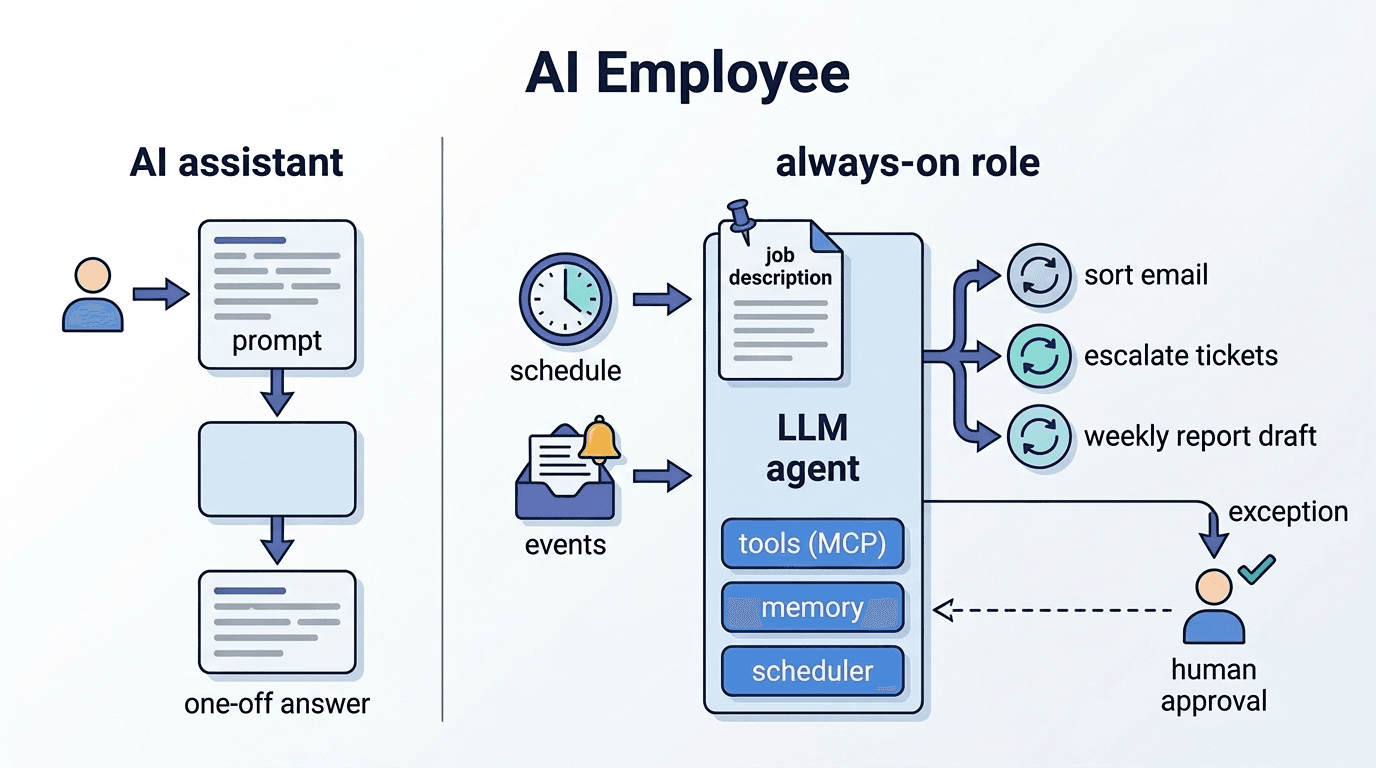
พนักงาน AI (AI Employee)
AI Agent อิสระที่รับบทบาทหน้าที่งานเฉพาะด้านและดำเนินงานอย่างต่อเนื่องเช่นเดียวกับพนักงานมนุษย์ จุดท
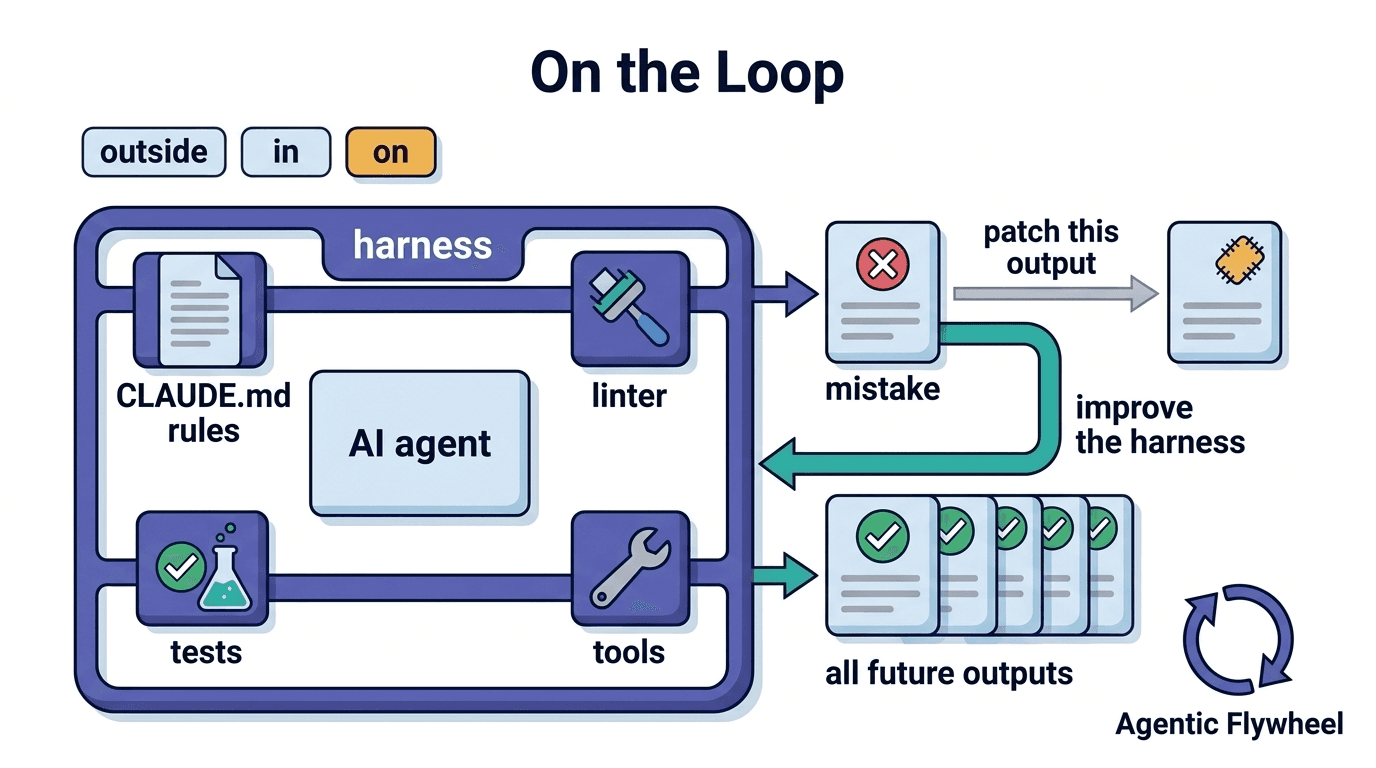
บนลูป
"On the Loop" คือรูปแบบการทำงานร่วมกันที่มุ่งเน้นการปรับปรุง harness (สภาพแวดล้อมการทำงาน ข้อจำกัด แ

AI พยากรณ์ความต้องการ (Demand Forecasting AI)
AI คาดการณ์ความต้องการ (Demand Forecasting AI) คือระบบที่วิเคราะห์ข้อมูลการขายในอดีตและปัจจัยภายนอกด